Here is a message we desperately need in these times – perhaps in all times. From His Holiness, the Dalai Lama’s keynote address for Tulane University’s 2013 commencement, May 18, in the Superdome in New Orleans.
Here is a message we desperately need in these times – perhaps in all times. From His Holiness, the Dalai Lama’s keynote address for Tulane University’s 2013 commencement, May 18, in the Superdome in New Orleans.
It’s that time of year. I seldom pay much attention to graduation speeches. I can’t remember anything said at my own, nor do any quotes come to mind from celebrities whose commencement addresses get soundbytes played on the news every June. But there is one graduation speech I’ve read and listened to many times and continues to be a source of inspiration. You may know it. If not, I’m happy to pass it on.

Steve Jobs at Stanford, 2005
In 2005, Steve Jobs, whose academic career consisted of one semester of college and a few audited classes, was chosen as the graduation speaker at Stanford. In his brief but memorable address, he spoke of finding one’s true vision, following our hearts, and not wasting our all-to-brief time walking someone else’s path. Here are three of my favorite quotes from the speech:
“You have to trust in something — your gut, destiny, life, karma, whatever. This approach has never let me down, and it has made all the difference in my life.”
About getting fired from Apple: “It was awful tasting medicine, but I guess the patient needed it. Sometimes life hits you in the head with a brick. Don’t lose faith. I’m convinced that the only thing that kept me going was that I loved what I did. You’ve got to find what you love…the only way to do great work is to love what you do. If you haven’t found it yet, keep looking. Don’t settle. As with all matters of the heart, you’ll know when you find it…keep looking until you find it. Don’t settle.”
“Your time is limited, so don’t waste it living someone else’s life. Don’t be trapped by dogma — which is living with the results of other people’s thinking. Don’t let the noise of others’ opinions drown out your own inner voice. And most important, have the courage to follow your heart and intuition. They somehow already know what you truly want to become. Everything else is secondary.”
I invite you hear everything this visionary had to say that day, in a text version of the speech, and / or this video clip.
As I scanned reviews of The Great Gatsby, I tuned in to one comment about the visionary quality of F. Scott Fitzgerald’s book: he saw the end of the roaring 20’s in 1925, before almost anyone else.
Almost anyone else…
I’d argue that T.S. Eliot, in Prufrock and Other Observations (1917), saw where our 20th century mode of life was leading even before the party began.

Here is how the title poem, “The Love Song of J. Alfred Prufrock,” begins:
Let us go then, you and I,
When the evening is spread out against the sky
Like a patient etherised upon a table;
Let us go, through certain half-deserted streets,
The muttering retreats
Of restless nights in one-night cheap hotels
And sawdust restaurants with oyster-shells:
Streets that follow like a tedious argument
Of insidious intent
To lead you to an overwhelming question…
Oh, do not ask, “What is it?”
Let us go and make our visit.
And here is how Prufrock ends:
We have lingered in the chambers of the sea
By sea-girls wreathed with seaweek red and brown
Till human voices wake us, and we drown.
One of the best professors I ever had helped me engage Eliot with the visual imagination, which helped me see how radical he was compared to the literary establishment of the day. A kind of tired, watered down romanticism was the norm before the war, so describing the sky as “a patient etherized upon the table” was shocking. “Have you ever seen someone unconscious?” the professor asked. “Or very sick or dead? Eliot isn’t describing a postcard sunset.”
But perhaps my most unforgettable poetic image came from another piece in Eliot’s first book. Regarded as a minor work, “Preludes” is even less cheery than Prufrock. Here’s how the poem ends:
Wipe your hand across your mouth and laugh;
The worlds revolve like ancient women
Gathering fuel in vacant lots.
“Picture it,” the professor said, so I did. I imagined an empty field on the outskirts of London, on a dark winter’s day. Old women with scarves, patched sweaters and faded coats circle slowly, eyes on the ground, looking for sticks or slats from a discarded crate they can burn at home to stay warm. Half a dozen figures or more in slow orbit. They might as well be 100 miles apart, even though they are next to each other, doing the same thing.
Which worlds revolve like ancient women? I’ve entertained many answers over the years, but one came up this week that helped clarify a sensation I’ve had very strongly since the November election.
The May 20, Time Magazine cover story featured our current crop of young people who are tagged as “Millennials.”

I’ve read such generational articles since the days when they were written about me and my cohorts. If you don’t take them too literally, they yield some interesting insights. In this case, when author, Joel Stein, wrote “Millennials aren’t trying to take over the establishment; they’re growing up without one,” I literally jumped to my feet and ran out to brew some coffee. I do that a lot when a light bulb goes on.
Millennials are growing up without an establishment. Bulls-eye. We’re all growing up without an establishment!
The worlds revolve like ancient women,
gathering fuel in vacant lots.
We’ve always had personal areas of concern, particular to our interests, our regions, and the groups that we align with, but have we ever been so lacking in the kind of national ethos and ideology that used to weld us together as one nation under one official God?
When journalists wrote about my generation, the lines were clear. We had an ugly war which you were either for or against, yes or no, no ambiguity. Now it’s all too inviting to forget that we’re still in a war no one believes in anymore, and maybe hasn’t for years. In earlier days, we knew who was good and who was bad. Now our enemies change on a regular basis. Who is our biggest threat this month? The worlds revolve and I can’t remember.
This week, if you live in Boston, you are concerned with the dead bomber’s burial. In Washington, you follow the Benghazi hearings. If you’re in congress or one of the 1%, you care about the deficit, though polls show that 92% of the rest of us do not.
If you live in Pennsylvania, you’ve got a new worry. The legislature decided it’s probably unconstitutional to ban guns from public college campuses. Think of armed drunken students on Friday night. A well regulated militia, indeed.
My own new biggest concern springs from a report that our CO2 levels are higher than they have been in three million years. I drive a hybrid car and use pumps instead of sprays, but clearly that’s not enough. Some still say it’s a made up problem, and a few believe these are the end-times, so it’s a moot point. What do I do if I’m not convinced? Does anyone write to their senators anymore about anything?
No establishment means no one at the helm. We’re on a ship without a rudder, or rather, many ships, going in circles like women gathering fuel in vacant lots. The guy next to you at the stoplight is either talking on bluetooth or talking to himself. You hope that if it’s the latter, he isn’t too angry and doesn’t have a gun.

House behind vacant lot, 2008, by Samuel A. Love, CC by-NC-ND 2.0
These days some of those ancient women have concealed weapons and none have had background checks. You spot a piece of wood at the same moment as another who narrows her eyes as if to say, “Are you feeling lucky today? Well, are you?”
Yesterday’s paper featured an article on the current generation of survivalists, who now call themselves, “preppers,” a terrible name that sounds like a table condiment or the slacks and sweater look for high school students. They are getting ready for the big collapse, which they say is just a matter of time. They make a compelling point – ships without rudders run aground. One local prepper who teaches his skills to others asks, “What would you do if you hadn’t had any water or food for three days?”
Strictly speaking, I think you die after three days without water, but it’s a good question. I know what I hope I’d do in a crisis, though I don’t think anyone knows in advance for sure. I recall stories of people helping each other during disasters and others doing just the opposite. What’s scary is that I think you tend to help people you view as neighbors, and we all have fewer neighbors than ever before.
The survivalists are right about one thing – you have to plan the future you want and practice for it. Isn’t that the real question, “the overwhelming question,” as Eliot put it? What do we want our lives to be like? What kind of lives are worth surviving for?
What would happen if those ancient women teamed up to help each other gather fuel? That’s so un-20th century, but now that we have no establishment, all bets are off. That kind of future is so foreign to our current way of life that even with the best intentions and effort, many of us won’t see it in our lifetimes. But that doesn’t really matter.
Outcomes are not as important as the questions. What do we want our lives to be like? How do we want to live? Better to start asking now, lest the day come when human voices wake us and we drown.

‘“It’s the movies that have really been running things in America ever since they were invented. They show you what to do, how to do it, when to do it, how to feel about it, and how to look how you feel about it.” – Andy Warhol
I had planned to continue discussing the story of Jorinda and Joringel from the Brothers Grimm, but a pair of articles I saw on successive days suggested a compelling interlude. We’ll return to the forest shortly.
The first article, “Big data,” outlines ways that new software and methods can identify structures in parts of the oceans of data that retailers and governments have not been able to access before. Everyone knows that advertisers target us based on our Facebook likes. Now there are ways to do the same with the photographs we post and other aspects of our online behavior. New algorithms find new patterns in all our activities, online and off. This includes the movies we pay to watch.
The second article appeared in the May 5 New York Times, “Solving Equation of a Hit Film Script, With Data.” In it, Brooks Barnes writes about Vinny Bruzzese, a highly paid script consultant, who charges up to $20,000 for a sophisticated analysis of a screenplay in terms of past box office performance. Bruzzese, a former statistics professor, can tell you which sort of demons do best in horror films and warn you that bowling alley scenes are a hallmark of low-grossing movies.
Though Bruzzese’s services are still too taboo for most movie people to cop to, Barnes says studios have hired him to analyze at least 100 scripts, including an early version of Oz the Great and Powerful. Meanwhile, Scott Steindorff, who produced The Lincoln Lawyer said, “Everyone is going to be doing this soon. The only people who are resistant are the writers.”
“This is my worst nightmare,” says Ol Parker, who wrote the script for The Best Exotic Marigold Hotel. “It’s the enemy of creativity…It can only result in an increasingly bland homogenization, a pell-mell rush for the middle of the road.”
I wonder if there is a greater nightmare lurking for writers like Parker – not just computer driven analysis, but computer driven generation of screenplays? I’m certain it’s possible.
First of all, interactive online books have been around for some time. Secondly, I’ve seen how this works in the field of computer graphics. My day job involved microchip design automation, starting over 15 years ago – chips helping to draw the next generation of chips. But what really convinces me that elements of screenplays could be synthesized is a computer generated astrological profile I ordered on whim last winter.
I plugged in my birthdate, place, time and, paid $50. Sixty seconds later, I was reading a 20 page, Jungian-style analysis of my natal chart, that was uncanny in describing my relationship with parents, among other things. It’s not that hard to understand how it is possible. The Sun in Aquarius, at one degree, forty-four minutes, in the second house, has a defined meaning. Assemble text to match the possibilities, and the rest is just number crunching. A literary outline would have fewer data points.
Colonel Mustard in the library with a wrench, for those who remember Clue.
Or this. Pick your genre – teenage slasher movie. Choose setting (urban, suburban, rural). Choose decade. Chose your villain (insane human, mutant, supernatural creature). Choose your hero (I’ll go with brainy nerd who has a congenital limp and can’t get a date for the prom). Choose the hair color of a cheerleader he will rescue. Finally, pick a screenplay structure (Save the Cat), add any notes, and hit send. A few minutes later, you’ve got your outline and pitch, with no hint of a bowling scene.
Oh brave new world! Andy Warhol saw it coming 50 years ago when he said, “Some day everybody will just think what they want to think, and then everybody will probably be thinking alike; that seems to be what is happening.”
The alternative is simple too – we keep our day jobs and write all the damn bowling scenes we want to. Life is to short to let someone else dictate our demons. As my computer generated horoscope said: “You need to face your fear of the world’s criticism, and your tendency to sabotage your creative efforts out of a deep need to be approved of by society.”
Feel free to borrow that bit of advice whenever you want to.
He was just arrested on Tuesday, but already they’re writing ballads about the North Pond Hermit:
Nobody seen his face in twenty-seven years,
Since that day in ’86 when he up and disappeared.
The story has travelled around the world, and unless you are living in the woods, you’ve heard the rudiments of Christopher Knight’s story:
At the age of 19, he disappeared and set up a camp in the woods near Rome, Maine, where he lived for 27 years by stealing sleeping bags, food, propane, and books from nearby vacation cabins and a summer camp. He spent the long winters wrapped in multiple sleeping bags and never made a campfire for fear of being discovered. He spent his time reading and meditating. His only conversation in 27 years was a greeting exchanged with a hiker he met on the trail in the ’90’s.

Christopher Knight
When he was arrested, Knight was neatly groomed and clean shaven. He’s up on current affairs thanks to a transistor radio he used to listen to rock music, news, and Rush Limbaugh. That’s about all we know, since Knight politely refuses to talk to journalists or explain himself to anyone. This guy is going to pass on his 15 minutes of fame, his shot at a spot on Letterman, and the chance for a best selling ghost-written bio!
He walked away into the pines to live out in the woods
He turned his back on everything and he was gone for good.
I think the story resonates so deeply because part of us too, wants to walk away from all that crap. “Lives of quiet desperation” in the words of Thoreau, who lived for two years in relative solitude at Walden Pond, but never made or intended to make a break as complete as that of Christopher Knight.
Into an unimaginable mystery like this, each of us will project our own biases. For me, Knight’s practice of meditation aligns him with spiritual seekers who have sought out caves of one sort of another for millennia, but they never threw off all human connections.
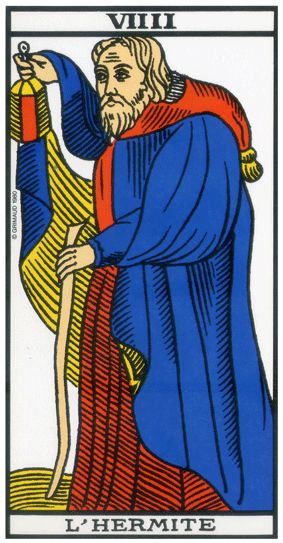
The Hermit, from the Tarot de Marseille
Christians have maintained a hermit tradition from the desert fathers through Thomas Merton, but none of them relinquished all human company. Milarepa, a famous Tibetan yogi, lived in a cave for years eating boiled nettles, which gave his skin a greenish cast, yet once he attained awakening, he returned to teach what he’d learned to others.
Did Christopher Knight intend to return someday, to tell us what he’d discovered about the mushrooms and eagles who were his only companions? We don’t know and won’t unless he decides to tell us. In a way, I hope he doesn’t. Whatever his story may be, it will be trivialized and forgotten a week after the tabloids get ahold of it. I don’t want Christopher Knight’s tale to be forgotten.
Some of his old friends have said he was “intelligent, quiet, and nerdy” in high school – just like millions of us, in other words. What could make an intelligent man who is one of us, simply decide to walk away, to opt out? I hope we will wonder about that for a long, long time.
The North Pond Hermit, livin’ in the woods,
The North Pond Hermit, they’d catch him if they could.
You can listen to The North Pond Hermit Song here.
*** UPDATE after posting the original article ***
Troy Bennet and his dog, Hook, who brought you this great ballad, have posted a link to an MP3 version we can download for an optional contribution via Paypal. Bennet says it isn’t his very best song, but it’s the one he’s written about a hermit this week.
In honor of a pair of local concerts Merle Haggard is set to perform the week after this, our paper ran an article and an interview with Haggard, a country music classic. Unfortunately, I’m busy both nights he’ll be in town, so I thought I’d post an article and a couple of songs for my pleasure and hopefully yours.
Merle Haggard was born in 1937, in Oildale, CA, near Bakersfield. He grew up wild and drew a three year term in San Quentin when he was 20. While in prison, he decided playing music would be a better way to live, and 1967 he recorded his first number one country music song, “The Fugitive,” which remains my all time Haggard favorite:
I first heard Haggard after he released his 1969 counter-counter-cultural anthem, “Okie from Muskogee.” Lyrics like, “We don’t smoke marijuana in Muskogee,” made it a tongue-in-cheek favorite on hippie radio stations of the day. Later that year, the Grateful Dead covered one of his songs, as did Joan Baez a short while later.
Haggard, who had his own battles with alcohol and drug abuse, is far less doctrinaire these days: he built a recording studio near his home in Redding, CA where he’s currently working on a tribute album to Bob Dylan. At 76, having also survived lung cancer, Haggard sounds grateful as well as surprised at his success and still being alive. If you like country music, you’re sure to enjoy the article and the interview.
Haggard says country music is “pretty shallow” these days, and when you listen to his work, it’s hard not to come to the same conclusion. Here is a country singer who shows the depths and soul that are possible in this classic American genre.
The title of this post comes from a new book reviewed on NPR, One Nation Under Stress: The Trouble With Stress as an Idea, by Dana Becker, PhD.

According to Dr. Becker, “stress” is a recent concept. The first article on stress in the New York Times was published in 1976. The first diagnoses of “nervous disorders” or “neurasthenia,” came from the work of Dr. George Beard ca 1869. In the NPR interview, Becker says that physicians of the time considered “American nervousness” to come from outside factors, related to the increasing pace of life after the civil war. “Stress,” as we understand it today, is the polar opposite.
Now we have internalized stress, focusing on the risks to our health and the ways we should cope with it, through diet, exercise, yoga, and so on. Our experience of stress derives from our ideas of stress, Becker says. The internal emphasis on health is necessary, but we let it divert us from questioning the external causes of stress. She gives an example in the NPR interview: many articles are written to help working mothers cope with stress – far fewer are written about the need for affordable daycare. We may eat kale and do yoga to survive the 24/7 world, but we seldom ask why this is the norm and what the alternatives are.
This argument echoes a major concern of James Hillman, who I frequently write about here. Though he was once Director of Studies at the Jung Institute in Zurich, in 1992 he co-authored a book called We’ve Had a Hundred Years of Psychotherapy and the World is Getting Worse. In it, he said:
“Every time we try to deal with our outrage over the freeway, our misery over the office and the lighting and the crappy furniture, and the crime in the streets, whatever – every time we try to deal with that by going to therapy with our rage and our fear, we deprive the political world of something.”
In her NPR interview, Dana Becker presented a balanced view of stress – it’s fine to treat the symptoms, which are personal, as long as we don’t gloss over the underlying causes, many of which are not. The promise of new view of a modern ailment is enough to put One Nation Under Stress near the top of my “to read” list.
The key aim of this blog, as stated on my “About” page, is to look at “the reality in our fantasies and the fantasy in our realities.” The phrase was inspired by James Hillman, who used the word “fantasy” to suggest how imagination and the unconscious always elaborate “literal” facts.
These days, nothing seems more literal than “the economy.” Its worldwide meltdown has caused and continues to cause untold suffering. The suffering itself is not imaginary – losing a job or a house is all too real. The fantasy, as Hillman used the term, is found in the fears that keep us up at night. It’s lodged in the sharply differing stories we hear of what caused the crisis, who is to blame, how bad it is, and what we should do to fix it.
I want to share the best account I’ve ever heard of our impasse. It’s a story of cause and effect that reaches back two centuries. It’s an account by Dr. Richard Wolff, Professor Emeritus of Economics at the University of Massachusetts, who was a guest on Moyers & Company on Feb. 22.

Dr. Richard Wolff on Moyers & Company
In an earlier lecture, ca 2008, Capitalism hits the fan, Wolff presented an historical framework to allow us to understand “how big, how serious, how profound” our current crisis is.
For 150 years, from 1820 to 1970, wages increased across every decade in America. Wolff believes this is unique in the history of the world.
America was blessed with unimaginable riches – minerals, timber, water, and millions of acres of farmland (after the native populations were killed or contained). Immigrants poured in from all over the world to work in factories and build railroads, convinced that their sacrifice could provide a better future for their children. For a century and a half, they were right. This gave rise to the myth of American Exceptionalism, the conviction that we as a nation are unique and this is our birthright.
Collectively, we began to measure our worth and success by this standard, but it failed in the mid 1970’s. Inflation adjusted wages peaked around 1973. There are four reasons according to Wolff.
The combination of many more applicants for fewer jobs held wages in check and has continued to do so. Americans tried to compensate by sending more people out of each home to work and by working longer hours. By 2000 we were working 20% more hours than we had in 1970 (why else invent fast food, Wolff asks). When that didn’t work well enough, we went on a borrowing binge to prop up our “standard of living,” often in the form of credit card debt, at 18% interest.
Forty years later, according to Wolff, we have a working class that’s exhausted, with collapsing personal lives and the anxiety of “a population whose average level of debt exceeds its annual income.”
With a workforce unable to carry more debt or work any harder, “We have reached the limits of this kind of capitalism,” Wolff says. “That’s why our current crisis is not temporary. It’s not a blip.”

Photo by Ann Douglas, 2010. CC by-NC-SA 2.0
The same period of stagnant wages saw an unprecedented bonanza for business. Flat wages plus technology driven leaps in productivity delivered all time record profits. Along with multi-million dollar compensation for upper management, more and more corporations got into the business of credit, and this, says Richard Wolff, is the key to understanding our economy over the last 30 years. General Motors, for instance, made more money from interest in loaning people money to buy cars than it did making cars.
Banks and corporations began to loan workers the money they no longer paid them, and this is the system, says Wolff, that is now imploding.
Our leaders don’t know how to fix it. Traditional economic measures, from stimulus to bailouts to regulation to austerity have been tried before. They were tried by two administrations during the ’30’s without much success – it took a world war to end the depression. These tactics have also been tried in Japan since 1989 with disappointing results.
What are the possible solutions? Wolff does not propose any concrete answers but simply offers one alternative model, based on the cooperative structures pioneered by some Silicon Valley startups. He claims such a structure offers a better hope of leading toward renewal than any other suggestions of which he’s aware.
“If we don’t take basic steps of this sort, to deal with a crisis that has built over this length of time; if we keep tinkering at the edges with our financial system, because we need to call this a financial crisis, rather than a crisis of capitalism, which is what it is, we will all be very sorry.” – Richard Wolf.
***
Work is a critical elements of our lives, one of the key factors of wellbeing or its lack. As such, it is rife with fantasy and arouses huge passions. Our current political climate of rancor makes that clear. None of our other issues cause such concern. What happens when the solutions offered by both political parties fall short?

Photo by windsordi, East Detroit, 2012. CC By-NC 2.0
In last week’s interview with Bill Moyers, Wolff suggested that the nation as a whole is like the proverbial deer caught in the headlights. He went on to say, “if my psychiatrist wife is right, as she usually is, what happens after that period of stasis, of shock, is a boiling over of anger, as you kind of confront what has happened. And that you were deceived and betrayed in your expectations, your hopes. And then the question is, where does that go?”
Best case, he says, we begin to ask questions about the system as a whole: “I think there’s a wonderful tradition here in the United States of people feeling that they have a right, even if they don’t exercise it a lot, to intervene, to control. There is that democratic impulse. And I put a lot of stock in the hope that if this is explained, if the conditions are presented, that the American people can and will find ways to push for the kinds of changes that can get us out of this dilemma. Even if the political leaders who’ve inherited this situation seem stymied and unable to do so.”
If he’s right, this is the place for fantasy, the place for imagination to plumb the sea of possibilities to bring up something that works in a new world in a new century.
 The First Gates