Tales of the Dummling

Many of Grimm’s fairytales begin with three sisters or three brothers who have a critical task to perform.  Invariably, the youngest succeeds.    In her introduction to a story called “The Golden Bird,” Maria Tatar, editor of the recently published bicentennial collection says: “If the female protagonists of fairy tales are often as good as they are beautiful, their male counterparts often appear to be as young and naive as they are stupid.”

“The Golden Bird” illustrates the point.  The youngest son is so hopeless that even his animal guide, a fox, grows frustrated, yet in the end, the boy wins “complete happiness.”

Not all youngest sons are so dense, and sometimes the stories have great depth, like “The Water of Life,” which I discussed here last March (http://wp.me/pYql4-1OC and http://wp.me/pYql4-1Pm).

According to Marie-Louise von Franz, Carl Jung’s closest colleague and author of five books on fairytales, the Brothers Grimm published  50-60 stories of dumb youngest sons.  Von Franz thought these stories were so important, individually and culturally, that she started her first book on folklore, The Interpretation of Fairytales 1970, with a detailed study of one Dummling tale, “The Three Feathers.”  The story is one of the better known Grimm stories, present in the new annotated edition as well.  What follows is a brief synopsis.  The tale isn’t long and those who wish can read it on Project Gutenberg: http://www.reelreality.com/fairy_tales/grimms_fairy_stories/index.html#dummling

“The Three Feathers” from the Project Gutenberg ebook edition of Grimm’s fairytales.

*** Synopsis of The Three Feathers ***

Once an aging king had three sons. Two were clever, but the third didn’t say much and was considered dim-witted.  People called him Dummling [or “Dummy” depending on the translation].  The king decided to test the boys to determine who should rule his kingdom when he was gone.   He told them whoever returned with the most beautiful carpet would inherit the kingdom.  Then he took them outside, blew three feathers into the air and told his sons the feathers would determine which way they should go.

One son’s feather flew east and another’s west, but Dummling’s feather flew straight ahead a few paces and fell to the ground.  The other brothers laughed and set out, but Dummling just sat down by the feather and waited.  Eventually he noticed a trapdoor nearby.  It opened onto a staircase descending into the earth.  The boy followed the stairs down to another door on which he knocked.  From inside a voice called:

“Maiden, fairest, come to me,
Make haste to ope the door,
A mortal surely you will see,
From the world above is he,
We’ll help him from our store.”

Inside was a fat toad, surrounded by many smaller toads.  The boy said he needed the world’s most beautiful carpet.  The toad called out to the younger ones to “bring the box for the boy at the door.”  Inside was a beautiful carpet.  Dummling carried it home, his father was astonished, and declared that he should be the next king.

“The Three Feathers” from the Project Gutenberg ebook edition of Grimm’s fairytales.

The two other brothers, who had simply bought pieces of linen from the first peasant women they met on the road, protested so loudly that the king decreed another test.  He sent his sons out to find the most beautiful ring.  Again one feather blew east, another west, and Dummling’s by the trapdoor.  The fat frog called for a box in which the boy found a beautiful gold ring.  The brothers brought rings they had made from  nails they had taken from cart wheels.

Again the king declared Dummling the winner, and again the older brothers protested.  The king’s third test was to bring home the most beautiful wife.  Dummling won a toad bride who became a beautiful human woman after he took her home.  The brothers, who had married the first peasant women they met, complained again so the king ordered a fourth test.  The brides were ordered to jump through a hoop suspended in air.  Naturally, Dummling’s wife, who had been a toad, easily won.  Dummling received the crown and he ruled “with great wisdom” for many years.

Jumping through the hoop by Arthur Rackham

Jumping through the hoop by Arthur Rackham

***

In The Interpretation of Fairytales, Marie-Louise von Franz devoted three chapters to an in depth analysis of this tale.  She believed Dummling stories reflect the situation of individuals, cultures, and institutions that get stuck when certain rigid patterns and ideas cut them off from sources of renewal.

The first thing she notes is that all the Dummling tales begin with a father and three sons but no wife or sisters.  The feminine element is missing and regardless of what he sets out to do, the most important achievement of the younger son will be to bring home a bride.  In abstract terms, that is bringing Eros into a situation overweighted with Logos.  Von Franz cites cultural examples like the importance of the cult of the Virgin Mary in the medieval Catholic church.  She also says that third-son stories:

“compensate the conscious attitude of a society in which patriarchal schemes and oughts and shoulds dominate.  It is ruled by rigid principles because of which the irrational, spontaneous adaptation to events is lost.  It is typical that Dummling stories are statistically more frequent in the white man’s society than in others, and it is obvious why that is so.”

Once you start thinking along these lines, many characters spring to mind from history as well as the arts.  Saint Francis, who called himself “God’s Fool,” brought flexibility and Eros to the medieval church.  A classic movie example from recent times is  Forest Gump 1994.  Tom Hanks’ Dummling character succeeded where the smart people failed.  Gump, who lived in the moment and was close to his emotions, reacted to things as they happened rather than to his own fixed ideas.  Remember the movie’s opening shot of a feather?  If nothing else, that convinces me that Forest Gump’s creators knew the Dummling stories in detail.
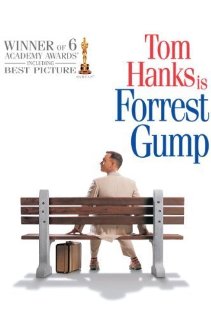
Tom Hanks as a modern Dummling

Tom Hanks as a modern Dummling

Von Franz amplifies the detail of the feather, saying it was a common medieval practice in many countries.  “If someone did not know where to go, if they were lost at a crossroads or had no special plan, he would take a feather, blow on it and walk in which ever direction the wind took it.  That was a very common kind of oracle by which you could be guided.”

It isn’t as apparent in this Dummling tale as it is many others that the older brothers are modern A-types.  They don’t have time to fuss with insignificant creatures like frogs, or dwarves, or old ladies, or any of those helpful beings who guide the youngest brothers on their way.  Youngest brothers have time to listen because their calendars are clear.  They sit by their feathers or walk through the forest, paying attention and waiting for new ideas to arrive.

Von Franz used the feather analogy in discussing her method of therapy.  She said when her patients were stuck, she would listen to their dreams to see which way the winds of the psyche were blowing.  When I studied psychology, one of my teachers spoke in the same vein, of the importance of listening to the little impulse, the small thoughts that are easy to ignore, like “Oh, that looks interesting,” or “Wouldn’t it be nice to take a few hours off for a walk beside the river?”  Smart older brothers, working on their MBA’s, don’t have time for things like that, which is how they get into therapy in the first place.

I’ve heard that when he was president, Harry Truman once said, “We’re going to try X, and if that doesn’t work, we’ll try something else.”  Our government might not be so stuck if politicians dared to admit that sometimes they don’t know the answers and need to see which way their feathers blow.

Sometimes being “smart” is a greater hindrance than being “dumb,” for the key thing is to be teachable.

I came upon the Dummling stories years ago, and they often come to mind when things are stuck in my own life or in what I observe around me.  “When you don’t know what to do, do nothing,” is a common and useful bit of advice.  I sometimes restate it and say, “When you don’t know what to do, sit by your feather and pay attention.”

Cloud Atlas: a movie review

Synopsis by author David Mitchell: “An exploration of how the actions of individual lives impact one another in the past, present and future, as one soul is shaped from a killer into a hero, and an act of kindness ripples across centuries to inspire a revolution.”

***

One viewing isn’t sufficient for a comprehensive “review” of a movie like this.  Like Roger Ebert, who called Cloud Atlas “one of the most ambitious films ever made,” I knew before it was half over that I wanted to watch it again.  Different critics have praised and panned the movie.  I want to offer a brief synopsis and weigh in with a solid two thumbs up.

It’s harder to move around in time in movies than in books. Inception 2010, notably altered the linear flow of time, with four levels of dreaming that unfolded simultaneously, yet fundamentally it was structured as a frame-tale.  Scheherazade did the same thing centuries ago in the The Arabian Nights.

British author, David Mitchell tried something more ambitious in his novel, Cloud Atlas 2004.  Six stories take place in different times and places, with implications that past, present, and future interconnect in ways that are too complex for a linear narrative.  For one thing, Mitchell says that the main characters in the different tales that bear an unusual birthmark are reincarnations of the same character.  Somni~451, the clone-turned-visionary in the dystopian future scene voices what I take to be the core theme of the movie:  “Separation is an illusion.  All our lives are interconnected.”

Counter to what I expected, the different stories were not hard to follow.  Anyone interested in fresh ways of imagining novels and movies should not miss Cloud Atlas.  I’m pretty sure you’ll want to see it more than once.

http://www.youtube.com/watch?v=pQFAPeaJOf8

Fairytales in the 21st Century

Arthur Rackham, untitled, 1904. Public domain.

When you look at our culture, it seems like fairytales have never been more popular.  “Grimm” and “Once Upon a Time” are starting their second television season.  Earlier this year, we had two movie versions of Sleeping Beauty.  Young adult paranormal stories remain popular with readers of all ages, and I’m currently reading a 1994 collection of classic fairytales retold by some of the best modern fantasy authors.  The book, Black Thorn, White Rose, by editors Ellen Datlow and Terri Windling, was reissued as a kindle edition and features challenging tales by authors like Nancy Kress, Patricia Wrede, and Jane Yolen.

Snow White begs for mercy. From an 1852 Icelandic version. Public doman.

The old stories call out to us with their promise of depth as the stuff and fluff of modern life fails to satisfy the yearnings of the soul.  Yet according to Wolfgang Mieder, professor of German and folklore at the University of Vermont, we’re missing a critical element that earlier generations possessed, and the loss is related to the flood of tales we have today.  “Everybody reads different stories and we no longer know the same fairytales. The connecting element is lost,” says Mieder.  He is optimistic about the survival of fairytales, but questions the way we now receive them.

Mieder, a German-American, won the 2012 European Fairytale Prize and has studied the social significance of fairytales for more than 40 years.  After high school, he traveled to the US from Germany to study mathematics, but a seminar in German folklore changed his life’s direction.  Folklore became very personal for him.  He recalls that in Germany, “In the 1950s you used to be given a colorful picture as a gift when you bought margarine, which I made a lot of effort to collect and paste in my album. With the album I got to know the world of fairytales.”

Wolfgang Mieder. CC-by-SA-3.0

Mieder, who has authored 200 publications and 500 articles, want his students to find the same personal connection to the old stories.  This can be hampered by the sheer volume of folklore appearing on TV, movies, and the internet.  Will the glut of information detract from the impact of stories that generations of people heard aloud in the flickering firelight?  Mieder is hopeful – he has observed a new interest in oral telling of old stories.

This is something I have experienced, both as a story teller and listener.  All over the world, it was largely during the dark months when the stories were told, and now we have a world-wide celebration of stories each November.

In 1988, J.G. Pinkerton, of the Connecticut Storytelling Center, imagined a night of storytelling, which he called Tellebration, to build community support for storytelling.  That year stories were told in six locations throughout the state.  By 1997, there were Tellebration events on every continent except Antarctica.

Tellebration is held on the Saturday before Thanksgiving, November 17 this year.  You can search for events near you – or even organize and register your own – at this site, hosted by the National Storytelling Network: http://www.tellabration.org/index.html

You can access the full article on Wolfgang Wieder here: http://www.dw.de/dw/article/0,,16234957,00.html

And finally, to see a wonderful site devoted to fairytales and folklore – the place where I found the Wieder article – visit the “Sur La Lune Fairy Tales Blog,” listed on my blogroll.

And finally-finally, as in really finally, I’ll be devoting next week to exploring some old stories and oral tradition. I’ll be largely or entirely unwired for the duration, but I promise you will hear more about this in upcoming posts.

Arthur Rackham, The Three Bears. Public domain.

Some of my favorite English books

A tweet from Hannah-Elizabeth, who blogs at The Last Classic  http://sonnemann.wordpress.com  inspired this post. She follows my book reviews and recently asked for a recommendation on something to read.

The other inspiration was the Olympics opening ceremony, which got me thinking of English novels and stories.  My greatest literary pleasures, from the first read-alouds I heard as a child until now have come from England.  The riverbank, the Shire, and Baker Street have become the landscapes of my soul.

There’s one key distinction to make:  when I talk about favorite novels, I don’t mean breakout, thrilling, or dramatic novels – necessarily.  I mean stories with  characters and worlds I want to live with and visit again and again.  When I started The DaVinci Code, for instance, I couldn’t put it down, but when I finished, I traded it in for credit at the local used bookstore.  I can’t imagine reading it again.

So here is a list, probably not complete and not in order of preference, of some of the story treasures British authors have given me.  To set the mood, let’s begin with this beautiful hymn that every diehard fan of Masterpiece Theater knows and loves.  “Jerusalem” was inspired by William Blake’s poem, “And did those feet in ancient time,” which was based on the legend that as a youth, Jesus visited England and Glastonbury with his uncle, Joseph of Arimethia.

Favorite English books.

The Wind in the Willows by Kenneth Grahame. I reviewed it here: http://wp.me/pYql4-19a. Try to get the edition illustrated by Arthur Rackham, which really gives a feel for the rural England of rivers, forests, and fields that were so soon to disappear in the new century .

The Lord of the Rings by J.R.R. Tolkien – Here was a man who spent his life giving shape to our spiritual homeland – The Shire and Rivendell.  His son said he suffered from bouts of depression all his life.  Understandable when you reflect that the summer this gentle dreamer graduated from Oxford, he was thrown into the maelstrom of the Somme.  There he saw the Shire, the rural England he loved, along with his college classmates, evaporate in the fires of Mordor, aka, the western front.

The Original Illustrated Sherlock Holmes by Sir Arthur Conan Doyle.  I read these detective stories again and again, even though I know who done it. Who doesn’t sometimes dream of life on Baker Street, sharing a pipe with Holmes before the game is afoot again? I could argue that Holmes was an early superhero, using uncanny intellect and powers of observation to save the world from uber-villain, Moriarity.

The Abhorsen Trilogy by Garth Nix. Nix, a former editor, has written a number of middle grade Arthurian adventures for boys.  In the Abhorsen tales, he gives us two fine female protagonists. In doing so, he inspired my first novel, whose main character, Emily, is a lot like Lirael, the heroine of the second and third books of the trilogy.  Nix lives in Australia, but the map of his Old and New Kingdoms looks a lot like the Scottish border, and everyone acts quite British, sometimes to the vexation of the good guys.

T.S. Eliot:  The Complete Poems and Plays, 1909 – 1950 I’ve been reading this book since I took a class on Eliot as a college sophomore. “The first gate” into the world of imagination and dream is an image at the opening of Eliot’s “The Four Quartets,” my favorite poem of all time.  Eliot was an American who spent his writing life in London.

Agatha Christie Mysteries.  Few authors create two characters as compelling as Hercule Poirot, star of 33 novels,  and Miss Marple, featured in 12.  When Christie killed off Poirot in 1975, a year before her own death, the little Belgian detective became the only fictional character to receive an obituary in The New York Times.   Books like Murder on the Orient Express and Death on the Nile, will stand with any mysteries ever written.  Here is free download, in all ebook formats, from Project Gutenberg, of  The Mysterious Affair at Styles, 1920, the first Poirot mystery. http://www.gutenberg.org/ebooks/863

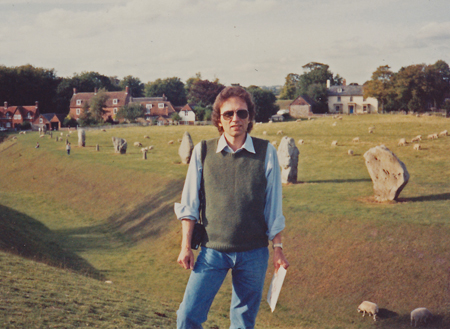
In the spirit of things. Yours truly at Avebury, 1991

The Narnia Tales by C.S. Lewis. Tolkien told Lewis not to publish the Narnia stories, saying Lewis would “embarrass himself.” Just goes to show the master of middle-earth didn’t know everything.  Mysterious old wardrobes will always be objects of interest to fans of Lewis’ series.

Mythago Wood by Robert Holdstock.  A small patch of primeval forest, one of the last in England that dates from the last ice age, is actually a “mythogenic zone,” a region which manifests the creatures of the deep human psyche and racial memory.  They deteriorate at any great distance from the wood, but near and in it they are very real – sometimes dangerously so.  in 1946, when Stephen Huxley returns from the service, both he and his older brother Christian, strive to enter the wood with the aid of a mysterious journal (don’t you just love those!) left by their father.  Both Stephen and Christian fall in love with Gweneth, who lives deep in the forest.  When his brother begins to assume the attributes of the dreaded “Outsider,” you know Stephen’s journey will not be easy.  Published in the US in 1986, this book had a profound effect on my outlook on fantasy literature.

Harry Potter Series by J.K. Rowling. I don’t think this needs any explanation

The Mabinogian Anonymous. Welsh tales, full of strange and sometimes ominous magic, that were already ancient when they were written down in the middle ages. Joseph Campbell and Heinrich Zimmer discussed some of these stories. They are best approached with poetic imagination as Fleetwood Mac did with the goddess, Rhiannon, who figures in two of the tales.

Rhiannon riding in Arbeth. Illustration from “The Mabinogian” by Lady Charlotte Guest. Public domain in the US

The Amelia Peabody Mysteries by Elizabeth Peters. Here are some great British mysteries written by a yank. Ms. Peters, now 84, was born in Illinois and received her PHd in Egyptology from the University of Chicago. There’s the connection. Her protagonists – Amelia Peabody, Amelia’s husband Emerson, their brilliant but incorrigible son Ramses, and in later stories, Amelia’s daughter in law, Nefret, are unconventional British archeologists who excavate in places like the Valley of the Kings when they’re not solving murders. There are twenty books in the series, spanning the decades from 1895 through the first world war against the background of mystery and intrigue in the turn of the century middle east. These are among the best beach reads I’ve ever found. Check them out at Ameliapeabody.com.  http://ameliapeabody.com/bookshelf.htm

***

I hope this excursion through some of my favorite books leads you to something enjoyable to read.  Lists are fun.  This was a small list, so next time I’ll post some with hundreds of titles to choose from.  Stay tuned!

Copyrights and the Olympic Opening Ceremony

Since my July 24 post on copyrights http://wp.me/pYql4-2fA generated significant interest, I want to direct you to another blog post discussing the probable copyright violations of Danny Boyle in his fanciful opening ceremony at the Olympics.

In her article “Reclaiming Mary Poppins and the Characters We Love,” Maggie O’Toole discusses way in which corporate interests have successfully lengthened and strengthened the rules in their own interest.  Maggie says:

“In this bit of public theater, director Danny Boyle reclaimed the British people’s ownership of their children’s literature, the rights to which have long since been sold off to various corporate interests…In doing so, he challenged the idea that these characters, or any characters, can belong to someone.”

Despite my recent musings on copyright, the idea never occurred to me.  Please read the full article.  If you love these characters, you will enjoy it!

http://maggienotmargaret.com/2012/07/28/reclaiming-mary-poppins-and-the-characters-we-love/

Notes on Superman and The Superman Song

It doesn’t take much reflection on superheroes (see my previous Batman post) to remember Superman.  For me, he always brings to mind a strange, funny, and poignant song by The Crash Test Dummies from their 1991 debut album, “The Ghosts That Haunt Me.”

What the song underscores is an intuition that has shaped my approach to characters in fiction:  they need to be larger than life but flawed and human too.  Though the plot needs super-strength, without his kryptonite allergy, the guy in the cape would be pretty boring.  Besides, it’s Clark Kent who we bond with.  Holding tight to his geek persona, in the days before geeks were cool, Clark sacrificed his hopes for human happiness out of dedication to a public that could never be allowed to know who to thank.  If you like stories of unrequited love and hopeless triads, Superman, Lois, and alter-ego, Clark, had it going decades before Twilight.

Even more poignant than fiction was the life of Christopher Reeve (1952-2004), one many actors – and I think the best – who played the Man of Steel.

Reeve as Superman

Reeve became a paraplegic in 1995, after a spinal injury suffered when he was thrown from a horse. For the rest of his life, he lobbied on behalf of spinal-cord injury treatment and stem-cell research. In overcoming the kind of loss that is most people’s worst nightmare, Reeve found the steel of courage in the depths of his human misfortune.

Reeve after his injury

Just like Clark Kent, in the last years of his life, Christopher Reeve lived a selfless life, dedicated to other people’s good.

The Crash Test Dummies had a similar intuition about Superman several year’s before Reeve’s accident, one both deeper and richer than what the word, “superhero” generally implies:

Folks said his family were all dead
Their planet crumbled but Superman, he forced himself
To carry on, forget Krypton, and keep going.

Superman never made any money
For saving the world from Solomon Grundy
And sometimes I despair the world will never see
Another man like him

The Serious Business of Play

As I worked on the previous post and began to envision a series of articles on imagination, the July-August issue of the Smithsonian Magazine arrived with a piece that fit the theme.  In “Why Play is Serious,” Alison Gopnik, a leading researcher in cognitive development, says play is “a crucial part of what makes all humans so smart.”

Alison Gopnik

Many of us intuitively know that play matters, but Gopnik and her colleagues at UC Berkeley have new theories and research on why it’s so important.  http://www.smithsonianmag.com/science-nature/Let-the-Children-Play-Its-Good-for-Them.html

How is it that very young children learn so much so quickly?  Gopnik’s research focuses on pretending, which she calls “counterfactual” thinking.  She gives the example of Einstein wondering what would happen on a train traveling at the speed of light.

Gopnik found that “Children who were better at pretending could reason better about counterfactuals – they were better at thinking about different possibilities.  And thinking about possibilities plays a crucial role in the latest understanding about how children learn.”

Photo by Don Bergquist, licensed by Creative Commons

Ms Gopnik is concerned about policymakers who “try to make preschools more like schools.”  In hard times, “frivolous” programs are always the first to go – disciplines like the arts, music and humanities – the very ones that stretch imagination and encourage us to envision new possibilities.

public-domain-image.com

By the time we are adults, we’ve learned how to sideline play in order to get down to business.  Even – or perhaps especially – in the creative realm, it’s no simple matter to let go of goal-oriented behavior when competition in the marketplace is so stiff.  Working for concrete or pre-defined results is the antithesis of the kind of free experimentation that opens up new vistas.

Some sort of strategy is usually needed for us to approach the unselfconscious freedom of children at play, but it doesn’t need to be anything dramatic.  At the end of his life, Joseph Campbell said an hour a day in a quiet room with a favorite book or a journal is enough for us to step into sacred space where the real hero’s journey always takes place.

Simple but never easy.  In a recent post on his own blog, Michael Meade quoted these marvelous lines penned by E.E. Cummings:

“To be nobody-but-yourself — in a world which is doing its best, night and day,
to make you everybody else — means to fight the hardest battle which any
human being can fight; and never stop fighting.”

The fact that the battle is hard is all the more reason why we cannot afford to forget how to play.

The Neverending Story: A Movie Review

Several people had wonderful things to say in response to preceding birthday post, where I restated what has become the mission statement of this blog:  to look for the fantasy in all realities and the reality in all fantasy.  The comments were almost too kind – but not quite – and they prompted me to begin several posts on people and things that have shaped my thinking about imagination.  What jumps to mind first is movie released in 1984.

The Neverending Story, 1979, a fantasy novel by German author, Michael Ende, was translated into English in 1983.  A film was released the following year, which I saw in the early ’90’s, after one of my psych professors said, “It’s a story about our culture’s war on imagination.”

A lonely boy named Bastian loves to read.  One morning on the way to school, he ducks into a bookstore to escape pursuing bullies.  He asks the grumpy store owner about an intriguing book called, The Neverending Story.  “It isn’t safe,” the owner says.  At an opportune moment, Bastian “borrows” the book and carries it into the school attic to read.

The book relates how the kingdom of Fantasia is under attack by the Nothing, a dark void that consumes everything it touches.  The creatures of Fantasia appeal to their ruler, The Childlike Empress, but the Nothing has made her ill.  She summons Atreyu, a warrior of Bastian’s age, to conquer The Nothing, and gives him a magical talisman, the AURYN to guide him on the quest.  The force behind The Nothing summons Gmork, a wolf-like beast who craves power, to kill Atreyu.

The AURYN. Stephen Spielberg keeps the original prop in his office

Nowadays we’d call this a middle-grade book, but 33 years ago, when The Neverending Story was written, that label didn’t exist.  Most books written for young people, then and now, focus on personal issues.  Bastian is lonely and has trouble at school, but this is just the inciting action, not the real subject of the story.  The book and movie are unique in presenting a very adult theme – imagination and the forces arrayed against it – in fiction for this age group.

Atreyu finds no clues concerning the Nothing, so he risks the Swamps of Saddness to find the wisest being in Fantasia. Those who succumb to the sadness sink into the swamp and are lost. This is the fate of Atreyu’s beloved horse, Artax.

The wise being  cannot help, but directs Atreyu to the Southern Oracle, 10,000 miles away.  While trudging through the swamp with Gmork on his trail and little chance of success,Atreyu begins to sink into despair.  A Luckdragon named Falkor rescues him and carries him most of the way to the oracle.

Atreyu and Falkor

The oracle tells Atreyu that the only way to save Fantasia is for a human child, who lives beyond the borders of the realm, to give the Childlike Empress a new name. Then the oracle crumbles, a victim of the Nothing.

Falkor and Atreyu seek the border, and find the Nothing, which has become incredibly strong. Atreyu encounters Gmork who explains that Fantasia is “humanity’s hopes and dreams,” while the Nothing is “human apathy, cynicism, and the denial of childish dreams.”

Atreyu kills Gmork but is wounded and nearly falls victim to the Nothing. He is rescued once again by Falkor, but when he regains consciousness, only fragments of Fantasia remain, floating in the void.  The two make their way to the Ivory Tower, where Atreyu tells the Empress he has failed.

She says no, he has succeeded.  His quest was the only way to draw the attention of the human child, who is listening to them as they speak.  Bastian realizes she is talking of him.  As the Nothing begins to consume the Tower, the Empress begs him to say her name.  Bastian races to the attic window, and cries, “Moonchild!” into the face of an approaching storm.  He finds himself face to face with the Empress, who reveals that the Nothing has consumed all of Fantasia but a single grain of sand.

The Empress gives Bastian the last grain of sand of Fantasia

The Empress tells Bastian that his imagination and wishes have the power to restore the land to its former glory. In the final scene, we see Bastian soaring on Falkor through skies in Fantasia and his own world.  I wasn’t crazy about the ending.  There’s a Disney quality though out, since in the days before digital animation, films like this relied  on animated models and actors in costumes, but that was not necessarily a liability.  Jim Henson pulled it off without missing a beat in Dark Crystal, 1982.

In the last scene of The Neverending Story, I’m aware of watching a children’s movie, which disappoints, since most of the film was greater than any such category.  Even so, in the 20 years that have passed since I saw the movie, I’ve never forgotten the chords it struck concerning imagination.  Please take a look at this clip of Atreyu meeting Gmork to get a sense of the movie’s scope:

http://www.youtube.com/watch?v=iDHBZlSNO6w

In succeeding posts, we’ll look at some views of Depth Psychology and certain spiritual traditions.  For both of them, literalism is the enemy of living with soul and imagination.   The Neverending Story tells us this is a battle we each must fight in our own hearts and minds.  The world of practical affairs and the marketplace have never had much use for the world’s dreamers.  Can we still manage to hear the cries of the Otherworld beings who fade into nothing at our lack of attention?  “Rosebud” in Citizen Kane is the dying cry of someone who lost Fantasia.

The Neverending Story echoes world folklore in showing the need otherworld creatures have for humans.  Irish and Scottish fairies steal mortal children.  The fairy queen sought out Thomas the Rhymer to be his consort for seven years, the same length of time the sea nymph, Calypso, held onto Odysseus in ancient Greece.  Why do such beings need us for redemption?

These are just some of the questions this apparently simple “children’s movie” raises.  They are far to complex to answer here, but I plan to take some additional forays into imaginal realms in the next few posts, so please stay tuned.