It couldn’t be a finer autumn day in north-central California. Going to vote this morning, in the golden-tinged sunlight, it was easy to bask in the hope of new beginnings, in the hope that difficult times will call forth a renewed vision and strength of purpose in those we elect. Perhaps “ordinary” men and women will prove to be extra-ordinary in our times as they have done in the past.
Yet this week I’ve been thinking of Citizen Kane, for I fear that many who run for political office share the motivation of Charles Foster Kane, in what some have called the greatest American movie ever made. Kane had a hole in his heart that no amount of money, or women, or power, or things could fill.
After his death, one of his friends told a reporter, “All he ever wanted in life was love. That’s Charlie’s story, how he lost it. You see, he never had any to give.”
How could he? When he was a boy, his mother essentially sold him into public life for a comfortable yearly stipend. The last word on Kane’s dying lips was “Rosebud,” the name of his boyhood sled, which represented the dream of freedom and warmth he could never force the world to yield up.
I think we have to know something about our own Rosebud, the hole in our own hearts, to keep our lives from careening out of control. If we haven’t gone a few rounds with our private angels and demons, we might even enter politics for all the wrong reasons!
Joseph Campbell phrased it in terms of the Grail Quest. In youth we may gain a vision or intimation of a Great Good, beyond the power of youth to bear. We spend our lives on the trail of this Boon which we have seen and lost. Something like that appears to happen to nations when the youthful vision gets lost, for the old stories make clear that when the Grail is hidden, the land becomes barren.
It’s a good day to pray for our new leaders, whoever they turn out to be, for “us and them” is just a destructive illusion; no matter what we may wish, we are all in this together.
Synopsis by author David Mitchell: “An exploration of how the actions of individual lives impact one another in the past, present and future, as one soul is shaped from a killer into a hero, and an act of kindness ripples across centuries to inspire a revolution.”
***
One viewing isn’t sufficient for a comprehensive “review” of a movie like this. Like Roger Ebert, who called Cloud Atlas“one of the most ambitious films ever made,” I knew before it was half over that I wanted to watch it again. Different critics have praised and panned the movie. I want to offer a brief synopsis and weigh in with a solid two thumbs up.
It’s harder to move around in time in movies than in books. Inception 2010, notably altered the linear flow of time, with four levels of dreaming that unfolded simultaneously, yet fundamentally it was structured as a frame-tale. Scheherazade did the same thing centuries ago in the The Arabian Nights.
British author, David Mitchell tried something more ambitious in his novel, Cloud Atlas 2004. Six stories take place in different times and places, with implications that past, present, and future interconnect in ways that are too complex for a linear narrative. For one thing, Mitchell says that the main characters in the different tales that bear an unusual birthmark are reincarnations of the same character. Somni~451, the clone-turned-visionary in the dystopian future scene voices what I take to be the core theme of the movie: “Separation is an illusion. All our lives are interconnected.”
Counter to what I expected, the different stories were not hard to follow. Anyone interested in fresh ways of imagining novels and movies should not miss Cloud Atlas. I’m pretty sure you’ll want to see it more than once.
Since my July 24 post on copyrights http://wp.me/pYql4-2fA generated significant interest, I want to direct you to another blog post discussing the probable copyright violations of Danny Boyle in his fanciful opening ceremony at the Olympics.
In her article “Reclaiming Mary Poppins and the Characters We Love,” Maggie O’Toole discusses way in which corporate interests have successfully lengthened and strengthened the rules in their own interest. Maggie says:
“In this bit of public theater, director Danny Boyle reclaimed the British people’s ownership of their children’s literature, the rights to which have long since been sold off to various corporate interests…In doing so, he challenged the idea that these characters, or any characters, can belong to someone.”
Despite my recent musings on copyright, the idea never occurred to me. Please read the full article. If you love these characters, you will enjoy it!
It doesn’t take much reflection on superheroes (see my previous Batman post) to remember Superman. For me, he always brings to mind a strange, funny, and poignant song by The Crash Test Dummies from their 1991 debut album, “The Ghosts That Haunt Me.”
What the song underscores is an intuition that has shaped my approach to characters in fiction: they need to be larger than life but flawed and human too. Though the plot needs super-strength, without his kryptonite allergy, the guy in the cape would be pretty boring. Besides, it’s Clark Kent who we bond with. Holding tight to his geek persona, in the days before geeks were cool, Clark sacrificed his hopes for human happiness out of dedication to a public that could never be allowed to know who to thank. If you like stories of unrequited love and hopeless triads, Superman, Lois, and alter-ego, Clark, had it going decades before Twilight.
Even more poignant than fiction was the life of Christopher Reeve (1952-2004), one many actors – and I think the best – who played the Man of Steel.
Reeve as Superman
Reeve became a paraplegic in 1995, after a spinal injury suffered when he was thrown from a horse. For the rest of his life, he lobbied on behalf of spinal-cord injury treatment and stem-cell research. In overcoming the kind of loss that is most people’s worst nightmare, Reeve found the steel of courage in the depths of his human misfortune.
Reeve after his injury
Just like Clark Kent, in the last years of his life, Christopher Reeve lived a selfless life, dedicated to other people’s good.
The Crash Test Dummies had a similar intuition about Superman several year’s before Reeve’s accident, one both deeper and richer than what the word, “superhero” generally implies:
Folks said his family were all dead Their planet crumbled but Superman, he forced himself To carry on, forget Krypton, and keep going.
Superman never made any money
For saving the world from Solomon Grundy
And sometimes I despair the world will never see
Another man like him
Batman, originally Bat-man or The Batman, first appeared in Detective Comics #27, in May, 1939, the creation of artist Bob Kane and writer Bill Finger. Popular from the start, Batman had his own comic by 1940.
The Caped Crusader joined the screen actor’s guild in the 60’s, with a campy TV show that altered some of my speech patterns forever (Observe the title of this post, Robin).
When the show ended, so did much of Batman’s popularity. In 1969,writer Dennis O’Neil and artist Neal Adams tried to return Batman to his roots as “grim avenger of the night.” Beginning with Tim Burton’s 1989 Batman, several big budget movie series have portrayed Bruce Wayne’s alter-ego in a dark and dangerous world – it’s always night in Gotham City.
Batman Begins, 2005
As if this intrepid crime fighter didn’t have enough on his plate, some are raising questions about his mental health. And when you think about it – what’s with the addiction to danger, the cape, the muscle suit, and probably lifts in the shoes? His car says size matters, but he can’t hang onto a girlfriend. His deepest relationship is with his butler. He’s certainly stuck in black and white thinking – people are good or bad, nowhere a shade of gray. Maybe he hasn’t worked through all of his childhood issues. Maybe he should ask his doctor about anti-depressants. Or viagra. Join an online dating service and settle down as a hedge-fund manager, like a respectable member of the 1%.
But no, says psychologist, Robin Rosenberg, author of What’s the Matter with Batman? The boy’s all right.
In a recent NPR interview, Rosenberg, who blogs about superheroes for Psychology Today, said: “Bruce Wayne is a really clever man who has both high intelligence and high EQ, emotional quotient.”http://tinyurl.com/6npy226.
Rosenberg turns the spotlight on us, asking why we assume there is something wrong with Batman. “People who are truly selfless, who have given so much of themselves, are confusing to most of us. And I think some of us, in cynical moments, say, ‘There must be something the matter with someone who would do that.'”
I’d modify her words to say that nowadays, we think a selfless billionaire is weird. Nothing new about this sentiment. In 1939, the year Batman emerged, Woody Guthrie wrote “The Ballad of Pretty Boy Floyd.”
Yes, as through this world I’ve wandered I’ve seen lots of funny men; Some will rob you with a six-gun, And some with a fountain pen.
Change “fountain pen” to “computer” and the statement rings as true as it did 73 years ago. The biggest difference now, as the new Batman movie, The Dark Knight Rises, comes out this Friday, is that most of us probably find it even harder to believe a super-rich man could be our friend.
In a post on the Psychology Today superhero blog, Robin Rosenberg wrote: “The stories of superheroes and heroes resonate with us because they tap into some essential truths about human nature, about our yearnings and aspirations, our demons and dilemmas, our fears and our frustrations.” http://www.psychologytoday.com/blog/the-superheroes.
Superheroes are archetypes. They’ve been present in our stories for millennia – only the outfits and details change. Heracles didn’t need to change clothes in a phone booth, because he didn’t work at The Daily Planet.
Heroes and superheroes are a secular expression of something everyone knows when they wake at the hour of the wolf – without a Higher Power, or higher powers, we’re screwed. There’s nothing accidental about the number of superhero movies so far this year. And some of them are a lot of fun!
Several people had wonderful things to say in response to preceding birthday post, where I restated what has become the mission statement of this blog: to look for the fantasy in all realities and the reality in all fantasy. The comments were almost too kind – but not quite – and they prompted me to begin several posts on people and things that have shaped my thinking about imagination. What jumps to mind first is movie released in 1984.
The Neverending Story, 1979, a fantasy novel by German author, Michael Ende, was translated into English in 1983. A film was released the following year, which I saw in the early ’90’s, after one of my psych professors said, “It’s a story about our culture’s war on imagination.”
A lonely boy named Bastian loves to read. One morning on the way to school, he ducks into a bookstore to escape pursuing bullies. He asks the grumpy store owner about an intriguing book called, The Neverending Story. “It isn’t safe,” the owner says. At an opportune moment, Bastian “borrows” the book and carries it into the school attic to read.
The book relates how the kingdom of Fantasia is under attack by the Nothing, a dark void that consumes everything it touches. The creatures of Fantasia appeal to their ruler, The Childlike Empress, but the Nothing has made her ill. She summons Atreyu, a warrior of Bastian’s age, to conquer The Nothing, and gives him a magical talisman, the AURYN to guide him on the quest. The force behind The Nothing summons Gmork, a wolf-like beast who craves power, to kill Atreyu.
The AURYN. Stephen Spielberg keeps the original prop in his office
Nowadays we’d call this a middle-grade book, but 33 years ago, when The Neverending Story was written, that label didn’t exist. Most books written for young people, then and now, focus on personal issues. Bastian is lonely and has trouble at school, but this is just the inciting action, not the real subject of the story. The book and movie are unique in presenting a very adult theme – imagination and the forces arrayed against it – in fiction for this age group.
Atreyu finds no clues concerning the Nothing, so he risks the Swamps of Saddness to find the wisest being in Fantasia. Those who succumb to the sadness sink into the swamp and are lost. This is the fate of Atreyu’s beloved horse, Artax.
The wise being cannot help, but directs Atreyu to the Southern Oracle, 10,000 miles away. While trudging through the swamp with Gmork on his trail and little chance of success,Atreyu begins to sink into despair. A Luckdragon named Falkor rescues him and carries him most of the way to the oracle.
Atreyu and Falkor
The oracle tells Atreyu that the only way to save Fantasia is for a human child, who lives beyond the borders of the realm, to give the Childlike Empress a new name. Then the oracle crumbles, a victim of the Nothing.
Falkor and Atreyu seek the border, and find the Nothing, which has become incredibly strong. Atreyu encounters Gmork who explains that Fantasia is “humanity’s hopes and dreams,” while the Nothing is “human apathy, cynicism, and the denial of childish dreams.”
Atreyu kills Gmork but is wounded and nearly falls victim to the Nothing. He is rescued once again by Falkor, but when he regains consciousness, only fragments of Fantasia remain, floating in the void. The two make their way to the Ivory Tower, where Atreyu tells the Empress he has failed.
She says no, he has succeeded. His quest was the only way to draw the attention of the human child, who is listening to them as they speak. Bastian realizes she is talking of him. As the Nothing begins to consume the Tower, the Empress begs him to say her name. Bastian races to the attic window, and cries, “Moonchild!” into the face of an approaching storm. He finds himself face to face with the Empress, who reveals that the Nothing has consumed all of Fantasia but a single grain of sand.
The Empress gives Bastian the last grain of sand of Fantasia
The Empress tells Bastian that his imagination and wishes have the power to restore the land to its former glory. In the final scene, we see Bastian soaring on Falkor through skies in Fantasia and his own world. I wasn’t crazy about the ending. There’s a Disney quality though out, since in the days before digital animation, films like this relied on animated models and actors in costumes, but that was not necessarily a liability. Jim Henson pulled it off without missing a beat in Dark Crystal, 1982.
In the last scene of The Neverending Story, I’m aware of watching a children’s movie, which disappoints, since most of the film was greater than any such category. Even so, in the 20 years that have passed since I saw the movie, I’ve never forgotten the chords it struck concerning imagination. Please take a look at this clip of Atreyu meeting Gmork to get a sense of the movie’s scope:
In succeeding posts, we’ll look at some views of Depth Psychology and certain spiritual traditions. For both of them, literalism is the enemy of living with soul and imagination. The Neverending Story tells us this is a battle we each must fight in our own hearts and minds. The world of practical affairs and the marketplace have never had much use for the world’s dreamers. Can we still manage to hear the cries of the Otherworld beings who fade into nothing at our lack of attention? “Rosebud” in Citizen Kane is the dying cry of someone who lost Fantasia.
The Neverending Story echoes world folklore in showing the need otherworld creatures have for humans. Irish and Scottish fairies steal mortal children. The fairy queen sought out Thomas the Rhymer to be his consort for seven years, the same length of time the sea nymph, Calypso, held onto Odysseus in ancient Greece. Why do such beings need us for redemption?
These are just some of the questions this apparently simple “children’s movie” raises. They are far to complex to answer here, but I plan to take some additional forays into imaginal realms in the next few posts, so please stay tuned.
David Brooks, a writer for The New York Times, and several friends “threw financial sanity to the winds” to follow Bruce Springsteen on tour through France and Spain , because supposedly the crowds are even more intense than their American counterparts.
Young European fans know every word of songs The Boss recorded twenty years before they were born. Their enthusiasm “sometimes overshadows what’s happening onstage,” says Brooks. The moment that spawned his article was seeing “56,000 enraptured Spaniards, pumping their fists in the air…and bellowing at the top of their lungs, ‘I was born in the USA.‘”
How could this be, especially since in Springsteen’s music, USA often means New Jersey?
Brooks asked himself the same question and borrowed a term from child psychology to help understand it. The word is paracosm, meaning a world in imagination, “sometimes complete with with imaginary beasts, heroes and laws that help us orient ourselves in reality. They are structured mental communities that help us understand the wider world.”
Children do it, says Brooks, and as adults we continue the habit. Then he adds the observation that is the point of this post:
“It’s a paradox that the artists who have the widest global purchase are also the ones who have created the most local and distinctive story landscapes.”
Springsteen’s New Jersey. J.K. Rowling’s English boarding school. Tony Hillerman’s Navajo country. 221B Baker Street. Downton Abbey. Tolkein’s Edwardian rural England, aka, The Shire.
Hob Lane, near where Tolkien lived as a boy
I often think of the books I hate to see end, the kind that inspire fans to continue the story on their own, as I described in a recent post on fan fiction http://wp.me/pYql4-298. Character remains the essential ingredient – we want to follow Harry, Ron, and Hermione wherever they may lead us – but in his article David Brooks points out the critical nature of the world where they more and act and love and fight. We wouldn’t really want to see the Hogwarts gang on Sunset Boulevard anymore than we’d want Sam Spade in St. Mary Meade, working a case with Miss Marple.
“If you build a passionate and highly localized moral landscape, people will come,” says Brooks, echoing Field of Dreams, a movie that largely took place in a cornfield. “If your identity is formed by hard boundaries, if you come from a specific place…if your concerns are expressed through a specific paracosm, you are going to have more depth and definition than if you grew up in the far-flung networks of pluralism and eclecticism…sampling one style then the next, your identity formed by soft boundaries, or none at all.”
I think this is an important thing to consider – one you seldom read about in books on writing but which instantly resonates when called to mind in the context of our favorite fiction.
But let’s end with The Boss
One of Springsteen’s best known songs, “My Hometown,” moves me the way “Born in the USA” moved a stadium full of Spaniards. Hometown for me is part of a paracosm, a special kind of imaginary landscape. I’ve said elsewhere that when I was young, we moved around too often for me to have any sense of a hometown, yet the moment I say the word I can see it vividly, with eyes opened or closed.
We’ll let the master paint the picture, since someone (I forget who) once observed that only a troubadour of Springsteen’s calibre could make you nostalgic for New Jersey.
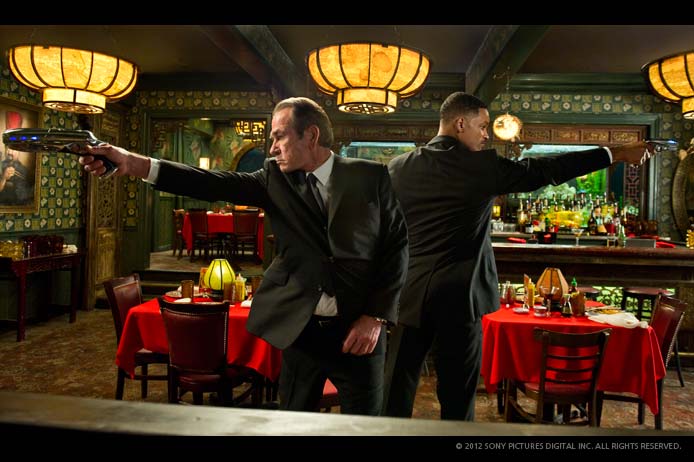
I want to say this is the best Men in Black yet and would do so except that they’ve all been fun, and this one assumes familiarity with the basic premise. Though it could not stand alone, this movie does not simply rest on the laurels of the franchise. It adds a number of plot twists including time travel and alternate futures. We also learn much of the backstory of Agent K (Tommy Lee Jones) through the excellent performance by Josh Brolin as his younger self. We learn where much of his stoicism comes from in relation to Agent J (Will Smith), and we discover a hint of romance in the background of Mr. No Fraternization. Throw in an earth-threatening bad guy, Boris the Animal (Jemaine Clement) and you have a movie that keeps your attention from start to finish.
Jemaine Clement as Boris the Animal
Boris escapes from LunarMax prison. He’s the last of the Boglodites, a race that would have destroyed earth except for the ArcNet shield that Agent K (Jones) had sent into orbit on the first moon rocket on July 16, 1969. Boris time-jumps back to July 15, 1969, kills K, and the Boglodite invasion begins in our time. The earth’s only chance is Agent J (Smith) who follows Boris back in time and teams up with Agent K’s younger self in a desperate effort to stop Boris.
They meet a key ally, Griffin (Michael Stuhlbarg), at an Andy Warhol be-in. Warhol is reveal as an agent, and Griffin as a 5th dimensional Arcadian who can see all possible futures. At Shea Stadium, he recalls his favorite moment in human history – when the Mets won the world series. His explanation of how this was possible made for a nice metaphysical aside. Involving factors like a home run ball that was flawed because a factory worker’s wife had left him the day it was made, Griffin’s story served as a fine illustration of the Buddha’s teaching on the interdependent arising of all phenomena.
young Agent K, Griffin, and Agent J
The plot depends on several nifty gizmos that just happen to appear at the right time, and we have the obligatory alien free for all and agent-gets-slimed moment, but those who liked the previous movies will enjoy the new situations, especially watching Will Smith overcome an alien shark with mustard.
I decided to see the non-3D version. The glasses sometimes give me headaches, and I suspect the in-your-face effect of some of the creatures would have been distracting. Either way, if you liked the earlier MIB movies, you’ll find a lot to like in this one.





 The First Gates