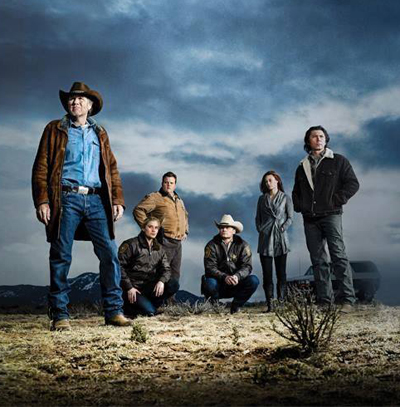
I’ve devoted only one of 645 posts to a television show, Longmire, because the series is exceptional. Walt Longmire, a rural Wyoming sherif, is haunted by his wife’s murder. Each week we see him try to keep peace with his own demons, with his daughter, his employees, and the neighboring Cheyenne reservation, while solving crimes and capturing desperadoes.
Though the show has a solid viewer base, A&E cancelled the series two weeks ago. TV Guide reports that Longmire viewers are too far over the hill. With an average age of 61, apparently we don’t by as much stuff as the sought-after 19-49 year old demographic.
“It was losing money for us,” said one A&E executive. “It’s a business.” No one thought the decision was based on quality…
All may not be lost. As one of the top 25 television shows of the summer, Warner Brothers is putting together a presentation to other cable networks to continue with a fourth season for Longmire. I hope they succeed so I don’t have to spend my “golden years” recalling the good old days when television was occasionally intelligent.
Last Friday, August 15, the theme of National Public Radio’s “TED Radio Hour” was “Simply Happy,” and carried the message that “finding happiness may be simpler than you think.” Narrator Guy Raz reviewed the ideas of five speakers whose TED presentations focused on happiness as something that can be cultivated.
Matt Killingsworth, a researcher at UC San Francisco, gathered real-time input from 35,000 people via a simple smart phone app one can register for at trackyourhappiness.org. Several times during the day, volunteers receive three questions on their phones:
1) How do you feel right now? (on a scale from very good to very bad).
2) What are you doing? (check one of 22 choices).
3) Are you thinking about what you are doing? (as opposed to “mind wandering”).
Killingsworth discovered that 47% of the time, people are thinking of something other than what they are doing (ranging from a high of 65% when taking a shower, to an interesting 10% whose minds wander while having sex). His finding, across all activities is that “people are substantially less happy when their minds are wandering.” This includes even unpopular tasks like commuting to work. He concludes that “mind wandering is a cause rather than a consequence of unhappiness.”
Though he doesn’t cite the growing interest in mindfulness meditation practice, it’s significant that recent articles in Scientific American have mentioned studies of this practice, including Is Mindfulness Good Medicine, which appeared on the Scientific American blog the day before NPR posted Killingsworth’s findings.
Carl Honore is a journalist and the author of In Praise of Slowness: Challenging the Cult of Speed (2005). He claims our world is “addicted to speed” and living “the fast life rather than the good life.” He says his wakeup moment came when he realized he was speed-reading bedtime stories to his young son, compulsively rushing through one of the richest times of his day.
Honore says we are “so marinated in the culture of speed that we almost fail to notice the toll it takes on every aspect of our lives – on our health, our work, our relationships and our community.” For one thing, speed and adrenaline can be exciting. For another there is a strong cultural bias that equates slowing down with being a slacker. One common meaning of “slow” is “not very bright.”
Honore says he still enjoys the fast pace of life as a journalist in London, but he is now “in touch with his inner tortoise,” and doesn’t unconsciously overload himself. “I feel like I’m living my life rather than actually just racing through it. So is it possible? That’s really the main question before us today. Is it possible to slow down? And I’m happy to be able to say to you that the answer is a resounding yes.”
Graham Hill was an early ’90’s internet millionaire by the age of 30. He sold the company he had built with friends, and then filled “the void” he felt inside with stuff: “I bought a 3,600 square foot home, Volvo sedan, tons of furniture, gizmos, technology, stereos, probably had one of the first MP3 players. You can’t believe how much stuff.”
Unlike most of his wealthy peers, Hill realized his stuff wasn’t making him happy so he got rid of most of it. He now lives in a custom designed, 420 square foot New York City apartment that is wonder of space efficiency:
Hill notes that Americans use three times as much space as we did 50 years ago, yet we have still spawned a $22 billion dollar, 2.2 billion square foot self-storage industry. Other consequences include, “Lots of credit card debt, huge environmental footprints, and perhaps not coincidentally, our happiness levels flatlined over the same 50 years. Well, I’m here to suggest there’s a better way – that less might actually equal more.”
Dan Gilbert, Harvard Psychologist and author of Stumbling on Happiness (2007), spoke in his talk of the many ways in which our happiness does not depend on circumstances or getting what we want. Humans are resilient enough, he says, to recover from serious trauma, though imagination generally tells us otherwise. Gilbert cited three cases, drawn from a single edition of the New York Times.
Jim Wright, Speaker of the House of Representatives before Newt Gingrich, resigned in disgrace after a scandal involving “a shady book deal.” He lost his position, reputation, and money, but now says, “I am so much better off physically, financially, mentally and almost every other way.”
Pete Best, The Beatles’ first drummer, was replaced by Ringo Starr just before the band became world famous. Still a drummer and studio musician, Best says, “I’m happier than I would’ve been with The Beatles.”
And most dramatic to me was Moreese Bickham, 78, released from prison because of DNA evidence after serving 37 years for a crime he did not commit. Upon release, Bickham said, “I don’t have one minute’s regret. It was a glorious experience.”
Baring “extraordinary” people like Gandhi or Nelson Mandela, we can hardly imagine prison as being worthwhile, let alone “glorious,” but Gilbert uses these and other examples to underline the power that “reframing” events has on our outlook. The stories we tell and the meaning we find in experience are critical. “It is wrong to say that we have no control over our happiness. It is wrong to say that we have complete control over our happiness. We have some input into how happy we will be…We can learn to see events in a constructive and positive way.”
Brother David Steindl-Rast, a Benedictine monk, has devoted himself to interfaith dialog and the interaction of religion and science. His TED topic was gratitude, as one might expect of a man whose home page is gratefullness.org. He says most people think we are grateful when we are happy, but the opposite is true: gratitude leads to happiness.
He outlines a simple way to cultivate gratitude, beginning with stopping our minds and our busyness to reflect that “You have no way of assuring that there will be another moment given to you. And yet, that’s the most valuable thing that can ever be given to us. We say opportunity knocks only once. Well, think again – every moment is a new gift, over and over again, and if you miss the opportunity of this moment, another moment is given to us, and another moment. We can avail ourselves of this opportunity or we can miss it. And if we avail ourselves of the opportunity, it is the key to happiness.”
Such a simple step, repeated, carries great weight, for Steindl-Rast reflects that grateful people are not fearful, and if we are not fearful, we will not be violent. “If you’re grateful, you act out of a sense of enough and not from a sense of scarcity, and you’re willing to share.If you’re grateful, you’re enjoying the differences between people and you’re respectful to everybody, and that changes this power pyramid on which we live. And it doesn’t make for equality, but it makes for equal respect, and that is the important thing. A grateful world is a world of joyful people, grateful people are joyful people. And that is what I hope for us.”
***
The question of attitudes and habits that lead to wellbeing has emerged as the key theme of theFirstGates this year. I’ve posted ideas from Carl Jung, the Dalai Lama, and Scott Adams, creator of Dilbert. Here are five more voices (and more to come) saying that happiness is not an accident, not given to a few select or fortunate people. It is a choice we can all make, a direction we can aim for at any given moment
This post was a (literal) coffee-snorter. Be warned, if you have a cup, put it down, and if you’re eating a blueberry muffin, swallow before reading this epic tale of Walmart brigands, trailer park ninjas, the Darwin awards, and other tales of so-called real life as stranger than fiction.
Every day, there are real stories in the morning newspaper that make you snort coffee out your nose or choke on a blueberry muffin. Note: This is why journalists call such pieces “muffin chokers.”
Yet the daily weirdness is more than funny. If you dissect these stories, you can learn deep storytelling lessons from the shallow end of the journalism pool.
Here’s a real story that just happened in my state: Man steals RV from Wal-Mart parking lot, leads police on wild chase. Swerves into sleepy little town where he knocks cars into front yards and such, then blasts through a house and crashes. Runs out, strips down to his underwear and invades a home to steal girl clothes. Cops catch him and haul him off.
This is pretty typical of a weird news story, and not simply because it started in the parking lot of a Wal-Mart — and yeah…
Maleficent opens in a world of beauty, threatened by a greedy human king. The visual contrast between human actors and fantasy animation was great enough to take a few minutes for suspension of disbelief to kick in. After that, I was in for the ride, through an ambitiously re-crafted tale of the Disney arch villainess who gave kids of my generation nightmares in Sleeping Beauty (1959). As the poster implies, this movie belongs to Angelina Jolie, whose performance is gripping.
The Sleeping Beauty themes of love and betrayal remain but they manifest very differently in the two Disney versions of the story. Men betray and women love; implicit in Disney’s previous blockbuster, Frozen, the theme is explicit in Maleficent. For now at least, it’s Disney’s key to box office success.
Retelling fairytales with a modern twist is nothing new. Fantasy authors like Nancy Kress, Jane Yolen, Steven Brust, and Roger Zelazny, to say nothing of Neil Gaiman and George R.R. Martin have been doing this for decades. I’m currently reading a 1994 collection of short retold fairytales, Black Thorn, White Rose, edited by fantasy writers, Ellen Datlow and Terry Windling. There are two different versions of Sleeping Beauty. In both, it is the prince who needs to be rescued.
I take this as an inevitable pendulum swing from earlier Disney movies where princesses mostly sat around singing, “Someday my prince will come.” We have to remember that no Disney movie, then or now, is “real” folklore, nor is any work fantasy fiction. By “real” folklore, I mean stories shaped by the collective imagination of generations of members of a culture, region, or tribe. Strictly speaking, any talk of folktales now must be in the past tense. Nowadays the events that might spawn new fairytales, over a generation or two, become headlines or tweets, “details at 6:00,” to be forgotten in a day or an hour.
Among other things, the old fairytales were full of hints on wise living for those who knew how to listen. Here is one simple list of some of the lessons they taught:
Sorrow is real, and so is joy
Joy is freely available to all, just as sorrow comes freely to all, whether rich or poor, and without regard to changes in material fortune
The world is fraught with danger, including life-threatening danger, but by being clever (always), honest (as a rule, but with common-sense exceptions), courteous (especially to the elderly, no matter their apparent social station), and kind (to anyone who has obvious need), even a child can succeed where those who seem more qualified have failed.
Much as I love them, I don’t find that fantasy movies and novels teach lessons like these in a visceral or unforgettable manner, which leaves us sadly impoverished. Dragons have not gone away – any glance at the headlines makes that clear. What is gone is the wisdom to know how to deal with them.
My title, a line from Monty Python and the Holy Grail, came to mind during recent reflections on independent bookstores.
Shakespeare and Company bookstore, Paris. Wikimedia Commons
I used to go to bookstores to make discoveries. The best were quirky, and I loved to be surprised and find something new to read. My all time favorite was a sci-fi/fantasy specialty store in a low rent strip mall. The store was a labor of love for the owner, who made most of his income trading collectables – signed Robert Heinlein first editions and vintage comic books.
I could walk in and say, “I’m looking for urban fantasy that centers on spirit guides,” or, “I’m in the mood for a quest – got anything that’s not a dumb Tolkien ripoff?” Most of the time, I’d find what I was looking for and have an interesting chat on trends in the genre with someone who was steeped in that world. You never know what you’re going to find in a place like that. Sadly, independents are on the ropes, but as the Pythons put it, they’re not dead yet. Here is a link to indiebound.org, which has a tab at the top right to locate independent booksellers.
We don’t even have to abandon ebooks to shop at indies! In February, 2012, I wrote about The Book Seller, a great independent shop in Grass Valley, that encourages ebook fans to order through their website; that way they get a commission on each sale (the format is .epub, the standard all-but-Amazon format, which can be read on a Nook or any laptop, smartphone, or tablet using the free Nook app).
I’m pretty sure that for just about everyone reading this blog, books are a huge and treasured part of our lives. If anything good has come out of the Amazon-Hachette dispute, it’s information like this which can help me rethink the way I buy books.
As Mark Coker put it, the ideal is “a vibrant ecosystem of multiple competing retailers.” It’s good to know what I can do to help secure such a future.
From indiebound.org
Footnote, June 3: Calmgrove, a blogging buddy, noted in a comment that the initials of my title, I’m Not Dead Yet, form a nice acronym, INDY. In addition to independent bookstores, he says it has something to do with fruit fly genetics – feel free to pursue that with him if you wish…
A blogging friend, Calmgrove, commented on my previous post, saying how strange it is that in modern times, despite an abundance of comediennes, there are no female tricksters. Then it struck me – and it’s so obvious, I can’t believe I didn’t think of this earlier.
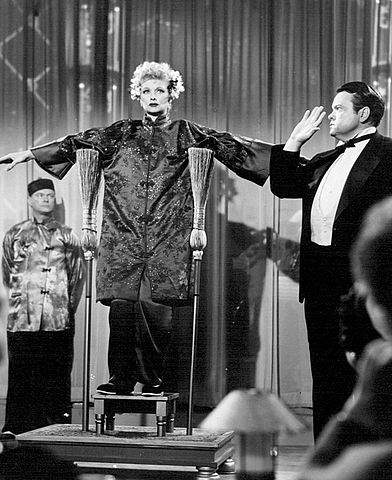
In an era when tricksters come to us on screens rather than stories told around a campfire, we cannot forget Lucille Ball’s role in “I Love Lucy.” The show ran from 1951 to 1957 and was the most watched the American television program during four of those six seasons. It is still in syndication in dozens of countries around the world.
Lucille Ball and Orson Welles.From a 1956 episode. Public domain.
Lucille Ball, with her clowning and physical comedy, set a tone that is still at the core of many sitcoms. Most of the best known women comics who followed cite her as a groundbreaker, an inspiration, a mentor, and often a friend. In terms of our “classic trickster” test, that is what she was, at all times. Never just a funny housewife, Lucy was an outrageous but charming disrupter, whose pioneering humor enlivened the spirits of millions who watched her.
I dare you to get through the chocolate factory scene with a straight face.
Quite a few full episodes of the show are available on YouTube.
I want to argue a paradox…that the origins, liveliness, and durability of cultures require that there be space for figures whose function is to uncover and disrupt the very things that cultures are based on. – Lewis Hyde
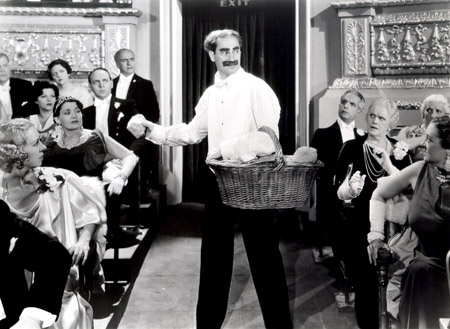
It has always made sense to me that the 1920s, 30s and 40s, when times were hard for so many, gave birth to our great movie tricksters: Charlie Chaplin, Laurel and Hardy, The Marx Brothers, and The Three Stooges. Their send ups of the 1%, among other things, are still hilarious. Where are their equivalents today?
My self-imposed moratorium on negative blog themes has passed. As I caught up on news I had kept at arms length, I found myself thinking often of trickster stories. In part because they are funny, and most of the news is not. And partly because the folly of tricksters has a sacred dimension while the folly of our headline makers is often just foolish. If you invite the Three Stooges to lunch and serve pie, the outcome is fairly certain. I read that the Georgia legislature voted to allow patrons to carry guns into bars; the result is likely to be just as predictable, but without the catharsis of laughter.
1) Tricksters both make and violate boundaries and live in relationship to them. Where there are no boundaries, trickster creates them, as in several Native American creation myths where Coyote makes the land and separates it from the sea. Where there are cultural boundaries, tricksters blur or invert the distinctions: right and wrong, friend or foe, male or female, living or dead.
2) Tricksters are usually on the road, and this makes them outsiders.
Through most of human history, solitary travelers have been rare. Until the last century, most people lived and died close to the area where they were born. Nomadic people travelled as tribes or clans, but Hyde says trickster is “the spirit of the doorway leading out, and of the crossroad at the edge of town. He is the spirit of the road of dusk,” who may pass through city and town but only to “enliven it with his mischief.”
Hyde points out that although there is an abundance of clever women who know how to be deceptive in world mythology, they are seldom full-time tricksters. Once the evil is vanquished, the curse lifted, they tend to settle down. Coyote and Loki do not domesticate, and the older cultures who gave us these stories would have had trouble imagining a woman who opted for a solo life on the road.
3) Tricksters are liars and thieves, but they are not petty criminals.
Tricksters steal things like fire and cattle, and according to Hyde, are often honored as creators of civilization. “They are imagined not only to have stolen certain essential goods from heaven and given them to the race but to have gone on and helped shape this world so as to make it a hospitable place for human life.”
We cannot be too doctrinaire about these things, for there is a distinction between “large” stories, like creation myths, and “small” folktales, where trickster sometimes steals cattle for himself. When he does so, however, in tales like “The Little Peasant” from Grimm, it is usually a case of swindling a swindler, or people who are dishonest and greedy to start with.
For obvious reasons, trickster isn’t welcome in corporate boardrooms. Like Robin Hood, he is into redistribution of wealth. He’s the patron of whistle blowers everywhere, and will gladly gum up the machine when it is no longer serving the greater good.
Perhaps that is why we need him now more than ever. We don’t even have to do anything. Hermes travels as fast as thought. For good and for ill, trickster is already here.
Just in case you’ve had too much of cutesy bunnies this season, Ms Vickie Lester, who blogs at Beguiling Hollywood, can fix that. Stop by to learn why Monty Python didn’t really know the first thing about scary rabbits. When I was a kid, I was terrified of lambs. My parents thought it was weird, but Vickie shows that there’s more going on than we think with these seemingly “harmless” creatures.







 The First Gates