Full Faith and Credit: a personal story and parable.

My wife and I got married in Santa Fe in 1976.  We didn’t have a lot of money, but our mothers were gone and our families and friends were on the coasts, so there would only be eight in the wedding party.  We arranged to have the reception and put everyone up at the lodge in a nearby national monument.

I worked in a printshop that had been one of the finest in town.  We still did brochures for the Santa Fe Opera, but signs were clear that the glory days were over.  A husband and wife team had started the shop, but they divorced, and with only one of them running the business, glitches appeared in the billing system, the revenues, and the payroll.  About the time we booked the rooms and locked in arrangements, my paychecks started to bounce.

The pressmen and I started cashing our checks at grocery stores and the boss’s bank, since our own banks charged fees for deposits that bounced.  The day before the wedding, a teller said, “I’m sorry, I can’t cash this check.  Your employer’s account is $1000 in arrears.”

“Please,”  I said.  “We’re getting married tomorrow, and we have to pay the caterers.  If they’re $1000 in the hole, what does another $150 matter?”

She bit her lip and scrunched up her eyebrows, then smiled, and handed me the cash.  “Congratulations!” she said.  “Have wonderful wedding day.”

Crisis narrowly averted.  But

Do you think I ever put my faith in that employer again?

Do you think other nations will put their faith in United States credit again?

I’ll answer the first question.  We set about saving money to move back to California where economic prospects were better.

I don’t know the answer to question number two, but I do know that trust takes time to build and is easy to squander…

Big news for online education

In mathematics, an inflection point is the place on a curve where the curvature changes from concave upward (positive) to concave downward (negative) or vice versa.

point_of_inflection

Andy Grove, former Intel CEO, gave the term a new relevance.  In his management book, Only the Paranoid Survive, he wrote:  “A strategic inflection point is the time in the life of a business when its fundamentals are about to change.  That change can mean an opportunity to rise to new heights.  But it may just as likely signal the beginning of the end.”

Grove borrowed a parallel term, “disruptive technology,” from business writer, Clayton Christensen.  A disruptive technology is an innovation, very often appearing crude at inception, that can change or eliminate entire industries.  The first horseless carriage must have seemed silly to buggy makers, just as the first kindle looked like a toy to brick-and-mortar bookstores.

A week after my first post on free online college classes, an article in Sunday’s Sacramento BeeAn elite school offers master’s degree online, suggests that we’ve already  passed an inflection point and that online coursework is a “disruptive technology” that is destined to change higher education in ways we cannot yet grasp.

Online classes are nothing new; I took an early online programming class in 1998, with mixed results.  Online graduate degree programs in business as well as software exist, many offered by private colleges.  What’s different now is the scale.

Beginning in January, Georgia Tech will offer online master’s degrees in computer science at a cost of $6,600, compared to the $45,000 price tag for the same courses taken on campus.  Some of the funding comes from AT&T which “will use the program to train employees and find potential hires.”  Estimates of future interest in this degree run as high as 10,000 students a year, including international participants.

Because of Georgia Tech’s prestige and the ambitious nature of this undertaking, educators are watching closely.  There is no guarantee of success for this particular program, but from the perspective of student loans alone, there is a huge need for innovation of this sort.  The first producers of new technologies are not always the ones who succeed, but like the first makers of personal computers and ebooks, they define inflection points that change the world.  Georgia Tech may well be doing the same thing.

Outsourcing yourself for fun and profit

At least a decade ago, when I worked in IT, I read a story online that I treasured like those special Dilbert clips everyone posts in their cubicle.  Supposedly, a software engineer making $90,000 a year outsourced his job to India, paying an engineer there about 20% of his salary (a handsome wage in India at the time) so he could split his workdays between online courses and video games.  As the story went, the code he got back from the Indian engineer was so good that he had to introduce bugs now and then to maintain credibility.

I loved telling the tale, though I figured it was probably just a nerd urban legend.  Today I found an identical case that is documented.  Well, identical except for location and inflation:  the country is China, and the US engineer’s salary is given as “six-figure.”

A “critical infrastructure company” in the US contacted Verizon security services to see why there were so many network logins originating in Shenyang, China.  At first the company thought they’d been hacked.  Later it turned out the VPN token had been supplied to the Chinese firm by an employee the Verizon report names as “Bob.”  Bob was described as:

“mid-40′s software developer versed in C, C++, perl, java, Ruby, php, python, etc. Relatively long tenure with the company, family man, inoffensive and quiet. Someone you wouldn’t look at twice in an elevator.”

Bob showed up every day at the office.  Here is Verizon’s report on how he spent his days ( http://tinyurl.com/ajm7oan ):

  • 9:00 a.m. – Arrive and surf Reddit for a couple of hours. Watch cat videos.
  • 11:30 a.m. – Take lunch.
  • 1:00 p.m. – Ebay time.
  • 2:00 – ish p.m Facebook updates – LinkedIn.
  • 4:30 p.m. – End of day update e-mail to management.
  • 5:00 p.m. – Go home.

NPR’s coverage of this story contains a link to the Verizon report, which notes that Bob had a reputation as the best developer in the company http://www.npr.org/blogs/thetwo-way/2013/01/16/169528579/outsourced-employee-sends-own-job-to-china-surfs-web

***

What’s just as interesting as Bob’s story is my reaction to it (and probably yours).  First, I assume that if Bob had the smarts to engineer this deal, he got a non-disclosure agreement from the Chinese company.  Such documents, to protect business secrets, are routine in all sub-contracting operations.

Beyond that, I found that along with humorous admiration for Bob’s escapade, I felt critical because he wasn’t “playing by the rules” – even though in the course of my own career, I watched all the rules change.

When I finally “settled down” and got a “real job,” I joined a technology company that boasted of never having a layoff.  The first one came about 18 months later, and before I left, I saw scores of empty cubicles of people whose jobs had been sent overseas.  These days we all know people who played by the rules and got screwed.

In the end, I wouldn’t want Bob’s karma, but his story illustrates something we hear again and again:  nowadays workers are on their own.  Company loyalty in response to employee loyalty is largely a thing of the past, and everyone has to take responsibility for their own careers, including use of the tools of the digital age.  For anyone reading this post in a cubicle and thinking of Bob and tropical islands, here is some recreational reading, referenced in the NPR story – The Four Hour Workweek, by Timothy Ferriss.

As the sergeant used to say in the classic cop show, Hill Street Blues, “Be careful out there!”

Change is the only constant

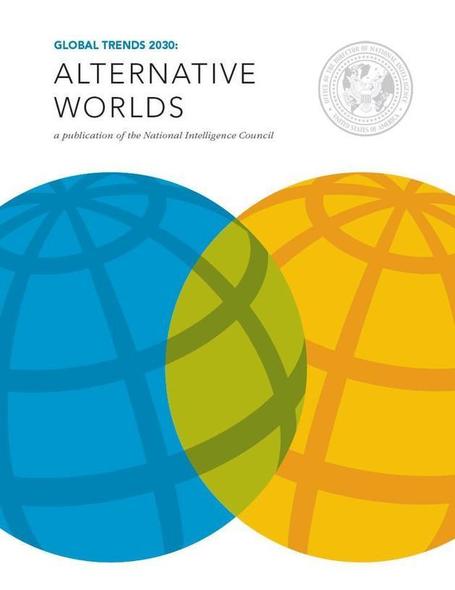
That’s what they say in the tech industry.  That’s what Buddha said 2600 years ago.  And that’s what the National Intelligence Council says in a 140 page report, “Global Trends 2030: Alternative Worlds.”

Click for the text of the whole report

Since 1997, the NIC, formed of all 16 US intelligence agencies, has issued five Global Trends reports, one after each presidential election.  For this one they engaged think tanks, government, and business leaders in 14 nations and concluded that the world will be radically different in 18 years.  The pace of change will be faster than at any period in modern history.

NIC Chairman, Christopher Kojm, says:
“We are at a critical juncture in human history, which could lead to widely contrasting futures. It is our contention that the future is not set in stone, but is malleable, the result of an interplay among megatrends, game-changers and, above all, human agency. Our effort is to encourage decision makers—whether in government or outside—to think and plan for the long term so that negative futures do not occur and positive ones have a better chance of unfolding.”

Here is a link to a summary of the report. ww.bloomberg.com/news/2012-12-10/u-s-intelligence-agencies-see-a-different-world-in-2030.html

The NIC defines “megatrends” as scenarios likely to happen under all circumstances.  “Game-changers” are “critical variables whose trajectories are far less certain.”  Additional possibilities are listed as “black swans,” discrete events that would cause large scale changes, either for good (a democratized China or a reformed Iran) or ill (global pandemic, WMD attack).

The report identifies four megatrends, changes regarded as inevitable over the next two decades:

  • Diffusion of power:  The US will lose it’s international dominance, but no other nation will take its place.  “Power will shift to networks and coalitions in a multi-polar world.”  Though the report didn’t say it, as a student of World War I history, I have to observe that the last time the world was structured this way, things did not turn out very well.  The report identifies one best case scenario as a new era of US/Chinese cooperation.
  • Individual Empowerment: A rising middle class in emerging nations, increased access to education, widespread use of technology, and health care advances can improve the lot of large numbers of people. The report notes that technology is two edged sword: it can benefit and disrupt.  Advances sometimes create and at other times eliminate jobs.  Technology fosters communication but also  leaves infrastructure vulnerable to cyber-attack.
  • Demographic Change: World population will grow from 7.1 to 8.3 billion, and 60% world will live in cities (it’s 50% now).  This will strain resources and increase pollution. Aging populations may slow economic growth in developed nations. Immigration will increase.
  • Food, Water, and Energy Shortages: In 18 years, the world will need 35% more food and 40% more water.  Our intelligence agencies don’t waste time pretending climate change isn’t real.  They note that conditions like widespread drought have grown more severe in just the 18 months they’ve been working on the report.

National Geographic issue on extreme weather, published one month before Superstorm Sandy

Rather than summarize more of the report, I invite readers to check it out for themselves.  Let’s step back and reflect on what this means.

My dogs do not like change.  They find comfort in their routines, and if I am honest, so do I.  This month a 72 year old hardware store, where you could find anything, closed it’s doors.  So did a 76 year old nursery, where master gardeners could always diagnose the ugly brown spots on your roses.  That’s enough to put me in a funk, imagining our big box future, and yet this is nothing compared to what Global Trends 2030 suggests is coming – change at a faster rate than anyone living has seen.

Change that rapid generates fear.  Looking at the last decade, we see resistance to change spawning violence.  Religious fundamentalists are more vocal in nearly all denominations.  Reactionary politicians grasps at some idealized past that is gone if it ever existed.  The urge to get what is mine at all costs further disrupt economic life and generates even more fear.  People bemoan the loss of civility.

Do we have any guides for living through times like these?

As I asked myself the question, I remembered Joseph Campbell’s assertion that world mythology holds wisdom for all the turns that life can take.  And Marie Louise Von Franz, Jung’s closest colleague, said that fairy tales offer the “purest and simplest” expression of “the basic patterns of the human psyche.”  Do stories created by people who traveled by foot and ox cart really have something to teach us in the 21st century?

I believe they do.  Next time we will consider what the old stories may say about living through difficult times.

All quiet on the holiday front

The chief of security at one of the largest area malls reported that this year’s Black Friday was the smoothest in 13 years.  He didn’t speculate on why that was true, so here’s a poll.  Pick whichever explanation(s) seem most plausible:

  1. The population has grown more civil.
  2. More people are shopping online.
  3. After all that’s happened this year, including the election, we’re too numb to respond to the usual holiday trappings.

Yesterday, I thanked the waitress at a local waffle place for the lack of “holiday” music.  “I know,” she said.  “Isn’t it great?  I’m hoping management keeps it up.”

I distinguish between Christmas music, which I enjoy at this time of year, and Holiday music.

People reading this blog in other countries may not be clear on the distinction.  Because of our nation’s diversity, in the public sphere, both at work and in stores, we say “Happy Holiday’s” instead of “Merry Christmas.”  The intent is not to offend people of other faiths.  The result is largely to trivialize the whole thing.  If you’ve ever gotten a song like “Little Saint Nick,” or “Rockin’ Around the Christmas Tree,” stuck in your mind, you know what I mean.

For helping spark the trend toward silence or simply generic music in stores, I present my 2012 Corporate Hero award to Shoppers Drug Mart, a popular Canadian pharmacy chain.  They started playing Holiday music the day after Halloween, but received so many complaints that they pulled the plug “until further notice.”

One comment on their Facebook page read, “Starting this music so early takes the sacredness and meaning out of what should be such a beautiful season.”  That sums up “the Holidays” in their entirety.

Luke’s gospel tells us that after the shepherds saw the baby Jesus, they ran off to Bethlehem to tell everyone, “But Mary treasured up all these things and pondered them in her heart”  Lk 2:19.

Pondering things in our heart is how an event becomes an experience.  It’s how we come to appreciate things, even simple acts like buying a gift or having waffles with a friend.

I never begrudge our merchants the chance to make a living at this time of year, and I appreciate them even more for pulling the plug on noxious music so I can treasure more of these things in my heart.

The end of the world as we know it

Having slept through Black Friday, the next big event on my calendar is the Mayan apocalypse, scheduled for December 21.

I had no intention of blogging about this until I received the Winter 2012 issue of the University of Oregon Quarterly, where an article by Alice Tallmadge, “Doomsday or Deliverance?” discusses this prophecy in the context of end-of-the-world folklore.

Associate professor Dan Wojcik, director of the UO folklore program, plans to travel to Chichen Itza, one of a huge number of visitors expected for the event, which for some heralds the shift to a higher world age, in the same spirit as the Harmonic Convergence of 1987.  The main organizer of that event, as well as the biggest publicist of 12/21/12, was Jose Arguelles (1939-2011).  In his obituary, the New York Times described his philosophy as “an eclectic amalgm of Mayan and Aztec cosmology, the I Ching, the Book of Revelation, ancient-astronaut narratives, and more.”

On the other end of the spectrum, Alice Tallmadge reports that sales of survivalist goods have spiked in recent months.  A recent Reuters poll found that 15% of people worldwide, and 22% of Americans believe the world will end during their lifetime.  The apocalypse has been a feature of Christian theology from the start, but professor Wojcik notes a recent uptick in secular end-time beliefs:  pandemics, overpopulation, and climate change are seen as threats to the planet without any hope of spiritual redemption.

Things that have a beginning have an end, from gnats, to humans, to stars, and all of creation in the western view of time as linear.  When the world survives a predicted ending date, the error is put down to miscalculation; the expectation persists.  What is it about end-time predictions that continue to fascinate most of us and motivate many believers?  The old saying, “Fool me once, shame on you, fool me twice, shame on me” doesn’t hold in this realm.

I wonder if it parallels our continuing love for disaster film?  Stories of terrible struggle and danger where we get to imagine ourselves among the survivors or among the happily raptured, coming through the ordeal to enjoy “a new heaven and earth.”  The ultimate do-over.

They don’t get any better than one of my all time favorite “disaster films,” made decades before the phrase was coined:  San Francisco (1936), with Clark Gable, Spencer Tracy, and Jeanette MacDonald surviving the 1906 earthquake.

Here’s hoping all our December disasters turn out as well!

And finally, for extra credit, here’s a different kind of celebration, with REM performing “It’s the End of the World As We Know It (and I Feel Fine).  Enjoy!

Twinkies, Part Deux

My previous article, which indulged in bit of nostalgia about grade school lunches, missed much of the actual drama that put Hostess, the maker of Twinkies, Ho-Ho’s, and Ding Dongs, on the ropes.

It isn’t quite over .  A USA Today article by Kevin McCoy reports that Hostess management and the baker’s union are meeting for mediation today, delaying the company’s second bankruptcy filing in less than a decade  http://usat.ly/TU81SA.

The maker of popular snack foods has a billion dollars in debt, which it blames on an “inflated cost structure,” largely as a result of labor contracts.  The union contends the problem is years of mismanagement.  An outside financial analyst found that problems included, “years of underinvestment in products, facilities and equipment, long-term neglect of once-dominant brands and hollowing-out of a distribution system that once provided a competitive advantage,”

Bruce Maiman, a local contributor to the Sacramento Bee, interviewed workers striking at the local Hostess bakery who say their hourly wage and pensions are lower than other bakers like Oroweat and Sara Lee  http://www.sacbee.com/2012/11/20/4998328/blame-workers-unions-or-the-executives.html.  Maiman lists a string of gaffes by a management led by six different CEO’s in ten years.

Local workers claim that rather than replacing outdated equipment, money was recently spent to replace windows and paint the lunchroom, locker room, and floors.  “They want it to look pretty so they can sell it,” says the head of the local baker’s union.

Selling assets may well be the outcome.  US Bankruptcy Trustee, Tracy Hope Davis, joined the union in arguing against management’s current shutdown plans – which among other things, would grant them large bonuses.  Davis favors Chapter 7 bankruptcy, which would liquidate assets according to US Bankruptcy Code priorities.

In other words, Twinkies may survive, so we’re better off waiting before spending $5,000, the going rate for a Twinkie on eBay.  This, says Bruce Maiman, just goes to show that “as long as human beings exist, the planet will never run out of Twinkies or nitwits.”   

Remembering an icon

When I was in grade school, the lucky kids had Hostess snack foods in their lunch. I remember one guy who would shove an entire Twinkie into mouth, partly to gross out the girls and partly to gloat over those whose mothers, like mine, packed boring things like carrots and celery.

Once I got to junior high, with its snack bar window, I could indulge, and that was when I made a terrible discovery – Twinkies just weren’t that good.  Oblivious to the dangers of breaking a filling, I generally spent my pocket money on corn nuts instead.  And yet, I will miss Hostess.  Not just because the cupcakes are good, and you gotta love any snack food called “Ding Dongs.”  Not just because the local Hostess bakery will close and thousands of people around the country will lose their jobs.

There’s something endearing about the little gold icon, an image of youth, when there were do-overs in terms of diet and teeth and most other things.  I would also argue that the same font of creativity that brought us Twinkies and Elvis impersonators brought us microchips and iPhones as well.  Say it loud and say it proud:  “Only in America!”

Hostess cared about its customers!  I remember hearing on NPR’s Science Friday that the company conducted experiments to determine how long you could safely nuke a Twinkie.  Seems that many enjoyed warming their Twinkies, but when left in the microwave too long, they would explode.  After careful research, Hostess reported that 60 seconds or less was generally safe.

The reputation of Twinkies was forever tarnished by the notorious “Twinkie defense” used in a sensational murder trial in 1978.  On November 27, disgruntled San Francisco City Supervisor, Dan White, climbed into City Hall through a first floor window, circumventing the newly installed metal detectors.  He carried a pistol and fatally shot Mayor George Moscone and fellow Supervisor, Harvey Milk, the first openly gay man ever elected to California public office.

At the trial, White’s defense attorneys argued diminished capacity resulting from depression and a steady diet of junk food, most notably Twinkies.  In what is widely regarded as a great miscarriage of justice, the jury found White guilty of manslaughter rather than first degree murder.  After serving five years of a seven year sentence, White – “the most hated man in San Francisco history,” according to the Chronicle – committed suicide.

None of this was the fault of Twinkies, and yet the growing awareness surrounding the trial, that sugary snacks, like cigarettes, might not be in our best interests helped doom the little “Golden Sponge Cake with Creamy Filling.”  I gotta confess, I long ago joined the bran muffin crowd.  I munch on carrots voluntarily now.

Twinkies were the brainchild of James A. Dewar of the Continental Baking Company, makers of Wonder Bread and the Hostess line of snack foods.  Machines used to make cream-filled strawberry shortcakes were idle when strawberries were out of season, so in 1933, Dewar used them to make banana cream filled snacks which sold, two for a nickel.  During WWII, when bananas were rationed, Hostess switched to vanilla creme, a move so popular they never went back.

Twinkies popularity grew in the 1950’s when Hostess sponsored the Howdy Doody Show. During the nuclear scare of the ’60’s, Twinkies were stored in bomb shelters, because according to Hostess, they “stay fresh forever.”  If Twinkies are as iconic of my generation as Howdy Doody, it’s also true that now we worry more about preservatives than thermonuclear war.

So long, little guy, and happy trails! Someday, enterprising history students will rediscover you in the course of their doctoral research in 20th century popular culture. They will come to know, as we do, that there are worse ways to meet the challenges of life than with a smile on your face and a golden bread-thing in your hand!