The Muppets Get Politicized

That's, Comrade Kermit, according to Fox

This began as a simple post over the weekend, after I spotted a story on Facebook about Fox News’ recent attack on the Muppets.  On Dec 2, Fox business anchor, Eric Bolling was shocked – shocked, he said, that the villain of  The Muppets Movie was an oil baron named Tex Richman.  Bolling asked his guest, Dan Gainor, if Hollywood was trying to brainwash children.  “Absolutely,” said Gainor. “And they’ve been doing it for decades.”  Bolling “wondered aloud why the Muppets couldn’t, for once, “have the evil person be the Obama administration”  http://www.guardian.co.uk/film/shortcuts/2011/dec/06/muppet-movies-communist-plots-revealed.

Silly me!  I thought the Muppets were all about friendship and kindness.  Now we learn that Fozzie and Gonzo are really Occupy operatives!  I guess the 1% need hugs too!

The Guardian article, referenced above said, “The discussion…didn’t just typify the Fox News mission to recast the outside world as leftwing propaganda; it threatened to usher in a whole new paradigm of stupid.”  My initial post  ended by questioning the phrase, “usher in,” since the new era of stupid has been here for a while.

But I held up my posting because Sunday night, I witnessed an escalation:  the Administration struck back, via the National Christmas Tree lighting ceremony.  It was broadcast at 11:00pm – sensible, since it wouldn’t have drawn many prime-time viewers.  In essence, it was a boring political add, thinly disguised as a heartfelt “event.”

“Reality TV,” I said.
“You mean surreality,” my wife replied.

In a word, it was yucky.  Nothing spontaneous or from the heart – the whole thing was as carefully choreographed as an episode of Glee, but without the humor, (good) music, or fun.  I took the dogs out and was ready to call it a night when I heard Kermit’s voice.  There he was, part of the festivities, ushering in a new era of political celebrity wars.

Kermit and Michelle Obama read The Night Before Christmas (courtesy, Disney Corp.)

Celebs always appear in political dog and pony shows, and the Democrats usually win the game.  They have the likes of Springsteen and Joni Mitchell.  Hank Jr. is no match for them by any measure.  And now the Dems are poised to win a war of non-human stars as well.  Sure, the GOP can draft Buzz Lightyear, but Kermit and Piggy will always be fuzzier.  And yet…

The whole thing strikes me as sad. I’m really sorry to see Jim Henson’s creations dragged into political nonsense.  We’re used to a popular culture of false fronts and illusion, but I always hope our politics will be a little more real than commercials of happy shoppers dancing through K-mart.

Ain’t gonna happen.  The parties learned their lesson from Jimmy Carter – only smiley faces get elected.  [**for those too young to remember, during the 1980 presidential campaign, after a decade of stagflation, Carter said the country was “in the grip of malaise.” He lost the election by a landslide.]

My hope is that our collective attention-span for news has grown so short that the Muppet foray into politics will soon be forgotten.  Let’s hope the PR machinery will roll on and focus on human folly, leaving the Muppets alone to be what they always have been – ambassadors of joy and goodwill, regardless of anyone’s politics.

Occupied

I sat up and took notice the other night when a local news announcer complained that the “Occupy Sacramento” protestors “could not even say what they want.” In other words, they won’t play by the rules – you know, the unwritten rule that says when a TV station sends a van to cover your event, you need to have your sound-byte ready. How else can they work it into a one minute segment and move on? How else can you be neatly pigeonholed?

Actually, there is at least one articulate answer to the question of what the protestors want, supplied by Naomi Klein, a Canadian author and activist, at the “Occupy Wall Street” rally in New York. http://www.thenation.com/article/163844/occupy-wall-street-most-important-thing-world-now. This link comes courtesy of Genevieve’s blog, Look Who’s Blogging Now, which you can find on my blogroll. I suggest you check it out if you are interested in this latest eruption of frustration with the status quo, since Genevieve is off to check out the “Occupy Minnesota” protests, and will likely have more to say.

Occupy Wall Street protestors

Perhaps one reason I took special notice of the protests that night, was because I’d been reading of another famous entity that didn’t seem to be playing by the rules; I mean the universe we live in. If – and this is a big if – a large group of European physicists are right, and neutrinos really move faster than light, then some of our core assumptions about the nature of matter are wrong. Here’s a good article by Jason Palmer, science and Technology reporter for the BBC news: http://scienceblogs.com/startswithabang/2011/09/this_extraordinary_claim_requi.php

So this neutrino walks into a bar a moment after he’s ordered a beer…

Suddenly we’re faced with conclusions like these:

  • Twentieth century politics no longer works.
  • Twentieth century economics no longer works.
  • Twentieth century physics may need to be revised at its core.
  • As I have often discussed here, twentieth century publishing models are spluttering, and I’m sure you can think of other specialty areas where the past no longer functions as a reliable guide to the present.

Something similar happened a hundred years ago. In 1905, Freud published The Interpretation of Dreams, and Einstein published his special theory of relativity. Nineteenth century notions of human nature and the world no longer fit. The start of World War I nine years later marked the greatest failure of business-as-usual in the history of the world (up until then).

So what happens now?

Einstein said, “The mind that creates a problem is not the mind that can solve it.” In other words, we have people who are sick of the status quo, but for the moment, avoid easy answers. Analogies to the Tea Party are obvious enough that even this week’s Saturday Night Live picked up the thread. As I recall, the media was frustrated with the Tea Party in the beginning for the same reasons – no central spokesperson, no succinct Powerpoint agenda. Once they sent people to Washington, the Tea Party got buttonholed pretty fast as a one-issue-movement. “Balance the budget without raising taxes and life will be good again.” Does anyone, even a member of congress, really believe that?

Here’s an observation by a local man:

“The enemy of my enemy is my friend? Despite reasonable differences, tea partyers and “occupiers” have far more in common with each other than with the politicos they elected to represent them. Conversely, Republicans and Democrats have more in common with each other than they do with the people who voted for them.” Bruce Maiman, “Wall Street Protestors, meet the tea partners,” editorial in The Sacramento Bee, Oct. 7, 2011, p. 13

The news media, even NPR, refused to acknowledge the occupiers for more than a week, but they didn’t go away. I hope they stay out in the open long enough for people and especially politicians to really get a glimpse of the underlying disappointment, fear, and outrage that animates so many who can no longer be soothed by simplistic answers.

What do they want? For now, “None of the above,” is a valid answer!

The Government and the Marx Brothers

Where's the Seal?

Back in college, one of my professors gave me an idea I’ve never forgotten.  He spoke of myths that shape and inspire our national consciousness, and how they always relate to a past that is not only gone but may not even have happened.  It must have been back in the 70’s, because he referenced the gun-in-the-rack, survivalist twist on the rugged individualism that Bonanza brought into our living rooms once a week.

The Cartwright boys get the job done

I’ve been thinking of myths of politics lately for one simple reason.  In following the current debate in Washington on the debt ceiling, I’ve come to a conclusion I have never reached before, through good times or bad – until now.  Quite simply, I think we are fucked.

Perhaps not over this particular crisis, for I don’t think any politician who wants to get re-elected – all of them, in other words – wants to get stuck with the blame for a national default.  But I think this “debate” reveals how utterly disfunctional our system has become.  Handwringing over the gummint has probably always been a national pastime – I finally believe it is justified.  Still, I prefer laughter and even creative thinking to handwringing, so I have been mulling over what myths I believed about about our leaders in the past, and what might be a better fit now.

Back in the days when my favorite TV show was “Leave it to Beaver,” I watched  Mr. Smith Goes to Washington with my parents: a rugged individualist from Montana takes on the system, and proves that right and integrity still can prevail.

Jimmie Stewart fights the good fight

Soon after I saw Mr. Smith, for a few brief years, we had Kennedy’s Camelot:  “Ask not what your country can do for you; ask what you can do for your country.”   Fast forward six years and there was Kent State and with Crosby, Stills, and Nash singing, “Soldiers are gunning us down.”  It’s been a roller coaster ride since then with ups and downs, times of malaise and times of letting the good times roll, but all along, at least for me, there was the faith that we can make things better.  Our system may be flawed but it works.  There was always someone to believe in, someone like Senator Robert Byrd, a real-life Jimmie Stewart who carried a copy of the Constitution in his pocket.

Sen. Robert Byrd, one of my heroes

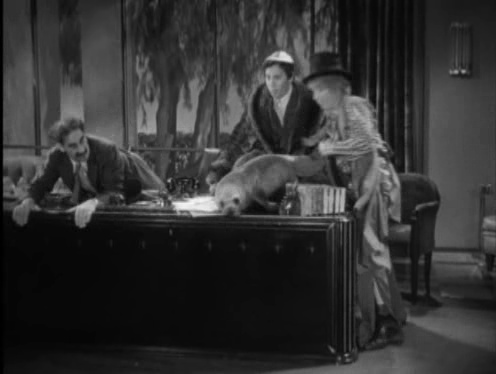
Senator Byrd is gone now, and so is my faith that we can right ourselves in time to avoid driving off a cliff.  What kind of myth fits that?  I’ve been mulling it over for several weeks, and it came to me yesterday, thanks to Turner Classic Movies.  They aired my favorite Marx Brothers film, Horse Feathers, and there it was:  my latest take on the current state of our government:

Do you think there’s a kinder way to depict our current crop of elected “servants?”  If so, please let me know!

Memorial Day, 2011

I had a friend at work who was rather vocal about his support for liberal social issues and his disdain for the political landscape during the Bush administration.  In 2007 or 2008, he spent three weeks in Shanghai on business.  On the last morning he was there, the television showed a stadium full of people who had gathered to witness an execution.  Three young men were shot by a firing squad for first time possession of marijuana; no appeals, no clemency.  My work friend said he wanted to kiss the ground when his plane touched down again on American soil.

Memorial Day always pulls me up short like that.  We have 364 other days each year to debate our past and present military engagements.  This is a day when people’s  thoughts turn to the courage and sacrifice of men and women in uniform who have done their best to defend a culture that gives us trial by jury, a constitution that says the punishment must fit the crime, and countless other benefits it is easy to take for granted until they are threatened.

This is a day when I think of my grandfather, Morgan.  At 17, he lied about his age so he could enlist for the war to end all wars.  To his great disappointment, it was over before he made it “over there.”

I think of my father, Howard, who served as a radar technician in WWII.  His old navy manuals fueled my own interest in ham radio, and ultimately led me down my career path.  As a non-combatant, my father avoided the worst physical and emotional scars, and yet even though he looked so young at 23, he and most of his generation always seemed older than their years.

My father in uniform, ca. 1943

Time paints the conflicts of the past with the sepia tones of memory.  The poppies grow in Flanders field, and the last World War I veteran died on May 5 of this year.  At 14 he lied about his age to join the Royal Navy and then lived to be 110.  This is the stuff of historical novels.  Present realities are never as tidy.  Yet this is a day to be thankful for all those who find the courage to serve, even if for the “wrong” reason – like a friend of mine who enlisted for Viet Nam in an alcoholic blackout.

Not long ago, while walking the dogs one Saturday morning, we passed a military honor guard waiting outside a local church.  I thought of the solemn dignity of the honor guard that folded the flag and handed it to me at my father’s memorial service.  Such rituals are very important.  By whatever means we have, these are things we have to remember.

Bill Moyers Journal: The Conversation Continues

“Democracy cannot survive without disinterested people to speak truth to power.”  –  Bill Moyers on NPR, May 23, 1011

I interrupt my previous thought train (unforgettable stories) to suggest that everyone listen to an unforgettable journalist who I happened to catch on “Talk of the Nation” on NPR yesterday:  http://www.npr.org/2011/05/23/136583949/bill-moyers-shares-favorite-journal-interviews.  This was a compelling conversation with a man of high ideals, who isn’t afraid to speak uncomfortable truths.

We like to think of ourselves as democracy, Moyers said, but the word “oligarchy” better describes our government – rule by a few people of wealth and power, who do things like deregulate banking and finance, which guarantees that events like our recent financial disaster will happen again, since nothing structural has changed.  Few significant differences remain between Republicans and Democrats, Moyers added, and neither party really cares for he interests of working people.  Yet Moyers’ voice was animated and full of joy and hope.  As well as current events, Moyers talked of his love for poetry and the inspiration he and millions of PBS viewers found in his conversations with Joseph Campbell.

This interview celebrated the publication of Moyers collection of 47 interview with “independent thinkers,” taken from his PBS probram, “Bill Moyers Journal,” that ran from 2007-2010.  This isn’t the sort of book I usually read, but Moyers is one of those rare talents, like Ken Burns, who I will listen to no matter where he chooses to go.  I downloaded the book to my kindle, and after listening to the radio interview, you may just do the same.

Election Stories

By “election stories,” I do not mean tales of all the adventures we’ve had on the way to the polls, fighting off pirates and dragons and the like.  Nor do I mean telling young people how good they have it: “When I was your age I had to walk six miles barefoot through snow to vote.” I do not even mean the attack add that shows a local congressional incumbent with a tan and claims he took junkets to Hawaii.  I mean the kind of ideas and national legends or mythologies that can energize large numbers of people for good or ill.

Take “The Domino Theory,” which led a generation of apparently well meaning leaders to conclude that if the communists were not stopped in Viet Nam, they would be knocking on our doors before long.  http://en.wikipedia.org/wiki/Domino_theory

A different story from the same time – that the United States could and should put a man on the moon – led not too indirectly to the technological revolution that has allowed me to earn a living for a quarter of a century and built the remarkable laptop computer I’m typing on now (Intel was founded in 1968, a year before the moon landing).

Strangely enough, it was an interview with a Tea Party spokesman that got me thinking about political stories in the air this election season.  His story was very simple “It’s about fiscal responsibility.  In my household, if debt outgrows income, bankruptcy is sure to follow.  Is it any different for the government?”

I heard Ben Bernanke argue the same week that, yes, the deficits will cause problems eventually if not addressed, but it is too early in the recovery to cut off government spending.  To me, that sounds like a true economic fact, but it doesn’t have the force, the power, the mojo, of a story.  It’s not the kind of thing that is going to hook my imagination the way the effort to balance the family books can do.  It certainly isn’t starting any grassroots movements.

Supposedly, both mainstream political parties are uncomfortable with the Tea Party.  Do mainstream Republicans or Democrats have any coherent stories this election season?  Beyond, “It’s their fault,” I mean.

I honestly cannot think of any at the moment.