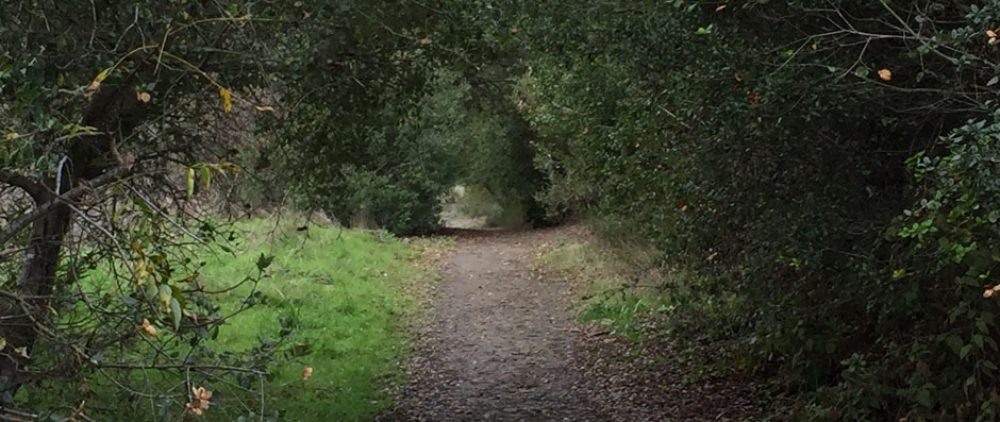

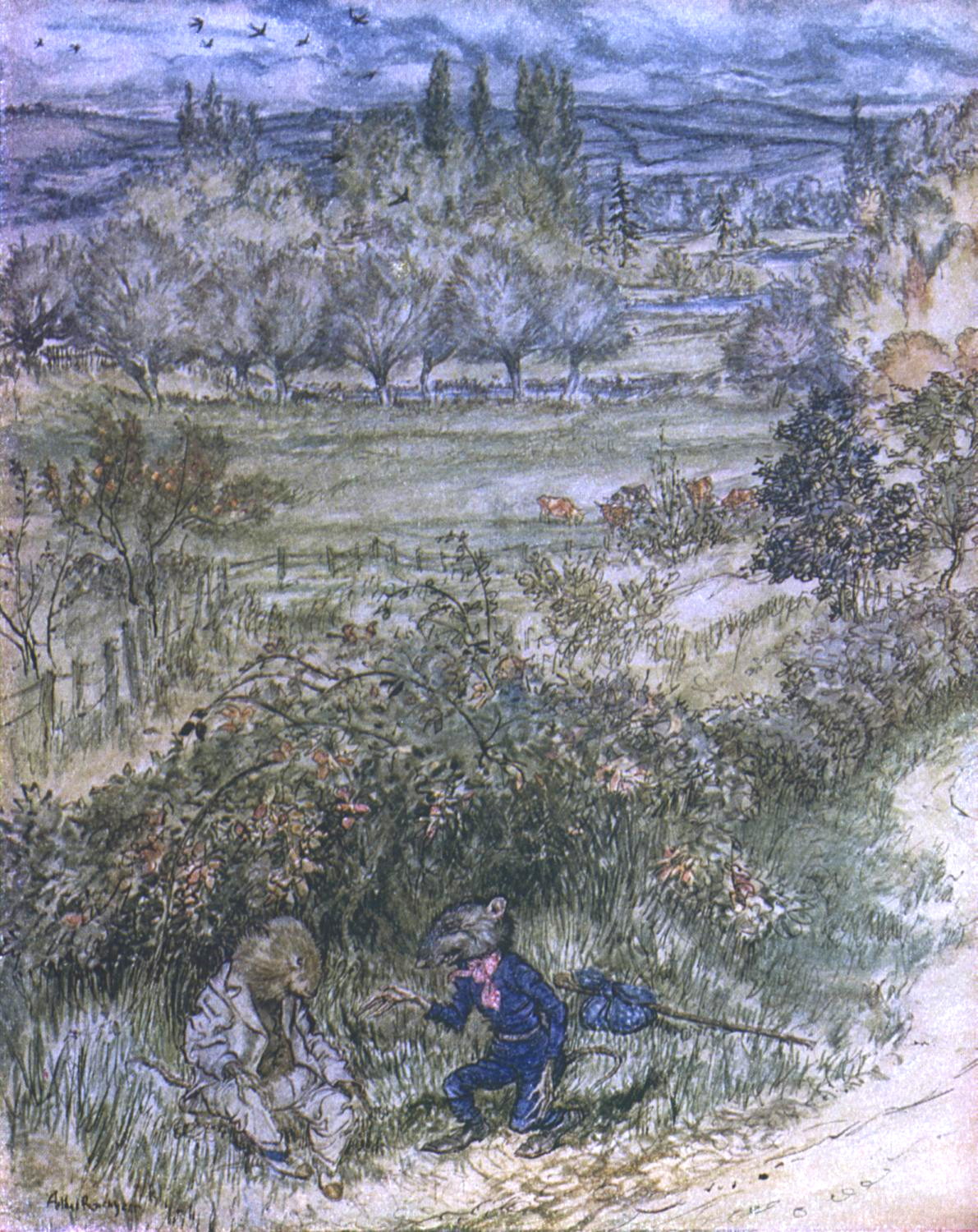
I’ve said before on this blog that “The Wind in the Willows” by Kenneth Grahame was probably the most influential book in my life. My mother read it to me when I was four or five, and that sparked an intense desire in me to learn how to read it myself. The edition she had – and I still have – was illustrated by Arthur Rackham.
The ink drawing above opens the ninth chapter, “Wayfarers All,” which is timely for this season. As summer fades and the leaves turn, the Water Rat becomes restless and goes walking through the countryside. He meets field mice and birds who are packing for their winter quarters. Then he meets a seafaring rat, who has been ashore for six months and is bound for the nearest seaport to find an outbound ship. Ratty is seized with an intense longing to see new horizons.
Longing for new horizons is one of the classic definitions of Pothos, a Greek word I learned from James Hillman. In Greek mythology, Zephyr, the west wind, had three sons: Eros who was love, Himeros, who embodied desire, and Pothos who was longing, regret, want. (1) That definition comes from a website devoted to Alexander the Great, who embodied an insatiable longing for what lay over the horizon.
Of the three sons of Zephyr, I suspect that Pothos, or longing, is our most constant companion. We’re entering the Christmas season, the annual time of feeding our longing with stuff, but most of us know by now that it’s only a temporary fix. In still moments, with the longing for something we cannot quite name, I think of Rilke’s Love Poems to God, whom he addresses as “the great homesickness we could never shake off.”
From that point of view, in the words of the old hymn, we’re all “wayfaring strangers.” Of all the seasons, it is autumn, with its golden but fading light and the stunning leaves that are gone so soon, that seems to embody the yearning for something we cannot quite name.


Yeah, Wind in the Willows.
LikeLike