
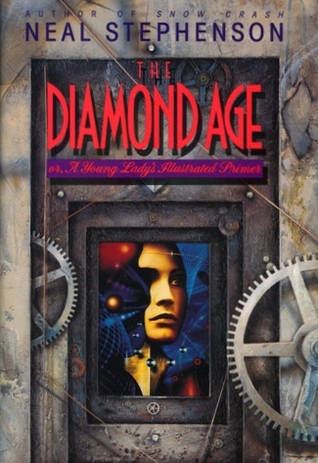
The Diamond Age: Or a Young Lady’s Illustrated Primer by Neal Stephenson

Diamond Age cover

I have written on several occasions of Snow Crash, the visionary science fiction novel that Neal Stephenson published in 1992. The book envisioned a future where nation-states had diminished importance. Most people lived as citizens of corporate enclaves and spent their free time jacked into virtual worlds. Snow Crash was written a year before the release of Mosaic, the first popular internet browser, and eleven years before the inception of Second Life, the best known virtual world.

Stephenson’s next book, The Diamond Age (1995), gives us a world transformed by nanotechnology, the manipulation of matter at the molecular level. In Stephenson’s 21st century, the integration of molecular biology and semiconductor physics has transformed everything. In the first scene, we meet Bud, a would-be enforcer for the lucrative “alternate pharmaceutical” industry, who has bulked up his muscles with intelligent, micro-robotic implants and wears what we now know as Google glasses to precision aim his “skull gun,” an implant as nasty as it sounds. In passing, Stephenson shows Bud in a waiting room, where people read articles on smart paper, essentially tablet computers, that have replaced magazines. Remember: The Diamond Age was published 15 years before the iPad and 17 years before the first Google Glass prototype.

In the diamond age, so named because synthetic diamond is cheaper than glass, objects made by hand are expensive and revered, since everything else is produced by matter compilers (a generation beyond 3d printers)? Just as in Snow Crash, nation states are obsolete. The upper classes live as members of cultural enclaves known as phyles or tribes, whose settlements are often above ground level, while the lower class “thetes” or people without a tribe, live below.

John Perceval Hackworth is a nano tech engineer for the Neo-Victorian, “New Atlantis” tribe. New Atlantis sits on an artificial mountain a mile above the polluted streets of Shanghai.  The clave is ruled as a corporate oligarchy by “Equity Lords” who style their culture after 19th century English royalty.

Hackworth is commissioned by Lord Finkle-McGraw to program an artificially intelligent book, A Young Lady’s Illustrated Primer, a subversive text, which will help his daughter Elizabeth lead a life beyond the boundaries of the status quo. Hackworth makes an illegal copy for his own daughter, Fiona, but this is stolen when Hackworth is mugged. It falls into the hands of Nell, Bud’s daughter, a thete who lives in a ground level slum. Hackworth, Fiona, Nell,her brother Harv, an actress named Miranda, and a Chinese black market engineer named Dr. X are all involved with the Primer for reasons of their own; at its deepest level, the Primer holds the key to decoding and reprogramming humankind’s future.

The Diamond Age, which won Hugo and Locus awards in 1996, is classified by genre wonks as “post-cyberpunk,” whatever that means. As he was in technology and socio-economics, so was Stephenson decades ahead of his time in speculative fiction. We call this kind of book “dystopian” now.  I can think of at least two recent movies that play upon themes explicit in The Diamond Age. I won’t name them because I have no evidence that their creators read the book. Still, it is hard to imagine any serious writer of dystopian fiction who hasn’t marveled at Neal Stephenson’s vision.

How to Fail at Almost Everything and Still Win Big by Scott Adams

How to Fail

“Don’t let reality control your imagination. Let your imagination be the user interface to steer your reality.” – Scott Adams.

How to Fail at Almost Everything is a quirky, funny, irreverent, and often inspiring “sort of autobiography” from the creator of Dilbert, that quirky, funny, irreverent, and often inspiring comic strip that lays out the truth of working in the trenches cubicles of corporate America.

This is not another collection of Dilbert cartoons or Dilbert philosophy.  It’s more of a Dilbert origin story.  We know we’re in for a different kind of kind of how-to-book when Adams begins by advising us to make sure our bullshit detectors are working before we take advice from a cartoonist.

He dismantles many self-help cliches in order to clear the way for fresh perspectives.  “Goals are for losers,” he says, and recommends strategy instead.  “I will finish my first novel,” is a goal. “I will write for an hour a day,” is a strategy.  Every day we don’t attain a goal is slightly depressing, he says, and soon after we reach it, the “what next?” question arises.  A strategy, on the other hand, brings a daily sense of satisfaction as we move in the right direction.

“I tried a lot of different ventures, stayed optimistic, put in the energy, prepared myself by learning as much as I could, and stayed in the game long enough for luck to find me…with Dilbert it did.” – Scott Adams

Adams gives a chronology of his many failed careers and entrepreneurial ventures. Shining through the story is a positive attitude that allowed him to find key lessons and life experience in every failure.  His optimism is gold, and he spends a lot of time writing of health, especially, diet and exercise, although he cautions that there is a “non-zero chance” that health advice from a cartoonist could be fatal.

“I’m here to tell you that the primary culprit in your bad moods is a deficit in one of the big five: flexible schedule, imagination, sleep, diet and exercise.”  The “big five” benefit mood, which builds personal energy, which is the driver of aspiration and effort.

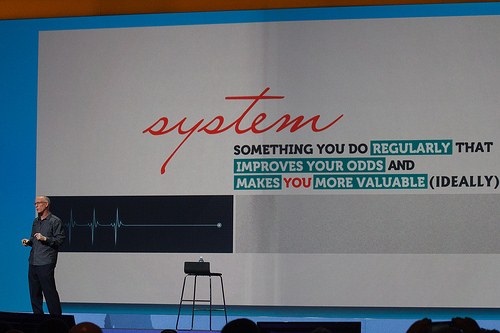
Scott Adams shares his ideas at IBM Connect 2014.  Photo by Greyhawk68, CC BY-NC-ND 2.0

Scott Adams shares his ideas at IBM Connect 2014. Photo by Greyhawk68, CC BY-NC-ND 2.0

Adams packs an abundance of topics into his book. Not every one resonated, and several dragged for me, but much of my copy is highlighted and underlined, and I’ve reread several chapters already.  If you like Dilbert, you will value this story of the life twists and turns of his creator, and you will benefit from the lessons he learned along the way.

A retreat with Edward Espe Brown

Edward Espe Brown

Edward Espe Brown

Saturday was the fourth time in as many years that I’ve attended a daylong retreat with Edward Espe Brown,  Zen abbot, author, cook, and altogether a charming and extremely funny man.  In 1965, Edward became a student of Shunryu Suzuki Roshi, author of Zen Mind, Beginner’s Mind.  When his teacher founded the Tassajara Zen Center near Big Sur, Ed became the head cook (as an author, he is best know for the Tassajara Cookbook and the Tassajara Bread Book).

Much of his learning took place in the kitchen, which gave him several unforgettable teaching stories. He relates his frustration in trying, without success, to produce a “perfect” muffin.  He tried numerous recipes and variations.  Everyone else thought they were great, but he was never satisfied.

One day he managed to taste a muffin without his usual preconceptions and found it delicious.  In that moment, he realized the source of his earlier discomfort – he’d been comparing his muffins to the “perfectly” shaped Pillsbury muffins he’d eaten as a kid.  This discovery led to one of the core ideas he tries to communicate as a teacher: we have the choice of living our lives according to someone else’s recipe or trying to discover our own.  “There is no by-the-book way for you to be you,” he says.

Given this background, it’s no surprise that he started the day by saying, “I’m not going to give you any meditation instructions, because then you might try to follow them – and be looking over your shoulder to ask, ‘How am I doing?”  The simplest instruction in Zen, “Just sit,” is the hardest to practice.  Similar things can be said for writing or painting (“Just write/paint what’s in your heart”) – and many other areas of life as well.

Such instructions (or lack thereof) assume the student knows the basics and some has experience.   This was true for the group that gathered on saturday.  It allows a generous teacher like Edward Brown to invite the student to seek what lies beyond a lifetime of learning how they are supposed to be.

Ed once said, “What is precious in us doesn’t come and it doesn’t go.  It is not dependent on performance.”  That’s a nice sounding aphorism, the kind of thing I jot down in notebooks.  Saturday’s retreat was a chance to test the waters, and as I hope I’ve made clear, at its best, Zen is about everything in our lives. I’d heard that Ed had written a new book, and it proved to be a fine example of finding our own way.

He has several traditional books in print on Zen and cooking, and he also edited a collection of Suzuki Roshi’s teachings.  When I’d read the title of his new book, By all Means A Zen Cautionary Tale, I assumed I’d be in for traditional reading.  Instead, I was surprised and delighted to find he’d written a semi-fictional, semi-autobiographical story of his adventures a little pig hand puppet.

When I asked him to sign a copy, I said, “This is great.  For my first 10 years, I had hand puppets.  They were my closest friends and confidents.”

“Ah, then you know,” he said.  “They’re powerful, aren’t they?”

In my next post, I’ll review By all Means, and after that, maybe the topic of conversing with inanimate things.  Please stay tuned!

——————————————————————————————–

PS:  When I posted this, I forgot to add a link to Edward’s home page, Peaceful Sea Sangha. In particular, I recommend the recordings of his talks, which give the flavor of his teaching style, his concerns, and his humor.

Dr Seuss to the rescue

A few days after his birthday 110 years ago, here’s a wonderful list of wise aphorisms by Dr. Seuss, courtesy of Rachael at Street of Dreams

beautiful loser's avatarStreet of Dreams

In honor of Dr. Seuss’s birthday, I’ve come across a fun little collection of life sayings (from his books) to live by.

I know I’ve posted similar things in the past, but everytime, I come across one of his books or a collection of his work, I am amazed at how insightful he was. And I am amazed at how complicated adults must make things.

Note: sorry this is a few days late. I thought I published this piece but apparently word press had other plans.

Dr Seuss to the rescue

View original post

Anatomy of the Deep State by Mike Lofgren

Be warned, this post has disturbing content.  If it was a movie, I’d rate it “R,” not because of sex or violence, but because it concerns a penetrating essay on the current state of the US government.  Change the channel now if you’re squeamish.

If you’re still here, good, because disturbing or not, I think everyone ought to read Anatomy of the Deep State, by Mike Lofgren, a former GOP Congressional aide who retired after 28 years as a staff member for Congress and the Senate.  This article is a distillation of ideas he explored in his recent book, The Party is Over: How Republicans Went Crazy, Democrats Became Useless, and the Middle Class Got Shafted.

party is over

Lofgren says what many of us have long suspected, that our visible political landscape is merely the tip of a much bigger iceberg – that our various issues, debates, and elections often have little to do with the real trajectory of power in this country.  Much of this “real” trajectory is hidden in plain sight.  With almost three decades inside the belly of the beast, Lofgren can show us where to look.

He cites many examples.  During the political circus surrounding the 2011 debt ceiling “crisis,” our leaders had no problem finding money to topple Gaddafi.  A few months later, during the government “shutdown”, while debates raged over canceling meat inspections and air traffic control, we gave $112 million to Syrian rebels, to keep that conflict going.  And since 2007, as our bridges collapse, schools fail, and cities go bankrupt, we’ve spent $1.7 billion on an NSA building in Utah the size of 17 football fields.  Its purpose is to house a yottabyte of data.  A yottabyte, the largest number computer scientists have so far coined, equals 500 quintillion pages of text.  “They need that much storage to archive every single trace of your electronic life,” Lofgren says.

The best news, according to Lofgren, is that what he calls the Deep State is far from invincible.  He notes how sufficient ineptitude draws pushback even from allies, citing our two failed wars and the Snowdon revelations among other things.  Past elites have often reacted to challenges in one of two ways.

Some have tried to “stay the course,” and Lofgren observes that,“The dusty road of empire is strewn with the bones of former great powers that exhausted themselves in like manner.”  Others have followed reformers, as diverse as Franklin D. Roosevelt, Charles de Gaulle, and Deng Xiaoping.  What each of these men developed in common was a deep understanding that their cultural stories and myths were ossified and that survival depended upon renewing both vision and action.

Mike Lofgren, a self-described “former proud Republican” now says, “there is…a deep but as yet inchoate hunger for change. What America lacks is a figure with the serene self-confidence to tell us that the twin idols of national security and corporate power are outworn dogmas that have nothing more to offer us. Thus disenthralled, the people themselves will unravel the Deep State with surprising speed.”

The first step in dealing with any problem is understanding its nature.  In this time of deliberate political and economic obfuscation, I highly recommend Anatomy of the Deep State as one of the best and most succinct diagnoses I’ve yet seen of what ails us.

‘On the Supposed Unsuitability of Fairytales for Children” Guest Post by J. Aleksandr Wootton

This is, in essence, a double reblog, in which you will meet two interesting writers in the field of folklore. The first is Benton Dickieson of Prince Edward Island, Canada, who blogs at A Pilgrim in Narnia. The second is the author he presents, J. Aleksandr Wootton, self described “Author, Folklorist, Poet, Book-Worm, Faerie Historian, Cultural Critic, and Virginian.”

Writing on the “Supposed Unsuitability of Fairtales for Children,” Wootton has much to say including a fine summary of a subject I’ve circled about on several occasions, attributes of successful fairytale heroes and heroines:

“The world is fraught with danger, including life-threatening danger, but by being clever (always), honest (as a rule, but with common-sense exceptions), courteous (especially to the elderly, no matter their apparent social station), and kind (to anyone who has obvious need), even a child can succeed where those who seem more qualified have failed.”

Enjoy the websites of both of these folklore enthusiasts.

Brenton Dickieson's avatarA Pilgrim in Narnia

J. Aleksandr Wootton chairs the fictional Folklore Studies department at Lightfoot College, where his research focuses on post-war Faerie. He has authored Her Unwelcome Inheritance, an account of fairy refugees on earth, and has recently published a poetry collection titled Forgetting: Impressions from the Millennial Borderland

For more on his writing, or to contact him, visit www.jackwootton.com.

“On the Supposed Unsuitability of Fairytales for Children”

J. Aleksandr Wootton

Shortly after supporting a local library event promoting fairytale literature, the folklore department at Lightfoot College received an animated communication from a very concerned mother regarding, in short, the “unsuitability of fairytales for children.”As this seems to be a rather widespread idea (I might mention the Daily Telegraph article of February 12, 2012) as well as an oddly long-lived one, I take the liberty of public response.Dear Madame,

Though you may be unaware of it, your email represents sentiments that have…

View original post 1,656 more words

An ambassador for the power of stories

Author Kate DiCamillo says "Story is what makes us human."

Author Kate DiCamillo says “Story is what makes us human.”

I almost skipped the final segment of the PBS Newshour on Friday.  They announced an interview with the newly chosen National Ambassador for Young People’s Literature, a position I’d never heard of.  I feared it might involve a discussion of post-Twilight, YA romance.  Fortunately, I stuck around, for the interview was profoundly inspiring.

The new National Ambassador, a position created by the Library of Congress in 2008, is Kate DiCamillo, author of Because of Winn-Dixie and The Tale of Despereaux.  The author of these award winning books for children claims to have been the shyest kid ever.  How did she come out of her shell and become an ambassador?  By telling stories, she says.  “And telling stories helped me connect with the world. And it turned me into somebody who can talk to people, I think.”

This Newberry Award winning author calls herself a late bloomer and kept a notebook where she tracked all 450 rejection letters she got before her first story was accepted.  Over the next two years, as ambassador for children’s literature, she hopes to “remind people of the great and profound joy that can be found in stories, and that stories can connect us to each other, and that reading together changes everybody involved.”

I invite everyone to watch Ms. DiCamillo’s interview.  It’s an upbeat testament to the power of stories and the power of persistence by someone whose life embodies these truths.

10 of the Greatest Essays on Writing Ever Written

I was delighted to find this post on WordPress’s “Freshly Pressed” page where it deserves to be. Here’s a collection of essays on writing, more than half by writers whose names are household words (in literary households) – Robert Frost, Henry Miller, Susan Sontag, T.S. Eliot, Kurt Vonnegut, and Joan Didion among them. They all look compelling. I’m looking forward to starting a piece on structure in fairy tales by the editor of “The Fairy Tale Review.” Enjoy!