Music (?) of the Season

Caution: entering Grinch zone.

Silence makes a lot of people uncomfortable, so in stores, you often hear music intended to be soft and inoffensive.  Most of the time, it’s pretty innocuous.  Now and then the muzak version of “Light My Fire” will force me to confront the passage of time, but that isn’t really a bad thing.

So why do stores at this time of year feel compelled to play the musical equivalent of leaf blowers on a Saturday morning?  I’m talking about all the denatured “Christmas” songs, the fluff ones, the ones designed not to offend, which wind up offending everybody because they are so insipid.  Do you like hearing, “Jingle Bell Rock?”  Or “Rocking around the Christmas Tree?”  If so, post a comment.  I probably won’t believe you and will assume you’re pulling my chain, but comment anyway.  Pa rum pum pum pum.

Today I ventured out to several stores, and I’ll share some of my findings.  My current working hypothesis is that stupid music confuses our brains and makes us less rational shoppers.  Let’s see how the data holds up.

First stop was JC Penny’s.  I like Penny’s, and they also shot up in my esteem for opting out of the Black Friday midnight madness.  I was hunting for a specific gift.  When I didn’t find it, I thought about browsing, but just then, “Holly Jolly Christmas,” came over the sound system.  I hurried for the exit.

Next I went to a Best Buy.  I went to look at DVD players and noticed there was no music at all – I could actually hear myself think!   In the end, I wasn’t sure which model to get, so I decided to think it over and come back later.  As I was leaving the store, after that moment of clarity, I began to wonder if that is not the point of obnoxious holiday music – to befuddle our minds and rob us of clarity?  What happens to your brain when you hear “Little St. Nick?”  All I can think is, “Make it stop,”  and I’m ready to throw down a credit card if that will do the trick!

Next stop was OSH, for a string of tree lights. No Christmas songs, for which they get kudos, but their music was equally strange – the worst of old time rock, with songs like, “Sugar Shack,” and “These Boots are Made for Walking?” I did as the lyric suggested and walked right out of there.  The strange thing is, I go to OSH throughout the year for minor hardware needs, and they never play music like that.  What possessed them to do it now?

That question launched my backup theory of holiday music – mass possession of store managers by evil entities.  Perhaps I should save that one for another occasion…

By then it was time for lunch, so I stopped at Fresh Choice, one of those make-your-own-salad restaurants.  I like eating there, but never again at this time of year!  The music was one part Dean Martin – Christmas songs you could tap dance to – and one part “The Little Drummer Boy,” which played twice while I was there.  Twice!!!  I am not making this up!

After I bolted my food and hurried out of the restaurant, I remembered the New Age adage that we attract to ourselves what we dwell upon. I did my best to clear my mind before my final stop of the day, at Beverly’s, a crafts store.

However you want to explain it, something worked.  Not only did I find exactly the gift I was looking for, but the music was nice instrumental Christmas songs.  I caught the sound of a harpsichord as I stood in the check out line, and I made a point of telling the clerk how much I enjoyed their civilized music.

So here are a few more Grinchly survival tips for the season, not necessarily in order of importance:

1)  Humor is everything.  Actually, this is number one in importance.

2)  If someone is doing something right, let them know.

3)  Earbuds are not a bad idea.  You may look silly if you’re not a teen, but I’m going to carry them next time.

I’ll be back with more tips as the season drags on, but meanwhile,  Be careful out there!

An Interlude with Mutant Chickens

The other day, I took a break from literary activities to meet a friend in Fair Oaks Village for coffee.  Once upon a time, Fair Oaks was a farming community, separated by miles of fields and orchards from Sacramento.  Those days are gone, but there’s still something inviting about the town.  It’s slower than the boulevards and mini-malls that surround it, but not yet gentrified.  That may have something to do with the chickens, but I will get to that.

Fair Oaks Coffee Shop and Deli

So my friend were I are sitting at a table outside, having coffee and waxing eloquent on matters of great import, when I spotted a mutant chicken pecking at the pretzel I’d dropped on the sidewalk.  If you really pay attention, even normal chickens are sort of scary; you can understand the theory that they descend from dinosaurs.  Watch them run around, and you think of mini-velociraptors.  Yet chickens are the official Fair Oaks bird.  Herds of them run loose in town, and they are even featured on the town sign.

Once, when our dog, Holly, was younger, she jerked her leash out of my hand and took off after a chicken. By the time I caught her, thinking I was about to burst a lung, an irate citizen informed me that chickens are protected.  I believe I said something along the lines of, “Come on, Holly, we’ll hunt for dinner elsewhere.”

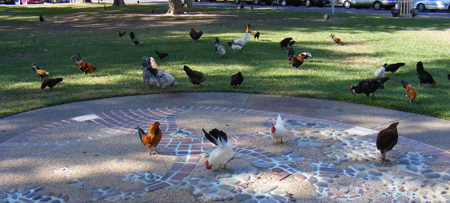
Fair Oaks is famous for chickens, and I have it on good authority that people throughout the region come here to dump their excess fowl.  What you have is a group of birds that interbreed, and every now and then you see a really demented one, who could play in a monster movie.  Such was the one who pecked at my feet the other day.  It had some kind of growth, like the extra head on the alien in Men In Black II.  I was so busy thinking of tetanus shots and keeping my feet out of its way, that I forgot the camera phone in my pocket and didn’t document the monster.   Today I went back with a real camera, and naturally all the chickens looked normal – or as normal as chickens can look.

Here’s the Fair Oaks chicken ideal:

Mural on the Fair Oaks, open air theater

And here’s the reality – chickens invading the public men’s room:

Employees must wash their hands before returning to work

The ideal – an idyllic shot in the town square

Don’t be fooled! Think of Alfred Hitchcock.

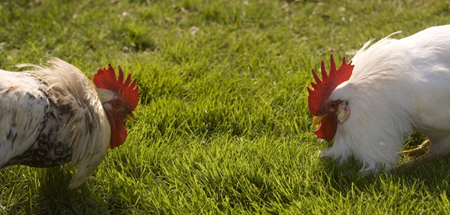
The real – high noon in roosterville.

Go ahead – make my day.

And finally, here is the biggest Ideal Chicken of all – at the 2010, Fair Oaks Chicken Festival:

Has everyone had a chance to go, “Awwww?”  If you can make it, this year’s Chicken Festival will be held on September 17.  Feel free to bring the munchkins, but be ready to change the subject if they ask, “What’s for lunch?”  Last year, the featured item was barbecued chicken.  (I’m serious).

Have fun if you go.  I would never dream of saying anything on my blog about eating Big Bird, but I will be home that day eating tofu.  Probably with the shades drawn too, in case the mutant chicken knows where I live.

The Government and the Marx Brothers

Where's the Seal?

Back in college, one of my professors gave me an idea I’ve never forgotten.  He spoke of myths that shape and inspire our national consciousness, and how they always relate to a past that is not only gone but may not even have happened.  It must have been back in the 70’s, because he referenced the gun-in-the-rack, survivalist twist on the rugged individualism that Bonanza brought into our living rooms once a week.

The Cartwright boys get the job done

I’ve been thinking of myths of politics lately for one simple reason.  In following the current debate in Washington on the debt ceiling, I’ve come to a conclusion I have never reached before, through good times or bad – until now.  Quite simply, I think we are fucked.

Perhaps not over this particular crisis, for I don’t think any politician who wants to get re-elected – all of them, in other words – wants to get stuck with the blame for a national default.  But I think this “debate” reveals how utterly disfunctional our system has become.  Handwringing over the gummint has probably always been a national pastime – I finally believe it is justified.  Still, I prefer laughter and even creative thinking to handwringing, so I have been mulling over what myths I believed about about our leaders in the past, and what might be a better fit now.

Back in the days when my favorite TV show was “Leave it to Beaver,” I watched  Mr. Smith Goes to Washington with my parents: a rugged individualist from Montana takes on the system, and proves that right and integrity still can prevail.

Jimmie Stewart fights the good fight

Soon after I saw Mr. Smith, for a few brief years, we had Kennedy’s Camelot:  “Ask not what your country can do for you; ask what you can do for your country.”   Fast forward six years and there was Kent State and with Crosby, Stills, and Nash singing, “Soldiers are gunning us down.”  It’s been a roller coaster ride since then with ups and downs, times of malaise and times of letting the good times roll, but all along, at least for me, there was the faith that we can make things better.  Our system may be flawed but it works.  There was always someone to believe in, someone like Senator Robert Byrd, a real-life Jimmie Stewart who carried a copy of the Constitution in his pocket.

Sen. Robert Byrd, one of my heroes

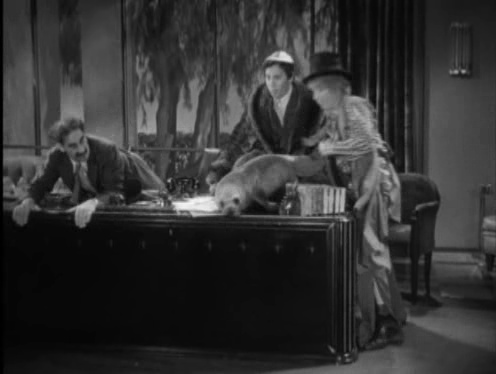
Senator Byrd is gone now, and so is my faith that we can right ourselves in time to avoid driving off a cliff.  What kind of myth fits that?  I’ve been mulling it over for several weeks, and it came to me yesterday, thanks to Turner Classic Movies.  They aired my favorite Marx Brothers film, Horse Feathers, and there it was:  my latest take on the current state of our government:

Do you think there’s a kinder way to depict our current crop of elected “servants?”  If so, please let me know!

My 100th Post

Trying to find something appropriate to say on the occasion of a fairly incredible milestone like this is about as hopeless as trying to really comprehend one of those big birthdays, like turning 30 or 50.  Experientially, it feels pretty much like the day before, just as this feels pretty much like post 99 or post 17 for that matter.

What I can very truthfully say is how much I appreciate all my readers, all the comments I have received, and all the links I have followed to find kindred spirits sharing their own ideas.  There is no longer any doubt that community can exist in cyberspace.  Earlier this morning, in regard to something else, Mary reminded me of a detail from Peter S. Beagle’s, The Last Unicorn: unicorns don’t have to be in each other’s immediate company – as long as they know there are other unicorns in the world, they do not feel lonely.  Thanks to all of you.

***

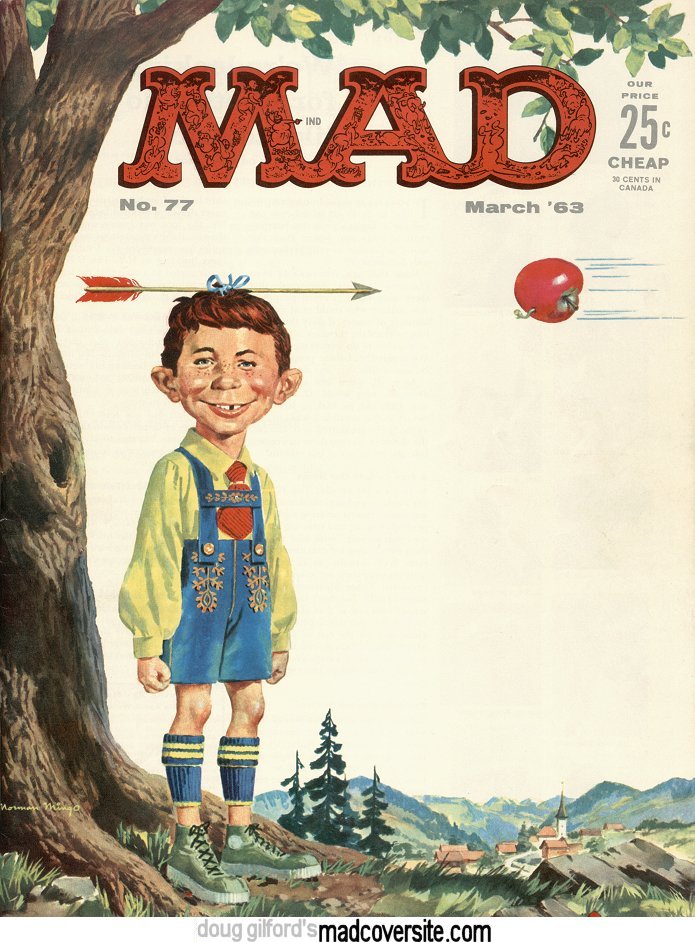
I started this post the way I started many others:  with an idea and the hope that it leads somewhere.  Very appropriately, I think, for such a significant milestone, the idea led me to Alfred E. Neuman.

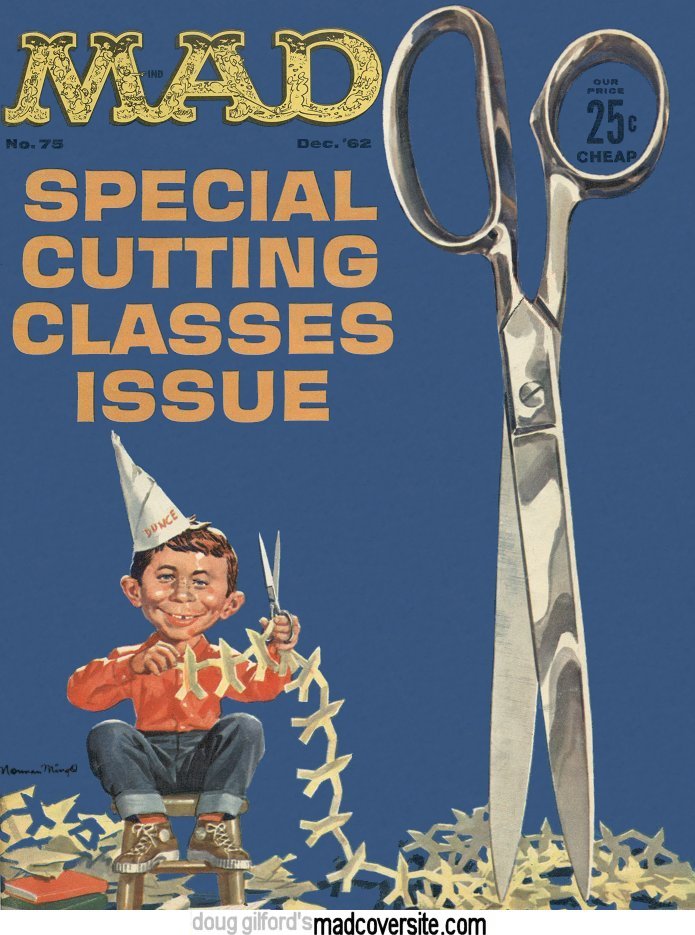
This is because Jen left a comment on my “Deja Vue All Over Again” post, regarding the school bomb drills.  “I couldn’t imagine how afraid they all must have been,” she said.  That triggered several vivid memories of photos and caricatures in Mad Magazine.  Mad parodied Kennedy and Kruschev.  The editors didn’t shy away from pictures of mushroom clouds.  In a way, they taught us the same technique that Harry Potter and his friends learned when faced with a boggart, those magical creatures that take the shape of your greatest fear.  When faced with a boggart, you have to look it in the eye and say the magic word, “Riddikulus!”

Mad taught members of my generation to say “Riddiculus” to much more than just the cold war.  Nothing was out of reach of the parodies.  Mad took special aim at Madison Avenue, popular culture, politics, education – in fact most all the artifacts of the “normal” world of adults.  Appropriately, I learned about beatniks from Mad. I seem to remember a picture of William Gaines, the founder, sporting a goatee.

One day my mother caught me coming home with a copy of Mad.  “Let me see that!” she said.  She snatched it out of my hand and flipped through it, thinking, I guess, that it was some new kind of Playboy. She chuckled once or twice and handed the magazine back.  “I guess this is all right,” she said.  Yes and no.  In many ways, Mad was far more more subversive for a grade school kid than Playboy could every have been.

More than once over the years, I have seen articles on Mad Magazine’s influence on the ’60’s counterculture, for it taught a whole generation to laugh at the world they were going to inherit.  Few sacred cows escaped Mad’s satire.  I assumed there would be lots of dissertations on that subject by now, but when I did I a search, I could not find any.  What I did find – and this would have made Gaines laugh out loud – was a term paper on Mad for sale, that had its basic facts wrong in the synopsis.

Mad has, however, made a significant contribution to the field of computer science through the work of Donald Knuth, Professor Emeritus of Computer Programming at Stanford.  Knuth is:

Author of the seminal multi-volume work The Art of Computer Programming, [and] has been called the “father” of the analysis of algorithms, contributing to the development of, and systematizing formal mathematical techniques for, the rigorous analysis of the computational complexity of algorithms. http://en.wikipedia.org/wiki/Donald_Knuth

Knuth’s first scientific article, “The Potrzebie System of Weights and Measures,” was published in a school magazine in 1957.  In it, he defined the basic unit of length as the thickness of Mad issue #26, and named the fundamental unit of force, the “whatmeworry.”  Mad bought the article and published it in issue #33, in June, 1957.

Remember that fun PBS show called, “Connections?”  The host, James Burke, loved to show how events, separated by centuries and thousands of miles, influenced each other.  So here, for this weighty and significant 100th post, is a brand new connection!   Think of it:  the influence of Mad Magazine on the man who taught us to analyze the sort of programming algorithms that make blogging possible.  Now if that’s not a happy thought, I don’t know what is!

Euphemania by Ralph Keyes

Show of hands: how many know why the British used to refer to bedbugs as Norfolk-Howards? Just as I thought. Or why a one-o’clock meant a fart in Australia? You can find out in: Euphemania: Our Love Affair With Euphemisms, by Ralph Keyes.

Answers:

  • In Victorian England, “bug” was a vulgar word, so a certain Mr. Joshua Bug changed his name to Norfolk-Howard. It didn’t quite work out as he expected.
  • Until World War II, a cannon was fired every day at 1:00pm from Fort Denison, in Sidney Harbor.

According to Keyes, such “situational euphemisms” are relatively short lived, though he notes that some persist for a while:  everyone who watched Super Bowl XXXVIII understands, wardrobe malfunction.

Other euphemisms are much more persistent, none more so than the words we use to avoid mentioning death:  passing away, kicking the bucket, buying the farm, and pushing up daisies (or as the French say, eating dandelions by the root).  Not all of these euphemisms are funny.  Keyes notes that in the military, an event is usually an occasion where someone died, often by friendly fire.  Unlike our more agrarian ancestors who slaughtered animals, we process or harvest them.

Sexual euphemisms are explored too.  Doing one’s duty originated in Rome, in reference to the responsibility of freed slaves to continue to have sex with their former masters.  Hiking the Appalachian Trail came to mean “having an affair,” thanks to a certain philandering governor.  Think of England, y’all!

Those who enjoy pondering words and their meanings will enjoy this article and interview with Keyes on NPR: http://www.npr.org/2010/12/14/132056878/-euphemania-our-passion-for-not-saying-it

RIP – Leslie Nielsen

Part of my holiday weekend was a self-imposed media blackout; often enough, it’s refreshing not to know what is going on, and so it was only this morning that I learned that Leslie Nielsen is gone.

http://www.npr.org/blogs/monkeysee/2010/11/29/131661180/remembering-leslie-nielsen-a-master-of-the-art-of-not-being-funny

There are precious few movies that stay fresh after three or four viewings, and almost any of his silly flicks will have me in stitches though I have seen them numerous times. Laughter and good humor – what a gift in this world!

http://www.youtube.com/watch?v=dTHsNVXXlus

So long, Shirley!

New help for coulrophobics

According to an NPR report, coulrophobia, the fear of clowns, is the third most common phobia in Britain, right behind the fear of spiders and needles. Our cousins across the water fear clowns more than they do flying in airplanes. Coulrophobia on NPR

Now there is new hope for sufferers thanks to the dedicated clownselors of the John Lawson circus, who offer pre-show therapy. Paul Carpenter, aka, Popol the Clown, explains how clown therapy works:

...we invite them to the big top during the day when it’s quiet and they meet me and our other clown, but they meet us in our normal, everyday guises, not in makeup or anything. And then we take them into the circus ring, and they watch us as we slowly transform ourselves into our clown personalities.

Popul (Paul Carpenter), right, and his friend, Kakehole

We put on our makeup very slowly, and then we put on our costumes. And if that goes well and they haven’t run for the door, we then try and get them interacting with us in the circus ring. We go through a few clown routines, getting them involved. And if that goes well, our ultimate aim is to get the person themselves dressed up in costume and makeup, and then we help them find their own inner clown..they come into the circus being scared, and then they end up leaving as a clown themselves.

Hmm…I’m not sure ’bout that. Finding my inner clown sounds pretty good, but why do I keep thinking of Stephen King and Chuckie?

I knew a real clown who was truly funny. I met Amelia Mullen, aka, Pansy Potts the Clown, at the Sacramento Storyteller’s Guild. There seem to be two general ways of telling a story to a crowd, either in “quiet” way of a storyteller around the campfire, or in the dynamic way of an actor on a stage, the way vaudeville must have been. My way is very much the former, while Amelia worked the crowd, strutting across the stage with gestures and wild voices. No one fell asleep when she was telling a story.

I later realized she developed this style of storytelling as a way of keeping the attention of rowdy four year olds while entertaining at birthday parties – now there is something to give you a phobia!