Dark Shadows – A Movie Review

I expected to like this movie. I wanted to like this movie.  At the theater, I tried to like this movie, but I couldn’t pull it off.

Dark Shadows was a gothic soap opera that ran from 1966 – 1971.  As a child, Johnny Depp wanted to be Barnabas Collins, a 200 year old vampire.  He got his wish, but sadly, not even a cast with Depp, Michelle Pfieffer, Helena Bonham Carter, Christopher Lee, and Alice Cooper can save a movie that doesn’t know what it wants to be.

Comedy blends well with horror – think of Young Frankenstein or Ghostbusters – but Dark Shadows blows it at several crucial points.  In one scene, the vampire seeks out a group of wide-eyed hippies.  He asks them about love and romance and then slaughters them – after we get to like them.  That’s a bush-league scripting error!  A screenplay can kill people we care for, but it cannot do so and hope to remain funny.  The rest of the comic riffs fall flat after this.

I bonded more with the hippies than with the characters I was supposed to care about.  The brave orphan, the confused adolescent girl, and the etherial love interest remain distant and two dimensional.  Barnabas never charms in the manner of Captain Jack Sparrow.

The love scene between Barnabas and the witch attempts to be wild and kinky but doesn’t get beyond the special effects.  The final battle is won by a ghostly deus-ex-machina.  The vampire wiggles his fingers, signifying hypnosis, and a mob of cops and townspeople do his bidding.  The plot is full of holes and unanswered questions.

We were in the mood for a gothic movie, and now I wish we had chosen The Raven.  Dark Shadows ends with a lead-in to a sequel which I do not intend to see.  Save your money on this one.

Somewhere Over the Rainbow

I happened upon this theme while geeking around with an iPhone app.  While looking for a way to create custom ringtones, I found, “Ringtone Converter” on iTunes.  This is a free app, designed to make 30 second ringtones from any song in your iTunes library.  Some of the songs don’t load, though most of them do, and I roamed through my library, auditioning songs as potential ring tones until I came to a clear winner – Israel Kamakawiwo’ole’s version of “Somewhere Over the Rainbow.”

As I listened to IZ’s voice, I looked up the song on Google.  It was written by Harold Arlen and E.Y. Harburg in 1939, for The Wizard of Oz, and almost cut from the movie by MGM CEO Louis Mayer who said it slowed down the action.  “Somewhere Over the Rainbow” went on to win the Academy Award and become one of the most covered songs of all time.  It’s number one on a list of “Songs of the Century “compiled by the National Endowment for the Arts.  In a letter to Howard Arlen, Judy Garland said,

“‘Over the Rainbow’ has become part of my life. It’s so symbolic of everybody’s dreams and wishes that I’m sure that’s why some people get tears in their eyes when they hear it. I’ve sung it thousands of times and it’s still the song that’s closest to my heart.”

The voice of Israel Kamakawiwo’ole speaks for itself.  It’s a good time of year to listen to this man who brought so much beauty into the world – his birthday was May 20.  When he died in 1997, Hawaii state flags were flown at half-mast, and his body lay in state in the capitol rotunda.  He was only the third person given this honor.  This video commemorates Israel’s voice and legacy, and records the thousands who came out to celebrate his life on July 12, 1997, as his ashes were given to the ocean and his spirit journeyed over the rainbow.

The Muppets Get Their Star

On March 20, the first day of spring, The Muppets received the 2466th star on Hollywood’s Walk of Fame.  The cast, which has charmed TV and movie viewers for 50 years, now joins a select group of “fictional” stars, which includes Mickey Mouse, Godzilla, Shrek, and The Simpsons.  Miss Piggy pointed out during the news conference, however, that all movie stars are fictional.

Photo by Frazer Harrison / Getty Images

Lisa Henson, CEO of Jim Henson Enterprises remarked that The Muppet’s star, in front of the El Capitan Theater, is very close to her father’s.  Henson created Muppet prototypes in 1955, for a show called Sam and Friends, which ran for six years on WRC-TV in Washington, DC.

Jim and Jane Henson with the cast of "Sam and Friends"

Henson died in 1990, at the age of 53, of complications from a severe strep throat infection.  Associates and family say he was so busy working, he didn’t seek medical help until it was too late.

During the last year of his life, Henson negotiated to sell the Muppets to Disney. The sale was finalized in 2004. The latest Muppet movie was released to DVD yesterday too, a seemingly successful effort to revitalize the cast and introduce Walter, a new character, who was present at the dedication ceremony.

Kermit received his own Walk of Fame star in 2002, but Henson’s little frog would be the first to say The Muppets are a group effort. The group finally has the recognition it deserves.

Life: The Movie by Neal Gabler – A Book Review

In his final movie, Being There, 1979, Peter Sellers plays Chance, a gardener with a low IQ, who becomes an advisor to the president and business tycoons. In one iconic scene, Chance is accosted by a knife wielding youth in Washington, DC.  He pulls out his TV remote control and clicks it to change the channel.  He is puzzled when the assailant doesn’t vanish.

Peter Sellers as Chance in “Being There”

This might be the perfect illustration for Neal Gabler’s, Life, The Movie:  How Entertainment Conquered Reality, (2000).  Gabler quotes historian, Daniel Boorstin, who wrote in the early 60’s that, “We risk being the first people in history to have been able to make their illusions so vivid, so persuasive, so ‘realistic’ that they can live in them.”  Done deal, according to Gabler, who calls us, not just a “post-modern culture,” but a “post-reality culture.”

At times I had to keep my own assumptions in check:  subjects like reality and imagination open onto psychological and spiritual vistas beyond the scope of this or any other single book.  But when Gabler cited concrete examples, I found myself nodding my head on almost every page.

“You know how to brood because you have seen Rebel Without a Cause,” Gabler says, quoting cultural analyst, Louis Menand.  “What better model does the world offer?”

Gabler charts the ascendency of entertainment in America from the early 19th century, where the split between high and low culture was fueled by our democratic suspicion of all elites.  Calling someone “aristocratic” was a serious insult.  During the 1840 presidential campaign, when a man called Daniel Webster an aristocrat, he thundered back that he’d grown up in a log cabin, and anyone calling him an aristocrat was “a coward and a liar.”  ( Sound familiar? )

Nathaniel Hawthorn despaired of the fate of serious writers amid the flood of “trash” being published.  One publisher sold four million dime novels in five years, at a time when the US population was only 25 million.

In 1850, 1% of the population owned 50% of the nation’s wealth and held almost all public offices.  Upward mobility was a myth, since 98% of that wealth had been inherited.  While the one-percent held the power, then as now, culture wars raged, sometimes with a violence that we (thankfully) haven’t seen yet.  One night in New York, rival Shakespearean actors, one British and one American, were both scheduled to perform, the former in an uptown theater, the latter downtown.  Police ejected the rabble who had bought tickets solely to heckle the British actor.  A much larger crowd gathered across the street to throw rocks as the “aristocratic” crowd tried to leave.  The militia was called, a riot ensued, and before the night was over, 22 lay dead and more than a hundred wounded.

In the end, it was movies that won the day for popular culture.  The 1% stayed away from the early nickelodeons, which tended to be crowded and crass.  Later, with middle-class patronage, refined behavior became the norm, but the elite have never fared well in the movies, from the Marx Brothers  Night at the Opera, to the present, where a too-expensive suit is always the mark of a villain.
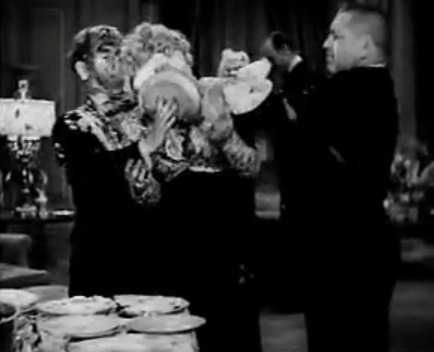
Three Stooges + high society + pies = disaster

As he charts the history of high vs. popular culture, Gabler makes a telling point.  It isn’t just about high brow and low brow – it’s about the ascendency of entertainment.  Being entertained is easy, and the corollary is that when the goal is entertainment, grabbing and holding audience attention is the supreme value, and “things that do not conform – for example, serious literature, serious political debate, serious ideas, serious anything – are more likely to be compromised or marginalized than ever before.”

Life: the Movie is a complex and disturbing book.  Gabler says in the introduction, it is diagnostic and not prescriptive.  To offer easy answers, he says, would be like the movie illusion where we meet the monster in act one and see it vanquished in act three.  Writing 12 years ago, Gabler said:

“One is almost compelled to admit that turning life into escapist entertainment is a perversely ingenious adaptation to the turbulence and tumult of modern existence.  Why worry about the seemingly intractable problems of society when you can simply declare ‘It’s morning in America,” as President Reagan did in his 1984 reelection campaign, and have yourself a long-running Frank Capra movie right down to the aw-shucks hero?”

I read this book after watching Neal Gabler speak on the fictions that lace the current election campaign on Moyers & Company, as I described in the preceding post. Because of it’s scope, I would recommend Life: the Movie only to those who want to delve into this issue in some depth.

But  I would recommend that everyone watch the ongoing conversation this year between Gabler and Moyers.  The confusions and illusions surrounding the political process are more convoluted than when the book was written, but Neal Gabler remains a reliable guide to pulling back the curtains and helping us draw closer to the truth.

Politicians as Would-Be Movie Stars

James Hillman died last fall at the age of 86.  Even though I only met him twice at lectures, I’ve read his books for decades, and he is one of only a few people who deeply shaped and changed the way I see the world.  Hillman was an influential post-Jungian thinker.  As I said in my “About” page, from Hillman I learned to search for the fantasy in our “realities,” and the reality in our “fantasies.”

James Hillman

Hillman considered literalism one of the great diseases of our time, but one area where I have trouble “seeing through” the illusion of “fact” is election year politics.

On Sunday I got a clue about why so much of the rhetoric sounds like bad dialog in a B grade movie – to a great extent, it is!  A guest on Sunday’s edition of Moyers and Company was Neal Gabler, a film historian, cultural critic, and author of Life the Movie: How Entertainment Conquered Reality (2000). Gabler says our politicians are trying to play movie heroes.  We-the-people demand it, but it makes us cynical because we know it’s a sham:  “we’re…in a campaign season where what we’re really watching is not so much political debate, though it’s called that, as we are watching a movie in which candidates are contending to be our protagonist-in-chief.”

Neal Gabler

Gabler continues:

“There’s a kind of American schizophrenia about our politics. On the one hand we love to sit back and see these people be compelled to seduce us because elections are basically about seduction…But that also gives way to an incredible cynicism about the process…And one of the reasons we’re cynical is because we get it. We get how it works.”

Gabler says now that we have an Occupy Wall Street movement, we need an Occupy Media movement.  We need people fed up enough to say, “I want a real debate on issues.”  Otherwise, “if we don’t start asking those questions we can’t move this forward at all. All we’re going to get is punditry and analysis of who’s winning and who’s losing and a movie. We’ll get nothing but the movie. But the problem is movies don’t answer the pressing questions of America. Policy answers the pressing questions of America and we have to demand to know what these guys are going to do and what choices they’re going to make.”

I personally don’t have much hope that it’s going to happen in this election cycle.  Meanwhile, Gabler’s image of the candidates-as-would-be-actors, trying to be Clint Eastwood or John Wayne, makes their actions intelligible.  There is Hillman’s “fantasy in the reality.”

If this sounds as interesting to you as it is to me, you can watch the 20 minute interview or read the transcript here:  http://billmoyers.com/segment/neil-gabler-on-how-pop-culture-influences-political-culture/

The good news is, Moyers promised to have him back on the show as the election year continues.

A Great Site With Free Books, Courses, Movies, and More

http://www.openculture.com/

How about a website with four hundred free online classes from well known universities like:

  • “Introduction to Visual Thinking,” from Berkeley
  • “Virgil’s Aeneid,” taught by a Stanford professor
  • “Game Theory,” from Yale
  • “Science, Magic, and Religion,” from a class at UCLA

What if the same website had classical audio books:

  • Poets like Eliot and Ginsberg reading their own work.
  • MP3’s of numerous authors:  Jane Austen, Charles Dickens, Fitzgerald.  Mary Shelley, Frank L. Baum.  Wanna hear Beowolf, The Iliad, or Moby Dick on the morning commute?
  • Or perhaps as you sit there in traffic you’d like to while away the time with Gibbon’s complete Decline and Fall of the Roman Empire.

On open culture you will also find free ebooks by a similar set of authors.

And 450 free movies, much like you see on TCM, but with some hard to find gems, like Luis Bunel’s 1930’s surrealist classic, L’age d’Or, or the 1902 French science fiction clip, A Voyage to the Moon.

On Openculture, you can also find free language lessons, free textbooks and other goodies.

But wait, there’s more!

I found the Openculture link on a wonderful WordPress Dailypost by Sylvia V., who lists a total of six sites where she goes for inspiration.  Now, thanks to her info, we can do the same.  http://dailypost.wordpress.com/2012/02/07/inspiration-that-clicks/

Save the Cat by Blake Snyder: A Book Review

I love (good) books on screenwriting, because of all the available guides to writing fiction, these focus most squarely on the primacy of story; first the forest, then the trees.  Last week a fortunate weblink led me to Save the Cat, 2005, a brief but idea packed gem of a book by Blake Synder (1957 – 2009).

Snyder was a successful screenwriter and a respected teacher who began his career in movies doing voice-overs for his father at the age of eight.  By his own admission, when he started writing for movies, he had only a vague idea of structure.  Discovering Syd Field’s Screenplay was a revelation:  “truly career-saving,” Snyder says, but there were still gaps in his sense of movie architecture.  Snyder developed the methods he presents in this book in response.  Because he spun things in an unusual way, and uses his own terms for concepts that may have become overly familiar, his methods move the imagination in fresh ways.

Blake Snyder 1957-2009

The title of his book, for instance, is a code for his belief in the primacy of creating characters we want to follow.  In the opening scenes of older movies, the protagonist often did something nice – like saving a cat – to bond with the audience, a step contemporary movies often skip in favor of showing a lead who is hip, slick, and cool.  Snyder cites this as the cause of failures of several recent films.

His approach is top down.  He begins with the log line and the title, and demands that the writer polish them before moving on, because they are a touchstone for writing the script itself as well as a key selling point.  This single sentence and title, when well crafted, reveal what the movie’s about, its genre, the lead characters, and (ideally) pique curiosity.  Snyder gives examples like:  “A cop comes to L.A. to to visit his estranged wife and her office building is taken over by terrorists – Die Hard.”

Snyder then suggests we do something that few writers ever dream of – pitch the concept to strangers.  He would literally pick people out in a Starbucks line, and say, “Excuse me, I’m working on a movie concept, and I wonder if I could get your feedback.”  Since he lived in L.A., the answer was often yes, but he challenges us to do the same wherever we are.

He moves through ever increasing levels of detail as he takes the reader through the development of the script, and one thing I really appreciated was his in-depth knowledge of stories:

“Jaws is just a retelling of the ancient Greek myth of the Minatour or even the dragon-slayer tales of the Middle Ages.  Superman is just a modern Hercules.  Road Trip is just an update of Chaucer’s Canterbury Tales – isn’t it?  To not know the roots of the story you’re trying to create, either from the last 100 years of movie storytelling or the last thousand, is to not honor the traditions and fundamental goals of your job.”

Though Blake Snyder died suddenly in 2009, a website serves as a blog on his methods, and offers a bulletin board as well as classes geared to both screenplays and novels.  http://www.blakesnyder.com/

I’m sure this is old news to the screenwriters who read this blog.  If so, pass it along to your novelist friends; it seems we don’t get out often enough.