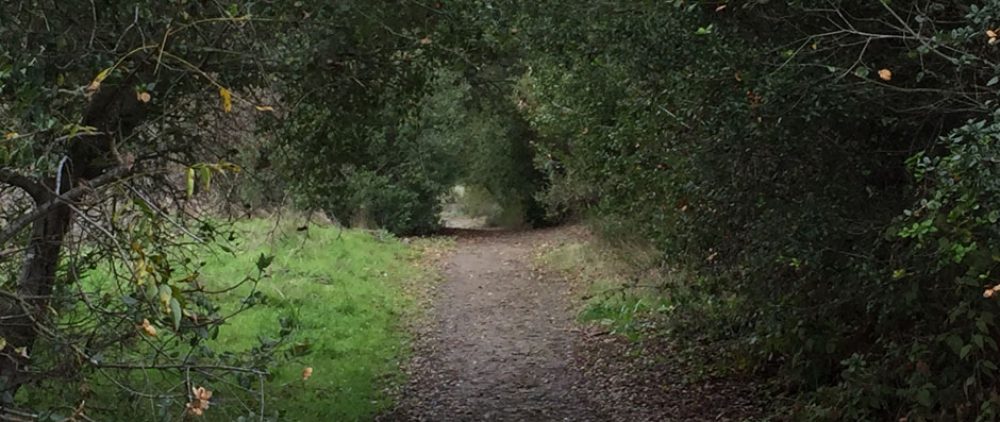
Happy August

The month of August, named after Augustus Caesar, begins with Lammas Day, the start of traditional harvest time in Britain and the end of summer in the old Celtic way of reckoning.  It feels like that in the northern hemisphere, doesn’t it?

Mid-Day Rest, Harvest, by William Frederick Witherington, British, ca. 1840.  Public domain

Mid-Day Rest, Harvest, by William Frederick Witherington, British, ca. 1840. Public domain

There’s something slightly ominous about August.  Back in college, I watched an eastern European apocalyptic film called, The End of August at the Hotel Ozone.  It was about as cheery as the name, and when you try them out, you find that none of the other months work as well in the title.  On the 4th day of August, in 1914, guns belched fire and World War I began.  On the other hand, like any month, there have been good and bad times in history; the second world war came to an end on August 14.

I like August.  I stand outside, watching the warm light of evening, and there is both beauty and poignancy, for you can’t help but notice the days getting shorter.  Here it is in a poem by Dana Gioia, “California Hills in August.”  He speaks to those who find the end-of-summer hills barren:

One who would hurry over the clinging
thistle, foxtail, golden poppy,
knowing everything was just a weed,
unable to conceive that these trees
and sparse brown bushes were alive.

And hate the bright stillness of the noon
without wind, without motion.
the only other living thing
a hawk, hungry for prey, suspended
in the blinding, sunlit blue.

And yet how gentle it seems to someone
raised in a landscape short of rain—
the skyline of a hill broken by no more
trees than one can count, the grass,
the empty sky, the wish for water.

The end of summer evokes its own sort of romantic feelings too, and I think that goes along with the dying of the light.  In earlier times, at the Lammas fairs, young people could enter a “trial marriage,” generally lasting 11 days.  They were free to walk away if it didn’t work out.  A bit more sparse than our hearts and cupids in February, but maybe more realistic.

And in that romantic spirit, I’ll end with a beautiful harvest song / love ballad by Fairport Convention, a marvelous group from across the water that is still going strong after 46 years.

Happy 94th birthday to Pete Seeger!

Pete Seeger, June 2007, by Anthony Pepitone.  CC-by-SA-3.0

Pete Seeger, June 2007, by Anthony Pepitone. CC-by-SA-3.0

I was lucky enough to hear Pete Seeger in a small, intimate venue when I was in my teens, and I was impressed by his humor, talent, and humility.  How wonderful that he just keeps going and going and going!

Here’s a nice five minute interview he did in 1994 with Bill Moyers, “Pete Seeger on What it Takes to Change the World.”

And here, just for the fun of it, is Bruce Springsteen and the band he formed to record,”The Seeger Sessions,” a tribute to Pete and one of my favorite albums. The song is “Mrs. McGrath,” an Irish anti-war song published in 1815 that Pete Seeger popularized and Springsteen set to rock-jazz-celtic rhythms. Enjoy!

http://www.youtube.com/watch?v=4qcCqq2Hayo

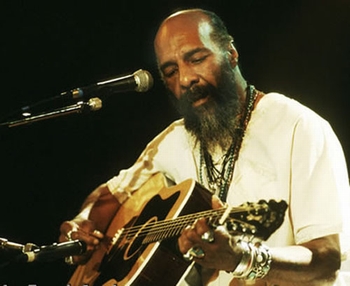
Remembering Ritchie Havens

richie-havens_esc

Lots of people are writing memorials to Ritchie Havens who died today at the age of 72.  “Folk singer and guitarist” is what the newspapers say.  Factually correct but nowhere near the experience of hearing his music, especially for the first time.

I was just a kid who found himself, through a strange karmic twist, at the Village Theater in New York, for the first show of Cream’s first American tour.  First we had to sit through a set by some folksinger none of us had ever heard of.  Some Ritchie something guy – and he stunned us. Left the main act in the dust  On our feet, open mouthed, one of those “never heard anything like this before” musicians.

A few years later he did the same thing for half a million at Woodstock.  All I can think to do now is pass on a couple of songs, especially for those who may not be familiar with his music.

Ritchie Havens at Woodstock

Ritchie Havens at Woodstock

Freedom was a theme that ran through most of his music.  One of his best known songs bore that name, but here is one of my favorites that isn’t as well known. He recorded this version of “Follow the Drinking Gourd” for an album of Civil War songs following Ken Burns’ documentary.  Slaves escaping north on “the underground railroad” were told to travel only at night and “follow the drinking gourd,” the constellation we know as the big dipper, where the north star would show them the way.

His songs songs were woven with hopes and dreams.  Here’s another one someone just posted, wanting to share some expression of this beautiful soul.

I keep wanting to say, “Rest in peace,” but for Ritchie Havens, I think it’s a given.

Singing along with Merle Haggard

In honor of a pair of local concerts Merle Haggard is set to perform the week after this, our paper ran an article and an interview with Haggard, a country music classic.  Unfortunately, I’m busy both nights he’ll be in town, so I thought I’d post an article and a couple of songs for my pleasure and hopefully yours.

Merle Haggard was born in 1937, in Oildale, CA, near Bakersfield.  He grew up wild and drew a three year term in San Quentin when he was 20.  While in prison, he decided playing music would be a better way to live, and 1967 he recorded his first number one country music song, “The Fugitive,” which remains my all time Haggard favorite:

I first heard Haggard after he released his 1969 counter-counter-cultural anthem, “Okie from Muskogee.”  Lyrics like, “We don’t smoke marijuana in Muskogee,” made it a tongue-in-cheek favorite on hippie radio stations of the day.  Later that year, the Grateful Dead covered one of his songs, as did Joan Baez a short while later.

Haggard, who had his own battles with alcohol and drug abuse, is far less doctrinaire these days:  he built a recording studio near his home in Redding, CA where he’s currently working on a tribute album to Bob Dylan.  At 76, having also survived lung cancer, Haggard sounds grateful as well as surprised at his success and still being alive.  If you like country music, you’re sure to enjoy the article and the interview.

Haggard says country music is “pretty shallow” these days, and when you listen to his work, it’s hard not to come to the same conclusion.  Here is a country singer who shows the depths and soul that are possible in this classic American genre.

Kacey Musgraves: a talented singer makes her recording debut

In my twenties, when I spent a lot of time in Oregon and the southwest, I came to love country music.  I enjoyed the roots of the genre as you hear it in artists like Hank Williams, Bill Monroe, and The Carter Family.  I also favored contemporaries of the time like Emmy Lou Harris and Johnny Cash.

I haven’t listened so much since the genre tilted toward glamour and glitz.  That’s one reason I was delighted to hear a fresh young artist introduced on NPR.  Twenty-four year old Kacey Musgraves writes and sings with the heart and authenticity of her country ancestors, even as her songs are squarely 21st century.  Her debut album, “Same Trailer, Different Park,” comes out on March 19.  You can sample the songs on the NPR page,  First listen: Kacey Musgraves.

Kacey Musgrave. Photo by Dave Hensley. CC By-NC-ND 2.0

Kacey grew up in Mineola, Texas.  In the words of NPR, she writes “about and for people who’ve learned to fit their dreams into recession-sized moving boxes; who gain comfort from their family traditions…who find their pleasures and pains not in the excesses promoted by Hollywood or Nashvegas, but in jokes shared during a work break at the Waffle House, or nights of glory at the local karaoke bar.”

Available youTube clips don’t have the acoustic quality I expect to hear after the album release, but I was taken by the optimism that underlies the poignancy in “Silver Linings:”

Woke up on the wrong side of rock bottom
Throw a lot of pennies in a well
That done run dry
Light up and smoke ’em if you have ’em
But you just ain’t got ’em
Yeah ain’t we always looking For a bluer sky?

I’m planning to visit iTunes for this on March 19.

Johnny Cash was born this day 81 years ago.

Johnny Cash, who was born February 26, 1932, died a decade ago, a matter of months after the loss of his beloved wife, June Carter Cash.

During his 71 years, the Man in Black won membership in the Rock and Roll Hall of Fame, the Country Music Hall of Fame, and The Gospel Music Hall of Fame. As those credentials suggest, his music spanned the entire spectrum. Most recently, “Girl from the North Country,” his duet with Bob Dylan, was featured on the soundtrack of Silver Linings Playbook.

There’s no way I could objectively pick a “definitive” Johnny Cash song – instead, I’ll post his version of a song that has been one of my favorites since the days when my parents played it when I was a kid.

The music of Iris Dement

Last Sunday I caught an NPR interview with one of today’s finest country and folk music artists, Iris Dement.  Her music is not as well known as it should be, though it has been featured on several notable TV shows and movies.

I first heard Dement’s music in the final scene of the final episode of my favorite TV show of the 90’s, Northern Exposure.  The song, “Our Town,” from her first album Infamous Angel 1992, illustrates one constant in her work, an unflinching look at the losses and longings that permeate our lives.

And you know the sun’s settin’ fast,
And just like they say, nothing good ever lasts.
Well, go on now and kiss it goodbye,
But hold on to your lover,
‘Cause your heart’s bound to die.
Go on now and say goodbye to our town, to our town.
Can’t you see the sun’s settin’ down on our town, on our town,
Goodnight.

In the NPR interview, Dement said that for her, singing is prayer, and two other songs on Infamous Angel reflect the range of her spirituality.  The album’s title song is about redemption, imagined from the perspective of her evangelical upbringing, while “Let the Mystery Be” opened the soundtrack of Little Buddha 1993.

Everybody’s wonderin’ what and where they all came from.
Everybody’s worryin’ ’bout where they’re gonna go when the whole thing’s done.
But no one knows for certain and so it’s all the same to me.
I think I’ll just let the mystery be.

Dement’s second album, My Life, 1994, won a grammy nomination in the Best Contemporary Folk Album category.  The liner notes explain why it’s dedicated to her father who had been a fiddler but stopped playing after he was “saved.”  Young Iris was fascinated by the dusty violin case in the back of the closet and one day mustered the courage to ask her father to play a song.  He looked at her and at at the violin for a very long long time before picking the instrument up.  The few bars he played gave his daughter permission.  “No Time to Cry,” is her song about his passing.

Also notable on My Life is “Sweet is the Melody,” a beautiful song and fine expression of the nature of the creative process:

Sweet is the melody, so hard to come by
It’s so hard to make every note bend just right
You lay down the hours and leave not one trace
But a tune for the dancing is there in it’s place

Dement appears in Songcatcher 2000, a movie about an early 20th century musicologist collecting Scots-Irish ballads in the Appalachians.  She sings “Pretty Saro,” an expression of American roots music that parallels her own search for musical authenticity. Her most recent film credit is True Grit, 2010, where her version of the classic hymn, “Leaning on the Everlasting Arms” plays at the end of the movie.  You can watch a clip in my review of the movie: http://wp.me/pYql4-up

The recent NPR interview follows the release of Dement’s fourth album, Sing the Delta, a reference to the Arkansas Delta where she was born. http://www.npr.org/2012/10/28/163560263/singing-is-praying-for-iris-dement.  She discusses the importance of her Pentecostal upbringing.  As the youngest of 14 children, she sang in the church choir and took her faith seriously as an adolescent.  Losing that faith as an adult is reflected in her new song, “The night I learned how not to pray,” yet Dement emphasizes her gratitude for what she was taught as a child, saying it gave her a message “about what’s going on underneath the waters of life.  My parents just gave me a gift I can’t even put a figure on.”

Though she left the beliefs that sustained her youth, Dement relates a lesson she learned from her mother, “My mom, who sang straight up until the day she died, told me one day: ‘You know, Iris, singing is praying and praying is singing. There ain’t no difference.’ So I think, even though I’ve left the church and moved away from a lot of the things that didn’t do me any good, I continued to pray — and that is singing for me.”

You won’t find music more sincere or heartfelt than this.

Tempest – Bob Dylan’s latest recording

Bob Dylan in concert in Spain, 2010, CC-by-2.0

Fifty years after his first album, Bob Dylan, 71, has released Tempest, his 35th studio album, to critical acclaim.  Over half a century, Dylan has never repeated himself.

Randal Roberts of The LA Times says,  “Dylan lives in every molecule of our being, has taught us about lyrical possibility, has reveled in the joy of words and the power and glory of making things up from scratch. To learn that a new Dylan project is in the works is to know that there’s a good chance your brain will be forever changed by at least one new rhyming couplet, snarling oath or graceful guitar line. On “Tempest,”…there are many such moments.”

The songs range from light to dark, from blues to ballad, from topical references to phrases borrowed from Child ballads, all resonating to Dylan’s unique and raspy voice.

“Scarlet Town,” echoes the “Barbara Allen,” where Sweet William on his deathbed lies, but veers away from easy interpretation, much like the inviting but ultimately opaque American folklore references in Dylan’s much earlier, John Wesley Harding, 1967.  Then and now, the poetry is Dylan’s own:

Scarlet Town, in the hot noon hours,
There’s palm-leaf shadows and scattered flowers
Beggars crouching at the gate
Help comes, but it comes too late
By marble slabs and in fields of stone
You make your humble wishes known
I touched the garment, but the hem was torn
In Scarlet Town, where I was born

http://www.youtube.com/watch?v=GUWlFGEfRAU&feature=related

The title song, “Tempest,” is a 14 minute ballad about Titanic, phrased as a waltz that echoes the rolling of waves as it borrows The Carter Family’s “Titanic.”

The night was black with starlight
The seas were sharp and clear
Moving through the shadows
The promised hour was near

Lights were holding steady
Gliding over the foam
All the lords and ladies
Heading for their eternal home

Tempest opens with a blues number, “Duquesne Whistle,” written with Robert Hunter, The Grateful Dead lyricist.  It’s followed by the angry and topical “Early Roman Kings.”  There is “Roll on John,” a tribute to John Lennon, “Tin Angel,” a song of murder and suicide, and it ends with “Soon After Midnight,” which sounds like a slow song at the end of a high school dance.

http://www.youtube.com/watch?v=KaWcVxPTgYU

If you’ve ever enjoyed Dylan’s music; if like Randal Roberts it has “forever changed your brain,” I urge you to check out the songs online. I bet you’ll download some or all of cuts, and marvel at the phenomenon of an artist who has continued to grow over fifty years.