Reflections on Story Water

My second post on this blog, on July 1, 2010, featured a poem called “Story Water” by the 13th century Persian mystic, Rumi.  It came to mind in the light of recent events.

Friday morning, as I worked on post #420, I got up for coffee and flipped on the radio.  The post concerned what folklore can teach us about living in difficult times.  After I heard of the murdered children, I put it aside.  Some events seem too much for stories.  Yet reflection later reminded me that stories are always with us, one way or another.  Rumi knew this.  He knew how the stories we hear feed our inner tales and the importance of choosing wisely where to place our attention.

On friday night, hundreds of people in Newtown, Connecticut went to church.  As I heard how they turned to a story of hope in a dark time, I thought of one of the first such stories I told myself.

One day in first grade, a classmate went home sick.  The following monday, the teacher told us she died.  I had seen dead birds in the woods behind our house, but that was the first time I realized death could visit at any time.  It could steal our friends and loved ones away in a heartbeat.

The dead girl’s name was Cindy Erwin, and she was the minister’s daughter.  I figured her father’s vocation gave her an in with Jesus, and she would be fine.  I never worried about Cindy, although I’ve never forgotten her name.  I knew it was the rest of us who were in trouble.

Stories like this, the ones we tell ourselves, shape our lives in ways we can barely imagine.  Everyone young or old who lived through events at Sandy Hook School or watched them unfold on TV will remember the day as long as they live and tell themselves stories about what happened and why and what it means.

According to Rumi, few of us know the answers with certainty.  That’s why we have stories.  That’s why they matter so much.  I think he would have agreed that in the end, the world is made of stories, so it matters very much which ones we tell each other and ourselves.  In ways we don’t understand, they shape the world as it unfolds.

STORY WATER by Rumi

A story is like water
that you heat for your bath.

It takes messages between the fire
and your skin. It lets them meet,
and it cleans you!

Very few can sit down
in the middle of the fire itself
like a salamander or Abraham.
We need intermediaries.

A feeling of fullness comes,
but usually it takes some bread
to bring it.

Beauty surrounds us,
but usually we need to be walking
in a garden to know it.

The body itself is a screen
to shield and partially reveal
the light that’s blazing
inside your presence.

Water, stories, the body,
all the things we do, are mediums
that hide and show what’s hidden.

Study them,
and enjoy this being washed
with a secret we sometimes know,

and then not.

Tempest – Bob Dylan’s latest recording

Bob Dylan in concert in Spain, 2010, CC-by-2.0

Fifty years after his first album, Bob Dylan, 71, has released Tempest, his 35th studio album, to critical acclaim.  Over half a century, Dylan has never repeated himself.

Randal Roberts of The LA Times says,  “Dylan lives in every molecule of our being, has taught us about lyrical possibility, has reveled in the joy of words and the power and glory of making things up from scratch. To learn that a new Dylan project is in the works is to know that there’s a good chance your brain will be forever changed by at least one new rhyming couplet, snarling oath or graceful guitar line. On “Tempest,”…there are many such moments.”

The songs range from light to dark, from blues to ballad, from topical references to phrases borrowed from Child ballads, all resonating to Dylan’s unique and raspy voice.

“Scarlet Town,” echoes the “Barbara Allen,” where Sweet William on his deathbed lies, but veers away from easy interpretation, much like the inviting but ultimately opaque American folklore references in Dylan’s much earlier, John Wesley Harding, 1967.  Then and now, the poetry is Dylan’s own:

Scarlet Town, in the hot noon hours,
There’s palm-leaf shadows and scattered flowers
Beggars crouching at the gate
Help comes, but it comes too late
By marble slabs and in fields of stone
You make your humble wishes known
I touched the garment, but the hem was torn
In Scarlet Town, where I was born

http://www.youtube.com/watch?v=GUWlFGEfRAU&feature=related

The title song, “Tempest,” is a 14 minute ballad about Titanic, phrased as a waltz that echoes the rolling of waves as it borrows The Carter Family’s “Titanic.”

The night was black with starlight
The seas were sharp and clear
Moving through the shadows
The promised hour was near

Lights were holding steady
Gliding over the foam
All the lords and ladies
Heading for their eternal home

Tempest opens with a blues number, “Duquesne Whistle,” written with Robert Hunter, The Grateful Dead lyricist.  It’s followed by the angry and topical “Early Roman Kings.”  There is “Roll on John,” a tribute to John Lennon, “Tin Angel,” a song of murder and suicide, and it ends with “Soon After Midnight,” which sounds like a slow song at the end of a high school dance.

http://www.youtube.com/watch?v=KaWcVxPTgYU

If you’ve ever enjoyed Dylan’s music; if like Randal Roberts it has “forever changed your brain,” I urge you to check out the songs online. I bet you’ll download some or all of cuts, and marvel at the phenomenon of an artist who has continued to grow over fifty years.

Marina, a poem by T.S. Eliot

One of best educational experiences I ever had was a class called “Yeats and Eliot” that I took as a college sophomore. I’ve been reading and rereading his work ever since. The name of this blog, “The first gate(s)” comes from the opening of Eliot’s long poem, “The Four Quartets,” which matches the scope and depth of the work of any poet who ventures into ineffable realms.

T.S. Eliot by Lady Ottoline Morrell, 1934. Public Domain

Eliot must have been quite a character.  He scandalized the early 20th century literary establishment with images like this, from the opening of “The Love Song of J. Alfred Prufrock:”

“Let us go then, you and I,
When the evening is spread out against the sky
Like a patient etherised upon a table;”

At the same time he offended the avant garde because he worked in a bank and joined the Anglican church.  Aware of such contradictions, he was never afraid to parody himself:

“How unpleasant to meet Mr. Eliot!
With his features of clerical cut,
And his brow so grim
And his mouth so prim
And his conversation, so nicely
Restricted to What Precisely
And If and Perhaps and But.”

By all accounts, he was also a joker, who served whoopee cushions and exploding cigars to dinner guests.  He and Groucho Marx were mutual fans.

***

“Marina” was one of the first Eliot poems I came to love, but I hadn’t read it for quite a while.  Ironically, it was the political conventions that brought these lines from the poem to mind:

Those who sharpen the tooth of the dog, meaning
Death
Those who glitter with the glory of the hummingbird, meaning
Death

Marina was #29 in Eliot’s series of  “Ariel Poems,” first published in September, 1930.  It was based on the Jacobean play, Pericles, Prince of Tyre.  Shakespeare is credited with the last acts of the play, the story of Pericles’ separation from, and reunion with, his daughter, Marina (most scholars believe the opening was composed by an inferior collaborator).

The play however, was simply a catalyst for poem that lives a life of its own, with haunting imagery that I think can speak to any of us, wherever we are.

Marina

By T.S. Eliot

Quis hic locus, quae regio, quae mundi plaga? 

What seas what shores what grey rocks and what islands
What water lapping the bow
And scent of pine and the woodthrush singing through the fog
What images return
O my daughter.

Those who sharpen the tooth of the dog, meaning
Death
Those who glitter with the glory of the hummingbird, meaning
Death
Those who sit in the sty of contentment, meaning
Death
Those who suffer the ecstasy of the animals, meaning
Death

Are become insubstantial, reduced by a wind,
A breath of pine, and the woodsong fog
By this grace dissolved in place

What is this face, less clear and clearer
The pulse in the arm, less strong and stronger—
Given or lent? more distant than stars and nearer than the eye
Whispers and small laughter between leaves and hurrying feet
Under sleep, where all the waters meet.

Bowsprit cracked with ice and paint cracked with heat.
I made this, I have forgotten
And remember.
The rigging weak and the canvas rotten
Between one June and another September.
Made this unknowing, half conscious, unknown, my own.
The garboard strake leaks, the seams need caulking.
This form, this face, this life
Living to live in a world of time beyond me; let me
Resign my life for this life, my speech for that unspoken,
The awakened, lips parted, the hope, the new ships.

What seas what shores what granite islands towards my timbers
And woodthrush calling through the fog
My daughter.

Lost, a poem by David Wagoner

David Wagoner, a prolific poet and novelist, was born in the midwest in 1926.  In 1954, he moved to the Pacific northwest and said that crossing the Cascades and coming down into a Pacific rainforest “was a big event for me, it was a real crossing of a threshold, a real change of consciousness. Nothing was ever the same again.”  He has taught at the University of Washington since that time.

He based his marvelous poem, “Lost” on teachings the northwest coast Indians gave their children on what to do if they ever got lost in the forest.

Lost

Stand still.  The trees ahead and bushes beside you
Are not lost.  Wherever you are is called Here,
And you must treat it as a powerful stranger,
Must ask permission to know it and be known.
The forest breathes.  Listen.  It answers,
I have made this place around you,
If you leave it you may come back again, saying Here.
No two trees are the same to Raven,
No two branches are the same to Wren.
If what a tree or a bush does is lost on you,
You are surely lost.  Stand still.  The forest knows
Where you are.  You must let it find you.

From, Travelling Light, Collected and New Poems, 1999

For All, by Gary Snyder

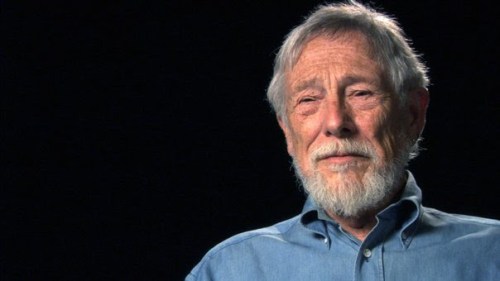
Gary Snyder

Fascinating as it can be, focusing on politics, as I have been doing lately, can overwhelm the thoughts with all that is wrong.  Take a step back, and the question becomes what is right?  And also, what isn’t touched by any of that?

Watching something that’s always right – the dogs running around the yard – I thought of this poem by Gary Snyder.  For All has long been one of my favorites, and it seems especially important now:  “I pledge allegiance to the soil of Turtle Island…”

For All

Ah to be alive
on a mid-September morn
fording a stream
barefoot, pants rolled up,
holding boots, pack on,
sunshine, ice in the shallows,
northern rockies.

Rustle and shimmer of icy creek waters
stones turn underfoot, small and hard as toes
cold nose dripping
singing inside
creek music, heart music,
smell of sun on gravel.

I pledge allegiance

I pledge allegiance to the soil
of Turtle Island,
and to the beings who thereon dwell
one ecosystem
in diversity
under the sun
With joyful interpenetration for all.

(from Axe Handles, 1983)

What Do 20% of Us Have in Common?

Not long ago, I read a Los Angeles Times article saying 20% of Americans suffered from mental illness in 2010.  The article ended with a warning:  “…we need to continue efforts to monitor levels of mental illness in the United States in order to effectively prevent this important public health problem and its negative impact on total health.”  The story did define what was meant by “mental illness.”  Do I have to keep an eye on every fifth guy in the Post Office line?

Not necessarily.

The Times’ source was a January 19 report by SAMSHA, the Substance Abuse and Mental Services Administration, which said 45.9 million Americans suffered from mental illness in 2010.  Their definition of mental illness is, “a diagnosable mental, behavioral, or emotional disorder (excluding developmental and substance use disorders)” in the DSM-IV, the 4th edition of The Diagnostic and Statistical Manual of Mental Disorders (1994).

Here’s how the DSM works: there are numerous schools of psychotherapy that differ in their approach to treating different disorders, but all have agreed to agree on the definitions of those disorders.  One of my psych professors insisted that the DSM says more about our cultural “norms” than about the health of the population.  For instance, in 1987, homosexuality was dropped from the list of disorders.  Prior to 1987, gays and lesbians were “mentally ill.”  After that, they were not.

Anyone who visits a psychotherapist and wants to submit an insurance claim will receive one of these diagnoses, most commonly, “Anxiety,” or “Adjustment Disorder.”  This fits the vast numbers of clients who are able to cope with life, but seek help with problems at work or problems at home or issues of self-actualization.  The SAMSHA report gave no mention of efforts to factor in the seriousness of the diagnosis.  There is no way to know how many of the 45.9 million Americans who are “mentally ill” suffer from anxiety vs. schizophrenia.

To the best of my knowledge, the rise of “insanity” coincided with the Industrial Revolution.  The US Census first noted the incidence of “idiocy/insanity” in 1840.  By 1880, there were seven types of insanity:  mania, melancholia, monomania, paresis, dementia, dipsomania, and epilepsy.

According to my psych professor, the DSM grew out of a research collaboration between the American Psychiatric Association (APA) and the US military between the world wars.  Soldiers in WWI suffered high rates of shell shock.  The military sought screening methods for those who would hold up in combat.  Although the screens later proved not to have the predictive power hoped for, the DSM came from this research.  In other words, our current definition of sanity is based the attributes of a good combat soldier.

Voices were raised in protest, almost from the start, notably by Thomas Szasz in The Myth of Mental Illness (1961) and a 1973 article by David Rosenham, “On Being Sane in Insane Places.”

I am not trying to minimize the suffering of those with mental afflictions that cause them to harm themselves or others.  First, I am questioning a report that excludes all forms of substance abuse from its definition of “mental illness.”  I also question defining “anxiety” as “mental illness,” when anyone who was paying attention in 2010 felt anxious.

I have often been struck, since I studied psychology, that our concept of sanity, modeled on the good soldier, also defines the “productive” member of our consumer culture.  It brings to mind a favorite line from a poem by Theodore Roethke:  What’s madness but nobility of soul at odds with circumstance?:

In a Dark Time

In a dark time, the eye begins to see,
I meet my shadow in the deepening shade;
I hear my echo in the echoing wood–
A lord of nature weeping to a tree,
I live between the heron and the wren,
Beasts of the hill and serpents of the den.

What’s madness but nobility of soul
At odds with circumstance? The day’s on fire!
I know the purity of pure despair,
My shadow pinned against a sweating wall,
That place among the rocks–is it a cave,
Or winding path? The edge is what I have.

A steady storm of correspondences!
A night flowing with birds, a ragged moon,
And in broad day the midnight come again!
A man goes far to find out what he is–
Death of the self in a long, tearless night,
All natural shapes blazing unnatural light.

Dark,dark my light, and darker my desire.
My soul, like some heat-maddened summer fly,
Keeps buzzing at the sill. Which I is I?
A fallen man, I climb out of my fear. 
The mind enters itself, and God the mind,
And one is One, free in the tearing wind.
– Theodore Roethke

The Year in Rearview and Words of Hope From Gary Snyder

Now is when writers compose their summaries of the outgoing year, and I wanted to weigh in too.  Problem was, I kept discarding drafts as my inner parental voices chimed in with, “Quit whining.”  Eliminate whining, and it’s hard to come up with things to say about 2011.

Fortunately, I found a spot-on analysis by another blogger, badlandsbradley, who wrote:  “2011 sucked. It was a big stupid year full of big stupid things. All around, it was just stupid.”  http://badlandsbadley.wordpress.com/2011/12/27/2012-a-look-ahead/

Now that we have that out of the way, what’s left?  I sometimes compose gratitude lists at turning points in the year, and I find it a worthwhile practice, but I think people have to do this for themselves.  I started one list by writing, “We survived,”  which brought to mind several good people who didn’t.  Sometimes the things we are grateful for are weighty, things to “ponder in our hearts,” as the Christmas story puts it.

In the middle of these reflections, a phrase I hadn’t thought of for years came to mind:  “Drown their butts, crush their butts.”  This stanza comes from Gary Snyder’s marvelous, Smokey the Bear Sutra. When found it online, I stopped to appreciate these words at the end of the poem:

(may be reproduced free forever).

Those five simple words of generosity opened a real wellspring of gratitude for me, so now I want to share this poem, one of my favorite by this Pulitzer Prize winning poet.  May reproducing it here benefit beings everywhere.

*****

Gary Snyder

Smokey the Bear Sutra

Once in the Jurassic about 150 million years ago,
the Great Sun Buddha in this corner of the Infinite
Void gave a Discourse to all the assembled elements
and energies: to the standing beings, the walking beings,
the flying beings, and the sitting beings — even grasses,
to the number of thirteen billion, each one born from a
seed, assembled there: a Discourse concerning
Enlightenment on the planet Earth.

“In some future time, there will be a continent called
America. It will have great centers of power called
such as Pyramid Lake, Walden Pond, Mt. Rainier, Big Sur,
Everglades, and so forth; and powerful nerves and channels
such as Columbia River, Mississippi River, and Grand Canyon
The human race in that era will get into troubles all over
its head, and practically wreck everything in spite of
its own strong intelligent Buddha-nature.”

“The twisting strata of the great mountains and the pulsings
of volcanoes are my love burning deep in the earth.
My obstinate compassion is schist and basalt and
granite, to be mountains, to bring down the rain. In that
future American Era I shall enter a new form; to cure
the world of loveless knowledge that seeks with blind hunger:
and mindless rage eating food that will not fill it.”

And he showed himself in his true form of

SMOKEY THE BEAR

  • A handsome smokey-colored brown bear standing on his hind legs, showing that he is aroused and
    watchful.

  • Bearing in his right paw the Shovel that digs to the truth beneath appearances; cuts the roots of useless
    attachments, and flings damp sand on the fires of greed and war;

  • His left paw in the Mudra of Comradely Display — indicating that all creatures have the full right to live to their limits and that deer, rabbits, chipmunks, snakes, dandelions, and lizards all grow in the realm of the Dharma;

  • Wearing the blue work overalls symbolic of slaves and laborers, the countless men oppressed by a
    civilization that claims to save but often destroys;

  • Wearing the broad-brimmed hat of the West, symbolic of the forces that guard the Wilderness, which is the Natural State of the Dharma and the True Path of man on earth: all true paths lead through mountains —

  • With a halo of smoke and flame behind, the forest fires of the kali-yuga, fires caused by the stupidity of
    those who think things can be gained and lost whereas in truth all is contained vast and free in the Blue Sky and Green Earth of One Mind;

  • Round-bellied to show his kind nature and that the great earth has food enough for everyone who loves her and trusts her;

  • Trampling underfoot wasteful freeways and needless suburbs; smashing the worms of capitalism and
    totalitarianism;

  • Indicating the Task: his followers, becoming free of cars, houses, canned foods, universities, and shoes;
    master the Three Mysteries of their own Body, Speech, and Mind; and fearlessly chop down the rotten
    trees and prune out the sick limbs of this country America and then burn the leftover trash.

Wrathful but Calm. Austere but Comic. Smokey the Bear will
Illuminate those who would help him; but for those who would hinder or
slander him,

HE WILL PUT THEM OUT.

Thus his great Mantra:

Namah samanta vajranam chanda maharoshana
Sphataya hum traka ham nam

“I DEDICATE MYSELF TO THE UNIVERSAL DIAMOND
BE THIS RAGING FURY DESTROYED”

And he will protect those who love woods and rivers,
Gods and animals, hobos and madmen, prisoners and sick
people, musicians, playful women, and hopeful children:

And if anyone is threatened by advertising, air pollution, television,
or the police, they should chant SMOKEY THE BEAR’S WAR SPELL:

DROWN THEIR BUTTS
CRUSH THEIR BUTTS
DROWN THEIR BUTTS
CRUSH THEIR BUTTS

And SMOKEY THE BEAR will surely appear to put the enemy out
with his vajra-shovel.

  • Now those who recite this Sutra and then try to put it in practice will accumulate merit as countless as the sands of Arizona and Nevada.

  • Will help save the planet Earth from total oil slick.

  • Will enter the age of harmony of man and nature.

  • Will win the tender love and caresses of men, women, and beasts.

  • Will always have ripe blackberries to eat and a sunny spot under a pine tree to sit at.

  • AND IN THE END WILL WIN HIGHEST PERFECT ENLIGHTENMENT.

    thus have we heard.

    (may be reproduced free forever)

The Wasteland

One of the books I treasure is a battered old trade paperback with yellowing pages.  I value the book,  Creative Mythology, because of the author’s inscription: “For Morgan with all my good wishes. Joseph Campbell, 3/13/79.”  

joseph_campbell_4

You could say Campbell’s  four day lecture series that spring did much to open the path my imagination has followed ever since.  None of the stories Campbell unpacked in his lectures or books affected me more than Parzifal (or Parsifal) and his quest for the holy grail. The version of the grail story Campbell recounts is by Wolfram Von Eshenbach (1170 – 1220).  Wolfram was a German knight and poet, and his Parzivalis regarded as one of the finest medieval German epics.  Campbell looks to this version because it’s roots reach deeper than later Christianized versions where only the pious and chaste Galahad can attain the grail.  What matters for this post are those echoes we can see in the tale of the ancient legends of sacred kingship, and the ways an unfit or weakened king can blight the land.

Wolfram Von Eshenbach from Codex Manasse

Sometimes in youth we receive a vision or powerful experience that shapes much of the rest of our lives.  So it is with Parzival who finds his way to the mystical Grail Castle and meets its wounded king, Anfortas,  who is also known as The Fisher King.  As a young knight, a spear pierced the Fisher King’s “thighs” – a euphemism for testicles according to Campbell.  In ancient times, the virility of the king and the fertility of the land were one.  In the grail stories, Fisher King could not be healed and couldn’t die.  All the realm was barren.

Robin Williams as the Fisher King in the 1991 movie of that name, a contemporary retelling of the story

While in the castle, during a mysterious ritual, Parzival has a vision of the grail, which is described as a stone, though its shape isn’t fixed, and it brings everyone “what their heart most desires.”  Though he is intensely curious, Parzival does not ask the meaning of what he sees.  In the morning, the castle is empty.  All traces of life are gone.  He rides away, and when he tells his story, listeners turn away in disgust.  If Parzival had asked the right question, he would have healed the king and restored the land.    The young knight wanders the blighted realm for 20 year, enduring hardships and contemplating his failure.  Just like us, he watches time turn his youthful dreams of glory to ashes.

“Parsifal” by Odilon Redon

At last, one cold Christmas Eve, Parzival encounters a hermit, tells his tale, and learns the question he should have asked. After that, he achieves the castle again.  When the ritual ends, Parzival asks, “Whom does the grail serve?”   Everything hinges on asking the right question.  Anfortas is healed, spring returns, and Parzival becomes the new Grail King.

***

Hearing this old tale, we have to ask how the story plays forward.  “Wasteland” clearly describes the state of the world we read about in the papers, and “impotent” seems an apt description of most of the world’s governments.  This perception is not even new, for T.S. Eliot named it ninety years ago in his poem, The Wasteland:

What are the roots that clutch, what branches grow Out of this stony rubbish? Son of man, You cannot say, or guess, for you know only A heap of broken images, where the sun beats, And the dead tree gives no shelter, the cricket no relief, And the dry stone no sound of water.

Giving mythical weight to our latest headlines, storyteller and mythologist, Michael Meade says: “Like Parsifal, the modern world has awakened from a deep sleep to find that the castle of abundance has disappeared, that the financial markets are in ruins, that blind religious beliefs are once again producing mindless crusades, and that great nature itself threatens to become a barren wilderness. Like Parsifal, we failed to ask the right questions when surrounded by abundance.” From “Parsifal, the Pathless Path, and the Secret of Abundance,” first published in Parabola, Fall 2009.  http://www.mosaicvoices.org/index.php?option=com_content&view=article&id=72:essay4parsifal&catid=53:essays&Itemid=68

This has happened before, again and again, Meade reminds us – beginnings and endings, decay and renewal.  The castle of abundance waits for us, individually and collectively, somewhere in the wilderness, but old pathways won’t take us there.  There’s a time to do as Parsifal did – drop the reins and let the horse, an image of our instinctive wisdom, pick its way through the forest. The old stories were told in the winter, when the nights were long and the fires warm.  This winter, I am drawn to look at some of these tales, to see what they are still whispering to our souls, for they are wiser than the daily ephemera that passes for wisdom but is really the source of our confusion.

As Michael Meade puts it: “Despite the current confusions of dogmatic religions and the literalism common to modern attitudes, the earthly world has always been a manifestation of the divine. Call it the Grail Castle, the Kingdom of Heaven, Nirvana, the Otherworld; it has many names and each is a representation of the eternal realm that secretly sustains the visible world. When time seems to be running out it is not simply more time that is needed, rather it is the touch of the eternal that can heal all time’s wounds and renew life from its source.”