The California Wolf

On December 28, a 2 1/2 year old male wolf crossed the border into California after a 1,000 mile journey south through Oregon.  Wolf OR7, as he is called by Fish and Game, is the first wild wolf in the state in almost 100 years.  A young wolf will leave his pack to search for a mate to start a new one in situations like too many wolves competing for game in a certain region.

Wolf OR7

The new California wolf is a descendant of the 66 Canadian wolves who were relocated to Yellowstone in the mid 90’s.  He is one of an estimated 1600 wolves who now roam free in the Rocky Mountain states, in the southwest, and in Oregon.

According Tim Holt, a freelance writer in Dunsmuir, CA, “local ranchers and a few pandering elected officials have him in their cross hairs, saying he ought to be shot on sight.”   At the same time, “there are wolf advocates who practically worship this predator, seeing the wolf as symbol and martyr of a vanishing wilderness.”

Holt sees another possibility:

The removal of wolves, or their reintroduction, reverberates up and down the food chain. By culling deer and elk, new wolf populations help restore vegetation along streambeds, improving habitat for songbirds, beavers and river otters. And by going after weak and old members of deer and elk populations, they help strengthen their stock. Wolves, in other words, are instinctive wilderness restoration specialists.

So the wolves’ return to this state offers a litmus test of our commitment to the health of our remaining wildlands. But it goes beyond that. Allowing them to reintroduce themselves would be one more sign that we’re moving away from a human-centered view of nature, based on narrow economic interests, and have begun to see ourselves as a part of what might be called the broader economy of nature. http://www.sacbee.com/2012/01/29/4221053/wolf-can-help-us-balance-our-approach.html#storylink=cpy
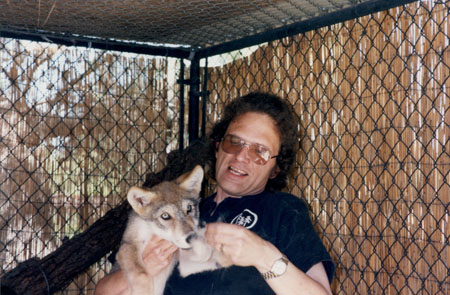
Somewhere deep within us as well, is a fear of wolves that makes generations of children shiver at Little Red Riding Hood.  That thrilled me when I read Jack London’s stores of wolves battling men.  I didn’t know at the time that London’s stories were pure fiction.  No such incidents ever happened.  During the ’90’s, I volunteered at the Folsom City Zoo because I wanted to interact with the wild canines – the wolves and foxes and coyotes.

Helping to socialize Redbud, a wolf pup, ca 1995

During the 90’s, all the texts on wolves agreed there were no confirmed cases of a non-rabid wolf attacking a human in North America.  I don’t think that has changed.  A classic account is 50 years old.  Farley Mowat, a Canadian author and conservationist, spent a summer living by himself among wolves.  In his 1963 book, Never Cry Wolf, he wrote:  “We have doomed the wolf not for what it is, but for what we deliberately and mistakenly perceive it to be — the mythological epitome of a savage, ruthless killer — which is, in reality, no more than the reflected image of ourself.”

Never Cry Wolf by Farley Mowat, 1963

The book, and the movie made of it in 1983, deserve much of the credit for reversing public attitudes toward the wolf, and allowing reintroduction to happen at all.

Never Cry Wolf movie, 1983

Gandhi said the character of a nation is revealed in the way it treats its animals.  Let’s hope the way we treat OR7 reveals something compassionate, wise, and generous in us.

Sage, at the Folsom City Zoo, ca. 1995

An Interlude with Mutant Chickens

The other day, I took a break from literary activities to meet a friend in Fair Oaks Village for coffee.  Once upon a time, Fair Oaks was a farming community, separated by miles of fields and orchards from Sacramento.  Those days are gone, but there’s still something inviting about the town.  It’s slower than the boulevards and mini-malls that surround it, but not yet gentrified.  That may have something to do with the chickens, but I will get to that.

Fair Oaks Coffee Shop and Deli

So my friend were I are sitting at a table outside, having coffee and waxing eloquent on matters of great import, when I spotted a mutant chicken pecking at the pretzel I’d dropped on the sidewalk.  If you really pay attention, even normal chickens are sort of scary; you can understand the theory that they descend from dinosaurs.  Watch them run around, and you think of mini-velociraptors.  Yet chickens are the official Fair Oaks bird.  Herds of them run loose in town, and they are even featured on the town sign.

Once, when our dog, Holly, was younger, she jerked her leash out of my hand and took off after a chicken. By the time I caught her, thinking I was about to burst a lung, an irate citizen informed me that chickens are protected.  I believe I said something along the lines of, “Come on, Holly, we’ll hunt for dinner elsewhere.”

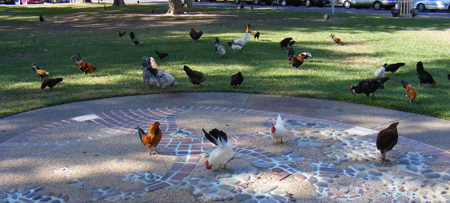
Fair Oaks is famous for chickens, and I have it on good authority that people throughout the region come here to dump their excess fowl.  What you have is a group of birds that interbreed, and every now and then you see a really demented one, who could play in a monster movie.  Such was the one who pecked at my feet the other day.  It had some kind of growth, like the extra head on the alien in Men In Black II.  I was so busy thinking of tetanus shots and keeping my feet out of its way, that I forgot the camera phone in my pocket and didn’t document the monster.   Today I went back with a real camera, and naturally all the chickens looked normal – or as normal as chickens can look.

Here’s the Fair Oaks chicken ideal:

Mural on the Fair Oaks, open air theater

And here’s the reality – chickens invading the public men’s room:

Employees must wash their hands before returning to work

The ideal – an idyllic shot in the town square

Don’t be fooled! Think of Alfred Hitchcock.

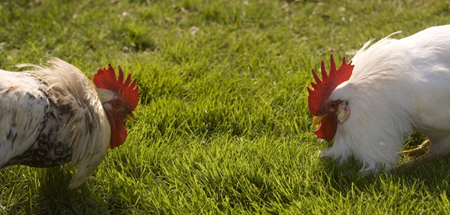
The real – high noon in roosterville.

Go ahead – make my day.

And finally, here is the biggest Ideal Chicken of all – at the 2010, Fair Oaks Chicken Festival:

Has everyone had a chance to go, “Awwww?”  If you can make it, this year’s Chicken Festival will be held on September 17.  Feel free to bring the munchkins, but be ready to change the subject if they ask, “What’s for lunch?”  Last year, the featured item was barbecued chicken.  (I’m serious).

Have fun if you go.  I would never dream of saying anything on my blog about eating Big Bird, but I will be home that day eating tofu.  Probably with the shades drawn too, in case the mutant chicken knows where I live.

Going to the Canines

Today is the 20 year anniversary of several important events.  For starters, I had managed to last seven years in the corporate world, so on Friday, August 30, 1991, I was starting my first sabbatical:  ten weeks paid time off.  The tech industry was booming then, and they did things like that.

I was also finishing up a masters’s thesis for a degree in psych I’d been working on in my spare time – I did things like that.  But the most important thing we did on this day 20 years ago was bring home a dog.

Charis negotiates a step - Aug. 30, 1991

We had her picked out and all the arrangements made ahead of time, but that day – leaving work for ten weeks and bringing home a puppy to celebrate was one of the most memorable of my life.  It was just a bit less memorable for Mary.  Charis was riding in a crate in the back seat, howling because she wasn’t used to cars, so Mary thought she might be happier riding on her lap, where the puppy promptly peed.  We laughed about it then and now – nothing a little soap and water couldn’t fix.

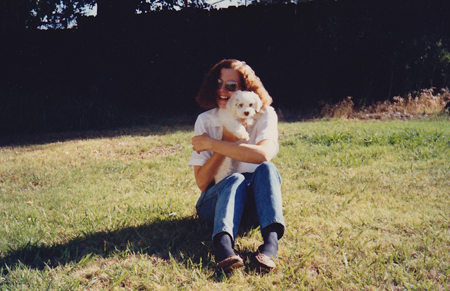
Mary and Charis, fall, 1991

We have shared every day for the last twenty years with one, or two, and recently three dogs (which is really too many but at the time we couldn’t say no).  We started this anniversary day with a walk in the park for our two rescue dogs, and then another class.  We’ve discovered that rescue dogs are analogous to foster kids – they have issues.  These two are doing pretty well with extra training (which I sometimes call, reform school, depending on their behavior).  A side benefit of the class is, it tires them out.  As I write this, they are sleeping like little angels.

Which is what they really are.  As William Stafford put it in his poem, “Choosing a Dog:”

“It’s love,” they say. You touch
the right one and a whole half of the universe
wakes up, a new half.

A few years after we got Charis, I spent some time as a volunteer for the Folsom City Zoo Sanctuary.  Vixen the fox had come there when she was four weeks old, so she got very used to humans.  So used to humans that she could milk it really well, and as a result, she was getting rather pudgy.  For her own health, some of the keepers and volunteers would leash her up and take her for walks.

Vixen the Fox, ca. 1995

Once or twice a week for several years, I would get there at 7:00 am and take this little wild animal for a walk through the rising dawn.  That was an unforgettable way to start the morning!  One day, someone at an 8:00 am meeting who hadn’t had his coffee said, “What the hell are you smiling about?”

“Long story,” I said.  And kept on smiling.  Through all of it, all of the ups and downs, the joys and the losses, that’s what it’s like when you share your life with dogs and their wild kin.

The Story of Charlotte’s Web by Michael Sims

In a recent interview on NPR, author Michael Sims discussed a project “that got really out of hand.”  He set out to do a natural history of children’s talking animal stories but became so fascinated by Charlotte’s Web that he never got beyond it.

Sim’s study, The Story of Charlotte’s Web: E.B. White’s Eccentric Life in Nature and the Birth of an American Classic, was published in June.  It’s interesting see what eccentricities and other facts Sims discovered about E.B. White.

White was quite a naturalist; on a farm in Maine, he studied spiders and raised pigs.  There really was a “Wilbur,” a pig that White was raising to slaughter in the fall, but it grew sick and died, despite all attempts to save it.  In his essay, “Death of a Pig,”  White recognized the irony of his sadness at the loss of an animal he had planned to kill, and his “sense of loss when the pig died, not as if he’d just lost some future bacon but as if he had lost…a fellow creature who was suffering in a suffering world.” 

Another time, while feeding the replacement Wilbur, White noticed a spider web with an egg sac.  The spider that wove the web disappeared, and White cut the egg sac down and carried it with him back to his apartment in New York.  He dropped it in a bureau drawer and forgot about it until the little spiders began to hatch.  According to Sims, White was delighted to watch them start to weave their webs in his room – that is, until the maid refused to work “in a spider refugee camp” and they had to go.

Sims explains that “eccentric” is a Greek word that originally meant, “off center.”  He goes on to say:

if ever there was a human being born off-center, it was E.B. White. He simply could not…follow in an established path if his life depended on it. And so he had his own quirky way. He was very fierce and funny hypochondriac. He liked to spend a lot of time alone. He loved working with animals, as much as possible. Even in New York City, even in writing for The New Yorker to begin with, he was off, you know, exploring what rats were doing in some alley.

Fans of E.B. White should enjoy listening to the interview or reading the transcript:  http://www.npr.org/2011/08/19/139790016/weaving-charlottes-web.  Of interest too, will be Michael Sims’s current project.  In keeping with his theme of “writing about how our imagination responds to nature in one way or another,” he is researching between the lines of Thoreau’s sojourn at Walden Pond to see how that great naturalist and philosopher filled up his days in ways we don’t yet know about.

Missy’s Homecoming Day, aka, Valentine’s Day

I’ve always been something of a Valentine’s Day Scrooge – “Humbug!”  Always, even in fifth grade, while trying to decipher the nuances of the text on candy kisses enclosed in the envelopes during the school Valentine swap.

I’m not doctrinaire about it.  I always bring Mary a card and some little treat.  And it is marvelous to stop to be mindful of the love and friendships we enjoy.  I’m just not a fan of Hallmark holidays.  It’s hard not to be a bit cynical when the hearts come out the last week of December, during the Christmas closeout sales.

Much of that cynicism ended two years ago, on Saturday, February 14, 2009, at noon.  Mary had spent the morning at Saint Francis Episcopal church.  Like their namesake, the good people there have a serious ministry with animals.  They rescue dogs and train them as companion and service animals for vets coming home from our wars.

Mary called to tell me an eight month old papillon had washed out of the program.  The little thing been mistreated or neglected, for she was much too hyper and skittish to make any kind of service training feasible.  “She is really sweet,” Mary said.  My wife later confessed that she was counting on me to be the voice of reason, and tell her to get real.  Didn’t happen!

Instead, I leashed up our other two dogs and took them over to meet Missy.  It was instant bonding, all around.  Humans and canines instantly warmed up to the little one, and she to us.  Thankfully, neither Mary nor I had any clue how much harder three dogs are to care for than two!  Missy was part of the family and we took her home within the hour.

Now Valentine’s day will forever have a face, one far more appealing than any stupid, rosy-cheeked cupid.  The hearts of people and animals do not seem to have any limits for how much love they can hold.  At this very moment I’m gazing at Missy curled up at my feet – one of the biggest hearts in one of the smallest beings I have ever had the joy of including in my life.

Missy

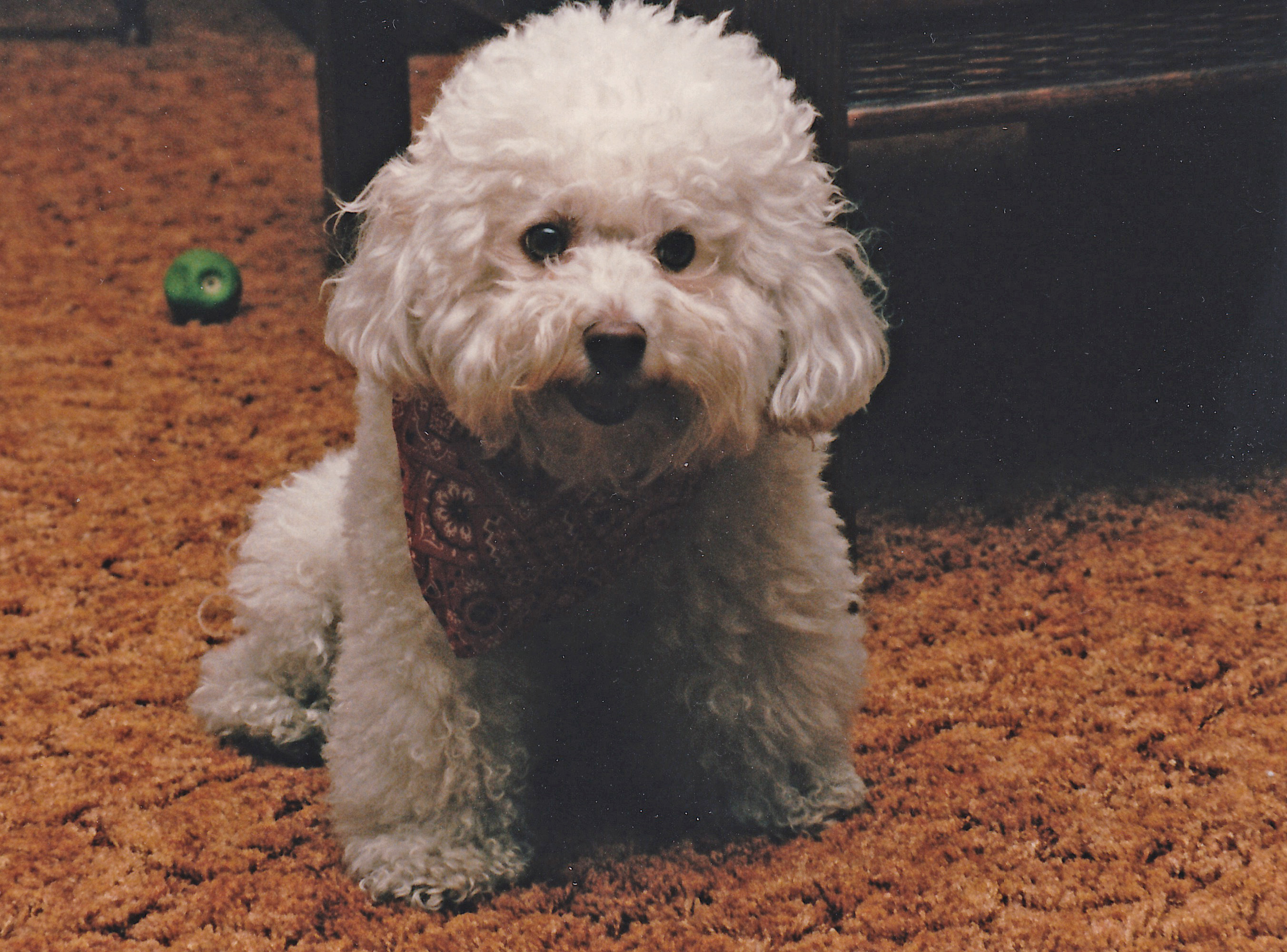
Charis – a Dog Story

We named our first dog Charis after Merlin’s mother in an Arthurian fantasy novel.  Some time later we realized the word meant “grace” in Greek.  That was just one of many things she brought into our lives.

We walked into the breeder’s living room where five little puppies huddled together in their pen.  Charis raised her head and hopped over her litter-mates to dash up to us, her little tail wagging furiously.  We took it as an omen – only later did we understand it was fairly predictable alpha behavior.  One of her mottoes could have been, “Obedience is optional.”  Luckily, “Will work for food,” was a motto too, so with the help of dog treats, we came to an understanding.

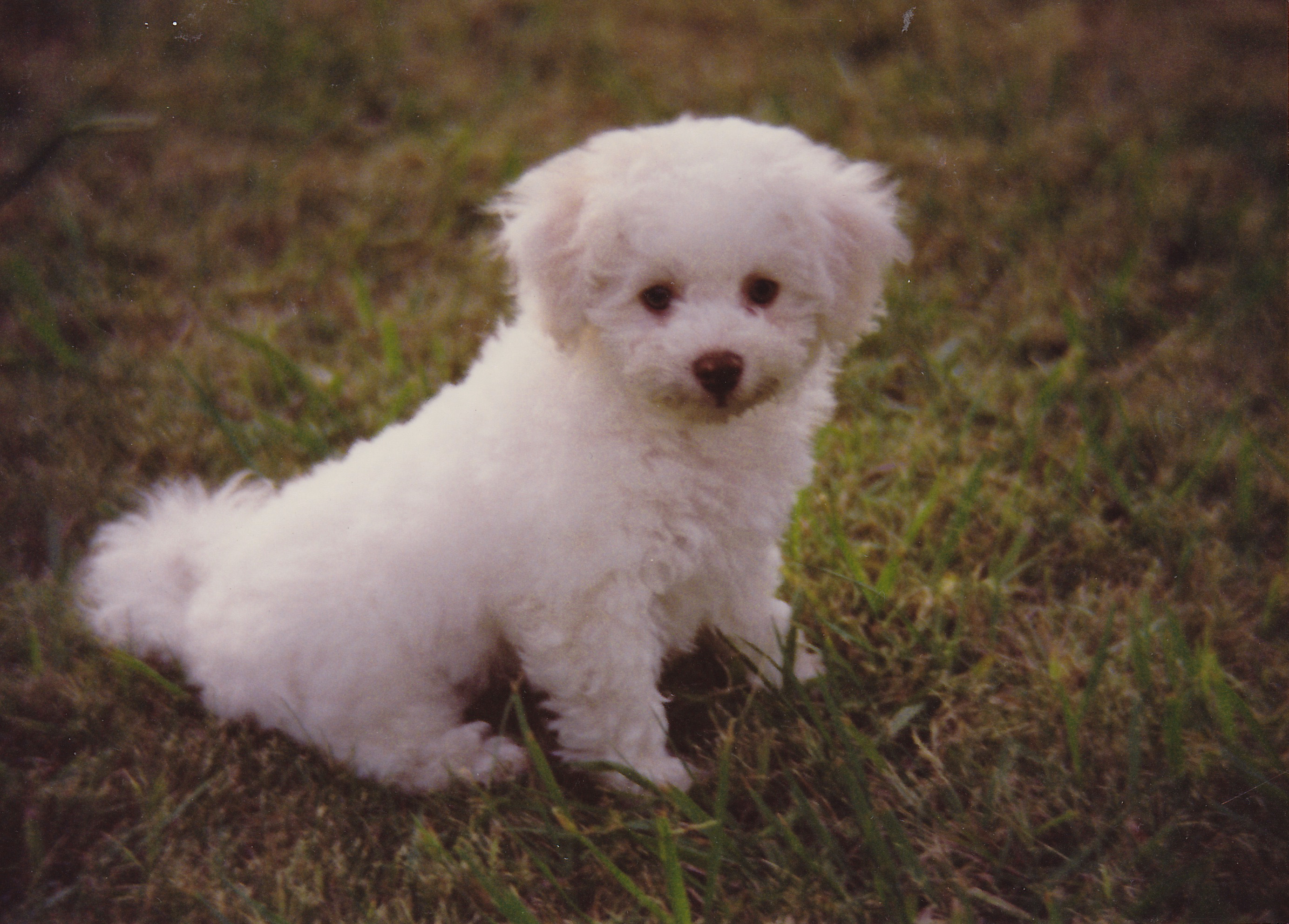
She was a purebred bichon frise, and we only got her because her red nose and blue eyes didn’t match the breed standard, so the breeder couldn’t use her as a show dog.  Her blue eyes turned gold by the time she was a year old, just like a wolf.  I thought she was about the most beautiful puppy I’d ever seen.

Charis as a puppy

Once we took her to a pet friendly motel on the Oregon coast that had it’s own nine-hole golf course. She was a trickster and a runner.  She scampered out the door as we were carrying things in and ran a merry chase, stopping to pee on several greens until another golfer called and she pranced up to him, wagging her tail, and for all you could tell, pleased as could be with herself.  The following year when we called, the motel was no longer pet friendly.  I’m not saying that Charis changed that all by herself, but still…

In the trickster mode - can you see it?

The same recessive gene that gave her wolf eyes, probably took her eyesight when she was 13.   She adapted to that pretty well, but also,  she was large for her breed, so by 14, she was blind and needed medication for joint problems. The vet said it might not be much longer. That night I dreamed that the aging Charis was not the real one. In the dream, I saw the real Charis dashing through the back yard, jumping over rocks and hurdles as if gravity didn’t exist.

But the Charis who had to deal with gravity and the passing of time could still go for walks, find her way around the house by smell and touch, and generally enjoy our company and that of her younger “sister.” It wasn’t quite time.

Charis

I think of her in November because the time finally came when she was 15 1/2.  We took her in to the vet for our final act of kindness four years ago on Veteran’s Day.  Extraordinarily difficult things happen to every one, but I have never had to initiate anything harder in my life.

There are some permanent lessons I learned at the end of her life, things that have stayed with me, but that’s for another time.  This is just a moment to remember, and put up several of my favorite photographs of a beautiful little soul that wore the shape of a dog for a few precious years.

Hamster Collaborates with Nobel Laureate

I love NPR!

During this morning’s commute, I learned how the spirit of play led two Russian-born scientists, Andre Geim and Konstantine Novoselov, to the discovery that won this year’s Nobel Prize in physics.

http://www.npr.org/templates/story/story.php?storyId=130344815

The pair teach at the University of Manchester in Britain, and the custom in their lab is to dedicate Friday afternoons to “crazy experiments.” One day, while picking up graphite with scotch tape, the idea that led to graphene was born. Graphene is a sheet of carbon one atom thick. It is the thinnest material on earth, 100 times stronger than steel, transparent, and an excellent conductor. Experiments with photovoltaic cells are already underway, and potential uses include better touch-screens, replacements for silicon transistors, and power generating clothing.

Geim, in particular, has a wacky streak. He once used magnetic fields to levitate a frog, and another time, listed his favorite hamster, Tish, as a collaborator on a scientific paper.

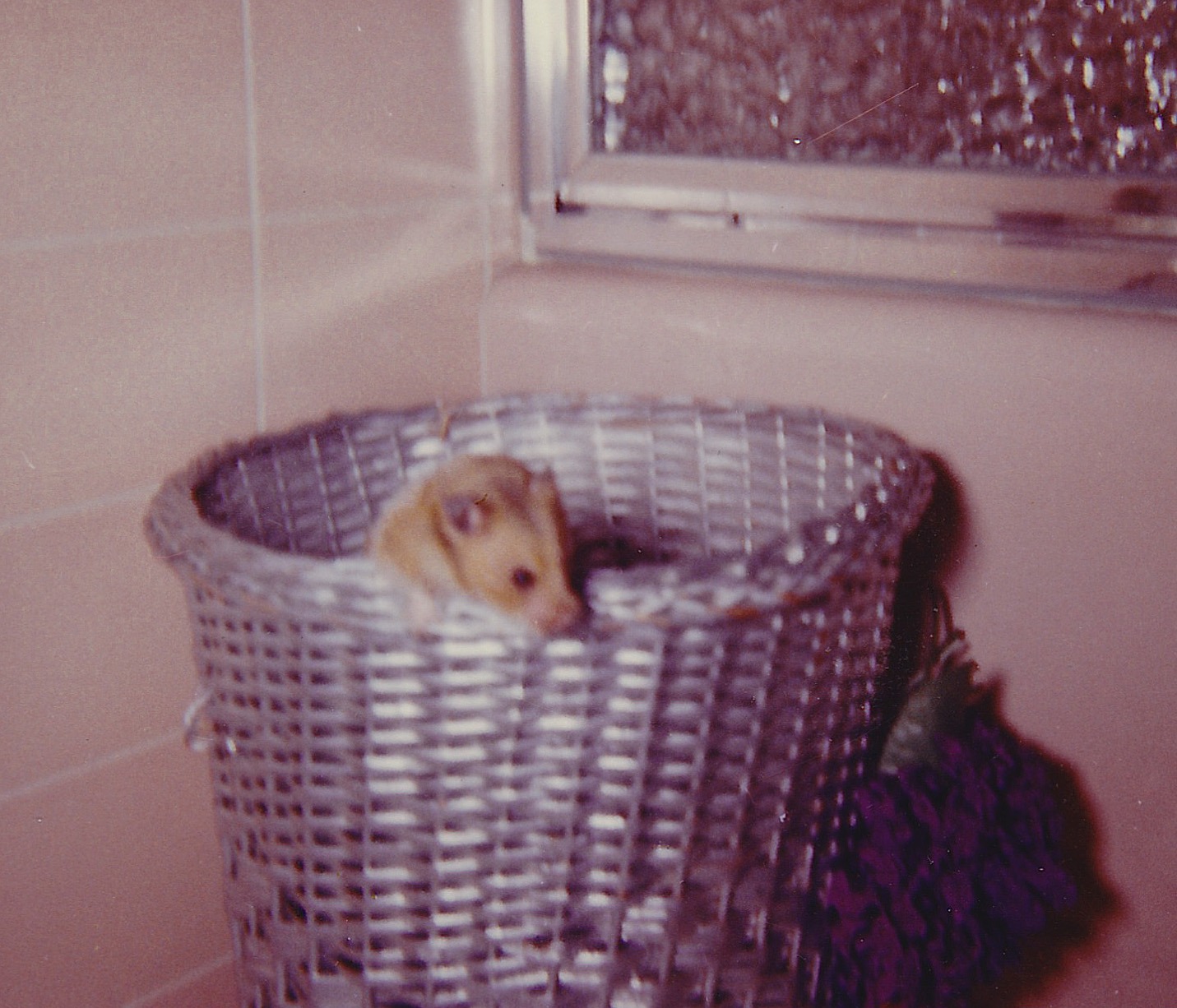
I can very much identify with that; my first serious literary project, in the fifth grade, was a sequel to Wind in the Willows, starring my hamster, Herman.

Herman gets some exercise

Doesn’t it seem like the funniest people are very, very serious about their humor?