
Thank you!

Thanks to everyone who stopped by this week to read and comment on “Tales of the Dummling” after it was freshly pressed.  I’ve been getting over a cold – fortunately not the nasty flu that’s going around, but bad enough that I was too tired to thank everyone who liked the post or signed up to follow thefirstgates.  Thank you now if I missed you then!

I’m grateful to the good folks at WordPress who singled out this particular post.  I was freshly pressed before, in 2011, which was exciting and encouraging, but this time the post truly mattered to me.  I won’t say I was, “Following my bliss,” because that phrase has been so over-used.  How about, “Following my feather?”  I didn’t think this kind of work would have that wide an appeal, but I’m happy to see that it does.

Your comments this week gave me many things to mull over.  Just like the very best stories, you raised questions I cannot easily answer.  Questions about the various goals that folktale characters pursue.  Questions about which attributes lead to success.  How and even whether to try to interpret fairytales – this is a topic I plan to address very soon.

Meanwhile, here is part of a post I started in December on what the stories tell us we need to do on a quest.  (Aren’t we are always on some kind of a quest?).

I called it, “What fairytales have to say about living in difficult times,” and though I don’t plan to finish it in its present form, I offer this portion of it as kind of an online journal entry, that’s bound to resurface later in some other form:

***

Dec. 12, 2012
In my previous post, I outlined a US intelligence report, Global Trends 2030, that listed factors likely to speed up the rate of change in our already fast moving world.  I ended with a question:  can fairytales tell us anything about living in difficult times?

I believe the answer is yes.  As James Hillman put it, “If we had more fairy tales when we were young, we’d need less therapy as adults.”  Fairytales always deal with crisis times.  Your father will die if you don’t find the water of life.  Your stepmother wants to kill you.  The king will cut off your head if you fail to capture  the firebird.

Lives are on the line in fairytales, and sometimes the characters don’t survive.  When they do, we find they share  certain characteristics which can be stated as guidelines for people on a quest, in the otherworld or in this one.

1. Never travel alone – successful quests demand allies.  Sometimes the hero or heroine assembles a group of companions with strange skills that prove to be essential.  At other times, a single helper is enough.  In longer tales the guide may change; a shaggy horse will become a spirit brother.  One of my psych professors claimed that the best chance of success in folklore belongs to those who win the help of an animal guide.  For Jung, such totem animals symbolize the “Self,” the center of our being, as well as our instincts, which get submerged in modern life.  On this point, all the world’s stories agree – our ordinary habits, ideas, and ways of doing things are never up to the most important tasks in life.
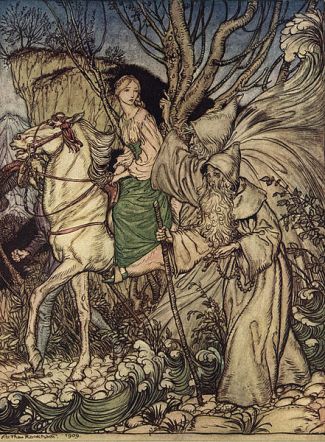
Undine by Arthur Rackham, 1909.  Public domain

Undine by Arthur Rackham, 1909. Public domain

Help often comes from people and places that “wise” people avoid.  The hideous hag or the strange man by the side of the road may hold the key to happiness and survival itself.  They reveal their secrets only to those who see and hear with the heart and their deepest wisdom.

2.  Be kind, but keep your wits about you:  In one story, a girl is kind to an ugly old hag and is rewarded.  Her step sisters mouth off, and forever after, toads fall from their mouths when they try to speak.  Kindness, respect, and compassion matter, yet some creatures are evil and we have to know the difference.  In the original version, Snow White falls for the witches tricks repeatedly (despite the dwarves warnings) before she finally takes a bite of the poison apple.  “Fool me twice, shame on me,” as the saying goes.  If strange little men give you shelter when you’re lost in the woods, you might want to heed their advice!

From an 1852 Icelandic translation of Snow White. Public Domain

3.  Be Flexible:  

4.   Trust Yourself and your instincts:

I cannot now remember what I was going to say about 3 and 4 – I’ll let you know when I figure it out, so please stay tuned!
Reflecting on 400 posts

It’s taken me a while to write about reaching this milestone, partly because I’ve been busy, and partly because it’s hard to wrap my mind around a number this big.  The only wise thought that comes to mind is, “Wow, that’s a lot of posts.”

Writing has always been a mode of discovery for me, a way of digging below the surface noise of the mind and excavating what I am really thinking/feeling/imagining at any particular point in time.  I like the image of archeology – writing as inner spade work.

Fiction most often reveals where imagination wants to go, while blogging typically tells me what I really think about the topic at hand.  I don’t much care for this western way of categorizing awareness.  I prefer the Tibetan conception where  “mind” resides at the heart chakra and includes thought, feeling, perception, imagination, and intuition – all the shifting contents of consciousness.  That seems closer to our lived experience.  When I say, “This is me,” I point to my heart not my head.

But I digress.

I am grateful to every one of my readers – I wouldn’t be doing this without you!  The realization that others find something useful in what I write is as thrilling now as it was when I first wrote stories in grade school.  I was especially gratified with your interest and encouragement for my exploration of Njal’s Saga.  I invested a lot of time and effort, and I’ll remember your response the next time such a major project tugs at my attention.

I don’t have any clear roadmap for the next 100 posts – it wouldn’t be exploration if I knew where I was going.  I hope you’ll ride along and continue to post your wonderful reactions!

Quite a few writers I know follow Kristen Lamb’s blog. She writes extensively about blogging, publishing, and the nuts and bolts of being an indie author.

Now, in response to the copyright lawsuit filed against Roni Loren (http://wp.me/pYql4-2fA), Kristen is using her organization, WANA (We are not alone) to create another source of copyright free images – the WANA Commons. Best of all, everyone is invited to contribute. Here’s a chance to give back to the blogging community, upload your own visual art to an appreciative audience, and strike (as the Jefferson Starship put it a long time ago) blows against the empire! Please check out Kristen’s post – to me, this is a very exciting project! – Morgan

Author Kristen Lamb's avatarKristen Lamb's Blog

First of all, I want you guys to know that I MISSED YOU! July was a whirlwind month for sure and reminded me of the days when I used to be on the road for sales. Wandering out of bed in the night to go to the bathroom, yet suddenly realizing you’re in a coat closet. Fun stuff!

We will talk about LA another day, because I have a GIFT for you guys. I KNOW! Another one? Hey, y’all are like my kids, and I’m a terrible mother because I dig spoiling every last one of you. Here, have some cake.

Most of you guys know I am all about writers blogging. Blogging plays to our strengths. Blogs are far less volatile than other types of social media. Twitter might be gone in a couple years, and Facebook could implode, but blogs will likely remain. This makes them one of…

View original post 1,370 more words

A warning about copyrights

Yesterday, friend and author, Amy Rogers, sent me a link to a recent account by a blogger who was sued after posting a copyrighted photograph.  In this case, attribution and a willingness to take down the image were not enough.  The photographer demanded compensation – “a significant chunk of money” – for the use of the photo over several week’s time.

Anyone who grabs or has grabbed pictures from Google images or related sources should read blogger, Roni Loren’s story. http://www.roniloren.com/blog/2012/7/20/bloggers-beware-you-can-get-sued-for-using-pics-on-your-blog.html

As I first read through the post, my thought was, “that’s nasty,” with a head shake for the litigious society we live in.  Then, as I scrolled through the comments, I saw several photographers say they were sick of seeing their images used without permission.  Regardless of anyone’s opinion, this is how it is.

Fortunately, Roni Loren provides some good info and links on finding millions of pictures that are okay to use.  Two sites in particular are Wikipedia Commons and Creative Commons.  Here is an exceptional article by Megan Ward on finding photos on Creative Commons and what the various usage codes mean.

http://meghanward.com/blog/2012/06/21/where-to-get-photos-for-your-blog/

I used Ward’s guidelines to search for replacements for several landscape photos in an earlier post, and found 60 nice ones to choose from, licensed by the artists to Creative Commons, with simple conditions like attribution and links to a website.

The first link given above, to Roni Loren’s article, references  a Wikipedia article on public domain, with websites for literally millions of images bloggers are free to use, arranged in dozens of categories.  I clicked on one link of public domain photos from WWI, and was pleased to recognize the site I had used for an earlier post on the Christmas Truce.  In general, copyrights are time limited, but research is necessary.

I had already learned to read the fine print in books I set out to review.  Some allow you to quote small sections for review purposes and some do not.  This is a similar exercise and one that is clearly just as important.

Many thanks to Amy for bringing this to my attention, and to Roni Loren for sharing her painful experience.  She urged other bloggers to pass it on, so consider doing so.

Michael Meade on Imagination and Being Ourselves

If you ask people to name the problems facing our country today, you get a fairly uniform set of answers:  economic stagnation and political stalemate are likely to head the list.  If you ask the cause of these challenges, agreement is likely to end.  Very few people will answer, as Michael Meade does, that we suffer from a poverty of imagination.  In a recent blog article on The Huffington Post, Meade says:

“Stagnation in the economy and “stalemation” in the political system stem from a collapse of imagination and increasing blindness about what a culture is supposed to cultivate and what a civil society is truly about…The problem is not simply a lack of work or a paucity of jobs. The problem is that genuine solutions to persistent problems require the kind of vision that transcends single-minded ideologies, rigid belief systems, and exaggerated self-interest.”  http://www.huffingtonpost.com/michael-meade-dhl/be-yourself_b_1640162.html

Meade reminds us that while any job may look good if we don’t have one, it’s not enough to satisfy the soul.  What we really want is to find our unique calling, in an atmosphere that now seems especially toxic to such a search.

This post is another in Meade’s ongoing series on the theme of our inner genius and how we might learn to listen and see what it wants.  He doesn’t offer simple or short term answers, but he does remind us of how much the quality of our lives depend on the quest:

“To become nobody but yourself, to struggle against the tide of sameness and the false security of simply fitting in — that is a fight worth having. To become oneself by finding a way to contribute one’s god-given talents and natural genius to this troubled world; that is the job to keep applying for. The real work in this life is not simply to succeed and “become somebody”; the real issue is to become one’s intended self.”

I encourage you to read this article and some of Meade’s other posts on becoming ourselves.

Happy Belated Birthday!

June 28 was the second anniversary of this blog, and I forgot about it until yesterday.  I’ve been preoccupied with offline things.

An out of town series of Tibetan teachings involves a lot of driving as well as study and practice.  The special needs of a very elderly dog (who is doing better for now) takes time and energy.  A neighbor and I were splitting large tree trunks when the rented splitter conked out, and we have to get back to it this week.  Most recently, Mary and I have been discussing a possible trip to Iceland (that’s Iceland not Ireland), with a small group of storytellers in late September.  You’re sure to hear more if it pans out.

A year ago, I appear to have been a more contentious blogger.  I wrote a summary of my experiences at the one year anniversary that made Freshly Pressed: http://wp.me/pYql4-10O.  One thing I mentioned then still happens – I post something and get up thinking,”That’s it.  I’ve run out of things to say.  It was a nice run while it lasted.”

On other occasions, I’ll read an older post and wonder, “What on earthwas I thinking?”

My rule of thumb for such moments is, “Don’t sweat it.”  A few days go by, and I get caught up in another idea.  Now I even know what my mission statement is, though I give myself permission to ignore it when necessary:

“To explore the reality in all fantasies and the fantasy in realities.”

One more thing hasn’t changed – readers keep me going.  People who visit and leave a comment, who point out a flaw or something they like, make it all worthwhile and keep me going.

Thank you very much!!!

Michael Meade on Genius

We all know what genius means in the modern sense of the word:  people like Einstein, Shakespeare, Leonardo, and Beethoven.  As far as I know, the image of the solitary genius, often suffering and at odds with the culture, is an artifact of the romantic era.  The word and original concept came from Rome, where it meant something else.

“In ancient Roman religion, the genius was the individual instance of a general divine nature that is present in every individual person, place, or thing.  The rational powers and abilities of each and every human being were attributed to his soul, which was a genius.” Wikipedia.  

The Three Graces – Pompeii fresco

In his blog on the Huffington post, Michael Meade has started a series on genius that delves into this classical meaning. Meade says:

“Genius involves deeply subjective qualities and an inner pattern that marks each person as unique in some way and genius tries to leave that mark on the world. Since the genius in a person is ageless it can awaken at almost any age.”

He then adds,

“An old Greek word for happiness translates as having a satisfied genius. Recognizing and following the promptings of one’s inner-genius can be one of the most fulfilling experiences of life even if all else has been reduced to garbage and scraps.”

Michael Meade

In these terms, genius has little to do with most of our cultural assumptions about the word, like IQ, conventional success, or 15 minutes of fame.  It is more like what we mean when we speak of “marching to one’s own drummer.”

I invite everyone to read Meade’s post and watch for the next in his series which will focus on “the genius zone.”

http://www.huffingtonpost.com/michael-meade-dhl/genius-fame_b_1563235.html