Remember Real Money?

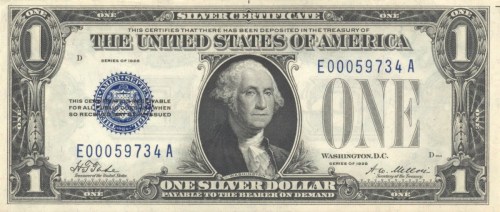
US Silver Certificate

In 1965, my father, who worked for IBM, was assigned to the south of France for two years, so the family packed up for Europe.  Back then, except for a few parodies in Pink Panther and James Bond movies, Americans in Europe got some respect.  Our money got a whole lot of respect – everyone wanted dollars.

My mother, who was an artist and appreciated fine drawing and engraving, drew the line at most European currencies.  “It looks like play money,” she said.  No wonder!  It was colorful and had big heads!  Real money, like good old yankee greenbacks, was sober and serious – it was monochrome and the heads were decently small.  I laughed the other day at a fast food restaurant.  I handed the clerk a twenty and he held it up to the light.  No one trusts a big-head!
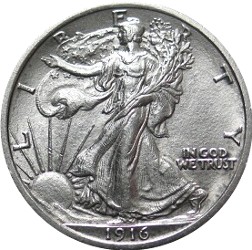
Our coins contained silver through 1965

My father was involved in the early development of magnetic card readers.  I remember his mood of euphoria the day engineers succeeded in programming a “1” and a “0” on a magnetic strip.  He announced that someday none of us would carry money at all.

“That sucks,” I said – my usual answer to my father when I was a teenager.  I thought of him today as I used my iPhone to buy a frappacino and then glanced at the budget headlines as I carried it out the door.

Money has always been abstract:  the great Lakota medicine man, Black Elk, called gold, “the yellow metal that drives men crazy.”  To his people, gold was just a pretty stone in the river – nothing to get excited about.

Now money is virtual as well – I used a pattern of pixels to buy my drink.  That doesn’t mean it doesn’t have as much power as it ever did – you can’t see or touch the wind, but this year especially, we have seen what it can do.  Still, in some ways, the increasingly non-material nature of money makes it seem all the more open to abuse.  As I understand it, the Fed doesn’t even have to print big-heads to increase the money supply – a few keystrokes will do it.

Standing liberty quarter

In truth, I love the convenience of electronic money.  A decade ago, when I was managing our affairs and my fathers, I had to write out 30-40 checks a month, a task that took a lot of time and was always subject to error, for my mind wanders when it is bored.  One Friday evening I wrote a payee the entire amount of my paycheck.  Luckily, that honest woman called me a few days later and said, “Uh, sir, I think you made a mistake.”

Abstract or not, we use our money for concrete things – a meal, a car, a house, a movie ticket, a new pair of shoes.  One immediately thinks of bartering, but these days, that seem rather strange.  In the last elections, a conservative senate candidate from Nevada suggested people might think of barter if their medical costs were too high.  Her opponents jumped on that statement, and their slogan, “Chickens for checkups” was a factor in her loss.

There is one aspect of money we do not think of often – in some of its forms, it is beautiful.  When I was a kid, I collected coins – just pennies for the most part.  I tended to spend anything bigger on baseball cards.  Now I have come to appreciate the sheer beauty of the two types of coins pictured here:  walking liberty halves, and standing liberty quarters.  These pictures show the amazing quality of the engraving.  Coins in this condition are premium, but fortunately, more heavily circulated specimens can be purchased for just a few dollars.  It’s quite an exercise in imagination to hold a coin that is 80 or 100 years old and wonder about its story.

It’s a lot more fun to think in these terms – of the beauty of money – than it is to think of our headlines or watch politicians on TV.  One thing “those European countries” did when we lived abroad, was periodically throw their governments out.  Even now, some nations hold votes of no confidence, which amount to a mass recall.  I remember feeling superior to that  – our system worked after all.  Now as I look at the big-heads in my wallet  – my mother’s old criterion for funny money – I doubt that I am alone in the fantasy of charging our leaders with high crimes of cluelessness and voting the rascals out.

Disruptive Technologies and the End of Borders.

In the electronics industry, one of our truisms was that change is the only constant.  We also talked and thought a lot about “disruptive technologies.”  The term was coined by Clayton Christensen in a 1995 article and elaborated in his 1997 book, The Innovator’s Dilemma.  Even well managed firms (and Borders does not seem to have been one of these), can be blindsided by failing to recognize “the next big thing.”  This is because its first manifestations tend to be clunky and crude.

The makers of fine coaches were probably not too worried when the first loud, dirty, and expensive horseless carriages appeared.  The empty factories and smokestacks in Rochester, NY are mute witnesses to Kodak’s failure to recognize the threat that digital photography posed to their chemical business.  Tower Books, which I loved, failed to develop an online presence, and Borders, among other things, was late to the eReader party.

There is no good news in this for anyone, least of all the 11,000 employees who are out of a job.  Or everyone who found wonderful things while browsing the stacks.  Even the idea that disappearing big-box bookstores will give indies a second chance seems unlikely.  One writer interviewed on NPR, whose books are carried by Borders, suggested that future bookstores may resemble what you find in airports:  “cookbooks, vampire novels, and celebrity tell-alls.”  http://www.npr.org/2011/07/19/138499967/mich-book-chain-borders-closing-after-40-years

I remember a college town where a wonderful independent bookstore closed soon after a Borders opened. Now it has come full circle and both are gone.  All I can think of are these words of the late George Harrison: All things must pass.

So Long to the Space Shuttle

Yesterday afternoon, I stopped at a Starbucks and used an app on my smartphone to pay for a drink.  Then I glanced at my email while waiting for the barista to finish my frappacino.  I would not be doing any of that without the the US space program, which has reached the end of an era with the last space shuttle flight.

For it was during the ten year “space race” to put a man on the moon, that miniturization of electronices found the means, motive, and opportunity to thrive.  Intel opened its doors in July, 1968, a year before the moon landing, with 100 employees and a plan to make SRAM’s.  Three years later, when they introduced the first microprocessor, the game was afoot.

In hindsight, we can see that during the tech boom, the law of unintended consequences was operating full tilt, carrying many seeds of our current bust:  the sophistication of the internet which enables the “offshoring” of hundreds of thousands of jobs even as ever increasing “efficiencies” allow employers to do more with fewer people.

Where will the “next new thing” come from?  From dreamers like  Jobs and Wozniak, who built the first Apple computer in their garage.  Or from childhood friends, like Bill Gates and Paul Allen, who were inspired by the January 1975 issue of Popular Electronics to build and sell an early BASIC Interpreter and form a company that Allen named, “Micro-Soft.”

***

In 1972, when Adam Frank was ten years old, a collection of books on space exploration  in the local library changed his life.  He decided to become a scientist.  Now an astrophysicist, teaching at the University of Rochester, he asked a number of scientists across disciplines what set them on their path.  He found that fully three generations of dreamers claim they were inspired by NASA.  What is going to ispire the next generation of scientists, he asks, for:

The loss of that dream would feel terrible for the 10-year-old I was all those years ago. More importantly, it would be a terrible loss for all the 10-year-olds dreaming now of exploration and science. And for a nation that needs science and scientists to survive, it would the most terrible loss of all.  http://www.npr.org/blogs/13.7/2011/07/08/137678718/the-inspiration-gap-and-the-shuttles-last-launch

***

Beyond all practical considerations, the space program gave moments that those who lived through them will never forget.  If you’re old enough, you probably remember exactly where you were and what you were doing when Neil Armstrong stepped onto the moon.

You probably also remember that beautiful day in January day when Challenger exploded.  Who had any idea that the loss of that crew could cut so deep?

We all know there are rhythms of expansion and contraction, of dreaming and the end of dreams.  The stars aren’t going anywhere.  Let’s hope we are able to stretch ourselves toward them again soon.

State Parks That Are Going Away

Don’t it always seem to go, that you don’t know what you got till it’s gone – Joni Mitchell

An article in Sunday’s Sacramento Bee, “A State Park Bucket List,” gave pictures and descriptions of 15 favorites among the 70 parks and historical sites we may only have another 13 months to see. http://www.sacbee.com/2011/06/05/3673215/a-state-park-bucket-list.html

Casualties of the California budget crisis, all these sites are scheduled to close in July, 2012.  Without ongoing maintenance, many of these parks, and especially those with old or historic structures, may never open again.

This includes the Jack London State Historical Park, which I wrote about on this blog last fall. https://thefirstgates.com/2010/10/23/of-words-and-wolves-thoughts-on-jack-london/

It includes the Bidwell Mansion in Chico, home of Gen. John and Anne Bidwell, founders of the town, who donated a magnificent 3600 acre park where the Sherwood Forest scenes for the 1938 Robin Hood withErrol Flynn were filmed.  Sherwood is a pleasant walk or bycycle ride from the center of town.

Those who can might want to check the newspaper link and plan a trip to see some of these gems while they still are open.

PS – One of my facebook friends just gave me this website which is open for donations to help save these parks, under the auspices of the California Institute of Man in Nature:   http://www.johnolmsted.net/   Donation buckets with the John Olmstead logo are also going to be available at California parks this summer.  FWIW, I just made a small donation through paypal.

Bill Moyers Journal: The Conversation Continues

“Democracy cannot survive without disinterested people to speak truth to power.”  –  Bill Moyers on NPR, May 23, 1011

I interrupt my previous thought train (unforgettable stories) to suggest that everyone listen to an unforgettable journalist who I happened to catch on “Talk of the Nation” on NPR yesterday:  http://www.npr.org/2011/05/23/136583949/bill-moyers-shares-favorite-journal-interviews.  This was a compelling conversation with a man of high ideals, who isn’t afraid to speak uncomfortable truths.

We like to think of ourselves as democracy, Moyers said, but the word “oligarchy” better describes our government – rule by a few people of wealth and power, who do things like deregulate banking and finance, which guarantees that events like our recent financial disaster will happen again, since nothing structural has changed.  Few significant differences remain between Republicans and Democrats, Moyers added, and neither party really cares for he interests of working people.  Yet Moyers’ voice was animated and full of joy and hope.  As well as current events, Moyers talked of his love for poetry and the inspiration he and millions of PBS viewers found in his conversations with Joseph Campbell.

This interview celebrated the publication of Moyers collection of 47 interview with “independent thinkers,” taken from his PBS probram, “Bill Moyers Journal,” that ran from 2007-2010.  This isn’t the sort of book I usually read, but Moyers is one of those rare talents, like Ken Burns, who I will listen to no matter where he chooses to go.  I downloaded the book to my kindle, and after listening to the radio interview, you may just do the same.

More on the eBook Gold Rush

I live about two miles north of the American River.  In 1848, “Captain” John Sutter, who owned this part of the territory, hired John Marshall to build a sawmill on the American not too far upstream, in the town of Coloma.   On the morning of January 24, Marshall spotted some flecks of yellow metal in the mill race.  He knew gold when he saw it.  Marshall tried to keep his discovery a secret, and we all know how that worked out.

Replica of Sutter's Mill at the Gold Discovery Site

 This bit of local history came to mind when I spotted an article in Forbes called, “Who Wants to be a Kindle Millionaire?”  http://blogs.forbes.com/kiriblakeley/2011/03/06/who-wants-to-be-a-kindle-millionaire/?

I would not have bothered with another post about Amanda Hocking, except this piece is writen by a traditionally published author, Kiri Blakeley, who writes in a very measured tone about Hocking’s success and the reality of traditional publsihing:

There used to be a time, not too long ago, when traditional publishing had many benefits…Publishers…used to do all kinds of nifty things for their authors, like throw them a cool book party, send them on a book tour, get their books reviewed in the press and give manuscripts loving yet eagle-eyed editing. Now, chances are an author doesn’t get any of those things—unless she’s on a reality TV show.

Blakeley continues:

… going with a traditional publisher can be extremely expensive. Authors are generally expected to pick up costs for their book’s website, a book’s outside publicist, marketing materials like postcards, and any costs associated with readings or tours. All of this can run into the tens of thousands of dollars. Trust me, I know.

This post is also worth reading because Blakeley’s interview with Amanda Hocking shows the young author to be very savvy about the uniqueness of her success, and dismissive of all the talk about the death knell of traditional publishing. 

Still, with the flurry of articles, you have to assume that every writer, editor, and agent with a computer has heard that Amanda Hocking struck the mother lode.  I have to think that when Forbes runs an article asking who wants to be a kindle millionaire, there are writers buying mules, covered wagons, and gold pans,and  firing up their laptops, and googling, “vampires.”

I find myself humming the naughty verse to “Oh Susannah,” and trying to make up more.

Read an eBook Week and Amazon in the News

Read an Ebook Week

This is Read an Ebook Week according to Catana, whose blog, “Tracking the Words,” is dedicated to exploring and entering the world of ebook publishing.  Check out the article here:  http://writingcycle.wordpress.com/2011/03/06/read-an-e-book-week/

Among other things, you can find special freebees and offers on Smashwords this week (a permanent link is now on my Blogroll).

And in case anyone hasn’t checked, you do not need special hardware to read an ebook.  All the major sellers have free apps for pc’s, macs, smart phones and tablets, so this might be a good time to take a look.

Amazon the Tax Evader?

A scathing editorial in the Sacramento Bee this morning condemned Amazon for refusing to pay state sales tax, and threatening California based affiliates if the legislature forces their hand.  http://www.sacbee.com/2011/03/07/3454226/amazon-refuses-to-pay-its-share.html

Weren’t all online sales initially tax free?  After that I thought it had to do with whether or not a company has a brick and mortar presence in the state in question.  Now with so many states in dire financial circumstances, I’m sure it’s only a matter of time until every online purchase is taxed.

There seems a bit much hand-wringing in this editorial though.  Noting that the state deficit is $26.5 billion, and uncollected taxes from Amazon total $300 million, it’s a bit disingenuous to suggest we blame Amazon if there’s not a cop when we need one, or if a disabled family member can no longer get in-home care.

Still, there’s the issue of fairness, and the local paper quotes the Seattle Times:  Amazon is a giant. It has helped drive hundreds, and maybe thousands, of bookstores out of business. The Internet retail industry already has a cost-of-real-estate advantage over free-standing stores. It should not have a tax advantage as well.

Given that eventual taxation is inevitable, the statement that really interested me is that Amazon “helped drive hundreds, maybe thousands of bookstores out of business.”

I’m skeptical of this one, for several reasons.

1)  I can think of several towns, like San Luis Obispo, where it was big box brick and mortar stores, rather than Amazon, that drove the appealing Indies away.

2)  Businesses big and small that ignored the web, including Tower, which I loved, are going or gone, but lavish web sites do not seem necessary to survive and thrive.  I’ve bought several rare editions from mom and pop used bookstores, with simple small-business type web sites.  You could argue that Amazon is one of the two major venues (eBay being the other) that give such enterprises a place in the virtual mall to display their wares.

These certainly are rapidly changing times.  How do you feel about it?  Is Amazon an enemy of the little guy?  A champion of the little guy?  Both?  Neither?  Email if you want more space to voice an opinion than a comment allows.

Welcome to the New World Order

The title of this post is actually a lyric from one of the Springsteen songs I posted, but also fits what I want to talk about today.

One afternoon twenty years ago, as I sat in my cubicle watching the clock inch toward 5:00, two friends from the IT department came over and asked if they could install something interesting called, “Mosaic” on my computer.  Ready for any diversion, I said, “Sure.

For those who do not remember, Mosaic was the first publically available internet browser. I spent the next three hours transfixed, only logging off when hunger drove me from the building. I didn’t realize I had witnessed something as significant as the steam engine – the world had started to change.

The other half of this equation manifested within the year – NAFTA – although us techies were slow to see what was happening as we continued to rake in the bonuses, at least for a while, for enabling the change.

It’s old news now:  the twin engines of the internet and globalization have changed the landscape of work forever, for everyone.  According to two significant articles I came upon recently, too few of our leaders are acknowledging what everyone in the trenches knows.

I glossed over the articles in my Springsteen post, which does not do them justice; both are worth reading.  The gist is that no amount of stimulus money, or politicians “plans,” or “business friendly environments” are going to bring back many jobs that a changing world has made obsolete.  In this country, economic recovery will not restore opportunities for elevator operators, gas station attendants, most travel agents, most manufacturing workers, or the tens of thousands of software engineers whose work is now done overseas.  New “efficiencies” have allowed occupations in all industries to be “right-sized.”

Here are the articles:

“Where the Jobs Aren’t:  Grappling With Structural Unemployment,” by Zachary Karabell, Time, January 17, 1011.
http://www.time.com/time/business/article/0,8599,2040966,00.html/

“Many Jobs Gone Forever Despite Onset of Recovery,” by Darry Sragow, The Sacramento Bee, Jan. 8, 2011,
http://www.sacbee.com/2011/01/08/3308378/many-jobs-gone-forever-despite.html/


In my opinion, all this was well underway ten years ago, but masked by a decade-long economic sugar-rush comprised of a housing bubble and military spending.  Quite a few people saw it for what it was.  In 2005, someone on a financial bulletin board quipped that soon Americans would earn their living selling each other beanie babies on eBay.

The grand irony as a tech worker over the last decade has been seeing so many positions eliminated as a direct result of our success.  Young yang always becomes old yang, according to the I Ching.

***

I have been thinking about how this affects writers.   On one hand, as Dylan said, “When you got nothin’ you got nothin’ to loose.”  I know published authors, but none who make their living solely from writing.   A while ago, someone asked Gary Snyder what he would do if he was just starting out as a poet.  Snyder, who has written poems about fixing old pickups, said he’d probably get a day-job as an auto mechanic.  For most of us, with vocations different from our avocation, not too much has changed.

This may be Pollyanna-ish, but I tend to think the internet represents mostly upside for us.  I do not mean just opportunities for exposure, though these are important, and I am certain new avenues will continue to emerge.

I am talking of information or services that one may fairly ask and receive payment for.  One example is Randy Ingermanson, whose AdvancedFictionWriting.com is listed on my Blogroll.  He charges a nominal fee for some of his online classes, and if they are as worthwhile as his free discussion of the “Snowflake Method” (for working out plot and structure), they are probably worth the cost.

The internet holds more information and services than any of us could use in ten lifteimes.  How does any one site rise above the crowd?  By specializing, somehow aligning with personal passion, I suspect.  Beyond Google I probably visit no more than a dozen sites on a regular basis, all of them very focused on topics of interest to me.

Sometimes over coffee I fantasize different internet ventures the way I fantasize story plots.  It recently struck me that it’s probably harder to write even a bad novel than to dream up an online venture that could generate income, if one was so moved and motivated.

What does it take after all, at a minimum, to write a novel?

  • A high degree of desire and determination.
  • In depth knowlege of fiction in general and one’s genre in particular.
  • Imagination to dream up story ideas, pick one, and continuously refine it.
  • The company of like minded people for advice and support.
  • Several years worth of evenings and weekends.

Isn’t it likely that if someone focused this kind of effort on an online endeavor, something worthwhile would come of it?  And if it happened to mesh with one’s passion…well, that is worth pondering over a cup of coffee.   Hmmm, now what features would you want in a beanie baby exchange?