When governments work as they should

An inspirational article in Sunday’s Sacramento Bee reminds us of what can be done when governments are composed of adults who are willing to work together toward a common goal.

An agreement between the California State Parks Department and local Indian tribal governments allowed an important ceremonial structure, closed for five years because of fire damage, to be reopened for an annual all-tribes gathering for dance and ritual this past weekend.

In question was the roundhouse at Indian Grinding Rock State Park, or Chaw’se in the Miwok language.

Chaw'se Roundhouse, photo by Mary Mussell.  When this photo was taken, Jan. 2011, the structure was closed

Chaw’se Roundhouse, photo by Mary Mussell. When this photo was taken, Jan. 2011, the structure was closed

The state said the cedar roof on the roundhouse, which is 60′ wide, had to be replaced, but the tribes could not agree on how to approach the task without disturbing ancestral spirits. Finally, Adam Dalton, chairman of the Jackson Rancheria Miwoks, offered to bring in a native construction crew, to work in cooperation with a state appointed structural engineer, while dismantling the damaged parts of the roundhouse with proper ceremonies.

Local tribes gathered each fall for thousands of years in the Grinding Rocks area to harvest the abundant acorns.  The park takes its name from the 1185 mortar holes left in the soft limestone slabs, where native women ground the acorns.  Some of the petroglyphs, carved between the mortar holes, are 2,000-3,000 years old.

Grinding Rock Mortar Holes

Grinding Rock Mortar Holes

The park, some 50 miles southeast of Sacramento, near Jackson, is one of my favorite destinations in the foothills, especially at this time of year or in the spring.  If you’re ever in the area, it’s well worth a visit.  Detailed information and history can be found on the park’s website.

Now, in addition to natural beauty and historical interest, the grounds at Chaw’se stand for the way governments are supposed to work.

The Vikings

The Vikings - a new, 9 part series on the History Channel

The Vikings – a new, 9 part series on the History Channel

On Sunday night, I watched episode one of The Vikings, a new dramatic series on the History Channel that begins with the ambitions of an 8th century Scandinavian warrior and farmer, Ragnar Lothbrok, who has heard rumors of wealthy places to the west called England and Ireland.

I was especially interested in the series after visiting Iceland last fall and delving into Icelandic sagas which chronicle the same culture 200 years later, after they’ve mastered the art of navigation on the open sea.  (search on “Iceland” on this blog to see the writings and photos that followed that trip).  All the details on episode one fit what I learned in terms of historical accuracy.   I’m looking forward to watching the next eight episodes in the series.

Episode one depicted a violent culture, but one with its own detailed code of honor.  In that respect, it mirrored the Old Testament world presented in episode one of “The Bible,” which came on next on the History Channel.  Plenty of smiting in both cultures.

I recommend the series.  Anyone who is interested can check out episode one on Hulu:  The Vikings on Hulu.

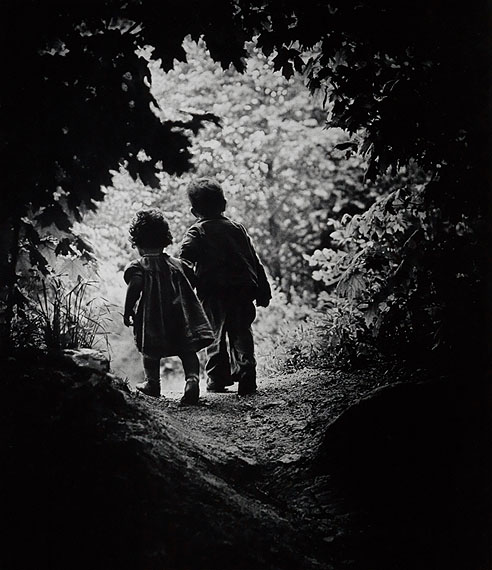
The Walk to Paradise Garden

Recent events brought to mind a photograph by W. Eugene Smith (1918-1978), one of the greatest photojournalists of all time.  Forgetful of personal risk, Smith wedded “news” photographs to a powerful aesthetic sensibility, creating a body of unforgettable work.

Smith was an idealist.  During WWII, he aimed for nothing less than showing the horrors of war so vividly that people would recoil from the prospect in the future.  As a Life Magazine photographer, he landed with marines during 13 Pacific island invasions, including the battles of Saipan, Guam, Iwo Jima, and Okinawa.

His almost legendary luck deserted him on Okinawa, when he was hit in the face and hand by mortar fragments.  “I forgot to duck but I got a wonderful shot of those who did,” he said.  “My policy of standing up when the others are down finally caught up with me.”  

Two years and 30 operations later he was still not sure he’d be able to use a camera again.  “The day I again tried for the first time to make a photograph I could barely load the roll of film into the camera. Yet I was determined that the first photograph would be a contrast to the war photographs and that it would speak an affirmation of life.”  

He followed his children as they went for a walk.  Fighting pain in his spine and hand, he took a single picture he called, “The Walk to Paradise Garden.”

The Walk to Paradise Garden by W. Eugene Smith

“The Walk to Paradise Garden” by W. Eugene Smith

The photo achieved world-wide fame when Edward Steichen chose it as the final image in his “Family of Man” exhibit in 1955.  Smith later wrote, “While I followed my children into the undergrowth and the group of taller trees…I suddenly realized that at this moment, in spite of everything, in spite of all the wars and all I had gone through…I wanted to sing a sonnet to life and to the courage to go on living it.”

I think as 2012 draws to a close, we all are in need of “sonnets to life and to the courage to go on living it.”  Smith’s photograph is the one that I am thinking of at this time.

The Princess Mary box and the Christmas Truce

When I was between the ages of 15 and 17, my family lived in France. One day in the flea markets outside Paris, I found a little brass box that bore my initials, MM, as well as a woman’s head in profile.  The inscription above the head read, “Imperium Britannicum” and below that, “Christmas 1914.”  The names of Britain’s WWI allies were printed around the perimeter:  France, Russia, Belgium, Serbia, Monte Negro, and Japan.

princess mary box

I bought the box – I don’t remember how much it cost – and have always kept little treasures inside.  Thanks to the internet, I discovered what it really is:  a Princess Mary Box, one of 400,000 gift boxes sent to British troops on the western front in time for Christmas 98 years ago [108 years ago in 2022].  The campaign to distribute the presents was led by Mary, the seventeen year old daughter of King George V.

***

In December, 1914, the first world war was four months old.  The German invasion of France had been stopped at the Marne that fall.  Both sides dug in for the winter, confident of a breakthrough in the spring that would end the war.  The first trenches were hastily dug, with no provision for drainage.  The winter was wet and cold, and the men spent their days knee deep in freezing water, with no way to get warm.

As Christmas neared, gifts began to arrive, which lifted the spirits of the troops.  According to firstworldwar.com, the men of the British Expeditionary Force got plum puddings and:

“Princess Mary boxes”; a metal case engraved with an outline of George V’s daughter and filled with chocolates and butterscotch, cigarettes and tobacco, a picture card of Princess Mary and a facsimile of George V’s greeting to the troops, “May God protect you and bring you safe home.” 

Princess Mary was 17 when she arranged for gift boxes for the troops.

The Germans got presents too, like meerschaum pipes, food, and small Christmas trees which they attached to the top of the trenches. A British Daily Telegraph correspondent reported that somehow the Germans slipped a chocolate cake into one section of the British lines, along with a request for a cease-fire that evening for a concert. The British agreed and sent gifts of tobacco in return.

That night, at 7:30, the German’s lit candles.  They raised their heads above the trenches and began to sing.  Later they called to the British to join in.  One Tommy yelled, “I’d rather die than sing in German.”  “It would kill us if you tried,” came the reply.

The British line stretched south from Ypres for 27 miles.  In some places, the trenches were only 30 yards apart.  Towns and fields and other reminders of civilian life had not yet been completely destroyed.  Every soldier stuck in the freezing mud longed for home and knew their foes did too.  The rain stopped on Christmas Eve.  The day was clear, and that night as they joined in Christmas carols, soldiers in ones and twos, then in groups, climbed out of the ground to greet each other in no man’s land.

British and German soldiers together, Dec. 25, 1914

In some places, the shooting never stopped, but in others the truce extended through Christmas day and beyond.  The men played soccer, traded uniform buttons and other souvenirs.  Barbers offered haircuts and shaves for free.  When the British high command, a safe 27 miles behind the lines, heard of the truce, they were outraged and issued stern orders forbidding fraternization.  Most field commanders on both sides ignored such orders.

Though in a few spots, things stayed quiet through New Year’s, in most places the truce ended when Christmas was over.  Captain J.C. Dunn, medical officer of the Royal Welch Fusiliers, recorded how the war started up again:

“At 8.30 [on Christmas night] I fired three shots in the air and put up a flag with ‘Merry Christmas’ on it, and I climbed on the parapet. He [the Germans] put up a sheet with ‘Thank you’ on it, and the German Captain appeared on the parapet. We both bowed and saluted and got down into our respective trenches, and he fired two shots in the air, and the War was on again.”

The story was squelched in the British papers until an account ran in the New York Times on December 31.  Word then spread around the world.  Nothing like it on that scale happened again.  Bombardments were ordered on future Christmas Eve’s to prevent it, and after the slaughter of 1916 and the introduction of poison gas, opposing troops grew more bitter toward each other.

I look at the Princess Mary Box and wonder about the soldier who opened it almost a century ago.  If the box turned up in a French flea market, I doubt that he made it home – many sent to the front in 1914 did not.  The brass of the box still shines.  It must have reflected lantern light in trenches and the flare of matches as the men lit up cigarettes sent from home.

princess mary detail

It’s nice to know how closely connected the box is with the Christmas truce, a moment in history that has always held a haunting fascination for me. Cynics claim the lull in fighting was used by both sides to spy out each other’s defenses.  I am not convinced.  People do not remember spying operations 100 years later, and the truce has never been forgotten.  As the men sang “Silent Night” in both languages, many in no man’s land must have truly experienced the peace of the holy day.

Firstworldwar.com concludes it’s account of the truce by saying:  “Perhaps this is the most important legacy of the Christmas Truce today.  In our age of uncertainty, it comforting to believe, regardless of the real reasoning and motives, that soldiers and officers told to hate, loathe and kill, could still lower their guns and extend the hand of goodwill, peace, love and Christmas cheer.” 

The text on this cross left near Ypres in 1999 reads, “1914 – The Khaki Chum’s Christmas Truce – 1999 – 85 Years – Lest We Forget.”

Lincoln: A movie review

Biographies and history books seldom convey how messy our lives really are as we live them or how messy our politics are in the morning papers.  We learn in grade school that Abraham Lincoln freed the slaves.  Now Spielberg’s Lincoln brings us a movie portrait of just how uncertain, costly, and chaotic that effort was.

Lincoln spans the months between January and April 1865, as the president cajoled, sweet-talked, threatened, and offered political appointments to members of congress in order to pass the 13th amendment to the constitution which banned slavery forever.  As a lawyer, Lincoln knew the Emancipation Proclamation, based on wartime powers he wasn’t even certain he possessed, could easily be struck down by the courts.

In tone, this is a post-heroic political movie that makes earlier visions, like Mr. Smith Goes to Washington, seem like hopeful adolescent illusions.  Yet maybe there is even more to admire in someone portrayed as flesh and blood, who holds onto an ideal in the midst of political and personal chaos.  We know the historical Lincoln agonized at the carnage of the last two years of the war and yet at the end, he allowed it to continue longer than necessary for the sake of an ideal that others considered madness.

Daniel Day Lewis is an actor of definitive roles.  For me, he became the definitive Hawkeye in The Last of the Mohicans 1992, and the archetypal 19th century criminal in his role as Bill the Butcher in Gangs of New York 2002.  Now he will be the Abraham Lincoln for this movie going generation.  With a fine supporting cast that includes Sally Field, Hal Holbrook, and Tommy Lee Jones, this movie will appeal to anyone with an interest in American History and fine drama.

More on the Brothers Grimm bicentennial

Earlier this month, I posted a piece on the 200th anniversary of first edition of the Brothers Grimm’s collection of German fairytales: http://wp.me/pYql4-2sw.

Yesterday the Sacramento Bee printed an article on this treasure trove of folklore and some of the worldwide activities the bicentennial has inspired (“The Grimm brothers from many angles,” by Jan Ferris Heenan, http://www.sacbee.com/2012/10/28/4939548/the-grimm-brothers-from-many-anglesin.html).

Of particular interest is the publication of a new collection, The Annotated Brothers Grimm by Harvard professor, Maria Tatar. At $35, it’s not cheap, but since I don’t do Playstation and Christmas is coming up…

In the 45 years after 1812, Jacob and Wilhelm Grimm published six more editions which were eventually translated into more than 160 languages. In the Bee article, Jan Heenan explains that the Grimm brother’s motivation was partly political – Napoleon had conquered the German states and the Grimms sought to preserve something “authentically German.” They also understood the irreversible changes taking place because of industrialization. Farms, towns, and forests, the birthplace of traditional tales for millennia, were emptying out as economic change drove people into cities and factories.

“These stories were the television and pornography of an earlier age,” said author John Updike, and the summaries of earlier versions of the tales makes this clear. Rapunzel got pregnant, the stepmother wanted to eat Snow White’s liver and lungs, and in some versions, Red Riding Hood disrobes for the wolf. Not the stuff of Disney, but according to Maria Tartar, the originals offer something more important for adults:

“These are stories that show you no matter how bad it is…if you use your wit and have courage, you can get back home again. Even if we know in the real world that you don’t always survive, these are the stories that tell you…you do have a chance.”

Tartar’s book is the new number one on my wish list.

Njal’s Saga: some concluding remarks.

1879 title page in Swedish. Public domain

It took me a while to get the gist of  Njal’s Saga. The first time through, I could have used a Cast of Characters; much of the effort was just keeping track of people whose names I couldn’t pronounce.  In rereading key sections aloud with the group in Iceland – the mode of presentation the author intended – the drama and human passion began to emerge.  And as I read these passages again while writing posts for this blog, a larger picture appeared.

Njal’s story is framed by the end of an era.  The best minds of the time made wrong decisions and couldn’t hold back the tides that swept outworn institutions away.  The suffering was intense and the body count was high.  “Things fall apart, the center cannot hold,” said Yeats at a similar time.

As I read of the battle at Thingvellir, a moment of near civil war, I kept thinking of similar periods.  Of the fall of Troy, the Mahabharata war, the end of the Roman Empire, and the “great war” in Europe.  And I thought of our own time, that Andrew Bacevich likens to the period of the Peloponnesian War, when the Athenian empire bled itself dry.  We know our current mode of living cannot be sustained.  We know that our leaders don’t have the wisdom the times demand, and like Matthew Arnold, we find ourselves, “Wandering between two worlds, one dead the other powerless to be born.”

Does Njal’s Saga offer any insight for times like these?

Not directly, for simple platitudes would be of no help.  It does offer up a number of vivid characters, some of whom manifest courage and generosity in the face of disaster, and others whose self-centered designs bring the disasters about.  We can’t help but ask ourselves who we want to emulate.  And something very interesting happens at the end of the tale.

By the end of the saga, Kari, who survived the killing of Njal, and Flosi, the chieftan who led the killers, have hunted and fought each other across Iceland, Scotland, and Ireland.  Both crossed Europe on foot to seek absolution in Rome.

Flosi returns to Iceland first.  Kari’s ship is wrecked on the coast in a winter storm, though his crew survives.  They wash up near Flosi’s homestead, and make their way there during a blizzard.  When they arrive, the saga tells us Flosi recognized Kari at once and “jumped up to meet him and kissed him, and then placed him in the high seat by his side.  He invited Kari to stay there for the winter.  Kari accepted.  They made a full reconciliation.  Flosi gave Kari the hand of his brother’s daughter, Hildigunn.”

The next summer, Flosi set out for Norway in a ship in bad condition, that he said was “good enough for an old man doomed to die.”  The ship was never seen again.  Kari named one of his sons, Flosi, and this Flosi’s son grew up to be “the most distinguished man of that line.”

Marriages like this, in folklore and myth, are never one dimensional affairs – a sacred marriage also takes place that brings new life to our broken world.  The Pandava line survives the Mahabharata war, and Aeneas leads the survivors out of Troy.  Monks on the coast of Ireland preserve the wisdom of Rome, and poppies grow in Flanders field.

The sacred marriage in alchemy. Public domain.

For the rest of us, who won’t see a new dawn anytime soon, we can remember the words of Tolkien, who was inspired by the sagas of Iceland as he wove his own account of surviving Mordor, a hell he experienced first-hand at the Battle of the Somme.

“I wish it need not have happened in my time,” Frodo tells Gandalf.

“So do I,” said Gandalf, “and so do all who live to see such times.  But that is not for them to decide.  All we have to decide is what to do with the times we are given.”

Njal’s Saga, part 3

Gunnar looks back at his home, 1898 illustration. Public domain.

In order to follow this discussion, it will help if you’ve read two earlier posts:

  1. Njal’s Saga, an Introduction: http://wp.me/pYql4-2sS
  2. Njal’s Saga, part 2: http://wp.me/pYql4-2tb

Scholars suggest that the author wove together two separate stories, an oral “Gunnar’s Saga,” and a related but distinct, “Njal’s Saga.”  Both men die during attacks on their homes.  Historically 18 years passed between the events; Gunnar died in 992 and Njal around 1010.  In the last third of the saga, Njal’s son-in-law, Kari, mounts a campaign of revenge against the killers which threatens the stability of the nation.  A pitched battle breaks out at the Althing, the National Assembly, which was sacred ground where fighting was forbidden.  When reconciliation finally comes, it signifies the dawn of new vision of life and its purpose.

Once the saga gets going, certain scenes come alive like movies – I know there’s a screenplay here…

***

Soon after Gunnar and Hallgerd were married, they attended a feast with Njal and his wife, Bergthora.  In no time, the two women were at each other’s throat.  The insults grew so extreme that Gunnar dragged Hallgerd out of the hall. Soon after that, she had one of Bergthora’s slaves killed.  Bergthora paid her back in kind, initiating a feud that escalated and took the life of free retainers and then kinsmen on both sides.

The killings took place while the husbands were at the Althing which  convened for two weeks every summer.  Aside from social activities, this was the time for legal action on matters the lower courts couldn’t settle.  It was also where “compensation” for killings was determined.

If you killed a man, even in self defense, you confessed it in front of witnesses.  A hidden killing was treated as murder and could result in exile for life.  A killing confessed was manslaughter and terms of compensation could be set:  a slave was worth seven ounces of silver, a freeman fifteen, and a kinsman as much as 200.  It may seem cold, but the system was designed to break the cycles of revenge that the old ethic of “honor” and blood retribution entailed.

Gunnar and Njal tried to keep up with the legalities of the killings-for-hire their wives initiated, but it became harder as stakes were raised.  Each killing drew more people, bound by family and friendship, into the feud.  Into this deadly mix came Mord Valgardsson, son of Unn,  who despised Gunnar and Njal.

If Hallgerd spawned chaos and harm, she did so in a half-unconscious manner.  She was reactive, without clear designs or premeditation.  Mord, by contrast, was cunning, able to weave elaborate snares for his enemies.  Our tour leader, Robert Willhelm, pointed out the similarity of Mord’s name to Mordred, King Arthur’s  son and nemesis.

During a famine, Hallgerd sent a servant to steal food from a man who refused to sell any to her husband.  When Gunnar, with his concept of honor, discovered the theft, he slaped his wife, who had already buried two husbands who hit her.  Hallgerd warned Gunnar that she would never forget the blow.

Njal prophesied that if Gunnar killed two members of the same family and broke the legal settlement for the killings, he would die soon after.  Through trickery, Mord ensured that Gunnar killed the son of a man he’d already slain.  In addition to a financial settlement for the killing, the Althing court sentenced Gunnar to three years in exile.

In one of the most poignant scenes, as Gunnar and his brother rode to the harbor, Gunnar’s horse slipped while fording a river.  Springing off the horse, Gunnar looked back at his farm and said, “Lovely is the hillside – never has it seemed so lovely to me as now, with its pale fields and mown meadows, and I will ride back home and not leave.”

That autumn, Mord sent word that Gunnar was home alone and 40 of his enemies mounted an attack.  Firing arrows from the second floor, Gunnar killed two assailants and wounded eight.  Then a man named Thorbrand got close enough to cut Gunnar’s bowstring.

Gunnar defending his home, 1898. Public domain.

Gunnar turned to his wife and asked for two strands of her waist length hair for a new bowstring. Hallgerd said, “Does anything depend on it?”

“My life depends on it,” Gunnar said, “for they’ll never be able to get me as long as I can use my bow.”

“Then I’ll recall,” she said, “the slap you gave me, and I don’t care whether you hold out for a long or short time.”

Gunnar wounded eight more attackers before he finally fell, exhausted and wounded in fifteen places.  One of the attackers said, “His defense will be remembered as long as this land is lived in.”

Gunnar’s mother was ready to kill Hallgerd who fled the house.  Gunnar’s friends raised a burial mound, and one night, as two of Njal’s sons passed by, they saw the mound open.  Four lights shone and cast no shadows.  The brothers heard Gunnar’s spirt sounding content as it spoke skaldic verse.

***

Gunnar embodied the old warrior ideal of life and death with honor that won you a place in Valhalla.  The dark side of this ethos was an unending string of killings that threatened the nation itself.  Things were about to change.  Shortly after Gunnar’s death, a Christian missionary named Thangbrand arrived in Iceland.  He wasn’t the sort of evangelist you want on your doorstep, since he carried a crucifix in one hand and a sword in the other and didn’t much care which he used.

One autumn morning, as Thangbrand celebrated mass, a man named Hall of Sida approached.  “In whose memory are you celebrating this day?” he asked.

“The angel Michael’s,” Thangbrand said.

“What features does this angel have?”  Hall asked.

“Many,” said Thanbrand.  “He weighs everything that you do, both good and evil, and he is so merciful that he gives more weight to what is well done.”

Hall said, “I would like to have him for my friend.”

With his openness to new ideas and the simple way he voices his spiritual longing, Hall becomes the first convert.  In 999 or 1000, the Althing declared Christianity to be the new religion.  Mord continued to work behind the scenes fomenting trouble for Njal and his sons, and around the year 1010, 100 armed men attacked Njal’s home and burned it, with him and most of his family inside.  Only Kari of Orkney, Njal’s son in law, escaped.  He raised a force to attack the burners, and at the next Althing, when the retribution process broke down, a pitched battle erupted at Thingvellir, the spiritual heart of the nation.

Battle at Thingvellir. Public domain.

During a lull in the fighting, members of the assembly intervened to arrange a truce.  Hall of Sida stood between the combatants and said, “All men know what sorrow the death of my son Ljot has brought me.  Many will expect payment for his life will be higher than for the others who have died here.  But for the sake of a settlement I’m willing to let my son like without compensation, and what’s more, offer both pledges and peace to my adversaries.”

Things have changed.  A few decades earlier, such a statement would have cost Hall his honor, but the saga says that when he sat down, “much good was spoken about his words, and everybody praised his goodwill.”

The combatants submitted to judgement.  Cash payments were levied as well as three years exile from Iceland for the combatants.  During the exile, they slew each other in Orkney and along the coast of Ireland, but finally, when the leaders returned to Iceland, they pledged friendship to each other.  The old ways had cost too much in blood and suffering.  The survivors had no stomach for anymore fighting.  The saga ends with a sense that a new wind was blowing through the land.

Next:  reflections on the story.