Shapeshifting in Faerie: The Ballad of Tam Lin

One fall day, when I was a college sophomore, I was boiling water for coffee in my off-campus apartment, getting ready to leave for a 9:00am class.  A clock radio on the counter was tuned to the local progressive rock station, but I wasn’t really listening, until a driving tempo opened a song with a strong, urgent, woman’s voice singing what was clearly a piece of folklore:

I forbid you maidens all,
that wear gold in your hair,
to travel to Carterhaugh,
for young Tam Lin is there.

I turned up the volume…

Them that go to Carterhaugh,
but they leave him a pledge,
either their mantles of green,
or else their maidenhead.

I was hooked by then, all my attention on this music.

Janet tied her kirtle green,
a bit above her knee,
and she’s gone to Carterhaugh,
as fast as go can she.

The group was Fairport Convention, the vocalist, an amazing singer named Sandy Denny who died in a tragic accident a few years later.  The song was, Tam Lin.
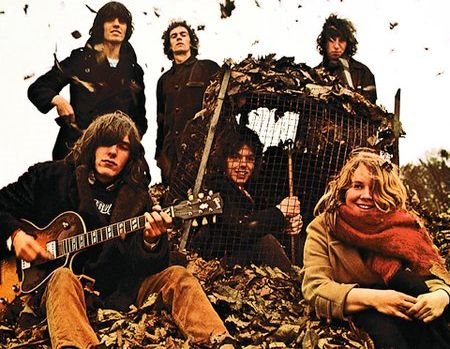
Fairport Convention

At the end of the day, I came home with the album, Liege and Lief tucked under my arm, and a backpack full of books like Folklore in the English and Scottish Ballads. You could say the passion that music ignited is with me to the present day:  it launched me into fantasy literature, shaped twenty years of storytelling, and this particular ballad is an important source for the fictional world I am building now for a heroine who wrestles with her fairy/mortal ancestry.

The ballad

Tam Lin comes from the Scottish border country and was first transcribed in 1549.  Francis James Child published 14 variants in his collection of English and Scottish ballads.  A mortal woman falls in love and conceives a child by a man who had been a mortal knight, until he was captured and somehow enchanted by the fairy queen.  In the Fairport lyrics:

Tell to me, Tam Lin, she said,
why came you here to dwell,
The queen of fairies caught me,
when from my horse I fell.

At the end of seven years,
she pays a tithe to hell,
I so fair and full of flesh,
am feared it be myself.

To disenchant her lover, Janet must hide at midnight on Halloween, at Miles Crossing, pull Tam from his horse, and hold on for dear life as the queen transforms him into a series of hideous and frightening shapes (I said this involved shapeshifting).  The queen turns Tam Lin into a snake, a newt, a bear, a lion, red-hot iron, and finally burning lead, at which point Janet does as instructed and throws him into a well, from which he emerges in his human form.  The queen is furious, and says if she had known of Janet’s loyalty, she’d have plucked out her eyes.  The real fairies of folklore are not nice people and are known to blind mortals who can see them.

Carterhaugh in 2005. You can still visit Tam Lin's well

Such renowned fantasy authors as Susan Cooper, Pamela Dean, Diana Wynn Jones, and Patricia McKillip have written novels based on Tam Lin’s story.  In 1970, Roddy McDowall directed a movie version staring Ava Gardner.  Countless individuals and groups have covered the ballad and there is at least one website devoted to nothing but exploration and creative elaboration of this song.  (see all these links here:  http://en.wikipedia.org/wiki/Tam_Lin)

What about the Shapeshifting?

Though Tam Lin is local to Scotland, the motif of disenchanting someone by holding on through countless frightening transformations is common to folklore throughout Europe.  This tale of shapeshifting is really quite different from Barth’s Menelaiad, discussed in the previous post.

There is a youthful, hopeful quality in this story of a heroic young woman who knows what she wants with such a fierce determination that nothing can thwart her, not even all the illusions and false paths that waylay most people’s dreams.

There is a quality of angst in Barth’s story question:  how can we ever sort out what is true from what is illusion?  I recall that after his campus visit, several sophomores proclaimed the death of literature as we know it.  Janet and Tam have no time for that – if this be illusion, play on, they would say (to badly misquote the bard).

Tam Lin explores the illusions of young lovers, while the Menelaiad does the same for a middle-aged and war-weary king.

Our final story of shapeshifting comes from India, and is several millenia old.  It sits somehwhere between the optimism and pessimism of the first two tales.  Yes, it affirms, life is a series of dreams, where dreams of joy transform into nightmares and back again endlessly – but imagine the joy of waking up.  That awakening, according to this tale, is nearer than we think.

Meanwhile here – as timeless as any fairy artifact – is Fairport Convention’s version of the Ballad of Tam Lin:
http://www.youtube.com/watch?v=jy3ihk205ew

On Shapechangers: Proteus in John Barth’s, The Menelaiad

I’ve been thinking a lot about shapechangers over the last few months.  I’m trying to refine the villain in my current novel, and I really want to give him shapechanging powers, but he needs some restrictions.  Presumably, a villain with an unlimited ability to change his form instantly and at will could never be caught.  That would be a different story than the one I am writing.

The figure of  “The Shapechanger” has fascinated me since I heard John Barth read his story, “The Menelaiad” four decades ago.  I have never forgotten that tale or several related stories which I will discuss in future posts.  “The Menelaiad,” was published in Barth’s collection of short fiction, Lost in the Funhouse, in 1968. English majors love it as “metafiction,” writing about writing, but what really caught me is the “simple” image of a man who wrestles a shapechanger and can never again be certain if his life is really unfolding as it appears, or if he is still engaged in the wrestling match.

Barth was fascinated with “frame tales,” stories within stories.  A classic example is The Arabian Nights.  Scheherazade  tells stories with multiple characters who each tell their own stories, often with people within those stories telling stories.  Barth claimed that in his search of world literature, he never found a story that went deeper than five levels, so he decided to write one with seven.  He began with an episode from the Odyssey, which has plenty of shapechanging and frame tales as it is.

Barth chose the episode where Menelaus, husband of Helen (who launched a thousand ships) relates how he was blown off course, to the Nile delta, after the fall of Troy.  (He tells the tale to Telemachus, son of Odysseus, who was urged by the goddess Athena in the shape of Mentor, an elderly advisor, to seek for news of his missing father – clear enough?)

Luckily for Menelaus, Eidothea, the daughter of Proteus, the Old Man of the Sea, falls in love with him, and relates how he may win sure and certain advice from her father who does not like to dispense such information.

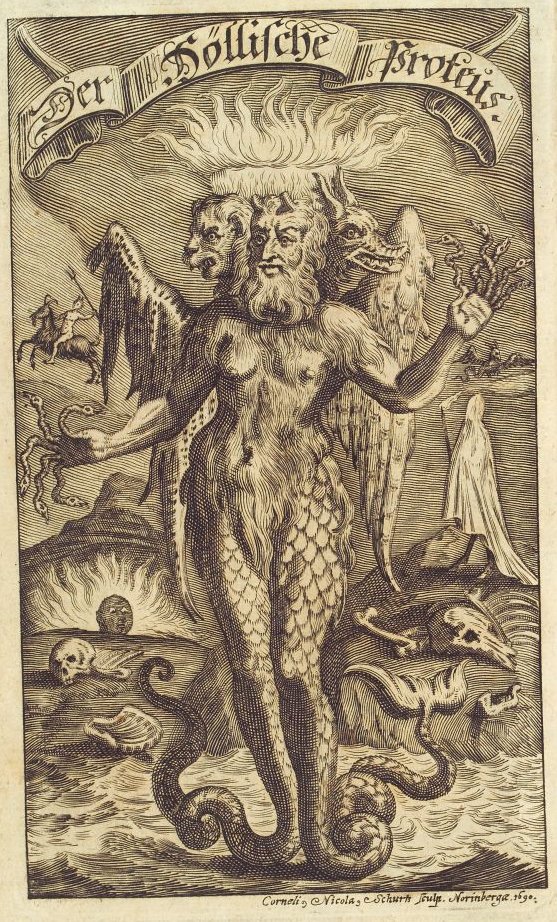
Proteus is herdsman of Poseidon’s seals, so Menelaus must hide himself in a smelly sealskin, jump Proteus when he comes into his cave at noon, and hang on for dear life, for Proteus:  “can foretell the future, but, in a mytheme familiar from several cultures, will change his shape to avoid having to; he will answer only to someone who is capable of capturing him. From this feature of Proteus comes the adjective protean, with the general meaning of “versatile”, “mutable”, “capable of assuming many forms”.  http://en.wikipedia.org/wiki/Proteus

Proteus, The Old Man of the Sea

Barth has a field day letting Menelaus tell the tale of conversations with different people at different times – when someone related what someone else related about what someone else related, he relates.

And yet, for all the tour de force writing, the central image of the tale is like a koan that stays with you.  While holding on to Proteus, Menelaus realizes he can never again be sure that Proteus has not changed into Menelaus holding Proteus, and if so, what or who is he?  All he can know for sure is that he is a voice asking who or what he is.

***

There is a classic Zen story of a man who dreams he is a butterfly.  When he wakes, he wonders if he is a man who dreamed he was a butterfly, or a butterfly dreaming he is a man.

It’s easy to flip the page and forget about that particular story.  It is harder or even impossible to forget Barth’s “Menelaiad,” once you make the effort to wade through some of his bizarre invented ways to use quotes in ways they were never designed to be used.  “”””This is frustrating!”””” he said, she recounted, he told me, I say.

I’ve always suspected that Proteus predates the Olympian pantheon of classical Greece, for what could be more antithetical to the ideals of clarity, order, and rational philosophy than a shapechanger?  There really is no character in mythology more dangerous to any kind of fixed worldview than one who can plant the seed of doubt at the core of awareness.  “Is this really true?”  “Are things really as they appear to be?”  The moment consciousness really and truly begins to entertain questions like these, the wrestling match has begun.

NEXT:  A ShapeChanger in Faerie.

Camelot and the Wild West

Last Sunday, after the Bears lost, I was working on one of my western movie posts. Mary switched channels and I looked up to catch the conclusion of First Knight, starring Sean Connery as King Arthur and Richard Gere as Lancelot. Several thousand light bulbs went on as I watched and realized the old west and Arthur’s Britain are territories of legend with much in common.

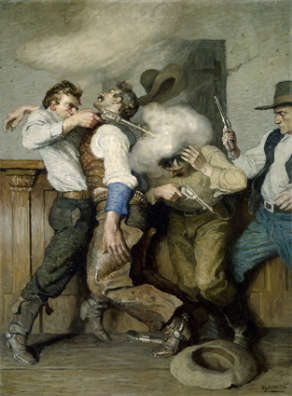
Duel to the Death by N.C. Wyeth

Both the old west and the Arthurian forests are places where legend fills in all we do not know.  Where there be dragons, there also is imagination.  We populate these realms with our angels and demons, and yet the settings are of this world, as opposed to outer space or Middle Earth.  You can visit Tombstone or Glastonbury.  Most historians agree there really was an Arthur of Britain who held off the Saxon invaders after the Roman legions left.  We know that Wyatt Earp, George Custer, and Calamity Jane were as real in their time as we are now.

Gunfight by N.C. Wyeth

I suspect that most of the tales we love of both knights and cowboys are hero journeys, in the classic sense outlined by Joseph Campbell. In his PBS series, The Power of Myth, Campbell said that when they left to search for the Holy Grail, each knight picked his own place to enter the forest – to follow the path of another would have been shameful.

That same ethic frames a number of westerns, and is historical fact in the case of the the mountain men.  Several kept articulate journals describing the yearning that moved them leave “civilization” behind to see what lay beyond the next ridge.

I do not want to belabor the point, but Pothos, the yearning for the unobtainable, was actively cultivated as a virtue in the courtly love ethic celebrated by the troubadors and in the stories of Cretien de Troyes.  Just like modern film directors, Cretien was writing about an era that was gone in his time, but inspired dreams we still share today.  Be it John Ford or Peckinpah, I’m a sucker for a good western, just as I love stories of the knights of old, from Mallory to Monty Python.

***

There is one huge difference between the world of Arthurian legend, and the world of the western – and by extension, the 21st century world we all inhabit.  When the knights entered the forest on their solitary quest, they knew what they were trying to save – Camelot – and they knew what they were trying to find – The Holy Grail.  These legends grew from a world that in reality was probably more brutal than the west of any of Sam Peckinpah’s westerns, and yet from all accounts I have read, this was a world where ultimate certainties were not in doubt.

For us the entrance into the forest or desert is a little darker, for we don’t even start with the same certainty that what we are after exists.  Still, in one account Joseph Campbell quoted, the Holy Grail, was never the same for any two people.  It changed to give each what their heart desired.  A very contemporary Grail!  If we don’t start out with a clear idea of what we are looking for, well I don’t think the knights of legend really did, or the people who climbed onto a covered wagon.

***

And finally, though lists always leave something to be desired, here is a pretty decent NPR list of classic and important westerns, from Stagecoach to Brokeback Mountain, to the new True Grit.  Happy Trails!

http://www.npr.org/blogs/monkeysee/2011/01/13/132905247/git-along-little-dogies-a-western-starter-kit/

Pothos in Westerns 2: Pat Garret and Billy the Kid

Sam Peckinpah was 48 when he directed Pat Garrett and Billy the Kid. His health was failing after too many years of drug and alcohol abuse; a documentary I saw showed the crew carrying him from one scene to another on a stretcher. He was also battling the studio for artistic control of  the project, a fight that he lost.  Critics panned the production release of the movie, though 10 years later, when the director’s cut was available, they praised it as one of his finest.

Peckinpah poured his heart and soul into this tale of a rebel who died too young.  It isn’t hard to see the connection. Maximilian Le Cain, a filmmaker living in Ireland, says:

[Peckinpah’s] finest works are permeated with an intensely haunting atmosphere of melancholy, loss, and displacement. His heroes are exiles, men out of step with their dehumanised times, alienated from love or domesticity, yearning for a redemption that they seem able to find only in self-destruction. It is a dark but intensely romantic vision. If for nothing else, Peckinpah admires his heroes for their staunch individualism in the face of a world that is changing for the worse, eroding under the blindly ruthless power of money. http://archive.sensesofcinema.com/contents/01/13/garrett.html

One summer saturday afternoon in 1973, I went to see Pat Garrett and Billy the Kid. I walked out of the theater stunned, went home and got my sister, and saw the movie again.  In the months and years that followed, I read everything I could about Billy the Kid.  I made a series of prints called, “Homage to Billy the Kid”  (the one that survives is shown below).  Two years later, my wife and I explored Lincoln County, New Mexico, where the key events of William Bonney’s life played out.

Homage to Billy the Kid, color etching by Morgan Mussell, 1973

It isn’t hard to understand why I resonated with Billy the Kid’s story.  “Billy, they don’t want you to be so free,” sings Bob Dylan in the title song.  I was an art student, stuck that summer in a western New York factory town, longing for the southwestern deserts where the skies and vistas are so open they don’t seem real.  Times were hard; the sixties were over; just as in the late 19th century, the price of being “out of step” had gone up.

Some biographies paint William Bonney as an engaging rebel, and others as a psychopathic killer.  I doubt that there is any chance of extracting the “real” William Bonney from legend, but one thing appears to be historical fact:  Billy the kid would not have been declared an outlaw if he had fought on the winning side of “the Lincoln County War,” a bloody open-range type conflict that culminated in a pitched battle on the streets of Lincoln.  There were no angels in that fight; no one deserved a white hat.

Not only is Pothos, the unrequited longing for “something more,” beautifully evoked by Kris Kristofferson’s portrayal of Billy, it permeates the New Mexico landscape and sky, which is like another character in the movie:  it mirrors the Kid’s doomed quest to “live free” with an extraordinary beauty that we glimpse but can never grasp and hold.

Perhaps the best known artifact of Pat Garrett and Billy the Kid is Bob Dylan’s elegy, “Knocking on Heaven’s Door,” which sets the tone for the whole movie in its most haunting scene:

Knocking on Heaven's Door in Peckenpah's "Pat Garrett and Billy the Kid"

Knocking on Heaven’s Door in Peckenpah’s “Pat Garrett and Billy the Kid”

In an effort to find the Kid, Garrett seeks out another town’s sherif, Colin Baker (Slim Pickens), a man so disillusioned he has to ask his wife where he left his badge.  He is building a boat in his yard – a pathetic dingy – so he can “drift out of this damn territory.”  Baker, his wife, and Garrett raid the hideout of a former member of Billy’s gang, and Baker is mortally wounded.  He stumbles over to die by the little creek he hoped to sail away on, and we see it is too shallow to float anything larger than a paper boat.

Sam Peckinpah grew up outside Fresno and used to cut school to cowboy on a relative’s ranch.  According to Maximilian Le Cain (citation above), he did his best to live the myth of the hard living, hard drinking, womanizing, knife-throwing free spirits whose stories he tells.  Cain believes that when Peckinpah started Pat Garrett, he understood and set out to reveal the emptiness of this way of life – its inability to satisfy the hunger within.  He says:

Pat Garrett presents us with a country full of men without a future…If the Western is fundamentally about a struggle for survival in the face of a hostile wilderness, Pat Garrett is about people just waiting around to die. If the West is a wide-open country, Peckinpah’s sees it as a prison from which almost every decent person is trying to escape.

Quite a few movies came out debunking the myth of the west in the decade after that optimistic western epic, How the West Was Won (1962).  Many of these films were politically motivated in an era when, if the body count from Viet Nam was too depressing, you could flip to the ironclad righteousness of the Cartwright boys on Bonanza.

Superficially, Pat Garrett, appears to fit into this group of largely forgotten movies, but it is more.  What lifts it above the myth-busting movies, according to Maximilian le Cain, is Peckinpah’s love of the genre:

Unlike the revisionists, [Peckinpah’s] best films were at least partially self-portraits as opposed to ‘issue’ movies. He exposed the emptiness at the heart of the myth from the inside with the same anguish that he might feel in disclosing a fatal disease from which he was suffering. It is this depth of feeling that really sets this film apart from its contemporaries and has ensured its survival in the face of time.

The King is Dead; Long Live the King!

The Oak King and the Holly King

As predicted by Las Vegas odds-makers, the Oak King scored a narrow victory today over his twin brother, the Holly King. The Winter Queen is reportedly in mourning, though she is expected to emerge – as she has since time began – in her guise as the Spring Maiden, on or about February 2, (aka, Imbolc, Candlemas, St. Brighid’s Day) to take her place beside the new reigning monarch. At least that is the story the old Britons told to explain how the darkest day of the year hides the seed of summer, and why the Winter King is likely to win the scheduled rematch on June 21.

Winter Solstice: the default explanation

Though I cannot prove it, I’ve always believed this tale of eternally battling twins must have gone into the making of the black-on-the-left vs. black-on-the-right episode of Star Trek.

Is this a real legend – one the Celts and Saxons actually told?   Robert Graves said as much in The White Goddess, suggesting that Balin and Balan, as well as Gawain and the Green Knight represent the eternally dueling pair in Arthurian legend.  Sir James Frazer’s earlier Golden Bough had a similar section entitled “The Battle of Summer and Winter,” although he told the story with only one eternally dying and reborn Divine King.

The Oak and Holly kings battle at a 2005 Winter Solstice ritual. Photo by Anderida Gorsedds.

Whatever you may think of the story, now that the solstice has arrived, may you stay warm and dry, and bask in the confidence that summer is coming around again.

“Tinsel,” by Hank Stuever, and other Christmas musings.

Last night I was working at the computer while a TV Christmas movie that neither of us were watching droned on in the background. I looked up when a little girl whose father had died said she was going to the north pole “to ask Santa to make Daddy not dead.”

I instantly recognized the world-view I’d had  at the age of four.  I went to Sunday School, of course, but knew that Santa Claus was the man with the mojo – the go-to guy.

I watched the movie for a while.  It was interspersed with commercials designed to lure me to the parking lots at 4:00am on Black Friday – and tried to remember certain art history lectures I’d heard at this time of year.  “The iconography of Christmas,” that kind of thing.

I remembered that the Puritans outlawed the celebration of Christmas, while in early 19th century New York, Christmas tended to be a drunken revel.  Wealthier citizens would find themselves terrorized by the rabble – kind of trick-or-treat with an edge – give us money or else.  I recalled that the well-to-do seized the “Night Before Christmas,” to attempt to transform the holiday – to get some of those energetic revelers into the stores.

I googled on “Christmas History in America,” and here are a few tidbits I found on the first site that came up: http://www.thehistoryofchristmas.com/

  • Christmas was illegal in Boston from 1659-1681. Anyone “exhibiting the Christmas spirit” was fined five shillings.
  • Congress and everyone else worked on Christmas Day, 1789, the first one celebrated  in the new American nation.
  • The New York City police force was formed in 1828, in response to a Christmas riot.
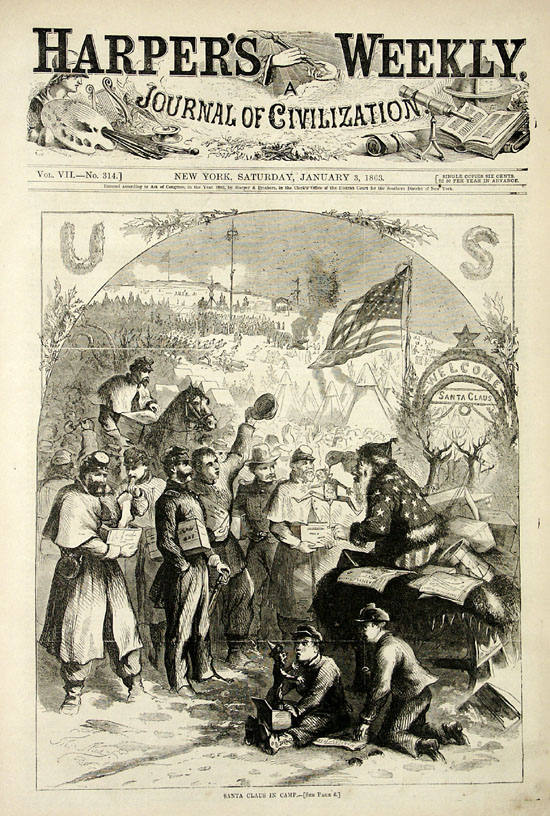
  • Before the civil war, north and south were split on Christmas.  The holiday was regarded as somewhat sinful in the north, while celebrated as an important social occasion in the south.  Yet in the 1860’s, Abraham Lincoln asked Thomas Nast for an illustration of Santa Claus with union troops, which had “a demoralizing influence on the Confederate army – an early example of psychological warfare.”

St. Nicholas delivers gifts to the Union Army

  • After the civil war, children’s picture books and women’s magazines had a large role in transforming the holiday into something we would now recognize.
  • Christmas was finally declared a United States holiday on June 26, 1870.

***

One interesting piece from a year ago was an NPR interview with Hank Stuever regarding his book, Tinsel:  A Search for America’s Christmas Present, an account of three Christmas holidays he spent in Frisco, Texas. http://www.npr.org/templates/story/story.php?storyId=121720242&ps=rs

Tammie explained to me early on about life in Frisco, that fake is okay here. And I think that’s a theme running through the book, fake is okay. If you’re going to ever fall in love with Christmas again, you have to embrace the fact that fake is okay here, no matter where you are.


The "Griswald house" in Frisco, Texas


Stuever wanted to do a piece on the Christmas season in a place well out of the snowbelt – where a White Christmas is pure fantasy.  He chose Frisco, Texas in part because he grew up in that part of the country, but also because it’s a town with seven million square feet of chain retail space, and:

[Christmas is] a half-trillion-dollar event in our lives. It steamrolls everything…so I wanted to go to one of those new fangled 21st century American places that are built around malls and box stores and big houses and big churches…demographics led me to Frisco.

It’s clear listening to the interview that Stuever isn’t there to make fun of anyone.   He expressed gratitude several times to those who invited him to shop with them, decorate with them, and celebrate in their homes.  He speaks with admiration of the single mother who tries to provide a nice Christmas for her three children with $1200 total, in a town where as many as 50,000 lights are part of home lighting displays.

She struggles really hard to always remain positive, which I think makes her emblematic of a lot of Americans who just, you know, come what may, we’re always told to make ourselves happier and be positive. And Christmas is really a freight train coming full of that, you know…there’s something wrong with you if you’re not happy at Christmastime.

Steuver, who writes about popular culture for the Washinton Post, doesn’t wind up too sanguine about Christmas. I wrote about Christmas because Christmas sort of freaks me out, like it’s so big and people have so much expectation heaped upon it that they can only come out of it with a smidgeon of melancholy amid all that joy.  

***

It’s the dark time of year.  The traditional time for sitting by the fire and telling stories.  Reflecting.  Hoping for renewal and the return of the sun as another year passes (where did the time go?).  Hoping for warmth and belonging, connecting with friends and family, our hearts full of the memory of and hope of Christmas peace:  hot cocoa around the fire, under the tree.  Mistletoe.  The star of Bethlehem, Currier and Ives prints, the Christmas we got that brand new bike as a kid. 

Hank Steuver’s book seems to ask, in Dr. Phil’s words, “How’s that workin’ for ya?”

It’s probably a good thing I cannot find my copy of  King of Morning, Queen of Day, a fantasy novel by Ian McDonald, which contains the funniest and most scathing single page on Christmas that I’ve ever read.  As in how will “Jingle Bell Rock,” or the Beach Boys’ “Little Saint Nick,” strike you in the stores four weeks from now?

The refreshing thing about reading the history of Christmas is seeing how dramatically the holiday has morphed in a short period of time.  Has and certainly will again.  Christmas as we know it or think we do is already a thing of the past – it is anything but solid and fixed, either for individuals, families or the culture.  And that’s really good news.  Did I mention how I feel about, “I saw Mommy kissing Santa Claus?”

Of Hamsters, Wisdom, and Persephone

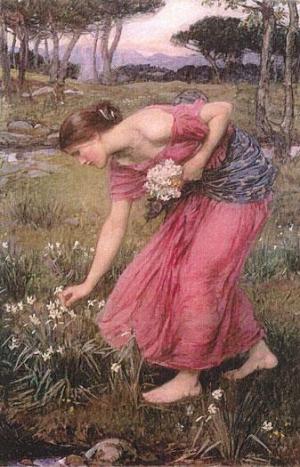
Persephone the Innocent

The protagonist of Karyn’s Magic, the young adult novel I’m writing, is a teenager who lets something evil into the world.  Not only must she scramble for damage control, but she is forced to see the same evil as a potential within herself.  I usually think of “loss of naiveté” as theme of adolescence, but remembering hamsters brought to mind a personal experience that happened earlier than that.

My fifth grade teacher had a pair of hamsters, favorite classroom pets.  At one point she could no longer keep them, and asked if anyone could provide them a good home.  I spend my Saturdays at a small museum in Alum Rock Park, in San Jose, that had a small zoo and classes and field trips for young people.  We had day trips to ocean tide pools, a weekend camping trip to the Mojave, plus at the museum we got to play with some of the critters.  One of my favorite stunts was to wrap a boa constrictor around my neck and explain to startled visitors that these snakes never squeezed anything they didn’t regard as food.

I told the teacher I had a home for her hamsters and took them to the museum.  “Great, we can use these,” the director said.  At the end of the day, after the museum closed to visitors, I learned what he had in mind.  Before I quite realized what was happening, he dropped one of the hamsters into a glass case with a huge rattlesnake.

The ensuing drama seemed to go on forever:  the hamster sniffing, scooting around, knowing something was wrong but not quite knowing what.  I wanted to look away but couldn’t.  The snake coiled in slow motion, almost lazily, with hard, unblinking eyes.  It’s strike was a blur, you couldn’t see it;  you could only hear, not see, the hamster slammed into the top of the cage by the force.  It was over in less than a second.  The animal did not even twitch.

I asked about the other hamster and learned that a snake that big cost several hundred 1960’s dollars, and live food was expensive.  I didn’t demand the other hamster back.  There were older kids there, some in jr. high, and I wasn’t about to wimp out. And scientists sometimes have to suck it up, right?

On Monday, the teacher asked how the hamsters were doing.  I told her and the class that they were fine.  I never put another boa constrictor around my neck.  I was at the edge of adolescence, and the world was poised at the edge of “the sixties;” there would be more and bigger occasions for guilt soon enough, but most of those are long forgotten.  This is the event I come back to when I think or write about the loss of innocence.

***

What does she hear on the wind?

James Hillman, the prolific author who coined the phrase, “archetypal psychology,” for his own brand of post-Jungian thought, borrows a phrase from Keats and calls our world, “the vale of soul-making.”  For Hillman, the natural movement of soul is down, into the depths, where a darker kind of wisdom lies.

(to understand Hillman it is critical to know that he uses the world “soul” as the ancients did:  not as the “eternal soul” of western religion, but more as we use the phrase, “psyche.”  He places “soul,” the source of imagination and fantasy, between the “eternal spirit,” and the body – a three-part image of personality you seem to see in biblical references, as well as in eastern religion even now).

The story that illustrates Hillman’s perspective on “innocence,” is the myth of Persephone.  As a beautiful young girl, she is playing one afternoon with her friends, when she bends to pluck a narcissus flower.  The ground opens up, and Hades, the Lord of the Underworld, scoops her into his chariot and carries her into the depths.  Hillman writes:

“Each of us enacts Persephone in soul, a maiden in a field of narcissi or poppies, lulled drowsy with innocence and pretty comforts until we are dragged off and pulled down by Hades, our intact natural consciousness violated and opened to the perspective of death.”  Revisioning Psychology

By the time the Olympian gods put enough pressure on Hades to cause him to relent, Hermes, messenger of the gods is stunned to see Persephone transformed. No longer the naive maiden, she is the darkly radiant Queen of the Underworld. She has eaten the food of the underworld – six pomegranate seeds, and must spend that six months of every year under the earth.

Supposedly that explains why there is winter, but in a far more interesting sense, it gives us an image of why, despite our wishes, wisdom doesn’t lie in the sunny, flower dotted fields of youth, but in the depths of a soul that knows both light and darkness.

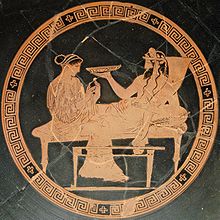
Persephone and Hades