Pandora’s box, repression, and gun violence

From my perspective, the big news this week was the start of senate hearings on gun violence, which evoked a wide range of passions across the spectrum of public opinion.  More poignant than any testimony in Washington was the death of Hadiya Pendleton, a 15 year old honor student who performed at President Obama’s inauguration on the 21st.  The day before the speechifying began, Hadiya was shot and killed in public park in a “nice” section of Chicago, about a mile from the president’s house.  Police think it was a case of mistaken identity.

I thought of Hadiya Pendleton as I was out walking the dogs in a “nice” local park.  I remembered a lecture one of my psych professors gave 20 years ago.  We were studying defense mechanisms, and of these, repression gets a lot of bad press.  Nobody wants to be repressed or live in a repressive society.

My professor expressed an alternate view in his lecture:  repression kept a lid on many antisocial behaviors.  He quoted James Hillman who said, “What used to be the darkest dreams of Freud’s neurotic patients are now played out on our streets.”

The human psyche has not changed in 100 years, but our world has altered dramatically.  Men no longer need to wear boiled shirts, and women are free to bare their ankles.  We’ve learned to embrace the individual conscience and the search for an “authentic me,” but we don’t know what to do if someone’s “authentic me” turns out to be a sociopath.

We’ve found out the hard way that you  can’t just unrepress the good stuff.  When we let our angels out of the box, the demons get a pass too.  Which brings to mind the story of Pandora.

In order to punish humans for Prometheus’ theft of fire, Zeus sent Pandora to earth with a sealed jar (later mistranslated as “box”) and instructions not to open it.  We all know what happens in folklore with orders like that.

Pandora by John Waterhouse, 1896

By the time Pandora got the lid back on, all the evils of the world had been released.  Only hope remained in the jar.  Pandora’s dilemma is ours.

When it comes to our violent behaviors, inhibition was not such a bad thing.  Now that it’s out of the box, the question becomes, what do we do with our hope?

Ancient Roman greenhouse gasses

Before the industrial revolution, humans did not pollute the atmosphere, right?  That is what most scientists thought until a study of greenhouse gasses trapped in ice revealed that human activity has generated significant traces of methane dating back at least 2000 years.

In “Classical Gas,” an article in the Feb., 2013 issue of Smithsonian, Joseph Stromberg reports that a team of 15 scientists took samples from Greenland’s mile and a half thick sheet of ice, which dates back 115,000 years.  The researchers looked at the concentration of methane in microscopic air bubbles in the ice.  They expected to find that historical methane traces increased during warm-weather periods.  Instead they found that it varied with human activity, most notably, large-scale agriculture and metallurgy.  Methane began to spike around 100 B.C.  At this period, the Romans kept large numbers of methane-producing cows, sheep, and goats.

Orpheus surrounded by animals. Ancient Roman floor mosaic. Photo by Giovanni Dall’Orto. CC-by-SA

At the same time, the Han dynasty in China increased its rice production, which is associated with methane-producing bacteria.  Both empires burned large amounts of wood to produce metal for weapons.

Roman relief of blacksmith. Photo by Wolfgang Sauber. CC-by-SA-3.0

Results of the Greenland ice study showed that between 100 B.C. and 1600 A.D., world methane production rose by 31 million tons per year – which sounds like a lot until you realize that US methane production alone is 36 million tons per year, and that isn’t the only greenhouse gas. The discovery that humans have had a measurable impact on the atmosphere for 2000 years does not mean ancient cultures affected climate the way we do. It does mean researchers have to redefine baseline levels of methane – what we define as “natural.”

We tend to project a certain environmental wisdom onto older cultures, assuming they were better stewards of nature than we are in our mechanized world.  Yet I know of at least two other cultures, whose worldview included a reverence for nature, that got into trouble when populations grew too large for a given territory.  Ironically we may have a better chance, using the lens of science, of recognizing and correcting our impact on the environment than people who viewed aspects of nature as divine.

Some bloggers might be tempted to end this post with a fart joke, but that would be immature.

Photo by Alexander Herrmann, CC-by-NC-ND-2.0

Photo by Alexander Herrmann, CC-by-NC-ND-2.0

Remembering Stan-the-Man

I was away all day, and when I got home this evening, I learned that baseball great, Stan Musial, died today at the age of 92.  Every time I think of him, I remember one of those glorious days of my childhood.

In the early summer of 1963, some of the dads took some of the kids to Candlestick Park to watch the San Francisco Giants play the Saint Louis Cardinals.  I had seen some of the greats of the day hit home runs – players like Willie Mays and Willie McCovey, but I’ve never before or after seen a homer like the one Musial hit out of the park  – literally – that day.

He was a left hander with a funny looking stance, with his knees together, almost touching, but the ball he hit that day cleared the right-field bleachers, sailed way above them, out to the parking lot beyond.  People were shaking their heads like they couldn’t believe what they’d seen.  Though the Cards were the home team’s opponents that day, everyone rose to their feet to clap as Stan rounded the bases.

He retired at the end of the year with numerous major league records and was inducted into the Hall of Fame in 1969 on the first ballot.

Stan Musial at the 2009 All-Star game

So what’s the big deal after all these years?   Just childhood nostalgia?  To some extent, maybe, but there is something more.  In one respect he reminds me of my father – both were born in 1920 and both served in the navy in WWII.  But more than that, it’s a “greatest generation” thing.  The day I saw Musial hit his home run, back in the era of my innocence, was also something like a time of national innocence.

It’s not that I think ball players were the saints that starry-eyed kids thought they were, but a player like Stan-the-man had no need of steroids.  It’s nice to pause and reflect on someone who personifies what we can become if we follow “the better angels of our nature.”

Here is the full story:http://usat.ly/VdXpmE

Outsourcing yourself for fun and profit

At least a decade ago, when I worked in IT, I read a story online that I treasured like those special Dilbert clips everyone posts in their cubicle.  Supposedly, a software engineer making $90,000 a year outsourced his job to India, paying an engineer there about 20% of his salary (a handsome wage in India at the time) so he could split his workdays between online courses and video games.  As the story went, the code he got back from the Indian engineer was so good that he had to introduce bugs now and then to maintain credibility.

I loved telling the tale, though I figured it was probably just a nerd urban legend.  Today I found an identical case that is documented.  Well, identical except for location and inflation:  the country is China, and the US engineer’s salary is given as “six-figure.”

A “critical infrastructure company” in the US contacted Verizon security services to see why there were so many network logins originating in Shenyang, China.  At first the company thought they’d been hacked.  Later it turned out the VPN token had been supplied to the Chinese firm by an employee the Verizon report names as “Bob.”  Bob was described as:

“mid-40′s software developer versed in C, C++, perl, java, Ruby, php, python, etc. Relatively long tenure with the company, family man, inoffensive and quiet. Someone you wouldn’t look at twice in an elevator.”

Bob showed up every day at the office.  Here is Verizon’s report on how he spent his days ( http://tinyurl.com/ajm7oan ):

  • 9:00 a.m. – Arrive and surf Reddit for a couple of hours. Watch cat videos.
  • 11:30 a.m. – Take lunch.
  • 1:00 p.m. – Ebay time.
  • 2:00 – ish p.m Facebook updates – LinkedIn.
  • 4:30 p.m. – End of day update e-mail to management.
  • 5:00 p.m. – Go home.

NPR’s coverage of this story contains a link to the Verizon report, which notes that Bob had a reputation as the best developer in the company http://www.npr.org/blogs/thetwo-way/2013/01/16/169528579/outsourced-employee-sends-own-job-to-china-surfs-web

***

What’s just as interesting as Bob’s story is my reaction to it (and probably yours).  First, I assume that if Bob had the smarts to engineer this deal, he got a non-disclosure agreement from the Chinese company.  Such documents, to protect business secrets, are routine in all sub-contracting operations.

Beyond that, I found that along with humorous admiration for Bob’s escapade, I felt critical because he wasn’t “playing by the rules” – even though in the course of my own career, I watched all the rules change.

When I finally “settled down” and got a “real job,” I joined a technology company that boasted of never having a layoff.  The first one came about 18 months later, and before I left, I saw scores of empty cubicles of people whose jobs had been sent overseas.  These days we all know people who played by the rules and got screwed.

In the end, I wouldn’t want Bob’s karma, but his story illustrates something we hear again and again:  nowadays workers are on their own.  Company loyalty in response to employee loyalty is largely a thing of the past, and everyone has to take responsibility for their own careers, including use of the tools of the digital age.  For anyone reading this post in a cubicle and thinking of Bob and tropical islands, here is some recreational reading, referenced in the NPR story – The Four Hour Workweek, by Timothy Ferriss.

As the sergeant used to say in the classic cop show, Hill Street Blues, “Be careful out there!”

Change is the only constant

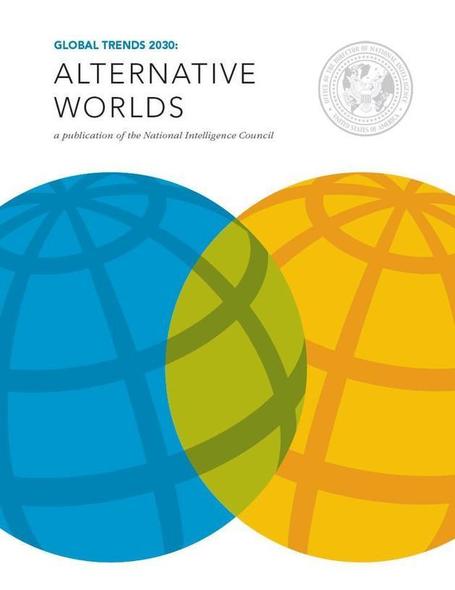
That’s what they say in the tech industry.  That’s what Buddha said 2600 years ago.  And that’s what the National Intelligence Council says in a 140 page report, “Global Trends 2030: Alternative Worlds.”

Click for the text of the whole report

Since 1997, the NIC, formed of all 16 US intelligence agencies, has issued five Global Trends reports, one after each presidential election.  For this one they engaged think tanks, government, and business leaders in 14 nations and concluded that the world will be radically different in 18 years.  The pace of change will be faster than at any period in modern history.

NIC Chairman, Christopher Kojm, says:
“We are at a critical juncture in human history, which could lead to widely contrasting futures. It is our contention that the future is not set in stone, but is malleable, the result of an interplay among megatrends, game-changers and, above all, human agency. Our effort is to encourage decision makers—whether in government or outside—to think and plan for the long term so that negative futures do not occur and positive ones have a better chance of unfolding.”

Here is a link to a summary of the report. ww.bloomberg.com/news/2012-12-10/u-s-intelligence-agencies-see-a-different-world-in-2030.html

The NIC defines “megatrends” as scenarios likely to happen under all circumstances.  “Game-changers” are “critical variables whose trajectories are far less certain.”  Additional possibilities are listed as “black swans,” discrete events that would cause large scale changes, either for good (a democratized China or a reformed Iran) or ill (global pandemic, WMD attack).

The report identifies four megatrends, changes regarded as inevitable over the next two decades:

  • Diffusion of power:  The US will lose it’s international dominance, but no other nation will take its place.  “Power will shift to networks and coalitions in a multi-polar world.”  Though the report didn’t say it, as a student of World War I history, I have to observe that the last time the world was structured this way, things did not turn out very well.  The report identifies one best case scenario as a new era of US/Chinese cooperation.
  • Individual Empowerment: A rising middle class in emerging nations, increased access to education, widespread use of technology, and health care advances can improve the lot of large numbers of people. The report notes that technology is two edged sword: it can benefit and disrupt.  Advances sometimes create and at other times eliminate jobs.  Technology fosters communication but also  leaves infrastructure vulnerable to cyber-attack.
  • Demographic Change: World population will grow from 7.1 to 8.3 billion, and 60% world will live in cities (it’s 50% now).  This will strain resources and increase pollution. Aging populations may slow economic growth in developed nations. Immigration will increase.
  • Food, Water, and Energy Shortages: In 18 years, the world will need 35% more food and 40% more water.  Our intelligence agencies don’t waste time pretending climate change isn’t real.  They note that conditions like widespread drought have grown more severe in just the 18 months they’ve been working on the report.

National Geographic issue on extreme weather, published one month before Superstorm Sandy

Rather than summarize more of the report, I invite readers to check it out for themselves.  Let’s step back and reflect on what this means.

My dogs do not like change.  They find comfort in their routines, and if I am honest, so do I.  This month a 72 year old hardware store, where you could find anything, closed it’s doors.  So did a 76 year old nursery, where master gardeners could always diagnose the ugly brown spots on your roses.  That’s enough to put me in a funk, imagining our big box future, and yet this is nothing compared to what Global Trends 2030 suggests is coming – change at a faster rate than anyone living has seen.

Change that rapid generates fear.  Looking at the last decade, we see resistance to change spawning violence.  Religious fundamentalists are more vocal in nearly all denominations.  Reactionary politicians grasps at some idealized past that is gone if it ever existed.  The urge to get what is mine at all costs further disrupt economic life and generates even more fear.  People bemoan the loss of civility.

Do we have any guides for living through times like these?

As I asked myself the question, I remembered Joseph Campbell’s assertion that world mythology holds wisdom for all the turns that life can take.  And Marie Louise Von Franz, Jung’s closest colleague, said that fairy tales offer the “purest and simplest” expression of “the basic patterns of the human psyche.”  Do stories created by people who traveled by foot and ox cart really have something to teach us in the 21st century?

I believe they do.  Next time we will consider what the old stories may say about living through difficult times.

The Face of Class Warfare

In the wake of the election, I more or less swore off posting political content here, except on special occasions like when the first day of a new month falls on Saturday. On days like this, I am allowed to provide links to stories I think are important.

Please check out this post on the website of Sen. Bernice Sanders (Independent) of Vermont: http://www.sanders.senate.gov/newsroom/news/?id=D3227558-DD10-4C92-AD1A-AD1E1E54543D

The good news is, Senator Sanders won a decisive re-election victory this past November. The people of Vermont know a good thing when they see it!

All quiet on the holiday front

The chief of security at one of the largest area malls reported that this year’s Black Friday was the smoothest in 13 years.  He didn’t speculate on why that was true, so here’s a poll.  Pick whichever explanation(s) seem most plausible:

  1. The population has grown more civil.
  2. More people are shopping online.
  3. After all that’s happened this year, including the election, we’re too numb to respond to the usual holiday trappings.

Yesterday, I thanked the waitress at a local waffle place for the lack of “holiday” music.  “I know,” she said.  “Isn’t it great?  I’m hoping management keeps it up.”

I distinguish between Christmas music, which I enjoy at this time of year, and Holiday music.

People reading this blog in other countries may not be clear on the distinction.  Because of our nation’s diversity, in the public sphere, both at work and in stores, we say “Happy Holiday’s” instead of “Merry Christmas.”  The intent is not to offend people of other faiths.  The result is largely to trivialize the whole thing.  If you’ve ever gotten a song like “Little Saint Nick,” or “Rockin’ Around the Christmas Tree,” stuck in your mind, you know what I mean.

For helping spark the trend toward silence or simply generic music in stores, I present my 2012 Corporate Hero award to Shoppers Drug Mart, a popular Canadian pharmacy chain.  They started playing Holiday music the day after Halloween, but received so many complaints that they pulled the plug “until further notice.”

One comment on their Facebook page read, “Starting this music so early takes the sacredness and meaning out of what should be such a beautiful season.”  That sums up “the Holidays” in their entirety.

Luke’s gospel tells us that after the shepherds saw the baby Jesus, they ran off to Bethlehem to tell everyone, “But Mary treasured up all these things and pondered them in her heart”  Lk 2:19.

Pondering things in our heart is how an event becomes an experience.  It’s how we come to appreciate things, even simple acts like buying a gift or having waffles with a friend.

I never begrudge our merchants the chance to make a living at this time of year, and I appreciate them even more for pulling the plug on noxious music so I can treasure more of these things in my heart.