Notes from 2017: Who doesn’t love a hero?

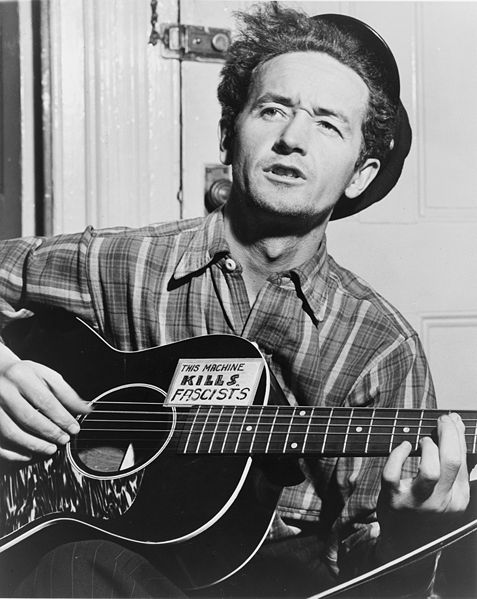
Woody Guthrie, 1943. Library of Congress.

Woody Guthrie, 1943. Library of Congress.

On January 16, The Times of London posed a question to Donald Trump:  “Do you have any models – are there heroes that you steer by – people you look up to from the past.”

In reply Mr. Trump said,: “Well, I don’t like heroes, I don’t like the concept of heroes, the concept of heroes is never great.” He then described his admiration for his father, from whom he learned “a lot about negotiation,” but then he gave himself final credit, saying that negotiation is “natural trait,” which “you either have or you don’t.”

Father and son may share additional traits. In 1950, Woody Guthrie leased an apartment from Fred Trump, and soon came to despise the president-elect’s father for his racism. In his song, “Old Man Trump,” he wrote:

Beach Haven ain’t my home!
No, I just can’t pay this rent!
My money’s down the drain,
And my soul is badly bent!
Beach Haven is Trump’s Tower
Where no black folks come to roam,
No, no, Old Man Trump!
Old Beach Haven ain’t my home!

In the 1970’s, the Justice Department sued Fred and Donald Trump for racial discrimination, under the 1968 Fair Housing Act, which Rep. John Lewis helped pass. The Trumps settled, “without an admission of guilt.

*****

Heroism begins with a concern for someone or something greater than oneself, so of course Mr. Trump is unacquainted with the concept. Polls show his approval rating has slipped since the election, but a core group of supporters apparently still hope that inauguration will somehow awaken a concern with their wellbeing and that of the nation.

I’m betting in six months – a year at the outside – the denial will wear off, and most of his remaining supporters will realize they’ve been conned as badly but effectively as those who enrolled at Trump University.

We will not find any heroes in the White House after Friday.
Notes from 2017: Six ways to be miserable (and one way to be happy).

Public Doman

Public Doman

The following aphorisms on traits to avoid were written by Patrul Rinpoche, a 19th c. Tibetan master. A contemporary Tibetan lama, Phakchok Rinpoche, gave a teaching on the text that was printed in Tricycle in January, 2016. Here are the aphorisms:

The proud will never be pleased.

The jealous will never be happy.

The greedy will never be satisfied.

The hateful will never be reconciled.

The stingy will never have enough.

The ignorant will never accomplish.

By contrast, here is what the Dalai Lama advised to cultivate happiness and wellbeing:

“If you want others to be happy, practice compassion. If you want to be happy, practice compassion.”

Notes from 2017 – Predictions and Prophecies

I’ve never been big on New Year’s predictions. Even if accurate, they’re like signs on a mountain road saying, “Watch out for falling rocks.” What do you do if you see one barreling at you?

Prophecies are even worse! In all the old stories, those who attempt to escape an evil fate choose the precise actions that bring it about. They do it every time!

Oedipus is probably the best known example. Told by the Delphic Oracle – an ironclad source – that his fate was to kill his father and marry his mother, what does he do? He quarrels with the first old guy he meets on the road and kills him! That’s when we know it can’t turn out well!

The following video is Keith Olbermann’s take on what we, as a nation, have done. Recognizing that our political and economic systems were broken, we went to the polls and made a choice that most of us now know can’t possibly turn out well…

See what you think. I’ll make a few predictions of my own in future posts, but most of them follow on this one.

Notes from 2017 – Remember moral courage?

On New Year’s day, Wall Street Journal editor, Gerard Baker sparked a social media storm after saying on Meet the Press that he has instructed his paper’s journalists not to report Donald Trump’s lies as lies, but as “questionable,” or “challengeable” statements (1) (2).

The word “lie,” he said, implies a moral judgement, and opens the Journal to claims of bias. He cited Mr. Trump’s claim that “thousands” of Muslims celebrated 9/11 on New Jersey rooftops. To call that a “lie,” Baker claimed, would imply an intent to deceive, so the Journal reported instead that there was “no evidence” to support the allegations.

There are many obvious problems with this approach. No one with a pulse believes that Trump made an inadvertent mistake – his intent with this lie was to win the support of xenophobes, in one of the classic moves of would-be tyrants. Trump learned in his earlier “birther” rants that if you repeat a lie often enough, those who want to believe you will, and will rally to support your cause.

I our midterm election in 2018, we’ll have new voters who were a year old on 9/11, with no clear memory of the event. “No evidence” is too weak a rebuttal to our would-be dictator-in-chief, who unfortunately, is an expert on manipulating the news, and in a classic strategy tyrants before him continues his efforts to discredit legitimate news outlets (3) (4) (5).

The journalists had gathered on Meet the Press to discuss Mr. Trump’s attempts to discredit news he doesn’t approve of. You can read a full transcript of the session here (6) Not being sufficiently versed in history, Mr. Baker doesn’t realize that capitulation will not save him or his paper if Trump can manage to gain the power over news outlets, like “stronger libel laws,” that he craves.

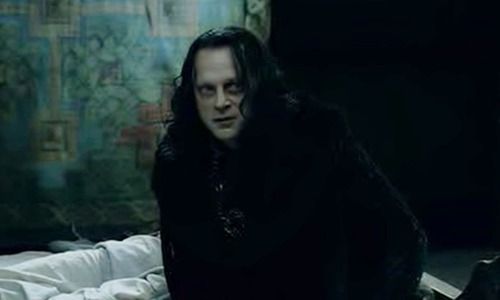
Therefore, I’m awarding Gerard Baker of the Wall Street Journal, my first Wormtongue Award of 2017. This is the first, but I’m sure not the last, such award I’ll hand out…

The First Gates "Wormtongue Award" goes to Gerard Baker, of the "Wall Street Journal"

The First Gates “Wormtongue Award” goes to Gerard Baker, of the “Wall Street Journal”

Notes from 2017 – A New Year

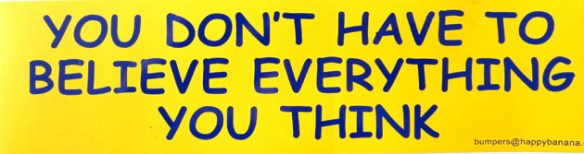
believe-everything-you-think-small

At midnight tonight, something changes – in our minds, and nowhere else. It’s like a graffiti artist once wrote on a step of the local library: “Time does not exist, only clocks exist.”

That could be a Buddhist aphorism, like the image of my all time favorite bumper sticker pictured above. Through Buddhist contemplative practice, we come to experience that the contents of our consciousness – the thoughts, emotions, concepts that shape our reality – are fluid and insubstantial. Like rainbows. Like state lines.

State lines exist because legislators, surveyors, and highway departments put signs saying things like “Welcome to Oregon,” at certain points in the landscape. The mountains and rivers and deserts know nothing of state lines, but I need to. The speed limit drops in Oregon, and I’ll get a ticket if I ignore that gap between consensual and ultimate reality.

Today I am thinking of Joseph Campbell who called out one of the core abstractions that separate people. In the last episode of The Power of Myth series, Campbell said the view of our beautiful planet, photographed from space, might well serve as an emblem of the religion of the future.

Image converted using ifftoany

Not anytime soon, I’m afraid. The Power of Myth was released in 1988, a time of optimism and economic expansion. In our current era of fear and economic decline, nationalism, fascism, xenophobia, and class warfare are becoming the new normal. No national or state boundaries are visible from space, but we, collectively, are killing each other over such abstractions, both with weapons and legislation.

I’d love to have started this post with, “Happy New Year,” but I don’t think that’s very likely. Nobody really believes it. There isn’t much “Happy days are here again” in the air. There’s too much bullshit online these days so I won’t add to it. Not for the first time will I say that I think the road ahead was accurately painted by Matthew Arnold in his 1867 poem, Dover Beach. In the last stanza he said:

“Ah, love, let us be true
To one another! for the world, which seems
To lie before us like a land of dreams,
So various, so beautiful, so new,
Hath really neither joy, nor love, nor light,
Nor certitude, nor peace, nor help for pain;
And we are here as on a darkling plain
Swept with confused alarms of struggle and flight,
Where ignorant armies clash by night.”

More than 100 years ago, Arnold saw our world as struggling through the death throes of a dying age and the birth pangs of a new one. That labor continues.

I hope you and your loved ones survive and thrive in 2017.

Notes from 2017 – The Hollow Crown

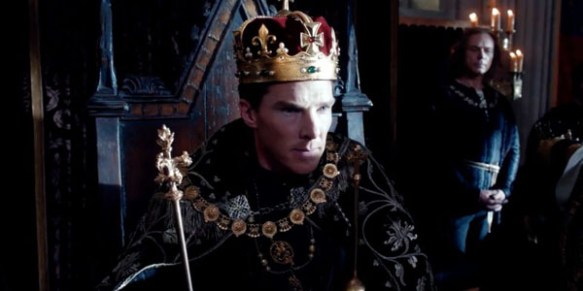
Benedict Cumberbatch as Richard III in PBS series, "The Hollow Crown."

Benedict Cumberbatch as Richard III in PBS series, “The Hollow Crown.”

I invite everyone to look at the magnificent productions of three of Shakespeare’s histories on PBS, on a series entitled, The Hollow Crown: The Wars of the Roses.

I’ll have more of to say on this in days ahead, for it bears directly on the stuff of our current and recent headlines – people who desperately quest for temporal power, but that can wait, because right now, and only for a while, you can watch the full movies online!

Watch these – they are great productions with star-studded casts!.

Henry VI, Part 1 – expires Jan 3, 2017.

Henry VI, Part 2 – expires Jan 10, 2017

Richard III – expires Jan 17, 2017

Enjoy, and make a contribution to PBS if you do!

Notes on Saint Stephen

100-saint-stephen

Today, December 26, is known as Saint Stephen’s Day, and in the UK, as “Boxing Day.” I’ve never understood the latter term – nor does Wikipedia, which says, “There are competing theories for the origins of the term, none of which are definitive.”

Saint Stephen was the first Christian martyr. A young and zealous deacon in the early church, he was tried for blasphemy. After denouncing the authorities who sat in judgement upon him, he was stoned in the year 34. Saul of Tarsus, who later became Saint Paul, famously held the cloaks of those who threw the stones.

The word, “martyr,” has lost much of its meaning through overuse. Now we use the word for someone who complains a lot. In church history, a few of the early martyrs seemed to choose their fate. There are stories of judges who said, “Look, if you just shut up, I’ll let you go,” but they wouldn’t. They believed that this literal following of Christ was a fast-track ticket to heaven.

The last thing the world needs now is religious zealots of any variety – those willing to use physical or legislative violence to try to destroy other people’s freedom to believe what they want to believe. Atrocities committed in the name of God – any God – are especially heinous. I suspect that much of that sort of violence, like politically motivated violence, boils down to fear. If my self-knowledge is so shallow that I don’t really know where I stand, then a contrary opinion that threatens my world view must be discredited or or silenced.

There are ways other than projecting my views onto some vengeful God. The Dalai Lama, one who humbly but joyously lives by the words he speaks, has said, “We could do without religion, and we could do without ritual, but we cannot survive without kindness.”

-Great words to remember on Boxing Day, which I’m pretty sure has to do with re-gifting rather than post-Christmas pugilism…