Paranoia stikes deep

My title comes from a phrase Stephen Stills used 46 years ago in the lyrics of, “For What it’s Worth,” a song The Buffalo Springfield released in January, 1967.

Paranoia strikes deep
Into your life it will creep
It starts when you’re always afraid
You step out of line, the man come and take you away

Those lyrics came to mind today around noon, when the dogs started barking. I found a UPS package on the doorstep, lightweight, about 10x8x8, from a local address I didn’t recognize.

“Expecting a package from a place called ‘Copperfield?'” I called to Mary, who was in the other room.

“No,” she yelled back. “Be careful opening it.”

“Honey, if it’s a bomb, being careful won’t help.”

“No,” she said. “I mean that poison.”

“OK,” I called. “I’ll start with the packing slip. That’s probably where they put the ricin.”

It turned out to be the can of black touch-up paint I’d ordered for our wood-burning stove. As you might have guessed, I wasn’t really scared of being blown up, but it was the first thing that came to mind. And why not? “They” consider my phone calls worth logging, and my internet hits, and my credit card use. Those of you with newer high-definition TV’s should realize there is a built-in feature that allows a 3d party to peer into your living room. That’s old news, as in posted at least a year ago, to a collective yawn.

There’s something happening here
What it is ain’t exactly clear

That’s the heart of our problem: what’s happening ain’t exactly or even a little clear, except maybe, “step out of line, the man come and take you away.”

One of the few people in Washington I admire, Sen. Bernie Sanders, Independent from Vermont, posted a survey on his website. Here are the four questions:

  1. Do you favor or oppose the National Security Agency’s program to monitor online communications in order to protect the nation from terrorist threats?
  2. Is it appropriate for the federal government to collect millions of phone records from American citizens, if doing so could potentially disrupt a terror plot?
  3. Do you think the president should or should not have the power to authorize the National Security Agency to monitor the electronic communications of American citizens without getting warrants?
  4. Do you favor or oppose changing the PATRIOT Act, which allows the government to collect the phone records of American citizens without a warrant?

I haven’t taken the survey yet, because I’m still “Unsure” on two of the questions. I find that upsetting, given that Sanders also posted the text of Amendment IV to the Constitution:

The right of the people to be secure in their persons, houses, papers, and effects, against unreasonable searches and seizures, shall not be violated, and no Warrants shall issue, but upon probable cause, supported by Oath or affirmation, and particularly describing the place to be searched, and the persons or things to be seized.

Decades ago, H.L. Mencken wrote, “The whole aim of practical politics is to keep the public alarmed (and hence clamorous to be led to safety) by menacing it with an endless series of hobgoblins, all of them imaginary.”

Right now, I think we are all numb. More precisely, I think this is what psychologists call “learned helplessness.” When a creature perceives that it’s powerless to prevent harmful events, it becomes listless and depressed. Or disgusted with politics. One of these days I expect that listlessness and disgust to erupt as outrage. When and if it does, I don’t think it’s going to be pretty or the stuff of songs – there is too much we have collectively stuffed, and for too long a time.

One Nation Under Stress

The title of this post comes from a new book reviewed on NPR, One Nation Under Stress:  The Trouble With Stress as an Idea, by Dana Becker, PhD.

According to Dr. Becker, “stress” is a recent concept.  The first article on stress in the New York Times was published in 1976.  The first diagnoses of “nervous disorders” or “neurasthenia,” came from the work of Dr. George Beard ca 1869.  In the NPR interview, Becker says that physicians of the time considered “American nervousness” to come from outside factors, related to the increasing pace of life after the civil war.  “Stress,” as we understand it today, is the polar opposite.

Now we have internalized stress, focusing on the risks to our health and the ways we should cope with it, through diet, exercise, yoga, and so on.  Our experience of stress derives from our ideas of stress, Becker says.  The internal emphasis on health is necessary, but we let it divert us from questioning the external causes of stress.  She gives an example in the NPR interview: many articles are written to help working mothers cope with stress – far fewer are written about the need for affordable daycare.  We may eat kale and do yoga to survive the 24/7 world, but we seldom ask why this is the norm and what the alternatives are.

This argument echoes a major concern of James Hillman, who I frequently write about here.  Though he was once Director of Studies at the Jung Institute in Zurich, in 1992 he co-authored a book called We’ve Had a Hundred Years of Psychotherapy and the World is Getting Worse.  In it, he said:

“Every time we try to deal with our outrage over the freeway, our misery over the office and the lighting and the crappy furniture, and the crime in the streets, whatever – every time we try to deal with that by going to therapy with our rage and our fear, we deprive the political world of something.”

In her NPR interview, Dana Becker presented a balanced view of stress – it’s fine to treat the symptoms, which are personal, as long as we don’t gloss over the underlying causes, many of which are not.  The promise of new view of a modern ailment is enough to put One Nation Under Stress near the top of my “to read” list.

Change is the only constant

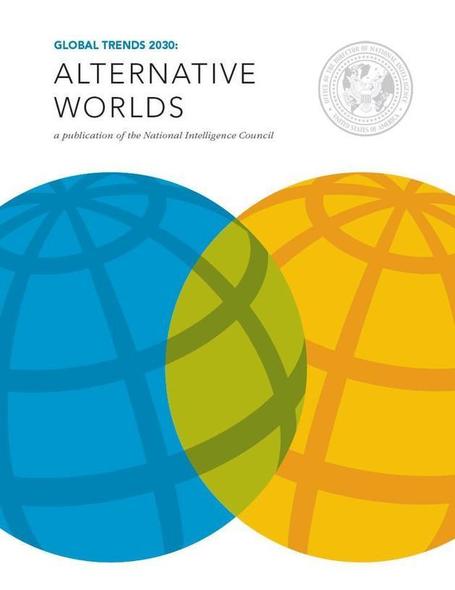
That’s what they say in the tech industry.  That’s what Buddha said 2600 years ago.  And that’s what the National Intelligence Council says in a 140 page report, “Global Trends 2030: Alternative Worlds.”

Click for the text of the whole report

Since 1997, the NIC, formed of all 16 US intelligence agencies, has issued five Global Trends reports, one after each presidential election.  For this one they engaged think tanks, government, and business leaders in 14 nations and concluded that the world will be radically different in 18 years.  The pace of change will be faster than at any period in modern history.

NIC Chairman, Christopher Kojm, says:
“We are at a critical juncture in human history, which could lead to widely contrasting futures. It is our contention that the future is not set in stone, but is malleable, the result of an interplay among megatrends, game-changers and, above all, human agency. Our effort is to encourage decision makers—whether in government or outside—to think and plan for the long term so that negative futures do not occur and positive ones have a better chance of unfolding.”

Here is a link to a summary of the report. ww.bloomberg.com/news/2012-12-10/u-s-intelligence-agencies-see-a-different-world-in-2030.html

The NIC defines “megatrends” as scenarios likely to happen under all circumstances.  “Game-changers” are “critical variables whose trajectories are far less certain.”  Additional possibilities are listed as “black swans,” discrete events that would cause large scale changes, either for good (a democratized China or a reformed Iran) or ill (global pandemic, WMD attack).

The report identifies four megatrends, changes regarded as inevitable over the next two decades:

  • Diffusion of power:  The US will lose it’s international dominance, but no other nation will take its place.  “Power will shift to networks and coalitions in a multi-polar world.”  Though the report didn’t say it, as a student of World War I history, I have to observe that the last time the world was structured this way, things did not turn out very well.  The report identifies one best case scenario as a new era of US/Chinese cooperation.
  • Individual Empowerment: A rising middle class in emerging nations, increased access to education, widespread use of technology, and health care advances can improve the lot of large numbers of people. The report notes that technology is two edged sword: it can benefit and disrupt.  Advances sometimes create and at other times eliminate jobs.  Technology fosters communication but also  leaves infrastructure vulnerable to cyber-attack.
  • Demographic Change: World population will grow from 7.1 to 8.3 billion, and 60% world will live in cities (it’s 50% now).  This will strain resources and increase pollution. Aging populations may slow economic growth in developed nations. Immigration will increase.
  • Food, Water, and Energy Shortages: In 18 years, the world will need 35% more food and 40% more water.  Our intelligence agencies don’t waste time pretending climate change isn’t real.  They note that conditions like widespread drought have grown more severe in just the 18 months they’ve been working on the report.

National Geographic issue on extreme weather, published one month before Superstorm Sandy

Rather than summarize more of the report, I invite readers to check it out for themselves.  Let’s step back and reflect on what this means.

My dogs do not like change.  They find comfort in their routines, and if I am honest, so do I.  This month a 72 year old hardware store, where you could find anything, closed it’s doors.  So did a 76 year old nursery, where master gardeners could always diagnose the ugly brown spots on your roses.  That’s enough to put me in a funk, imagining our big box future, and yet this is nothing compared to what Global Trends 2030 suggests is coming – change at a faster rate than anyone living has seen.

Change that rapid generates fear.  Looking at the last decade, we see resistance to change spawning violence.  Religious fundamentalists are more vocal in nearly all denominations.  Reactionary politicians grasps at some idealized past that is gone if it ever existed.  The urge to get what is mine at all costs further disrupt economic life and generates even more fear.  People bemoan the loss of civility.

Do we have any guides for living through times like these?

As I asked myself the question, I remembered Joseph Campbell’s assertion that world mythology holds wisdom for all the turns that life can take.  And Marie Louise Von Franz, Jung’s closest colleague, said that fairy tales offer the “purest and simplest” expression of “the basic patterns of the human psyche.”  Do stories created by people who traveled by foot and ox cart really have something to teach us in the 21st century?

I believe they do.  Next time we will consider what the old stories may say about living through difficult times.

The Face of Class Warfare

In the wake of the election, I more or less swore off posting political content here, except on special occasions like when the first day of a new month falls on Saturday. On days like this, I am allowed to provide links to stories I think are important.

Please check out this post on the website of Sen. Bernice Sanders (Independent) of Vermont: http://www.sanders.senate.gov/newsroom/news/?id=D3227558-DD10-4C92-AD1A-AD1E1E54543D

The good news is, Senator Sanders won a decisive re-election victory this past November. The people of Vermont know a good thing when they see it!

Rosebud

It couldn’t be a finer autumn day in north-central California.  Going to vote this morning, in the golden-tinged sunlight, it was easy to bask in the hope of new beginnings, in the hope that difficult times will call forth a renewed vision and strength of purpose in those we elect.  Perhaps “ordinary” men and women will prove to be extra-ordinary in our times as they have done in the past.

Yet this week I’ve been thinking of Citizen Kane, for I fear that many who run for political office share the motivation of Charles Foster Kane, in what some have called the greatest American movie ever made.  Kane had a hole in his heart that no amount of money, or women, or power, or things could fill.

After his death, one of his friends told a reporter, “All he ever wanted in life was love.  That’s Charlie’s story, how he lost it.  You see, he never had any to give.”

How could he?  When he was a boy, his mother essentially sold him into public life for a comfortable yearly stipend.  The last word on Kane’s dying lips was “Rosebud,” the name of his boyhood sled, which represented the dream of freedom and warmth he could never force the world to yield up.

I think we have to know something about our own Rosebud, the hole in our own hearts, to keep our lives from careening out of control.  If we haven’t gone a few rounds with our private angels and demons, we might even enter politics for all the wrong reasons!

Joseph Campbell phrased it in terms of the Grail Quest.  In youth we may gain a vision or intimation of a Great Good, beyond the power of youth to bear.  We spend our lives on the trail of this Boon which we have seen and lost.  Something like that appears to happen to nations when the youthful vision gets lost, for the old stories make clear that when the Grail is hidden, the land becomes barren.

It’s a good day to pray for our new leaders, whoever they turn out to be, for “us and them” is just a destructive illusion; no matter what we may wish, we are all in this together.

Alternate futures

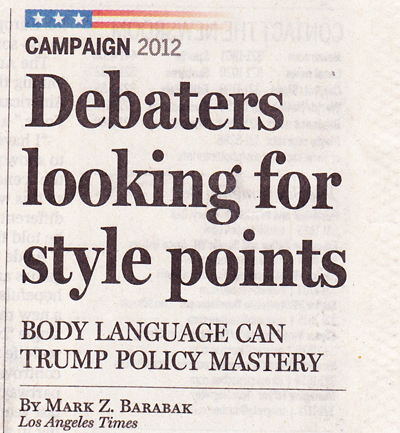
Last night, I gave up five innings of the Giants National League pennant victory to watch the presidential debate.

I sacrificed the five run 3d inning in hopes of hearing the candidates answer a single question that moderator, Bob Shieffer, asked about 40 minutes in:  “What is your vision of America’s place in the world?”

Seconds later, a voice-over interrupted with tornado warnings for several counties north of here.  By the time it ended, the candidates were talking about the economy.  I waited for Shieffer to lead them back to the question he’d asked, but it never happened.  Same old, same old, I guess – the same dysfunctional vision I wrote about in January, in a post called, “Sabre-rattling over oil:  better get used to it.” http://wp.me/pYql4-1AT

This was the first of several posts about the ideas of Col. Andrew Bacevich, a Vietnam veteran, West Point graduate, and currently a professor of History and International Relations at Boston University.  Like George McGovern, the first man I ever voted for as president, who died earlier this month, Bacevich is a warrior who hates warfare.

Sen. George McGovern (1922-2012) flew 35 bombing missions over Germany in WWII and ran for president in 1972 on a peace in Vietnam platform.

Bacevich pulls no punches in The Limits of Power: The End of American Exceptionalism (reviewed here http://wp.me/pYql4-2kX).

Rereading key passages recently, Bacevich’s anger became even more apparent – the anger of a patriot who sees his country sliding down a slippery slope to disaster.  His core thesis is that in turning away from President Carter’s 1980 call for energy independence – never mind the lip-service it gets every four years – the United States has squandered lives and wealth in a hopeless series of wars aimed at compelling the rest of the world to play by our economic rules:

“For the United States the pursuit of freedom, as defined in an age of consumerism, has induced a condition of dependence – on imported goods, on imported oil, and on credit.  The chief desire of the American people, whether they admit it or not, is that nothing should disrupt their access to those goods, oil, and credit…The chief aim of the U.S. government is to satisfy that desire, which it does in part through the distribution of largesse at home…and in part through the pursuit of imperial ambitions abroad.”

Bacevich argues that the status quo benefits those in power in Washington:

“…rather than addressing the problem of dependence, members of our political class seem hell-bent on exacerbating the problem…To hard-core nationalists and neoconservatives, the acceptance of limits suggests retrenchment or irreversible decline.  In fact, the reverse is true.  Acknowledging the limits of American power is a precondition for stanching the losses of recent decades and for preserving the hard-won gains of earlier generations going back to the founding of the Republic.”

In a 2008 interview with Bill Moyers, Bacevich said, “I happen to define myself as a conservative,” yet when you read his prescription for addressing the ills he enumerates, they parallel those of Dr. Jill Stein, the Green Party candidate for president. Moyers interviewed Stein on September 7: http://billmoyers.com/segment/jill-stein-and-cheri-honkala-on-third-party-politics/

Dr. Jill Stein, Green Party presidential candidate

Dr. Stein graduated summa cum laude from Harvard Medical School, and has specialized in environmental health.  She got her start in politics with a successful effort to pass a referendum to reform election spending in Massachusetts.  Reality set in when the Democratically controlled legislature overturned the people’s will in an unrecorded vote.

Both mainstream presidential candidates refer to their “plans” to create jobs, though they haven’t offered specifics.  Stein has a plan too:  cut defense spending in half and use the money to fund a “Green WPA” which would train and employ many of those now unemployed to work toward true energy independence.

In a 2008 interview with Moyers, Bacevich answered the obvious objection that cutting defense spending would jeopardize national security.  Those persons and groups that wish us harm are ““akin to a criminal conspiracy…Rooting out and destroying the conspiracy is primarily the responsibility of organizations like the FBI, and of our intelligence community, backed up at times by Special Operations Forces.  That doesn’t require invading and occupying countries.”  Events last year proved him correct.

***  

What chance do ideas like these have of making it into the mainstream?  Little or none at present, but I don’t think that is the point.  Ideas rooted in reality can be seeds that sprout over time.  The first Earth Day was a peripheral event, but it has picked up momentum every since.

Bacevich repeatedly stresses that not all limits are bad, and despite the title of his book, affirms that he does believe in American exceptionalism  “if American exceptionalism implies that there are certain qualities that make the United States of America a special place, a wonderful place– a place worthy of a patriot’s love.”

In the course of their critiques, both Bacevich and Stein affirm that it’s love of country and citizens that motivates their efforts to change what’s broken.

After all, what other nation on earth could have invented the World Series?

Stories, Dreams, Politics, and Baseball

Yesterday, I struck up a conversation with another San Francisco Giants fan about the possible conflict between the National League Championship Series and Monday’s Presidential Debate.  The Giants are down three games to two.  If they pull off a win tonight, the final game will be Monday.

Later, considering which program I want to watch vs. the one I should watch, I thought of how clear it’s become to me that this election is not about the candidates themselves, but about the visions, or perhaps more accurately, the stories about America they embody.  Most people seem less than thrilled by the candidates themselves, but everyone takes the stories seriously.

A high school history teacher planted the seeds of this understanding decades ago.  At the time of another presidential election, he suggested that most voters are swayed by an image of times past, a story of “the good old days,” which probably never existed.  He argued that the imagination of the conservatives of his day echoed the television show, Bonanza.

The Cartwrights (l-r), Adam, Little Joe, Ben, and Hoss. Public domain.

Ben Cartwright and his three sons carved a fine spread out of the wilderness – they did it on their own, by the sweat of their own brows, thank you very much.  The only hint of government was the Virginia City sheriff, and generally the Cartwrights told him what to do and not vice versa.

In a similar manner, liberals dream of Kennedy’s “Camelot” and its precursor, The New Deal.  For the generation that came of age during The Great Society and the War on Poverty, “less government” is a codeword for Charles Dickens’ London: “Are there no prisions?  Are there no workhouses?”

Scrooge meets Ignorance and Want. Public domain.

And whenever you hear a politician of any persuasion invoke “family values,” you can bet their story embodies the world of Norman Rockwell.  Anyone grow up in a family like this?

Norman Rockwell mural. Public domain, courtesy Oregon Historical County Records Guide.

We’re dealing with powerful stuff here – nothing drives us more than our dreams, which means we need to be careful.  I liked Bonanza and still enjoy Norman Rockwell, but I try not to bring them into the voting booth.  Kids learn how to separate dreams from the world of make-believe:  they know that “I want to be a doctor” is different from “I want to fly like Super-man.”  What kids know, politicians seem to forget.

Tomorrow night, the presidential candidates are scheduled to discuss “foreign policy.”  Webster’s Dictionary defines policy as, “1.  wise, expedient, or prudent conduct or management.  2. a principle, plan, or course of action, as pursued by a government, organization, or individual, etc.

I expect to hear a story that goes like this:  “We are number one and if you want to keep it that way, vote for me.”  I’m not so sure we’ll hear much about policy, aka, “wise, expedient, or prudent conduct or management.”  For that we often have to look to outsiders.

I’ve done precisely that over the last few months, and was startled to find a clear and feasible foreign policy articulated with very similar features from both a liberal and a conservative point of view.  There’s a beautiful story in there too, one involving national renewal through shared effort and dedication.  A dream, to be sure, but it doesn’t require Superman.  This will be the topic of a post in the coming week.

Meanwhile, though I’ll be watching the debate, I’ll have my phone set to the instant scoreboard app.  “The Giants are number one,” is a dream that could happen, but if Superman is listening, we’re not above asking for help!

*** Update, Sunday Night ***

The Giants won, 6-1, so there will be a game 7!