So Long to the Space Shuttle

Yesterday afternoon, I stopped at a Starbucks and used an app on my smartphone to pay for a drink.  Then I glanced at my email while waiting for the barista to finish my frappacino.  I would not be doing any of that without the the US space program, which has reached the end of an era with the last space shuttle flight.

For it was during the ten year “space race” to put a man on the moon, that miniturization of electronices found the means, motive, and opportunity to thrive.  Intel opened its doors in July, 1968, a year before the moon landing, with 100 employees and a plan to make SRAM’s.  Three years later, when they introduced the first microprocessor, the game was afoot.

In hindsight, we can see that during the tech boom, the law of unintended consequences was operating full tilt, carrying many seeds of our current bust:  the sophistication of the internet which enables the “offshoring” of hundreds of thousands of jobs even as ever increasing “efficiencies” allow employers to do more with fewer people.

Where will the “next new thing” come from?  From dreamers like  Jobs and Wozniak, who built the first Apple computer in their garage.  Or from childhood friends, like Bill Gates and Paul Allen, who were inspired by the January 1975 issue of Popular Electronics to build and sell an early BASIC Interpreter and form a company that Allen named, “Micro-Soft.”

***

In 1972, when Adam Frank was ten years old, a collection of books on space exploration  in the local library changed his life.  He decided to become a scientist.  Now an astrophysicist, teaching at the University of Rochester, he asked a number of scientists across disciplines what set them on their path.  He found that fully three generations of dreamers claim they were inspired by NASA.  What is going to ispire the next generation of scientists, he asks, for:

The loss of that dream would feel terrible for the 10-year-old I was all those years ago. More importantly, it would be a terrible loss for all the 10-year-olds dreaming now of exploration and science. And for a nation that needs science and scientists to survive, it would the most terrible loss of all.  http://www.npr.org/blogs/13.7/2011/07/08/137678718/the-inspiration-gap-and-the-shuttles-last-launch

***

Beyond all practical considerations, the space program gave moments that those who lived through them will never forget.  If you’re old enough, you probably remember exactly where you were and what you were doing when Neil Armstrong stepped onto the moon.

You probably also remember that beautiful day in January day when Challenger exploded.  Who had any idea that the loss of that crew could cut so deep?

We all know there are rhythms of expansion and contraction, of dreaming and the end of dreams.  The stars aren’t going anywhere.  Let’s hope we are able to stretch ourselves toward them again soon.

The Freedom Index

Actually, there is no Freedom Index, except in my possibly fevered imagination.  The idea came from reading the WordPress Daily Post, “What Does Freedom Mean?”  That’s a good question to think about.  It is very hard to answer, which makes it interesting.

All of the obvious answers lead you in circles.  Millions of people in these troubled times long for the freedom that work brings, but that reminds me of all the five dollar bills I tossed into lottery pools at work.  I’m guessing that nearly all working stiffs sometimes dream of winning the lottery and achieving that sort of freedom – even though lots of studies show that a year later, most winners are no higher on the Happiness Index (which really exists).

News reports are always full of threats to our freedom, often couched in words of blame for someone else.  Still, on a hypothetical Public Freedom Index, things could be a lot worse.    We can watch fireworks if we choose – or not, since we don’t have mandated public celebrations.  The explosions tonight will be for fun; we live free of the threat of real bombs.  We can can blog and tweet to our heart’s content, and Google on a staggering array of topics.

Personal Freedom is always a little more dicey.  We are still guaranteed “the pursuit of happiness,” but you have to wonder how most people would answer the Dr. Phil question:  “How’s that working for you?”

The Dalai Lama says all of us desire happiness and an end to suffering, but we really don’t know how to go about it.  Many of our choices lead to the opposite result.  Perhaps the freedom to ask – really ask – where our real happiness lies, is one of the greatest freedoms of all.  That and Freedom of Information which allows us to follow the trail where ever it leads.

Here is Buddhist blessing/prayer, known as The Four Immeasurables:

May all beings have happiness and the causes of happiness.
May all beings be free from suffering and the causes of suffering.
May all beings know the supreme happiness that is beyond suffering.
May all beings rest in equanimity, free from attachment and free from aversion.

Happy Fourth of July!

A Year of Blogging

Snoopy writing

During high school and college, I tried to keep journals, because that’s what writers are supposed to do, but I never got too much traction writing only for myself.

Far more important were the letters I wrote to several close friends during that time.  You could say I learned to write because of them, for they really encouraged me, and an appreciative audience was all it took to turn on an incredible flow of words.  I wrote page after page, jotting down ideas as I tried them on for size, and things that just came to me in mid-sentence.  What kept me going was the thrill of knowing someone wanted to read what I had to say.

I think you can see where I am going with this…

Fast forward a few decades and in June, 2010, I signed up for a day long blogging workshop because these days, “building a platform,” is what writers are supposed to do.  I had and have some fairly cynical thoughts on that proposition (for writers of fiction that is), but that is beside the point.  I simply would not have kept at it if blogging was nothing more than a means to an end.

Almost immediately, this endeavor took on a life of its own.  It continues to surprise me.  If I had to sum up what blogging means to me, I would say, “discovery.”  Not only because of all the things I get to research and learn about, but because I continuously surprise myself by finding things in the psyche I don’t know are there until I see them on the screen.

So I want to sincerely thank everyone who stops here and reads a post, and maybe even takes a moment to leave a comment.  You keep me going and I appreciate you very much

I’ve learned many things this year, chief among them, the seemingly inexhaustible way the mind generates ideas.  I don’t know how many times I’ve posted something and gotten up thinking, “Well, that’s it.  It was a nice run while it lasted, but I’m finally out of things to say.”  The experience is so common, that I get to see, at least once or twice a week, that if I just go do something else, the next idea will appear in it’s own time.

Ideas are common – they come and go, but once in a while one sinks deep, resonates, and even changes some aspect of your life.  Something stated very simply this spring by Edward Espe Brown, who I posted about at the time, had that effect.  It crystalizing themes that had been on the back burner for a very long time:

Are you going to be a rule follower or are you just going to be you? – Edward Espe Brown

Brown made the comment in the context of spiritual practice, but it has a much wider scope.  It certainly does in the field of writing.  Here’s a confession:  some two years ago, a critique group buddy said, “I’ve heard that editors don’t like colons.”  I am ashamed to admit that I went home and rewrote several sentences.  Blogging has sharpened my perception of the absurdity of pronouncements like that, and something else that Brown said cuts at the very motive for heeding “advice” of that sort:

What is precious in us doesn’t come, doesn’t go, and it does not depend on performance.

Edward Espe Brown

I am very fortunate indeed to have a forum like this where I get to pass along things of value like that when I come upon them.  And as for what’s coming up in the next year – I promise I’ll let you know as soon as I do.  Meanwhile, I very much hope you will stay tuned.

A Literary Agent’s Comments on Nonfiction Opportunities

The guest speaker at the local California Writer’s Club’s June lunch meeting on Saturday was Matt Wagner, founder of Fresh Books, Inc. Literary Agency:  http://www.fresh-books.com/

Wagner specializes in nonfiction titles.  His clients include several “Dummies” book authors, Dave Crenshaw, who wrote The Myth of Multitasking, and Michelle Waitzman, whose Sex in a Tent:  A Wild Couple’s Guide to Getting Naughty in Nature evoked a lot of interest when he passed it around.

Here’s the bad news:  Wagner debunked any notion that nonfiction writers are thriving in our current “legacy publishing” environment.  With Borders in bankruptcy, a suitor seeking to buy Barnes&Noble just for the Nook, and the explosion of epublishing, confusion reigns in nonfiction as well as fiction.  If things are uncertain for publishers, they are worse for agents, some of whom are trying to reposition themselves as coaches to stay in business.  This leaves mid-list authors who are trying to break into print at the bottom of the food chain (Wagner defines mid-list as, “You are not Suzy Orman”).

Several categories of non-fiction are doing well.  One are the series books – the “Dummies” and the “Idiot’s Guide” titles.  Part of the secret is, of course, that these books are not for dummies.  I’ve read several that were excellent introductions to their topics.

Wagner also cited, “vertically integrated niche publishers” as prospering, and gave an example I recognized:  O’Rielly Publications, which specializes in books on open-source software.  For the quarter century I worked in electronic design automation, O’Rielly titles occupied at least a third of my bookshelf, and the same held true for my colleagues.  Need a reference on the Linux operating system, or the PERL or TCL programming languages?  O’Rielly has it, often written or co-authored by the developer of the language.  In addition, they have websites, blogs, and webinars.

This, according to Matt Wagner, is a route for nonfiction authors that is opening up in our internet world.  Do you have an area of expertise?  Is it something someone might subscribe to a newsletter to learn?  An example jumped right to mind:  Randy Ingermanson’s Advancedfictionwriting.com (there’s a link on my blogroll).

Ingermanson, author of the traditionally published, Fiction Writing for Dummies, offers several free articles on his website, including his “Snowflake Method” of plot design, which I have discussed here (it is very worthwhile).  He also gives you the option of purchasing software to guide you through the process.  There’s a free e-zine, and as well as other articles and lecture series’ available for nominal fees in several electronic formats.

Check this site out, both for its free content (solid suggestions on plotting and building scenes), but also because it’s a great example of the kind of “vertical integration” that agent, Matt Wagner believes is the emerging model for how nonfiction writers can survive and even thrive in our emerging new world of publishing.

Dreaming Up Ideas

I have been busy working on several blog posts, but they are for later this summer.  Meanwhile, I found myself less than excited by any of my other topic ideas, so I drifted over to a blog filled with a wealth of advice and inspiration, “Writing On The Wall” (you can find it in my blogroll).  Out of all the tags, I chose a section called, “Getting Ideas.”  http://writingonthewallblog.blogspot.com/search/label/getting%20ideas

Most of the posts were by a contributor named Annette Lyon, who shares a number strategies for jump-starting the creative process in fiction, as well as some interesting facts, like Orson Scott Card’s moment of inspiration for Ender’s Game, and this great quote from Tom Clancy:  “The difference between fiction and reality?  Fiction has to make sense.”

I especially liked Ms. Lyon’s account of wrestling with the infamous cliche that she heard from a college creative writing teacher – the famously stupid advice to “Write what you know.”  I suspect that most fantasy authors have never believing that nugget.  Write what you can imagine is more accurate for writers and poets from Homer to H.G. Wells, to J.K. Rowling, but Lyon’s misguided professor actually forced his students to compile a list of 100 things they knew, and were thus qualified to write about.

Lyon, who had wanted to be an author since the second-grade, was initially paralyzed by the realization that she didn’t know anything on her list well enough to write about it.  Fortunately for her and for us, she round-filed the list as soon as she could and rephrased the motto as, Write what you are willing to learn about.  

Any writer who has ever researched anything will agree with her, and reading her post, I realized that learning new things is one of my greatest pleasures in blogging.  And speaking of learning, check out “Writing on the Wall.”  Scroll through the tags and you’re bound to learn something new and find this sort of inspiration.

A Retreat with Anam Thubten Rinpoche

I recently heard the results of a poll that I found surprising: 50% of Americans report having had a “spiritual experience,” but of that group, 80% say they never want to have another. That was exactly the opposite of the 70 or 80 people who gathered on Saturday for a daylong retreat with Anam Thubten Rinpoche, sponsored by the Sacramento Buddhist Meditation Group.

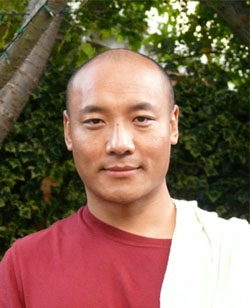
Anam Thubten Rinpoche

Rinpoche is a Tibetan word meaning, “precious one,” and is usually only applied to those recognized as reincarnations of spiritual leaders or teachers of the past, most famously, the current 14th Dalai Lama.

I first attended a retreat with Anam Thubten in December, 2005 and have been fortunate enough to get to a half-dozen more since then, for his home and teaching center, the  Dharmata Foundation in Point Richmond, CA, is not far away.  In the years since I first heard him, the clarity, resonance, and joy contained in his teachings have brought him greater renown:  his book, No Self, No Problem, originally published by the Dharmata Foundation, has been picked up by Snow Lion Press (a self-publishing success story!), and he was chosen to kick off the ongoing series of online retreats at Tricycle.com

In my own efforts to write of the concept of no-self last December, I quoted Anam Thubten for his simple, experiential way of presenting the concept:  “this ‘I’ is a fictitious entity that is always ready to whither away the moment we stop sustaining it.  We don’t have to go to a holy place to experience this.  All we have to do is simply sit and pay attention to our breath, allowing ourselves to let go of all our fantasies and mental images”

It should be clear that any culture like Tibet, that believes in Rinpoches, is not using the concept of “no-self” to tell us we don’t exist or that life does not continue after death.  In Anam Thubten’s vision, “no-self” means an end to the painful illusion of seperation, an end to isolation, an end to living in a friend-or-foe, fight-or-flight world.

Yet although he mentioned this concept, which first drew me to his teachings, on Saturday he had a different focus, “Primordial Mind,” the unconditioned and indefinable base of what we are, prior to concepts, prior to ego, prior to all delusions.  The experience of this spacious mind is surprisingly near if we are willing to let go of fixed concepts, and practice a simple meditation technique, and if we are motivated by devotion, by longing for union with the absolute the way a thirsty man longs for water.

Anam Thubten’s book elaborates the concepts we need to let go  of as well as his favorite meditation practice – the simple but difficult art of learning to relax and let go of effort, even the effort to meditate “well.”  This longing – for God or the guru or Buddha; for oneness, or emptiness or, selflessness, or enlightenment – however we conceive of the ultimate good, is finally a longing for love, he said, and this is what remains when our fixed ideas break down.  In Anam Thubten’s teaching, God is love, or Buddha Nature is love, as it is in the words of many other spiritual masters.

My description is close to being new-agey, which is why Anam Thubten is the teacher and I am not.  He didn’t gloss over the difficulty and struggles involved in a serious spiritual search, and in his quiet and understated way he noted that if one is not receptive, “this talk will be very strange.”

In the end, it is the person of the teacher himself that does the convincing.  Is this person really what he seems – genuinely centered, full of peace and compassion?  I believe Anam Thubten really is a man of peace and joy and I trust his message that what he has found is accessible to anyone willing to look and make the effort.   More information and his teaching schedule can be found at the Dharmata Foundation website,  http://www.dharmatafoundation.com/

Dharmata is a word that means, “the way things truly are.”

Memorial Day, 2011

I had a friend at work who was rather vocal about his support for liberal social issues and his disdain for the political landscape during the Bush administration.  In 2007 or 2008, he spent three weeks in Shanghai on business.  On the last morning he was there, the television showed a stadium full of people who had gathered to witness an execution.  Three young men were shot by a firing squad for first time possession of marijuana; no appeals, no clemency.  My work friend said he wanted to kiss the ground when his plane touched down again on American soil.

Memorial Day always pulls me up short like that.  We have 364 other days each year to debate our past and present military engagements.  This is a day when people’s  thoughts turn to the courage and sacrifice of men and women in uniform who have done their best to defend a culture that gives us trial by jury, a constitution that says the punishment must fit the crime, and countless other benefits it is easy to take for granted until they are threatened.

This is a day when I think of my grandfather, Morgan.  At 17, he lied about his age so he could enlist for the war to end all wars.  To his great disappointment, it was over before he made it “over there.”

I think of my father, Howard, who served as a radar technician in WWII.  His old navy manuals fueled my own interest in ham radio, and ultimately led me down my career path.  As a non-combatant, my father avoided the worst physical and emotional scars, and yet even though he looked so young at 23, he and most of his generation always seemed older than their years.

My father in uniform, ca. 1943

Time paints the conflicts of the past with the sepia tones of memory.  The poppies grow in Flanders field, and the last World War I veteran died on May 5 of this year.  At 14 he lied about his age to join the Royal Navy and then lived to be 110.  This is the stuff of historical novels.  Present realities are never as tidy.  Yet this is a day to be thankful for all those who find the courage to serve, even if for the “wrong” reason – like a friend of mine who enlisted for Viet Nam in an alcoholic blackout.

Not long ago, while walking the dogs one Saturday morning, we passed a military honor guard waiting outside a local church.  I thought of the solemn dignity of the honor guard that folded the flag and handed it to me at my father’s memorial service.  Such rituals are very important.  By whatever means we have, these are things we have to remember.

A Childhood Story I Have Never Forgotten: The Death of Balder

Like many children, I read to be scared witless, to be less lonely, to believe in other possibilities.” – Amy Tan

When I was young, I spent hours devouring a ten volume set of stories and poems called, Journeys Through Bookland:  A New and Original Plan for Reading Applied to the World’s Best Literature for Children , 1939.  

The illustrations alone could transport you to other worlds, and the world I most liked to visit was that of the Norse gods.  Interesting choice for a kid, since this was a world that was destined to end badly.  At Rangarok, the last battle, the forces of chaos and darkness would win the day.  No doubt this mythic cycle influenced Tolkien’s Silmarillion, and just like our mortal lives or a fleeting sunset, the certainty of an ending lends these northern stories a haunting beauty.  Within that canon, there is one story that fascinated me more than others and pops into mind whenever I think of the root stories of my life.

The Death of Balder:

Balder, the god of light and summer, was the second son of Odin and Frigg and beloved of mortals and gods alike.  Because he was associated with truth, his mother worried when he was plagued with nightmares of his own death.  Frigg travelled the nine worlds, extracting vows from humans, immortals, plants, and metals not to hurt her son.  Because Balder was popular, every creature agreed – except the mistletoe, which Frigg considered too insignificant to ask. ( Oops!!!!! )

Now Loki was the trickster and the most fascinating and multi-faceted character of the lot.  He wasn’t one of the ruling family of gods, though sometimes humans prayed to him and he helped.  As a sower of chaos, he kept things in motion.  Coyote did the same for Native Americans, but Loki was much darker and proved deadly to Balder.

Loki and Rhinemaidens, by Arthur Rackham, 1910

Balder was asking for trouble the day he stood before the gods and challenged them to throw their spears and weapons at him.  “Gimme your best shot!”  In a color plate in Journey’s Through Bookland, there he was, the curly-haired golden boy, strutting his stuff like a star quarter back.  Ten years later, reading the Illiad in college, I would learn the word, hubris, but even without the vocabulary, I knew he was asking for trouble.  I knew I was supposed to like him, but I honestly thought him a moron.  You wanted to slap Balder – and Loki did worse that that.

Balder’s blind brother, Hodr wanted to join the fun, so Loki, in the shape of Thokk, a giantess, offered to help.  Did I mention Loki was a shapeshifter?  Loki/Thokk handed Hodr a dart made of mistletoe and guided his throw so it pierced Balder’s heart.  Thokk also refused to weep at Balder’s funeral, thus preventing him from returning from Hel.

The gods caught Loki and his punishment was terrible:  he was chained beneath the earth with a serpent above him dripping searing venom on his face and there he will stay until the bones of the earth are shattered at Ragnarok.  Sometimes the pain is so fierce, Loki writhes in agony and the earth shakes.  Without the god of light, the final battle draws near, and Fenris the Wolf, strains against the chains he will break at the start of Ragnarok.

Odin battles Fenris at Ragnarok

So why did the story fascinate me so?  When I was younger and imagined myself to be wiser, I might have tried to concoct some plausible explanation, but now I agree with Heraclitus (as quoted by James Hillman) who observed that one can never plumb the depths of the soul or be certain of its shifting landscapes and cast of characters.  But I am certain that one thing that keeps this story alive for me in imagination is mystery:  all the questions I cannot answer.

  • Why was Balder such a jerk?  Well over the years I sort of got a handle on this with the understanding that mythological gods are do not have well-rounded personalities.  It is a function of the god of summer to die – though most often in annual cycles.
  • Why, in spite of my best efforts, did I secretly identify with Loki even as I feared and loathed him?  I have no clear idea, except now I suspect that is a common reaction.  Somehow it is necessary, and we know it in our bones.
  • Why such a cruel and unusual punishment for Loki?  Isn’t it out of proportion to the crime?  I remember I thought so as a kid.
  • Why did I enjoy a story and illustrations that frightened me out of my wits?  That too, I think, is necessary.  That’s why we like Stephen King and Mary Shelley and why I’m betting Bram Stoker will outlive Twilight.  I believe well meaning people who would clean up fairy tales for children have it all wrong – life itself will sometimes be more scary than any story, and the old tales are like inoculations.
Ultimately, “The Death of Balder” just leaves me wondering – wondering about all kinds of things.  About the kind of people who would tell such a story.  About how they found their courage in a cosmology in which their gods were doomed to go down in defeat in the end.  Wondering if they really believed that or if, like the classical Greeks, they told these as beautiful wisdom tales without thinking they were literally true?

My wondering about a story like this could go on forever, which is probably why it still lives and breathes for me all these decades later.

NEXT:  Two ballads that keep me wondering.