
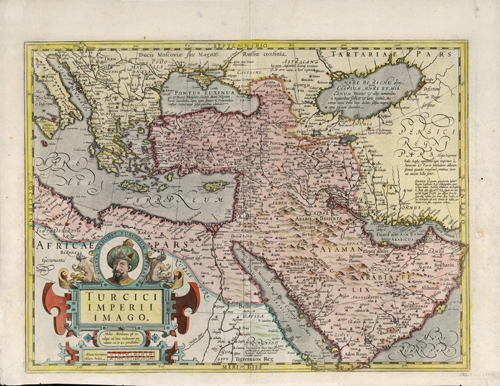
At its height, the Ottoman Empire (1299-1922), controlled North Africa, much of the Mediterranean, and portions of the Balkans, Italy, Austria, Hungary, and Russia. Innovations in medicine, mathematics, astronomy, architecture, philosophy, chemistry, physics, calligraphy, weaving, music, and literature are part of their cultural legacy. They gave us scalpels, alarm clocks, and coffee.
The following notes on the decline of the Empire come from A World Undone, 2007, by G.J. Meyer, an excellent history of World War I that I have quoted before.
The high point of the Empire occurred during the reign of Sultan Suleiman the Magnificent, from 1520-1566. The Sultans did not have wives, but large numbers of concubines, who gave them large numbers of sons. Suleiman had 300 women in his harem, but became enamored of a red-haired Russian woman, who later became known as “the witch,” She convinced Suleiman that his favorite son was plotting against him. Suleiman had this son killed and the witch’s son, Selim, installed as his heir. Meyer says:
“Selim the Sot was short and fat and a drunk. He never saw a battlefield and died after eight years on the throne by falling down and fracturing his skull in his marble bath.” Meyer describes the Sultans that followed him as “craven.” This started the Empire’s decline.
*****
Let me put this in bold type:
It only took eight years for a craven leader to begin the ruin of what, for 300 years, had been the most powerful and innovative Empire in the known western world.
 The First Gates