The wounded magpie
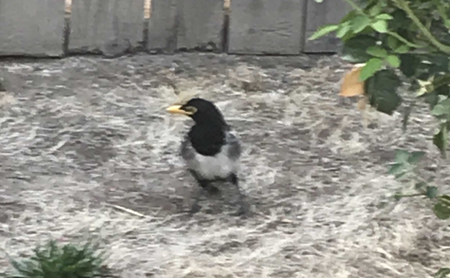
Last Friday afternoon, I came home from various errands to find a magpie with a broken wing in the back yard. Seeming dazed, it was swung its head back and forth, as if its vision was impaired, and flapped wings in unsuccessful effort to fly. Then it would run, often in circles, falling over because its balance was off. The afternoon was hot, but the bird was fast enough to scoot away when I tried to set a water bowl nearby.
In the evening, I turned on sprinklers. As the sun got low, other magpies flew into the yard to peck at seeds or insects. The injured bird joined them to eat, but when they flew away, it made it’s way alone to a section of fence behind the cover of bushes. Hours later, when I took the dogs out before bed, I shone a flashlight to look, and the bird hadn’t moved. I wondered if the magpie, left behind by its tribe, felt something akin to loneliness.
I hadn’t been sure the bird would last through the night, fearing that injuries or a cat would finish it off, but in the morning, it was dashed around with more energy and coordination than the day before. I checked on it through the day, and that afternoon, was surprised to see it approach a squirrel that climbed down a tree in the shade where the bird was resting.
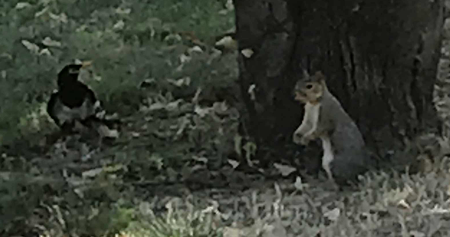
Magpie and squirrel
The magpie came close to the squirrel, who at that point, charged and drove it away, but this close encounter between two species I’d never seen interact before made me wonder again if the bird was experiencing something we would call abandonment.
We’ll never know, but such speculations can no longer be dismissed as mere projection or pathetic fallacy. I’ve seen numerous examples of this recently, including an article this week in The Atlantic, about an Alaskan Orca who carried her dead calf with her for 17 days:
“It is hardly anthropomorphic to ascribe grief to animals that are so intelligent and intensely social. Tahlequah’s relatives occasionally helped her carry her dead calf, and may have helped to feed her during her mourning…
The Lummi Nation, who live in the Salish Sea and also depend on salmon, have long understood this side of the southern residents. ‘We’ve fished alongside them since time immemorial,’ says Jay Julius, the nation’s chairman. ‘They live for the same thing we live for: family.’”
Our role in the magpie’s story came to a happy ending. We managed to scoop it into a cardboard box I’d drilled with air holes, and on Sunday morning, carried it to the Sacramento Wildlife Care Association, a wonderful organization that rehabilitates injured or orphaned birds and animals.
As I’ve said before, both modern physics and ancient Buddhist teachings agree that there really isn’t “a world out there,” out there. The physical world we experience is what our limited senses configure out of swirling masses of energy and light. The meanings we experience are those we impute on a world that is far more dream than solid “reality.”
I never named the magpie for fear it wouldn’t survive, but in my favorite version of the dream, this bird, healed and nourished until it is strong again, will rejoin its fellow magpies, stronger than it was before, as a result of its time of trial and solitude.

 The First Gates