
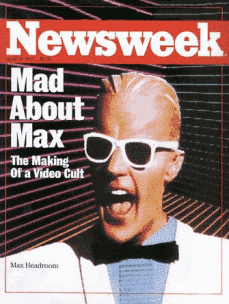
Remembering Max Headroom, a visionary TV show

max headroom newsweek

In 1984 I joined Intel as their graphic workstations  were shrinking from video arcade sized units to large desktop computers. In my spare time, I sometimes played with a Commodore64 and saved quarters for Space Invaders. The first IBM personal computer did not roll out until the following year.

That was the state of technology when Max Headroom was born.  The creation of a British trio, George Stone, Annabel Jankel, and Rocky Morton, Max was an artificially intelligent, disembodied personality who lived in cyberspace before the term was coined.  Computer animation wasn’t advanced enough to portray the computerized look the group was after, so filming Max required a four hour makeup session that actor Matt Frewer described as “a very painful, torturous and disgusting enterprise.”

Rocky Morton described Max as a “very sterile, arrogant, Western personification of the middle-class, male TV host,” but he was also “media-wise and gleefully disrespectful,” which endeared him to younger viewers.

Max appeared on American TV in 1987, as a talking head – literally – in a TV newsroom in a dystopian near-future dominated by large corporations and television.  Although he became a spokesman for “The New Coke,” and appeared on Sesame Street, only 13 shows aired.

Part of the problem was that Max was down right irritating, with his visual and vocal stutter and an op-art background that was the best computer animation could do at the time.  Here is a 3o second sample from his Coke commercial:

The fact remains that Max Headroom was decades ahead of his time. In one episode, for instance, terrorists blow up all TV towers in the city, pushing the population to riot when they find they have nothing to watch. In the nick of time, city officials pacify everyone by distributing hand-held video viewers loaded with old reruns.

Remember, this was 1987, when the best technology Hollywood had to offer wasn’t enough to capture the vision of Max’s creators.

So what brought Max Headroom to mind right now?  Beyond Max’s “dystopian future dominated by large corporation and television” that is.  Why today, December 3, 2012?

Yesterday, after  a series of storms, I ventured out to the supermarket and walked in just as they played the Christmas carol holiday song I hate most, “Little Saint Nick,” by the Beach Boys.  I had to compliment the store, however – the sound was just barely audible.  Not loud enough to cause real annoyance, I thought, but enough to keep silence at bay, which might cause people to riot.

That brought Max to mind.  “Ha-ha-ha-happy Ho-ho-holidays, everyone.”

Tales of the Elves: Icelandic Folktales for Children

Tales of the Elves cover

One day God decided to visit Adam and Eve.  They welcomed him and introduced  their children – all except the ones Eve had not finished bathing.  After all, you want your kids to be clean when the Supreme Being drops in.  God was aware of this and said, “What is hidden from me shall be hidden from men.”  Those children became the elves who live in the hills and mounds of Iceland.  They can see us but we can’t see them unless they wish it.

I know this because I read a magical book, Tales of the Elves, based on the Icelandic folktales of Jon Arnason, adapted by Anna Kristin Asbjornsdottir and illustrated by Florence Helga Thibault.  I found the book on our visit to Iceland, which I wrote about in the fall.

Interest in elves isn’t limited to children in Iceland.  One day, as we toured the countryside, our driver pointed to a spot in a wide valley where the highway curved around a pair of volcanic rocks.  The stones were only 8′ – 10′ tall, nothing modern earth movers couldn’t remove.  That was the intention of the highway crew.  The problem was, the bulldozers broke down or stalled every time they  approached the twin rocks.  Every time.  Locals explained that the stones marked the entrance to an underground elven settlement.  The equipment worked perfectly after the construction crew decided to route the highway around the stones.

If this reminds you of Irish fairies, there’s good reason.  Genetic testing has proven that many Icelanders, especially the women, came from Ireland, specifically, the viking settlements there.  The stories themselves teach us similar lessons in coexisting with “the hidden ones.”

“Midwife to the elves” shows how the elven folk can give the gift of the sight and take it away again.  “Elf Wind” demonstrates the courage and cunning required to set things right if you do something foolish, like cut the grass on an elven mound.  “Payment for Milk” is about the boons the elves can grant if you treat them with kindness and goodwill.

I’d been looking forward to writing this review since I found Tales of the Elves, but unfortunately I couldn’t find any venue where interested readers can find the book.  Not on Amazon US or UK.  Not on bookfinders.com or ebay.  I couldn’t find ordering information on the publisher’s website.  I posted a request for information on the illustrator’s Facebook page, and I’ll pass along anything I discover.  Meanwhile, here is the information – if you love folklore and fine illustration of fantasy themes, it’s worth keeping an eye open for this book.

Anna Kristin Asbjornsdottir (adaptation), Florence Helga Thibault (illustration), Victoria Cribb (trans), Tales of the Elves, Bjartur publishing, Reykjavik, 2012

ISBN:  978-9979-788-80-5

Please post any information you may discover.

The Face of Class Warfare

In the wake of the election, I more or less swore off posting political content here, except on special occasions like when the first day of a new month falls on Saturday. On days like this, I am allowed to provide links to stories I think are important.

Please check out this post on the website of Sen. Bernice Sanders (Independent) of Vermont: http://www.sanders.senate.gov/newsroom/news/?id=D3227558-DD10-4C92-AD1A-AD1E1E54543D

The good news is, Senator Sanders won a decisive re-election victory this past November. The people of Vermont know a good thing when they see it!

The Life of Pi: A movie review

What you’ve heard about this movie is true: it’s the tale of a boy who winds up in a lifeboat in the Pacific with a Bengal tiger. It’s also true that most critics have praised The Life of Pi. I’m with them; this is a magical film.

Pi Patel livess an idyllic childhood in Pondicherry, India.  His father owns a zoo, and Pi develops a love for the animals as well as a spirituality that embraces the Hindu gods, Jesus, and Allah.

As he tries to practice all three faiths, his father, convinced of the supremacy of reason, warns that “If you believe in everything, you will end up not believing in anything at all.”  Pi’s father also demonstrates graphically that tigers are not your friend, a lesson that shakes Pi’s trust in nature.  The real blow falls after economic hardship forces Pi’s family to relinquish the zoo.  They sail for Canada with all the animals on a freighter, but a storm sinks the vessel, and Pi is the only human to survive.

What god do you pray to and what do say when your way of life and your family are suddenly gone, and you’re alone in a lifeboat with a zebra, an orangutan, a hyena, and a tiger named Richard Parker?  Initially, there is little time for prayer in the struggle to survive.  Soon it’s just Richard Parker and Pi.  There are cans of water and boxes of biscuits for 30 aboard the lifeboat, as well as a book on survival and a pencil that Pi uses to journal in the margins.

An optimist, Pi’s spirituality returns with expressions of gratitude and surrender as the ocean moves through her various phases, with deadly storms, cornucopias of fish and rain, and scenes of unearthly beauty.

Einstein once said the only important question is whether or not the universe is a friendly place. The adult Pi, who narrates the tale, believes it is. Was his ocean a friendly place or not? Both and neither, his story seems to say; it’s far more vast than that.

The western fantasy of objective truth leads us to believe there are true stories and false ones. The eastern view, shared at least in part by novelists and movie makers, is that our stories create our realities.

What does your heart say?  What does it lead you to believe?  That’s the question the grown-up Pi seems to asks us with his story and a half smile on his face.  It’s the same enigma the ocean and Robert Parker put to him.

All quiet on the holiday front

The chief of security at one of the largest area malls reported that this year’s Black Friday was the smoothest in 13 years.  He didn’t speculate on why that was true, so here’s a poll.  Pick whichever explanation(s) seem most plausible:

  1. The population has grown more civil.
  2. More people are shopping online.
  3. After all that’s happened this year, including the election, we’re too numb to respond to the usual holiday trappings.

Yesterday, I thanked the waitress at a local waffle place for the lack of “holiday” music.  “I know,” she said.  “Isn’t it great?  I’m hoping management keeps it up.”

I distinguish between Christmas music, which I enjoy at this time of year, and Holiday music.

People reading this blog in other countries may not be clear on the distinction.  Because of our nation’s diversity, in the public sphere, both at work and in stores, we say “Happy Holiday’s” instead of “Merry Christmas.”  The intent is not to offend people of other faiths.  The result is largely to trivialize the whole thing.  If you’ve ever gotten a song like “Little Saint Nick,” or “Rockin’ Around the Christmas Tree,” stuck in your mind, you know what I mean.

For helping spark the trend toward silence or simply generic music in stores, I present my 2012 Corporate Hero award to Shoppers Drug Mart, a popular Canadian pharmacy chain.  They started playing Holiday music the day after Halloween, but received so many complaints that they pulled the plug “until further notice.”

One comment on their Facebook page read, “Starting this music so early takes the sacredness and meaning out of what should be such a beautiful season.”  That sums up “the Holidays” in their entirety.

Luke’s gospel tells us that after the shepherds saw the baby Jesus, they ran off to Bethlehem to tell everyone, “But Mary treasured up all these things and pondered them in her heart”  Lk 2:19.

Pondering things in our heart is how an event becomes an experience.  It’s how we come to appreciate things, even simple acts like buying a gift or having waffles with a friend.

I never begrudge our merchants the chance to make a living at this time of year, and I appreciate them even more for pulling the plug on noxious music so I can treasure more of these things in my heart.

The end of the world as we know it

Having slept through Black Friday, the next big event on my calendar is the Mayan apocalypse, scheduled for December 21.

I had no intention of blogging about this until I received the Winter 2012 issue of the University of Oregon Quarterly, where an article by Alice Tallmadge, “Doomsday or Deliverance?” discusses this prophecy in the context of end-of-the-world folklore.

Associate professor Dan Wojcik, director of the UO folklore program, plans to travel to Chichen Itza, one of a huge number of visitors expected for the event, which for some heralds the shift to a higher world age, in the same spirit as the Harmonic Convergence of 1987.  The main organizer of that event, as well as the biggest publicist of 12/21/12, was Jose Arguelles (1939-2011).  In his obituary, the New York Times described his philosophy as “an eclectic amalgm of Mayan and Aztec cosmology, the I Ching, the Book of Revelation, ancient-astronaut narratives, and more.”

On the other end of the spectrum, Alice Tallmadge reports that sales of survivalist goods have spiked in recent months.  A recent Reuters poll found that 15% of people worldwide, and 22% of Americans believe the world will end during their lifetime.  The apocalypse has been a feature of Christian theology from the start, but professor Wojcik notes a recent uptick in secular end-time beliefs:  pandemics, overpopulation, and climate change are seen as threats to the planet without any hope of spiritual redemption.

Things that have a beginning have an end, from gnats, to humans, to stars, and all of creation in the western view of time as linear.  When the world survives a predicted ending date, the error is put down to miscalculation; the expectation persists.  What is it about end-time predictions that continue to fascinate most of us and motivate many believers?  The old saying, “Fool me once, shame on you, fool me twice, shame on me” doesn’t hold in this realm.

I wonder if it parallels our continuing love for disaster film?  Stories of terrible struggle and danger where we get to imagine ourselves among the survivors or among the happily raptured, coming through the ordeal to enjoy “a new heaven and earth.”  The ultimate do-over.

They don’t get any better than one of my all time favorite “disaster films,” made decades before the phrase was coined:  San Francisco (1936), with Clark Gable, Spencer Tracy, and Jeanette MacDonald surviving the 1906 earthquake.

Here’s hoping all our December disasters turn out as well!

And finally, for extra credit, here’s a different kind of celebration, with REM performing “It’s the End of the World As We Know It (and I Feel Fine).  Enjoy!

Twinkies, Part Deux

My previous article, which indulged in bit of nostalgia about grade school lunches, missed much of the actual drama that put Hostess, the maker of Twinkies, Ho-Ho’s, and Ding Dongs, on the ropes.

It isn’t quite over .  A USA Today article by Kevin McCoy reports that Hostess management and the baker’s union are meeting for mediation today, delaying the company’s second bankruptcy filing in less than a decade  http://usat.ly/TU81SA.

The maker of popular snack foods has a billion dollars in debt, which it blames on an “inflated cost structure,” largely as a result of labor contracts.  The union contends the problem is years of mismanagement.  An outside financial analyst found that problems included, “years of underinvestment in products, facilities and equipment, long-term neglect of once-dominant brands and hollowing-out of a distribution system that once provided a competitive advantage,”

Bruce Maiman, a local contributor to the Sacramento Bee, interviewed workers striking at the local Hostess bakery who say their hourly wage and pensions are lower than other bakers like Oroweat and Sara Lee  http://www.sacbee.com/2012/11/20/4998328/blame-workers-unions-or-the-executives.html.  Maiman lists a string of gaffes by a management led by six different CEO’s in ten years.

Local workers claim that rather than replacing outdated equipment, money was recently spent to replace windows and paint the lunchroom, locker room, and floors.  “They want it to look pretty so they can sell it,” says the head of the local baker’s union.

Selling assets may well be the outcome.  US Bankruptcy Trustee, Tracy Hope Davis, joined the union in arguing against management’s current shutdown plans – which among other things, would grant them large bonuses.  Davis favors Chapter 7 bankruptcy, which would liquidate assets according to US Bankruptcy Code priorities.

In other words, Twinkies may survive, so we’re better off waiting before spending $5,000, the going rate for a Twinkie on eBay.  This, says Bruce Maiman, just goes to show that “as long as human beings exist, the planet will never run out of Twinkies or nitwits.”   

Remembering an icon

When I was in grade school, the lucky kids had Hostess snack foods in their lunch. I remember one guy who would shove an entire Twinkie into mouth, partly to gross out the girls and partly to gloat over those whose mothers, like mine, packed boring things like carrots and celery.

Once I got to junior high, with its snack bar window, I could indulge, and that was when I made a terrible discovery – Twinkies just weren’t that good.  Oblivious to the dangers of breaking a filling, I generally spent my pocket money on corn nuts instead.  And yet, I will miss Hostess.  Not just because the cupcakes are good, and you gotta love any snack food called “Ding Dongs.”  Not just because the local Hostess bakery will close and thousands of people around the country will lose their jobs.

There’s something endearing about the little gold icon, an image of youth, when there were do-overs in terms of diet and teeth and most other things.  I would also argue that the same font of creativity that brought us Twinkies and Elvis impersonators brought us microchips and iPhones as well.  Say it loud and say it proud:  “Only in America!”

Hostess cared about its customers!  I remember hearing on NPR’s Science Friday that the company conducted experiments to determine how long you could safely nuke a Twinkie.  Seems that many enjoyed warming their Twinkies, but when left in the microwave too long, they would explode.  After careful research, Hostess reported that 60 seconds or less was generally safe.

The reputation of Twinkies was forever tarnished by the notorious “Twinkie defense” used in a sensational murder trial in 1978.  On November 27, disgruntled San Francisco City Supervisor, Dan White, climbed into City Hall through a first floor window, circumventing the newly installed metal detectors.  He carried a pistol and fatally shot Mayor George Moscone and fellow Supervisor, Harvey Milk, the first openly gay man ever elected to California public office.

At the trial, White’s defense attorneys argued diminished capacity resulting from depression and a steady diet of junk food, most notably Twinkies.  In what is widely regarded as a great miscarriage of justice, the jury found White guilty of manslaughter rather than first degree murder.  After serving five years of a seven year sentence, White – “the most hated man in San Francisco history,” according to the Chronicle – committed suicide.

None of this was the fault of Twinkies, and yet the growing awareness surrounding the trial, that sugary snacks, like cigarettes, might not be in our best interests helped doom the little “Golden Sponge Cake with Creamy Filling.”  I gotta confess, I long ago joined the bran muffin crowd.  I munch on carrots voluntarily now.

Twinkies were the brainchild of James A. Dewar of the Continental Baking Company, makers of Wonder Bread and the Hostess line of snack foods.  Machines used to make cream-filled strawberry shortcakes were idle when strawberries were out of season, so in 1933, Dewar used them to make banana cream filled snacks which sold, two for a nickel.  During WWII, when bananas were rationed, Hostess switched to vanilla creme, a move so popular they never went back.

Twinkies popularity grew in the 1950’s when Hostess sponsored the Howdy Doody Show. During the nuclear scare of the ’60’s, Twinkies were stored in bomb shelters, because according to Hostess, they “stay fresh forever.”  If Twinkies are as iconic of my generation as Howdy Doody, it’s also true that now we worry more about preservatives than thermonuclear war.

So long, little guy, and happy trails! Someday, enterprising history students will rediscover you in the course of their doctoral research in 20th century popular culture. They will come to know, as we do, that there are worse ways to meet the challenges of life than with a smile on your face and a golden bread-thing in your hand!