Fan Fiction on the Radar

A year ago, I wrote a post on Harry Potter fan fiction,  http://wp.me/pYql4-14b.  My information came from an article in Time on the occasion of the release of the final Potter movie.  I had no idea how popular fan fiction had become, since my only prior experience was with its 20th century incarnation as cheaply printed fanzines on the magazine racks at Tower.  I sometimes skimmed but never bought.

All of that has changed.  The genre was featured last Friday in a Wall Street Journal article, “The Weird World of Fan Fiction.”  No wonder the Journal took notice.  E.L. james, author of the Fifty Shades of Gray erotic trilogy, which sold 15 million copies in three months, got her start writing fan fiction based on the Twilight Series (Edward as a powerful CEO and Bella as his sex slave).

The article mentions other well known writers whose first work was fan fiction. Meg Cabot, author of The Princess Diaries began writing Star Wars stories when she was 11.  Naomi Novik, author  of the Temeraire series, which has been optioned by Peter Jackson, continues to write fan fiction.  For her it is play, and she has more than 400 stories online, set in the worlds of Star Trek, Sherlock  Holmes, and The Avengers.

In addition to fan fiction writers who have broken into the mainstream, some have gathered huge numbers of online readers at sites like fanfiction.net or wattpad.net.  One story based on The Hunger Games has been read two million times.

Fan fiction isn’t new.  Conan Doyle fans in the late 19th century wrote their own Sherlock Holmes stores as authors continue to do.  The theme for an upcoming TV series with a female Watson appeared first on fanfiction.net.  One can argue that both Homer and Shakespeare in his histories, created stories akin to fan fiction; they used pre-existing worlds, situations, and characters.

The Journal gives a sense of the wild playfulness of fan fiction authors.  There is Pride and Prejudice in Space. We have Alice and the Mad Hatter battling zombies, and The Lord of the Whiskers, which populates Middle Earth with cats.  Male-male romance appears to be common, with Kirk and Spock, and Harry and Draco among readers’ favorite couples.  There are character cross-over stories too, like characters from the TV series, Glee, winding up in Middle Earth.

Published authors are mixed in their response.  Some, like J.K Rowling and Stephanie Meyer welcome the spinoff stories.  Others like George R.R. Martin and Anne Rice are dead set against fan fiction, and threaten lawsuits, though suits are seldom launched except when fans try to move borrowed worlds into mainstream publication.  Orson Scott Card was initially opposed to fan fiction but has come to embrace it.  This fall he will host a contest for Ender’s Game fan fiction.  Fans can submit works to his website, and the winning stories will be published in a anthology.  “Every piece of fan fiction is an add for my book,” Card said.  “What kind of idiot would I be to want that to disappear?”

I understand the draw of fan fiction.  My first real literary effort was a sequel to The Wind in the Willows that I wrote in the fifth grade because I didn’t want the story to end.  In college I was seized with great, “What am I going to do now?” angst when I finished Lord of the Rings.  One of the things I did was work with a group of independent filmmakers on a 20 minute epic entitled, Billy the Kid Meets the Wizard of Oz

The word, “amateur” comes from the Latin, amare, to love.  With that in mind, I look forward to checking out some of the web sites where these amateurs post their work.

Humans May Not Be the Original Artists

Don’t worry, I’m not suggesting a space alien theory – quite the opposite.  As reported on NPR, a new method of dating the paintings in Altamira and some of the other caves painted by prehistoric artists suggests that some of them may have been created before Homo Sapiens arrived in Europe.  This would mean that Neanderthals, who roamed Europe for at least 200,000 years, were the original artists.

Pedro Saura AAAS/Science

Alistair Pike of the University of Bristol says that some Spanish cave paintings are at least 40,800 years old.  Humans had just arrived from Africa.  Archaeologist, Joao Zilhao of the University of Barcelona, is convinced that some of these works were done by Neanderthals.  We know they engaged in symbolic behavior.  They made ritual burials, they decorated beads and other implements, and left caches of ground up colored minerals that may have been used for pigments.

Though not everyone agrees, these findings and theories appear in the journal, Science.  Pike says he and his Spanish colleagues just need to find paintings “a few thousand years older” to prove their point.  They’re planning a return to the region to continue their search.

Take a look at this and several related articles on the NPR website.  It helps put things in perspective for me to realize that we are not the only intelligent species that now walks, or has every walked the earth.

http://www.npr.org/2012/06/15/155009945/famous-cave-paintings-might-not-be-from-humans

Michael Meade on Genius

We all know what genius means in the modern sense of the word:  people like Einstein, Shakespeare, Leonardo, and Beethoven.  As far as I know, the image of the solitary genius, often suffering and at odds with the culture, is an artifact of the romantic era.  The word and original concept came from Rome, where it meant something else.

“In ancient Roman religion, the genius was the individual instance of a general divine nature that is present in every individual person, place, or thing.  The rational powers and abilities of each and every human being were attributed to his soul, which was a genius.” Wikipedia.  

The Three Graces – Pompeii fresco

In his blog on the Huffington post, Michael Meade has started a series on genius that delves into this classical meaning. Meade says:

“Genius involves deeply subjective qualities and an inner pattern that marks each person as unique in some way and genius tries to leave that mark on the world. Since the genius in a person is ageless it can awaken at almost any age.”

He then adds,

“An old Greek word for happiness translates as having a satisfied genius. Recognizing and following the promptings of one’s inner-genius can be one of the most fulfilling experiences of life even if all else has been reduced to garbage and scraps.”

Michael Meade

In these terms, genius has little to do with most of our cultural assumptions about the word, like IQ, conventional success, or 15 minutes of fame.  It is more like what we mean when we speak of “marching to one’s own drummer.”

I invite everyone to read Meade’s post and watch for the next in his series which will focus on “the genius zone.”

http://www.huffingtonpost.com/michael-meade-dhl/genius-fame_b_1563235.html

What I’m Listening to Now – A World Undone by G.J. Meyer

I’m a huge fan of audiobooks and have been since the days of cassettes.  Audiobooks are great for travel, especially over repetitious routes.  I spent last weekend in the bay area to attend some Tibetan teachings, and I’ll be making more trips in the weeks ahead, so I wanted to find something to listen to on the road.

I usually favor action-adventure novels for travel, but this time I chose A World Undone: The Story of the Great War, 1914-1918, by G.J. Meyer.

The opening was so fascinating – history truly can be more fantastic than fiction – that I downloaded the ebook in order to read certain sections in detail.

But why choose such a tragic story for a road trip?

For several reasons.  Mostly because the Great War has held a haunting fascination for me since I read All Quiet on the Western Front when I was sixteen (the author, G.J. Meyer said something similar in his introduction).  Because of my father’s work, we were living in France when I read the book, and older people at that time remembered the war.  Several told us there wasn’t a family in France that didn’t lose a father, or husband, or brother, or son.  I remember sitting in old cafes and parks, thinking that everything must have looked the same to the young men in 1914 who would march into a maelstrom no could have imagined, least of all their leaders.

Like the Titanic two years earlier, the first world war was a tragedy we cannot forget because it marked a loss of innocence for the generation it consumed and for every one that came after.  As the title of Meyer’s book suggests, a world order was swept away in a horror no one wanted.

“Thirty-four long, sweet summer days separated the morning of June 28, when the heir to the Austro-Hungarian Empire was shot to death, from the evening of August 1, when Russia’s foreign minister, and Germany’s ambassador to Russia fell weeping into each other’s arms and what is rightly called the Great War began.”

An assassination should not have sparked a world war.  In that era, assassinations were commonplace.  In the years before 1914, presidents of the United States, France, Mexico, Guatemala, and Uruguay were killed, as were Prime Ministers of Russia, Spain, Greece, Bulgaria, Persia, and Egypt.  Kings and Queens of Austria, Italy, Serbia, Portugal, and Greece were murdered, and no armies were mustered.  This time things spun out of control through a series of errors and misunderstandings that makes one cringe when seen through the lens of history.

“Men with the power to decide the fate of Europe did the things that brought war on and failed to do the things that might have kept the war from happening.  They told lies, made mistakes, and missed opportunities.  With few if any exceptions they were decent, well-intended men…But little of what they did produced the results they intended.”

Those results reverberate down through the present day.  Think of Iraq, a nation of sects and ethnic groups that hate each other, created by European diplomats who understood none of that as they drew the borders.  Think of the lesson the world learned from the Armenian genocide – that most of the time, perpetrators can get away with “ethnic cleansing.”

Meyer describes in detail these “decent, well-intended men,” leaders of backward-looking monarchies and empires that were already out of date.  Kaiser Wilhelm owned 300 military uniforms but failed to understand how little glory there was in facing machine guns and poison gas.  Franz Joseph, Emperor of Austria-Hungary, didn’t even like his nephew, the Archduke who was assassinated, but he let his generals persuade him that punishing Serbia might restore some of his nation’s fading glory.

Such accounts go on and on and perhaps are the point of this post.  A hundred years ago, political leaders failed to grasp that the world had changed and required new methods and understandings.  Today I believe our political leaders have failed to grasp that the world has changed and requires new methods and understandings.  I spotted a fine example last Friday, just before I got in the car, in Time Magazine.  In her article, “Your Global Economic Mess is Now Being Served,” Rana Foroohar says:

“Not only are the fortunes of the world’s major markets and economies still very much tied together, but the root cause of their problems is the same:  dysfunctional politics.  There are economic solutions available that could calm markets and help countries avoid the risk of a double dip; what’s lacking is the political will to implement them.”

This take on the world economic situation is eerily similar to Meyer’s description of the political landscape a hundred years ago.  Nations are linked together even when they would rather not be, while leaders are lost in the mindsets of the previous century.  Nineteenth century poet, Matthew Arnold described the condition like this:

Wandering between two worlds, one dead,
The other powerless to be born

What does one do in such a situation?  There aren’t any clear answers, but a few thoughts came to mind as I mulled this stuff over during my trip.

It helps to think that most of our leaders are clueless instead of the villains I sometimes take them to be.  The thought reminds me that it’s as much a waste of time to indulge in anger as it is to believe they have any real solutions.

Our current politics and economics are mostly driven by fear.  During the run-up to World War I, the Austrian ambassador said, “Fear is a bad counselor.”  His words are as true today as they were a hundred years ago.  Making decisions based on fear is something I try to avoid, though clearly it’s sometimes difficult.  Avoiding most TV news programs is a good place to start.

And finally, there’s something like acting as if this was already the world I want to live in.  What that looks like can change from moment to moment.  Often it’s a matter of small gestures and courtesies.  And yet, if enough people acted in ways that went beyond us and them thinking…

There’s a man named Jean Jaures who did his best to stop the outbreak of World War I.  As a pacifist and a socialist, he was loved by some and hated by others, but Meyer says,

“As a leader, a thinker, and simply as a human being, Jaures stood out like a giant in the summer of 1914…he had dedicated his life to the achievement of democracy and genuine peace not only in France but across the continent…Everyone who knew him and has left a record of the experience tells of a sunny, selfless, brilliant personality, bearded and bearlike and utterly careless of his appearance, indifferent to personal success or failure but passionately dedicated to his vision of a better and saner world.”

Jean Jaures

In Meyer’s opinion, Jaures was the one man in Europe who might have been able to calm the war fever that gripped all of Europe at the end of July.  On the afternoon of July 31, 1914, a confused and unemployed 29 year old named Raoul Villain was walking through Montmartre with a gun in his pocket.  He was planning to travel to Germany to assassinate the Kaiser, when he saw Jaures and some friends enter a nearby cafe.  Ever careless of his own safety, Jaures sat with his back to an open window.  Forgetting the Kaiser, Villain fired two bullets into his head.  War was declared the next day.

Jaures reminds me of Gandhi and Martin Luther King, two other men whose lives and deaths ask us what kind of world we want to live in.  One way or another, our actions answer that question every day.

I know what kind of response I want to give.

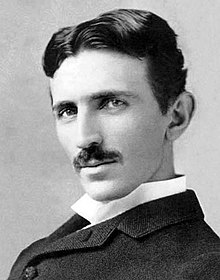
The Nikola Tesla Guide to Writing

Albert Berg’s Unsanity Files is one of the blogs I follow, enjoy, and draw inspiration from. Here is a uniqute take on Nikola Tesla, the famous inventor who held more than 100 patents. Albert discovered more than electro-mechanical genius in Tesla’s book, “My Inventions.” Here are several valuable principles about writing he discovered.  Enjoy

Albert Berg's avatarThe Unsanity Files

Those of you who follow my Twitter feed know that I recently finished reading a book called My Inventions by Nikola Tesla. Before reading this book, I had a nominal knowledge of Tesla. I read a short biography on him back when I was in high school, and I was aware of his hero status on the internet, but reading his life story in his own words gave me a new appreciation for the man.

As a child who grew up idolizing the likes of Thomas Edison, and dreaming of what it might be like to have a career as an inventor, Tesla has always held a special place in my heart. But as a writer, I realized that his approach to life was something I could emulate as a writer as well. What follows is a short list of the things I learned from Tesla’s life that I think could benefit writers…

View original post 1,223 more words

Men In Black III – A Movie Review

Saving the world one alien at a time

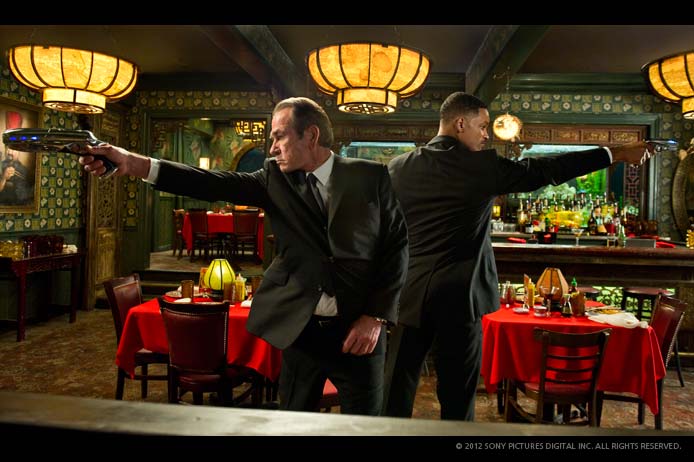
I want to say this is the best Men in Black yet and would do so except that they’ve all been fun, and this one assumes familiarity with the basic premise. Though it could not stand alone, this movie does not simply rest on the laurels of the franchise. It adds a number of plot twists including time travel and alternate futures.  We also learn much of the backstory of Agent K (Tommy Lee Jones) through the excellent performance by Josh Brolin as his younger self.  We learn where much of his stoicism comes from in relation to Agent J (Will Smith), and we discover a hint of romance in the background of Mr. No Fraternization.   Throw in an earth-threatening bad guy, Boris the Animal (Jemaine Clement) and you have a movie that keeps your attention from start to finish.

Jemaine Clement as Boris the Animal

Boris escapes from LunarMax prison.  He’s the last of the Boglodites, a race that would have destroyed earth except for the ArcNet shield that Agent K (Jones) had sent into orbit on the first moon rocket on July 16, 1969.  Boris time-jumps back to July 15, 1969, kills K, and the Boglodite invasion begins in our time.  The earth’s only chance is Agent J (Smith) who follows Boris back in time and teams up with Agent K’s younger self in a desperate effort to stop Boris.

They meet a key ally, Griffin (Michael Stuhlbarg), at an Andy Warhol be-in.  Warhol is reveal as an agent, and Griffin as a 5th dimensional Arcadian who can see all possible futures.  At Shea Stadium, he recalls his favorite moment in human history – when the Mets won the world series.  His explanation of how this was possible made for a nice metaphysical aside.  Involving factors like a home run ball that was flawed because a factory worker’s wife had left him the day it was made, Griffin’s story served as a fine illustration of the Buddha’s teaching on the  interdependent arising of all phenomena.

young Agent K, Griffin, and Agent J

The plot depends on several nifty gizmos that just happen to appear at the right time, and we have the obligatory alien free for all and agent-gets-slimed moment, but those who liked the previous movies will enjoy the new situations, especially watching Will Smith overcome an alien shark with mustard.

I decided to see the non-3D version.  The glasses sometimes give me headaches, and I suspect the in-your-face effect of some of the creatures would have been distracting.  Either way, if you liked the earlier MIB movies, you’ll find a lot to like in this one.

An Author’s Guide to Publishing in 2012, by Amy Rogers.

Those who have followed thefirstgates for a while will be familiar with Dr. Amy Rogers.

Amy Rogers

I reviewed her excellent first novel, Petroplague, in September, 2011 http://wp.me/pYql4-1ep.  In March of this year, she contributed a two part guest post detailing some of the rapid changes in today’s publishing landscape, an issue she follows in depth http://wp.me/pYql4-1MR.  Last Friday, Amy gave an updated presentation on  publishing options to the Sacramento branch of the California Writer’s Club during our monthly breakfast meeting.

Not long ago, there were only two publishing choices:  traditional publishing and the so called vanity press.  Now we have a spectrum of possibilities which keep getting harder to navigate.  Hybrid arrangements are multiplying:  traditional agencies offering ebook options, and agented independent publishing companies.

Rogers began her presentation by stressing the importance of every writer evaluating their individual goals.  Why do we want to publish this particular book?  How will we measure success?

Do we seek the implied approval that selection by a traditional publisher confers?  If so, do we have the time to invest in the process, knowing there is no guarantee of ultimate success?

If we choose to go the independent route, are we ready and willing to spend the time and/or money on five key tasks required for any book to be successful:  editing, cover design, layout, getting an isbn number, and marketing/distribution?

With a sense of our goals, Amy Rogers presentation, posted in full on her blog, will prove especially valuable.  A downloadable pdf version, is available too http://tinyurl.com/739ga5s.

After reviewing the presentation, take the time to explore Ms Rogers’ website, ScienceThrillers.com.  With a Ph.D in immunology, teaching experience in microbiology, and a writing career that began in grade school, Amy is uniquely qualified to write and review thrillers involving the depredations of “wee beasties.”  ScienceThrillers has grown to include reviews of books in multiple genres, publishing news, book giveaways, notices of writing contests, and her own quarterly newsletter.  It’s a site I’m very happy to recommend.