The Annotated Wind in the Willows

“The Mole had been working very hard all the morning, spring-cleaning his little home.” So begins one of the great literary adventures of my life, The Wind in the Willows, published in 1908 by Kenneth Grahame.

I’ve written about The Wind in the Willows before: http://wp.me/pYql4-19a.  My parents read it aloud when I was little, and since then, it has been part of my life.  Now the annotated edition, which I got this month, reveals details about the text and the author that I never knew before.

The opening paragraph details the Mole’s spring cleaning.  Soon he has dust in his throat and eyes and splotches of whitewash on his fur.  Then the text says something rather strange:  “Spring was moving in the air above and in the earth below and around him, penetrating even his dark and lowly little house with its spirit of divine discontent and longing.”

I’ve been known to put off spring cleaning for months, but from laziness not “divine discontent.”  As a younger reader, this phrase escaped me.  Only now do I realize how Mole’s spirit of longing belonged to the author.  I always imagined Kenneth Grahame as a country gentleman, strolling quietly by the river.  Notes in the annotated edition make clear that while this came later, for much of his life, Grahame lived with a frustrated dream of living like that.
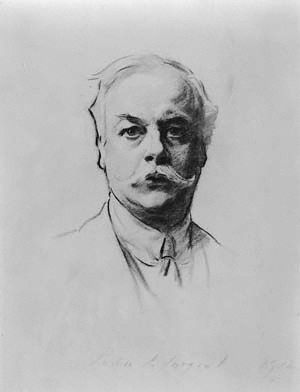
Kenneth Grahame by John Singer Sargent, 1912.  Public domain.

Kenneth Grahame by John Singer Sargent, 1912. Public domain.

He knew and loved the country life, but economic necessity tied him to London.  He abandoned his dream of going to Oxford and took a post at the Bank of England.  He married late in life, and both he and his wife had health problems.  Their only son, Alastair, was born with a congenital vision defect.  One day in November, 1903, a respectably dressed man came into Grahame’s office, pulled out a revolver, and began shooting.  The man didn’t hit anyone and was later sent to an asylum, but Grahame was shaken.  Already a private man, he kept even more to himself, his home, and vacations near the sea.

Grahame was already a popular author of several books of essays, but he stopped writing entirely between the years of 1903 and 1908.  Because of his wife’s health problems, Kenneth was Alastair’s primary care giver.  In the evenings, he made up stories about a mole, a toad, and various other animals, who lived beside a river.  A governess would later recall hearing Alastair ask questions and make suggestions; the two of them worked the stories together.

Alastair Grahame, 1907

Father and son spent the summer of 1907 apart.  Kenneth sent Alastair  a series of 15 letters which continued the tales and became the seeds of chapters for the book he would write the following year.  The letters are included in the annotated edition.  Also in this edition is an introduction by Brian Jacques, contemporary author of the Redwall series of animal stories.  Jacques lets us know what he thinks of the editors and agents who hesitated in printing The Wind in the Willows.  He has nothing good to say about people so short of imagination that they could not imagine a toad disguised as a washerwoman.

Arthur Rackham, 1940

An enthusiastic recommendation from President Theodore Roosevelt helped Grahame’s publishing efforts and the book has been in print ever since.

Some have suggested that Wind in the Willows is two books in one.  The madcap adventures of toad seem geared to please children – they were Alastair’s favorites – while other sections explore deeper emotions like homesickness, fear, wanderlust, and of course the theme of divine discontent.  This takes center stage in chapter 7, “The Piper at the Gates of Dawn,” in which the animals, searching for a lost baby otter, encounter the ancient god Pan.

The Piper at the Gates of Dawn. Frontispiece to a 1913 edition by Paul Bransom. Public domain.

Grahame first wrote about Pan in 1891 in an essay that appeared in his first book, The Pagan Papers 1893.  His longing for unspoiled nature on the eve of the 20th century was widespread in Victorian and Edwardian society.

As Mole and Rat approached the god, they were seized with the kind of awe and fear that scriptures around the world describe when people encounter angels.  When the vision ended, the animals “stared blankly, in dumb misery deepening as they slowly realized all they had seen and all they had lost.”

Then a little breeze “blew lightly and caressingly in their faces; and with its soft touch came instant oblivion.  For this is the last best gift that the kindly demigod is careful to bestow on those to whom he has revealed himself in their helping:  the gift of forgetfulness.  Lest the awful remembrance should remain and grow, and overshadow mirth and pleasure, and the great haunting memory should spoil all the afterlives of the little animals helped out of difficulties, in order that they should be happy and lighthearted as before.”

Life brought less solace for Grahame. His son, Alastair, who inspired the stories, was a budding artist and creator of his own literary magazine, but he was plagued with emotional problems. He enrolled at Eton but had to leave for this reason. He went up to Oxford in 1918, but didn’t do well with exams. On top of this, numbers of WWI veterans were returning to college, bringing the focus and maturity they had learned in the trenches.

In May, 1920, Alastair Grahame asked for a glass of wine after dinner, then walked to Port Meadow, outside Oxford, where a number of railroad lines merged. During the night, he was hit by a train and died. His father wrote that his vision problems might have led to disorientation.  The autopsy report suggested he lay on the tracks and waited for a train.

The Grahames were devastated. They spent the next four years in Italy. When they returned to England, they moved to a town beside the Thames where they lived for the rest of their lives. Kenneth was able to spend his days by the river, as he had always dreamed of doing, but the joy he once had making stories for his son must have been absent.

Arthur Rackham, 1940

Arthur Rackham, 1940

Some biographers have suggested that Grahame, good at everything he tried, must have been disappointed with his son. Annie Gauger, editor of the Annotated edition says no.  She includes letters and other material to demonstrate that The Wind in the Willows was a joint creation of father and son.  Since the stories were first told out loud, I have to agree – from experience I know that oral storytelling is a complex dance between teller and audience.  Out of their limitations, their longings, and divine discontent, Kenneth and Alastair Grahame  gave readers over the last hundred years a world of peace and friendship, far from “the wide world” trials, where if you listen, you can sometimes make out the music of the gods of nature on the wind.
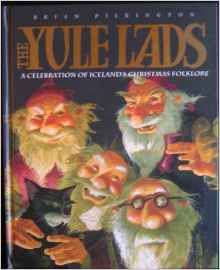
The Yule Lads: Icelandic Christmas folklore.

The Yule Lads

In most Christian countries, Christmas was slower to catch on than other major church holidays.  The clergy may have been wary of pagan solstice celebrations which happened at the same time of year and included serious revelry.  Some early Christmas festivities mimicked the custom.  They were banned in 17th century England, and American Puritans outlawed them too.

According to Brian Pilkington, author of The Yule Lads, Iceland was ahead of the curve. A 16th century law stated that “All disorderly and scandalous entertainment at Christmas and other times and Shrovetide revels are strongly forbidden on pain of serious punishment.”

Icelandic winters are long and dark, with fewer than five hours of daylight at this time of the year.  Imagination tends to fill the darkness with what we fear, and Pilkington’s book describes “the lads” that kept Icelandic children awake at night.  The gentlemen pictured on the cover are not our shopping mall Santas!

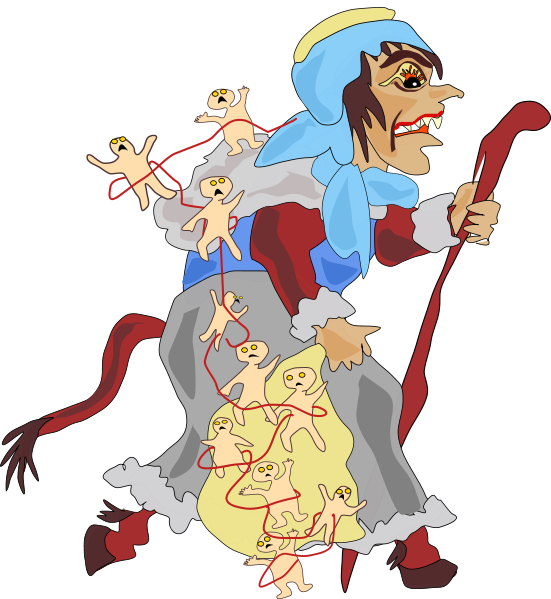
The matriarch of the clan was the ogress, Gryla, who loved to eat stewed children.  It couldn’t be just any kid though.  It had to be one who was “naughty, lazy, or rude.”  In one 13th century account, Gryla had 15 tails, and tied to each was a sack full of naughty children.  It was not “the most wonderful time of the year” if you were young!  The Icelandic word for icicle is “grylukerti” which means “Gryla’s candle.”

Gryla. CC-by-SA-2.5

Gryla had three husbands and 80 children, though legend now boils it down to 13 sons who visit the homes of children on successive nights from Dec. 12 – 25.  Time and the law have taken the edge off the Yule Lads, for a 1746 decree said “The foolish custom, which has been practiced here and there about the country, of scaring children with Yuletide lads or ghosts, shall be abolished.”  By the 19th century, the Lads had morphed from cannibals into rascals and petty thieves, who even began to leave gifts for good children who left their shoes on a window ledge.

The first to arrive was Stekkjarstaur, the “Sheep Worrier.”  He would visit the the sheep cot and try to suck milk from the ewes.  That doesn’t work in December and led author, Brian Pilkington to suggest that Sheep Worrier’s IQ is “somewhat less than three digits.”  These days  he heads for the fridge to get his milk.  If a child has been good, Stekkjarstaur leaves a sugary sweet.  Bad children get a potato.

Next comes Giljagaur, aka, “Gully Gawk” who travels through gullies and ravines, also in search of milk, but he looks for cow barns and inattentive milkmaids.  “Stubby” arrives the third night, as short as his name suggests.  He likes to raid the kitchen, as do the brothers that follow, “Spoon Licker,” “Pot Licker,” and “Bowl Licker.”  In their present forms all they do is mischief, but food thieves were no joke in earlier times.  For northern farming families, the time between Christmas and the spring thaw in April or May could be times of famine if food or fodder for livestock ran short.

The next lad to show up is Hurdaskellir, or “Door Slammer,” one of only two of Gryla’s sons who isn’t out to fill his belly.  Imagine loud bangs in the dead of night and you know how he gets his jollies.

And as if the sons of Gryla were not bad enough, children also had to contend with Jólakötturinn, the Yule Cat, a huge feral creature who hunts children on Christmas Eve instead of mice. Like the lads, the cat discriminates in choosing his victims, eating only those who have not received a new item of clothing for Christmas. Pilkington says that “Until fairly recently in Iceland, all clothing came directly from sheep. The wool had to be washed, combed, and spun before it was painstakingly crafted into a garment. It was a long, arduous process.”  Fear of the Cat induced lazy children to do their part!

This is a fun book and a fine counterbalance to the usual TV holiday movies.  You can picture families gathered around the fire as the wind howls outside, thinking as we do when hearing a good ghost story, “This can’t be true…can it?”  Something within the listeners then and within us now loves to be scared, to confront monsters and vanquish them in imagination.  On that score, Gryla & Sons and the Yule Cat satisfy!

A click on the book cover at the top of this post will take you a site where you can order The Yule Lads.

Tales of the Elves: Icelandic Folktales for Children

Tales of the Elves cover

One day God decided to visit Adam and Eve.  They welcomed him and introduced  their children – all except the ones Eve had not finished bathing.  After all, you want your kids to be clean when the Supreme Being drops in.  God was aware of this and said, “What is hidden from me shall be hidden from men.”  Those children became the elves who live in the hills and mounds of Iceland.  They can see us but we can’t see them unless they wish it.

I know this because I read a magical book, Tales of the Elves, based on the Icelandic folktales of Jon Arnason, adapted by Anna Kristin Asbjornsdottir and illustrated by Florence Helga Thibault.  I found the book on our visit to Iceland, which I wrote about in the fall.

Interest in elves isn’t limited to children in Iceland.  One day, as we toured the countryside, our driver pointed to a spot in a wide valley where the highway curved around a pair of volcanic rocks.  The stones were only 8′ – 10′ tall, nothing modern earth movers couldn’t remove.  That was the intention of the highway crew.  The problem was, the bulldozers broke down or stalled every time they  approached the twin rocks.  Every time.  Locals explained that the stones marked the entrance to an underground elven settlement.  The equipment worked perfectly after the construction crew decided to route the highway around the stones.

If this reminds you of Irish fairies, there’s good reason.  Genetic testing has proven that many Icelanders, especially the women, came from Ireland, specifically, the viking settlements there.  The stories themselves teach us similar lessons in coexisting with “the hidden ones.”

“Midwife to the elves” shows how the elven folk can give the gift of the sight and take it away again.  “Elf Wind” demonstrates the courage and cunning required to set things right if you do something foolish, like cut the grass on an elven mound.  “Payment for Milk” is about the boons the elves can grant if you treat them with kindness and goodwill.

I’d been looking forward to writing this review since I found Tales of the Elves, but unfortunately I couldn’t find any venue where interested readers can find the book.  Not on Amazon US or UK.  Not on bookfinders.com or ebay.  I couldn’t find ordering information on the publisher’s website.  I posted a request for information on the illustrator’s Facebook page, and I’ll pass along anything I discover.  Meanwhile, here is the information – if you love folklore and fine illustration of fantasy themes, it’s worth keeping an eye open for this book.

Anna Kristin Asbjornsdottir (adaptation), Florence Helga Thibault (illustration), Victoria Cribb (trans), Tales of the Elves, Bjartur publishing, Reykjavik, 2012

ISBN:  978-9979-788-80-5

Please post any information you may discover.

Soup imitates Art imitates Soup

Fifty years ago, Andy Warhol rocked the art world and the world of popular culture with his depiction of Campbell’s soup cans at the Los Angeles Museum of Contemporary Art. This year, Campbell’s returned the favor, with a collectors edition of 1.2 million cans of tomato soup that went on sale at Target on September 2.

Campbell’s 50th anniversary “Art of Soup” cans feature Andy Warhol picture and quotes on the back.

The art world of the ’50’s was dominated by the Abstract Expressionists, who lived bohemian lifestyles and had little but scorn for popular culture.  Warhol embraced it, even as he critiqued it with comments that ring true to this day, such as, “Someday everyone will be famous for fifteen minutes.”

Campbell’s Soup Cans by Andy Warhol, 1962

Campbell’s at first had reservations about Warhol’s depictions, but two years later, noting the popularity of his art, Campbell’s marketing manager sent Warhol a letter of appreciation and “a couple of cases of soup.” That same year, Campbell’s commissioned the first of several artworks they would purchase from Warhol over the years.

Back of the special cans, with image of Warhol and quote

In one of his memorable quotes, Warhol said, “I am deeply superficial.”  Much like Marcel Duchamp, one of the thrusts of his work was to raise question the nature of art.  The Abstract Expressionists embraced a hard drinking, hard loving, bohemian stance.  Willem de Kooning wore paint spattered jeans to his opening at the Museum of Modern Art.  He shunned imagery that “the masses” could comprehend, and celebrated the personal signature of his unique, impassioned brush strokes.

Warhol wore coats and ties, called his studio, “The Factory,” and his best known works showed common objects, reproduced by photo silkscreen, often by an assistant.  Warhol never touched them at all.  “Art is whatever you can get away with,” he said.  Regarding the bohemian set, he said, ““Those who talk about individuality the most are the ones who most object to deviation.”

If Duchamp and Warhol are kindred spirits, there is one great difference between them.  When Duchamp hung a urinal in a gallery, he did it for the shock value.  By all accounts, Warhol truly loved the icons of popular culture he depicted.  He also loved technology and experimented with an Amiga computer shortly before his death in 1987.  No doubt he would have been pleased by Campbell’s tribute.

Andy Warhol by Jack Mitchell. CC by SA

*** Some Andy Warhol quotes ***

“I think having land and not ruining it is the most beautiful art that anybody could ever want to own.”

“I’d asked around 10 or 15 people for suggestions. Finally one lady friend asked the right question, ‘Well, what do you love most?’ That’s how I started painting money.”

“It’s the movies that have really been running things in America ever since they were invented. They show you what to do, how to do it, when to do it, how to feel about it, and how to look how you feel about it.”

“During the 1960s, I think, people forgot what emotions were supposed to be. And I don’t think they’ve ever remembered.”

“Some day everybody will just think what they want to think, and then everybody will probably be thinking alike; that seems to be what is happening.” 

*** Update on the collectors cans ***

The edition of 1.2 million cans that went on sale September 2 for $0.75 appears to be sold out:  four can sets are going for $20 – $30 on eBay.

Quite a few writers I know follow Kristen Lamb’s blog. She writes extensively about blogging, publishing, and the nuts and bolts of being an indie author.

Now, in response to the copyright lawsuit filed against Roni Loren (http://wp.me/pYql4-2fA), Kristen is using her organization, WANA (We are not alone) to create another source of copyright free images – the WANA Commons. Best of all, everyone is invited to contribute. Here’s a chance to give back to the blogging community, upload your own visual art to an appreciative audience, and strike (as the Jefferson Starship put it a long time ago) blows against the empire! Please check out Kristen’s post – to me, this is a very exciting project! – Morgan

Author Kristen Lamb's avatarKristen Lamb's Blog

First of all, I want you guys to know that I MISSED YOU! July was a whirlwind month for sure and reminded me of the days when I used to be on the road for sales. Wandering out of bed in the night to go to the bathroom, yet suddenly realizing you’re in a coat closet. Fun stuff!

We will talk about LA another day, because I have a GIFT for you guys. I KNOW! Another one? Hey, y’all are like my kids, and I’m a terrible mother because I dig spoiling every last one of you. Here, have some cake.

Most of you guys know I am all about writers blogging. Blogging plays to our strengths. Blogs are far less volatile than other types of social media. Twitter might be gone in a couple years, and Facebook could implode, but blogs will likely remain. This makes them one of…

View original post 1,370 more words

Paracosms in Writing and Music

When I turned to the editorial page of the local paper this morning, I learned a new word and a wonderful concept.  http://www.sacbee.com/2012/06/27/4591277/springsteens-global-attraction.html.

David Brooks, a writer for The New York Times, and several friends “threw financial sanity to the winds” to follow Bruce Springsteen on tour through France and Spain , because supposedly the crowds are even more intense than their American counterparts. 

Young European fans know every word of songs The Boss recorded twenty years before they were born.  Their enthusiasm “sometimes overshadows what’s happening onstage,” says Brooks.  The moment that spawned his article was seeing “56,000 enraptured Spaniards, pumping their fists in the air…and bellowing at the top of their lungs, ‘I was born in the USA.‘”  

How could this be, especially since in Springsteen’s music, USA often means New Jersey?

Brooks asked himself the same question and borrowed a term from child psychology to help understand it.  The word is paracosm, meaning a world in imagination, “sometimes complete with with imaginary beasts, heroes and laws that help us orient ourselves in reality.  They are structured mental communities that help us understand the wider world.”

Children do it, says Brooks, and as adults we continue the habit.  Then he adds the observation that is the point of this post:

“It’s a paradox that the artists who have the widest global purchase are also the ones who have created the most local and distinctive story landscapes.”

Springsteen’s New Jersey.  J.K. Rowling’s English boarding school.  Tony Hillerman’s Navajo country.  221B Baker Street.  Downton Abbey.  Tolkein’s Edwardian rural England, aka, The Shire.

Hob Lane, near where Tolkien lived as a boy

I often think of the books I hate to see end, the kind that inspire fans to continue the story on their own, as I described in a recent post on fan fiction http://wp.me/pYql4-298.  Character remains the essential ingredient – we want to follow Harry, Ron, and Hermione wherever they may lead us – but in his article David Brooks points out the critical nature of the world where they more and act and love and fight.  We wouldn’t really want to see the Hogwarts gang on Sunset Boulevard anymore than we’d want Sam Spade in St. Mary Meade, working a case with Miss Marple.

“If you build a passionate and highly localized moral landscape, people will come,” says Brooks, echoing Field of Dreams, a movie that largely took place in a cornfield.  “If your identity is formed by hard boundaries, if you come from a specific place…if your concerns are expressed through a specific paracosm, you are going to have more depth and definition than if you grew up in the far-flung networks of pluralism and eclecticism…sampling one style then the next, your identity formed by soft boundaries, or none at all.”

I think this is an important thing to consider – one you seldom read about in books on writing but which instantly resonates when called to mind in the context of our favorite fiction.

But let’s end with The Boss

One of Springsteen’s best known songs, “My Hometown,” moves me the way “Born in the USA” moved a stadium full of Spaniards.  Hometown for me is part of a paracosm, a special kind of imaginary landscape.  I’ve said elsewhere that when I was young, we moved around too often for me to have any sense of a hometown, yet the moment I say the word I can see it vividly, with eyes opened or closed.

We’ll let the master paint the picture, since someone (I forget who) once observed that only a troubadour of Springsteen’s calibre could make you nostalgic for New Jersey.

Enjoy the paracosm.

Humans May Not Be the Original Artists

Don’t worry, I’m not suggesting a space alien theory – quite the opposite.  As reported on NPR, a new method of dating the paintings in Altamira and some of the other caves painted by prehistoric artists suggests that some of them may have been created before Homo Sapiens arrived in Europe.  This would mean that Neanderthals, who roamed Europe for at least 200,000 years, were the original artists.

Pedro Saura AAAS/Science

Alistair Pike of the University of Bristol says that some Spanish cave paintings are at least 40,800 years old.  Humans had just arrived from Africa.  Archaeologist, Joao Zilhao of the University of Barcelona, is convinced that some of these works were done by Neanderthals.  We know they engaged in symbolic behavior.  They made ritual burials, they decorated beads and other implements, and left caches of ground up colored minerals that may have been used for pigments.

Though not everyone agrees, these findings and theories appear in the journal, Science.  Pike says he and his Spanish colleagues just need to find paintings “a few thousand years older” to prove their point.  They’re planning a return to the region to continue their search.

Take a look at this and several related articles on the NPR website.  It helps put things in perspective for me to realize that we are not the only intelligent species that now walks, or has every walked the earth.

http://www.npr.org/2012/06/15/155009945/famous-cave-paintings-might-not-be-from-humans