Some of my favorite English books

A tweet from Hannah-Elizabeth, who blogs at The Last Classic  http://sonnemann.wordpress.com  inspired this post. She follows my book reviews and recently asked for a recommendation on something to read.

The other inspiration was the Olympics opening ceremony, which got me thinking of English novels and stories.  My greatest literary pleasures, from the first read-alouds I heard as a child until now have come from England.  The riverbank, the Shire, and Baker Street have become the landscapes of my soul.

There’s one key distinction to make:  when I talk about favorite novels, I don’t mean breakout, thrilling, or dramatic novels – necessarily.  I mean stories with  characters and worlds I want to live with and visit again and again.  When I started The DaVinci Code, for instance, I couldn’t put it down, but when I finished, I traded it in for credit at the local used bookstore.  I can’t imagine reading it again.

So here is a list, probably not complete and not in order of preference, of some of the story treasures British authors have given me.  To set the mood, let’s begin with this beautiful hymn that every diehard fan of Masterpiece Theater knows and loves.  “Jerusalem” was inspired by William Blake’s poem, “And did those feet in ancient time,” which was based on the legend that as a youth, Jesus visited England and Glastonbury with his uncle, Joseph of Arimethia.

Favorite English books.

The Wind in the Willows by Kenneth Grahame. I reviewed it here: http://wp.me/pYql4-19a. Try to get the edition illustrated by Arthur Rackham, which really gives a feel for the rural England of rivers, forests, and fields that were so soon to disappear in the new century .

The Lord of the Rings by J.R.R. Tolkien – Here was a man who spent his life giving shape to our spiritual homeland – The Shire and Rivendell.  His son said he suffered from bouts of depression all his life.  Understandable when you reflect that the summer this gentle dreamer graduated from Oxford, he was thrown into the maelstrom of the Somme.  There he saw the Shire, the rural England he loved, along with his college classmates, evaporate in the fires of Mordor, aka, the western front.

The Original Illustrated Sherlock Holmes by Sir Arthur Conan Doyle.  I read these detective stories again and again, even though I know who done it. Who doesn’t sometimes dream of life on Baker Street, sharing a pipe with Holmes before the game is afoot again? I could argue that Holmes was an early superhero, using uncanny intellect and powers of observation to save the world from uber-villain, Moriarity.

The Abhorsen Trilogy by Garth Nix. Nix, a former editor, has written a number of middle grade Arthurian adventures for boys.  In the Abhorsen tales, he gives us two fine female protagonists. In doing so, he inspired my first novel, whose main character, Emily, is a lot like Lirael, the heroine of the second and third books of the trilogy.  Nix lives in Australia, but the map of his Old and New Kingdoms looks a lot like the Scottish border, and everyone acts quite British, sometimes to the vexation of the good guys.

T.S. Eliot:  The Complete Poems and Plays, 1909 – 1950 I’ve been reading this book since I took a class on Eliot as a college sophomore. “The first gate” into the world of imagination and dream is an image at the opening of Eliot’s “The Four Quartets,” my favorite poem of all time.  Eliot was an American who spent his writing life in London.

Agatha Christie Mysteries.  Few authors create two characters as compelling as Hercule Poirot, star of 33 novels,  and Miss Marple, featured in 12.  When Christie killed off Poirot in 1975, a year before her own death, the little Belgian detective became the only fictional character to receive an obituary in The New York Times.   Books like Murder on the Orient Express and Death on the Nile, will stand with any mysteries ever written.  Here is free download, in all ebook formats, from Project Gutenberg, of  The Mysterious Affair at Styles, 1920, the first Poirot mystery. http://www.gutenberg.org/ebooks/863
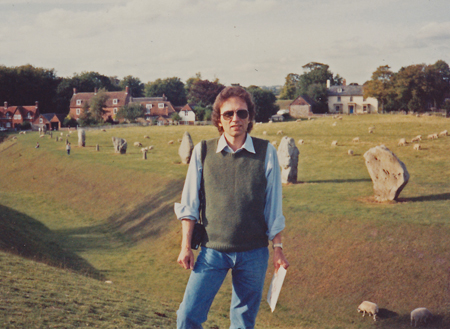
In the spirit of things. Yours truly at Avebury, 1991

The Narnia Tales by C.S. Lewis. Tolkien told Lewis not to publish the Narnia stories, saying Lewis would “embarrass himself.” Just goes to show the master of middle-earth didn’t know everything.  Mysterious old wardrobes will always be objects of interest to fans of Lewis’ series.

Mythago Wood by Robert Holdstock.  A small patch of primeval forest, one of the last in England that dates from the last ice age, is actually a “mythogenic zone,” a region which manifests the creatures of the deep human psyche and racial memory.  They deteriorate at any great distance from the wood, but near and in it they are very real – sometimes dangerously so.  in 1946, when Stephen Huxley returns from the service, both he and his older brother Christian, strive to enter the wood with the aid of a mysterious journal (don’t you just love those!) left by their father.  Both Stephen and Christian fall in love with Gweneth, who lives deep in the forest.  When his brother begins to assume the attributes of the dreaded “Outsider,” you know Stephen’s journey will not be easy.  Published in the US in 1986, this book had a profound effect on my outlook on fantasy literature.

Harry Potter Series by J.K. Rowling. I don’t think this needs any explanation

The Mabinogian Anonymous. Welsh tales, full of strange and sometimes ominous magic, that were already ancient when they were written down in the middle ages. Joseph Campbell and Heinrich Zimmer discussed some of these stories. They are best approached with poetic imagination as Fleetwood Mac did with the goddess, Rhiannon, who figures in two of the tales.

Rhiannon riding in Arbeth. Illustration from “The Mabinogian” by Lady Charlotte Guest. Public domain in the US

The Amelia Peabody Mysteries by Elizabeth Peters. Here are some great British mysteries written by a yank. Ms. Peters, now 84, was born in Illinois and received her PHd in Egyptology from the University of Chicago. There’s the connection. Her protagonists – Amelia Peabody, Amelia’s husband Emerson, their brilliant but incorrigible son Ramses, and in later stories, Amelia’s daughter in law, Nefret, are unconventional British archeologists who excavate in places like the Valley of the Kings when they’re not solving murders. There are twenty books in the series, spanning the decades from 1895 through the first world war against the background of mystery and intrigue in the turn of the century middle east. These are among the best beach reads I’ve ever found. Check them out at Ameliapeabody.com.  http://ameliapeabody.com/bookshelf.htm

***

I hope this excursion through some of my favorite books leads you to something enjoyable to read.  Lists are fun.  This was a small list, so next time I’ll post some with hundreds of titles to choose from.  Stay tuned!

Sales of “Imagine” halted after author admits inventing quotations

In May, I reviewed Jonah Lehrer’s new book, Imagine:  How Creativity Works  http://wp.me/pYql4-1Rv.  I ended by saying, “This is a wonderful study for anyone interested in imagination, creativity, and the conditions which favor it.”

Today I was saddened to read that Lehrer admitted fabricating Bob Dylan quotes in Imagine and lying about them when questioned by another journalist.  He resigned as a staff writer for The New Yorker, and Houghton Mifflin halted sales of the book, which had sold 200,000 copies since March and spent 16 weeks on The New York Times bestseller list.  http://www.sacbee.com/2012/07/30/4674919/author-acknowledges-fake-dylan.html

In a statement Monday, Lehrer said:  “The lies are over now. I understand the gravity of my position. I want to apologize to everyone I have let down, especially my editors and readers.”

The incident raised a number of questions.  It is striking in part because strict enforcement of ethical standards has become so rare in public life.  We don’t even blink when we read of fresh bank scandals, or athletes on steroids, or the California Parks department with a hidden stash of millions of dollars even as it was moving to shutter some of our finest parks.  We’re running a presidential campaign on attack adds, where truth is merely an option, rather than statements of principle from either candidate.  These days I look to PBS and the Comedy Channel for responsible TV journalism.

With standards so lax in so many areas of public life, how many aspiring writers can be certain they would resist the urge to tweak a sentence or two for a shot at the best seller list?  I am not, by any means, excusing Lehrer’s actions – I am saying I think I understand them.

I also understand failure.  It’s a fire that can consume a person or temper what they are made of.  I hope Mr. Lehrer can rise from his ashes with the kind of deeper and darker wisdom that comes from enduring the dark night of the soul.

An Author’s Guide to Publishing in 2012, by Amy Rogers.

Those who have followed thefirstgates for a while will be familiar with Dr. Amy Rogers.

Amy Rogers

I reviewed her excellent first novel, Petroplague, in September, 2011 http://wp.me/pYql4-1ep.  In March of this year, she contributed a two part guest post detailing some of the rapid changes in today’s publishing landscape, an issue she follows in depth http://wp.me/pYql4-1MR.  Last Friday, Amy gave an updated presentation on  publishing options to the Sacramento branch of the California Writer’s Club during our monthly breakfast meeting.

Not long ago, there were only two publishing choices:  traditional publishing and the so called vanity press.  Now we have a spectrum of possibilities which keep getting harder to navigate.  Hybrid arrangements are multiplying:  traditional agencies offering ebook options, and agented independent publishing companies.

Rogers began her presentation by stressing the importance of every writer evaluating their individual goals.  Why do we want to publish this particular book?  How will we measure success?

Do we seek the implied approval that selection by a traditional publisher confers?  If so, do we have the time to invest in the process, knowing there is no guarantee of ultimate success?

If we choose to go the independent route, are we ready and willing to spend the time and/or money on five key tasks required for any book to be successful:  editing, cover design, layout, getting an isbn number, and marketing/distribution?

With a sense of our goals, Amy Rogers presentation, posted in full on her blog, will prove especially valuable.  A downloadable pdf version, is available too http://tinyurl.com/739ga5s.

After reviewing the presentation, take the time to explore Ms Rogers’ website, ScienceThrillers.com.  With a Ph.D in immunology, teaching experience in microbiology, and a writing career that began in grade school, Amy is uniquely qualified to write and review thrillers involving the depredations of “wee beasties.”  ScienceThrillers has grown to include reviews of books in multiple genres, publishing news, book giveaways, notices of writing contests, and her own quarterly newsletter.  It’s a site I’m very happy to recommend.

The Wind Through the Keyhole, by Stephen King: A Book Review

I recently said I look for “imaginative escapism” in summer reading, and Stephen King’s, The Wind Through the Keyhole, 2012, qualifies on both scores.

This book is a celebration of stories by a consummate storyteller.  It is structured as a frame tale, three levels deep – a story within a story within a story, something you find in some our oldest epics and story collections like The Odyssey and The Arabian Nights.

In case we we miss that connection, King says it another way through his main character, Roland Deschain, who tells his traveling companions, “There’s nothing like stories on a windy night when folks have found a warm place in a cold world.”  Later, during a story concerning his younger self, Roland says, “A person’s never too old for stories…Man and boy, girl and woman, never too old.  We live for them.”

This is the eighth of King’s Dark Tower Novels, and the first I have read, but the introduction caught me up well enough to proceed.  Roland Deschain is a gunslinger in Mid-World.  A gunslinger is a cross between a knight errant and an old west marshall.  Many gunslingers are descendants of “the old White King, Arthur Eld.”

Mid World borders our own and is “filled with monsters and decaying magic.”  In places, there are gates between the worlds, or places where “the veils are thin.”  Three of Roland’s companions come from New York.  The fourth is a billy bumbler, a talking, dog-like creature.

Roland and his companions – his ka-tet – barely have time to find shelter from a starkblast, a devastating storm, with winds like a hurricane, the sudden onset of a tsunami, and temperatures so cold that trees snap and explode.  While the friends shelter by the fire in the only stone building in a deserted town, Roland tells of one of his first assignments as a gunslinger.

In the first story, “The Skin-Man,” Roland rides with his partner, Jamie Red-Hand, to the desolate mining town of Debaria, where a shapeshifter has slaughtered dozens of people.  This a gritty western world, like the bleakest of early Clint Eastwood’s westerns, and the monster is more deadly than the bad and the ugly Clint faced down.

While talking to an 11 year old survivor of an attack, a boy whose father and a dozen others were slaughtered, young Roland tells the second tale, “The Wind Through the Keyhole,” about another 11 year old, Tim Ross, who goes on a dangerous quest to save his mother who has been injured by a treacherous step-father.  Tim sets off to find Maerlyn, aka Merlin, at the heart of The Endless Forest.

Picture an 11 year old on an Arthurian quest, who stumbles into a swamp filled with gators and is saved by a group of plant people who communicate telepathically and give him a strange disk with buttons and lights that speaks and answers his questions in a female voice.  Her name is Daria.  Once she tells him she’ll be “offline” for half an hour, “searching for a satellite link.”

Just when he’d begun to believe she really had died, the green light came back on, the little stick reappeared, and Daria announced, “I have reestablished satellite link.”

“Wish you joy of it,” Tim replied.

Well, why not?  Is a magical iPhone so different from an enchanted sword or magical ring?  A master storyteller like Stephen King can pull of escapades like this because he always has me asking the one question that really matters in storytelling.  To quote Neil Gaiman, that question is, “What happened next?”

There’s adventure, courage, cruelty, humor, horror and much more as Roland Deschain takes us in and leads us back out of three levels of story.  One constant throughout all the tales is the wind, and I think Roland speaks for King when he says:

In the end, the wind takes everything, doesn’t it?  And why not?  Why other?  If the sweetness of our lives did not depart, there would be no sweetness at all.

The Wind Through the Keyhole is a very satisfying summer read – and quite a bit more.

Imagine by Jonah Lehrer: A Book Review

Update, July 31, 2012.

On July 30, author Jonah Lehrer admitted fabricating quotes in Imagine. He resigned his position as staff writer for The New Yorker, and Houghton Mifflin suspended sales of the book. You can read my full post on the topic here, which contains a link to the newspaper story. http://wp.me/pYql4-2hg

It is with much sadness that I’ve decided to remove the text of my review. Some of Lehrer’s observations on creativity remain insightful. At the same time, I think it is vital to stand up for ethics wherever we can find it in public life.

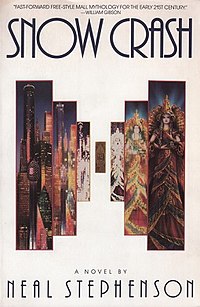
Snowcrash by Neal Stephenson – An Appreciation

Twenty years ago, Mary and I got our first real home computer (the Commodore 64 didn’t quite count).  With an Intel 486 processor, 500k of ram, an 8k external modem, and AOL memberships, we were wired!  Full-fleged members of the information age, at least by the standards of the day.

The same year, 1992, Neal Stephenson published a visionary novel called, Snowcrash. In retrospect, it merits the word, “prophetic,” for its sketch of life in the metaverse – a word Stephenson coined – and in the inconvenient world we call “reality.”

Consider:

In Snowcrash, Stepenson posits a world where nation states have transferred most of their power to corporations. Most people are corporate citizens and live in corporate enclaves, or less prestigious burbclaves.  The hero of Snowcrash, Hiro Protagonist, is a citizen of “Mr. Lee’s Greater Hong Kong.”  Military power belongs to private contractors, as do the roadways, which vie for driver/customers.  The post office is gone; private couriers deliver snail-mail.  The United States occupies a smallish territory centered in the Mohave Desert, and keeps it’s employees busy with make-work projects.  The former United States economy hinges on two industries – computer microcode and high speed pizza delivery, which has been revolutionized since the Mafia took control.

Though Hiro is a citizen of Hong Kong, as a pizza driver, he can’t afford to live in their enclaveclave.  Home is a self-storage unit under the flight path at LAX.  Like most of his hip and cyber-savvy generation, he spends most of his time online in the guise of his avatar, navigating virtual worlds.  But something is happening in the online world.  A strange new computer virus, when opened, generates a graphic pattern that scrambles the brains of the user.  They are dazed and speak in tongues.  With a young woman named YT, for Yours Truly, Hiro sets out to unravel the mystery.

The villain turns out to be a charismatic preacher.  In his attempt to secure both temporal and spiritual power, he has tapped into the ancient Sumerian glyphs that first scrambled human speech patterns in the event known as the Tower of Babel.

It’s been 20 years since I’ve read Snow Crash, so I’m writing this from memory.  I’m not necessarily recommending the whole novel.  The first jaw-dropping 100 pages, where Stephenson built his world, flew by and still leave me in awe.  I remember the rest of the book dragging in parts, but I still think of the story all the time.  Most futuristic fantasies prove as silly as the 1930’s movie shorts that show humans zipping along in their air cars between high rise buildings, happy and without any accidents.  This book is different.

In 1992 there were no virtual worlds.  Now there are, and you have to create an avatar to negotiate them.  These days, it isn’t so hard now to imagine a bright young man living in a self-storage shed.  But above all, Snow Crash comes to mind because in the wake of “citizens united,” it’s so easy to see corporate power growing while government power wanes.  With Super Pac money rolling the election year dice, does the government control corporations or do corporations control government?  Neal Stephenson saw this and other aspects of our world coming 20 years ago.

Snow Crash, is a visionary novel that all lovers of fantasy should know.

Life: The Movie by Neal Gabler – A Book Review

In his final movie, Being There, 1979, Peter Sellers plays Chance, a gardener with a low IQ, who becomes an advisor to the president and business tycoons. In one iconic scene, Chance is accosted by a knife wielding youth in Washington, DC.  He pulls out his TV remote control and clicks it to change the channel.  He is puzzled when the assailant doesn’t vanish.

Peter Sellers as Chance in “Being There”

This might be the perfect illustration for Neal Gabler’s, Life, The Movie:  How Entertainment Conquered Reality, (2000).  Gabler quotes historian, Daniel Boorstin, who wrote in the early 60’s that, “We risk being the first people in history to have been able to make their illusions so vivid, so persuasive, so ‘realistic’ that they can live in them.”  Done deal, according to Gabler, who calls us, not just a “post-modern culture,” but a “post-reality culture.”

At times I had to keep my own assumptions in check:  subjects like reality and imagination open onto psychological and spiritual vistas beyond the scope of this or any other single book.  But when Gabler cited concrete examples, I found myself nodding my head on almost every page.

“You know how to brood because you have seen Rebel Without a Cause,” Gabler says, quoting cultural analyst, Louis Menand.  “What better model does the world offer?”

Gabler charts the ascendency of entertainment in America from the early 19th century, where the split between high and low culture was fueled by our democratic suspicion of all elites.  Calling someone “aristocratic” was a serious insult.  During the 1840 presidential campaign, when a man called Daniel Webster an aristocrat, he thundered back that he’d grown up in a log cabin, and anyone calling him an aristocrat was “a coward and a liar.”  ( Sound familiar? )

Nathaniel Hawthorn despaired of the fate of serious writers amid the flood of “trash” being published.  One publisher sold four million dime novels in five years, at a time when the US population was only 25 million.

In 1850, 1% of the population owned 50% of the nation’s wealth and held almost all public offices.  Upward mobility was a myth, since 98% of that wealth had been inherited.  While the one-percent held the power, then as now, culture wars raged, sometimes with a violence that we (thankfully) haven’t seen yet.  One night in New York, rival Shakespearean actors, one British and one American, were both scheduled to perform, the former in an uptown theater, the latter downtown.  Police ejected the rabble who had bought tickets solely to heckle the British actor.  A much larger crowd gathered across the street to throw rocks as the “aristocratic” crowd tried to leave.  The militia was called, a riot ensued, and before the night was over, 22 lay dead and more than a hundred wounded.

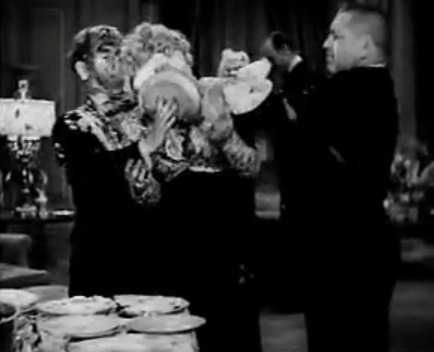
In the end, it was movies that won the day for popular culture.  The 1% stayed away from the early nickelodeons, which tended to be crowded and crass.  Later, with middle-class patronage, refined behavior became the norm, but the elite have never fared well in the movies, from the Marx Brothers  Night at the Opera, to the present, where a too-expensive suit is always the mark of a villain.

Three Stooges + high society + pies = disaster

As he charts the history of high vs. popular culture, Gabler makes a telling point.  It isn’t just about high brow and low brow – it’s about the ascendency of entertainment.  Being entertained is easy, and the corollary is that when the goal is entertainment, grabbing and holding audience attention is the supreme value, and “things that do not conform – for example, serious literature, serious political debate, serious ideas, serious anything – are more likely to be compromised or marginalized than ever before.”

Life: the Movie is a complex and disturbing book.  Gabler says in the introduction, it is diagnostic and not prescriptive.  To offer easy answers, he says, would be like the movie illusion where we meet the monster in act one and see it vanquished in act three.  Writing 12 years ago, Gabler said:

“One is almost compelled to admit that turning life into escapist entertainment is a perversely ingenious adaptation to the turbulence and tumult of modern existence.  Why worry about the seemingly intractable problems of society when you can simply declare ‘It’s morning in America,” as President Reagan did in his 1984 reelection campaign, and have yourself a long-running Frank Capra movie right down to the aw-shucks hero?”

I read this book after watching Neal Gabler speak on the fictions that lace the current election campaign on Moyers & Company, as I described in the preceding post. Because of it’s scope, I would recommend Life: the Movie only to those who want to delve into this issue in some depth.

But  I would recommend that everyone watch the ongoing conversation this year between Gabler and Moyers.  The confusions and illusions surrounding the political process are more convoluted than when the book was written, but Neal Gabler remains a reliable guide to pulling back the curtains and helping us draw closer to the truth.

The Shape-Changer’s Wife by Sharon Shinn: A Book Review

I’ve enjoyed several young adult fantasies by Sharon Shinn and reviewed one of them here http://wp.me/pYql4-iQ.  Before she published her first YA book, Summers at Castle Auburn, in 2001, Shinn had a solid reputation as an adult fantasy writer.  I recently finished her first novel, The Shape-Changer’s Wife, which won the Locus award for Best First Fantasy Novel in 1995. Shinn was nominated for the John W. Campbell Award for Best New Writer that year.  On top of these honors – all well deserved – long time readers of this blog will know I am fascinated by stories of shape shifters (check out three posts I wrote on the theme in Feb., 2011).

At the start of The Shape-Changer’s Wife we meet Aubrey, a young man with a sunny disposition who is already on his way to becoming a skilled magician. His master sends him to study with Glyrenden, highly skilled in the art of shape-changing:

“Learn everything he teaches you so well you can cast his own spells back at him,” the old wizard had said. “Glyrenden respects only those stronger than he is, and those he hates. If you cannot beat him, he will destroy you.”

With the optimism of youth, Aubrey brushes the warning aside and sets out. Even when local villagers react to Aubrey’s request for directions with narrowed eyes and cold responses, his hunger to learn drives him on.

Shinn is masterful in building a sense of menace, which begins the moment Aubrey steps into the 3″ of dust that cake the entry way of the shape-changer’s house.  It builds when he meet the uncanny servants – Orion, covered with hair except for his eyes and nose, and Arachne, a woman who fights a loosing battle against the dust, while muttering curses and shooting everyone hostile glances.  Above all, Aubrey is fascinated by Lilith, the shape-changer’s wife, whose emerald eyes seem to see right through him, who is silent and self-contained, and doesn’t react to anything like any other woman he’s ever met.

Shinn’s presents magic as matter-of-fact.  Shape-changing sounds dramatic to Aubrey, so he is dismayed when Glyrenden hands him piles of books on anatomy and science and makes him practice hours of concentration exercises.  “How can you change into something you don’t understand in all of it’s details,” the shape-changer asks.  In Shinn’s books, magic is seldom dramatic.  More often, it forms an atmosphere like the felt danger offstage in a Hitchcock movie.

By the middle of the tale, Aubrey is hopelessly in love with Lilith, even as he perceives that “She seemed to be fashioned from the idea of a woman, and not to be a woman at all.”  This and other related perceptions lead him to pierce the secret of Glyrenden’s house – why the townspeople fear him, and why no bird or animal will come anywhere near the wizard’s dwelling.  Aubrey learns that the only way to undo Glyrenden’s “barbaric spells” is to kill him or become a better wizard, and even if he succeeds, the spells may prove too strong to break.

“I came to magic with joy.” Aubrey says.  “I thought it was a splendid thing to take the well of power that I found within me and shape it to marvelous uses…But magic, I have discovered…is not inherently good in itself.  And some of it – yes, some of it is inherently evil.  There are wicked spells, savage spells, enchantments that are so black that even to know them withers the heart just a little, taints the soul.  And yet to be a great magician, to be a sorcerer of any ability or renown, those spells must be learned as well.  For if a magician does not know them, they can be used against him.”

With measured pace, Shinn has brings us through her imagined world to one of our oldest stories, that of tasting the fruit of the Tree of Knowledge.  The Shape-Changer’s Wife is also a love story, but told with a kind of restraint that is rare in the fantasy genre.

You seldom see titles by Sharon Shinn on the shelves of Barnes&Noble, and never her YA titles.  At first glance, her books are not the stuff of blockbuster series and lucrative movie deals, though I can see them as moody, gothic dramas.

Shinn is a wizard in her own right.  Beyond the pleasure I’ve gained from six of her novels, I return to them often to study the masterful way she can weave character and atmosphere into stories I cannot forget.

Sharon Shinn