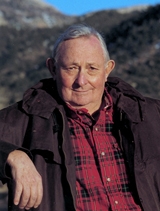
Tony Hillerman: An Appreciation

Tony Hillerman

Tony Hillerman

For many years during the nineties and the early part of the last decade, Tony Hillerman’s mysteries were a part of my annual celebration of spring.  In April or May his newest title would hit the bookstores – just in time for the beach or the pool at the gym.  “Beach read” is often synonymous with “guilty pleasure,” but I never feel guilty about enjoying good stories.

Hillerman is best known for the 18 mysteries set in northern Arizona and New Mexico and featuring Navajo tribal policemen Joe Leaphorn and Jim Chee, and later in the series, officer Bernadette Manuelito, who eventually marries Chee.  This series won Hillerman the 1974 Edgar Award, the 1991 Mystery Writers of America Grand Master Award, as well as the Navajo Tribe’s “Special Friend of the Dineh Award.”  Dineh is usually translated as “the People.”

The stories emphasize the Navajo ideal of living in harmony with the world and bring in themes from Navajo cosmology.  Many of Hillerman’s criminals are rumored to be witches – the worst thing you can become.  Leaphorn, the first detective in the series is skeptical, but…

Leaphorn didn’t believe in witchcraft.  He believed in evil, firmly believed in it, saw it practiced all around him in its various forms-greed, ambition, malice-and a variety of others.  But he didn’t believe in supernatural witches.  Or did he? (The Shape Shifter, 2006).

Chee, the younger officer, tries to walk in the worlds of both a modern policeman and a tribal shaman.  More than once, at the end of a case, Chee undergoes a traditional ritual to restore his balance and harmony.

Details of Navajo culture pervade all of Hillerman’s books and lend the restrained pacing of a people who think it rude to interrupt someone else who is talking.  In real time, the cops may have to drive a hundred miles to interview a suspect, but Hillerman keeps things moving by letting his detectives constantly mull over the compounding mysteries, and notice tiny details in the vein of Sherlock Holmes.

That said, the book I recently found, The Shape Shifter, the only one the Navajo mysteries I had not read read, is not where I would suggest a new reader start.  In places, it is a bit too slow, and it assumes we are familiar with the characters.

Skinwalkers (1990) would make a better first time Hillerman read.  This is the book where Leaphorn and Chee first team up, and the story is filled with supernatural menace.  Skinwalkers are especially nasty witches who change shape to harm others, like European werewolves.  Skinwalkers is one of three Hillerman titles featured on the PBS series, Mystery, with Wes Studi brilliantly cast as Leaphorn.

Skinwalkers movie

This is old-time detective fiction at its best, with the unique slant of a unique people, living in a remote and beautiful part of the country.  I only wish there were more of Hillerman’s books I hadn’t read.

Hollowland by Amanda Hocking – A Book Review

If you are a writer, unless you’ve been living with wolves, chances are you have heard of Amanda Hocking, the twenty-something Minnesota author of young adult fantasies who spun the publishing industry in an unexpected direction.

One year ago this month, after a string of rejections from agents and editors, Hocking uploaded two novels in Kindle format.  She thought $43 for her first two weeks of sales was “pretty good.”  By the start of this year, she was selling half a million eb00ks a month, and in March she signed a reported $2 million dollar contract with St. Martin’s Press.

Amanda Hocking’s story has been told in the New York Times, the Wall Street journal, and on dozens if not hundreds of blogs, but one key question is seldom directly addressed:  are her books any good?  I just finished my first Hocking novel, and the short answer is, yes, it was lively, original, and I liked it a lot.

Hollowland starts with a bang and the action does not let up.  How is this for an opening sentence?

“This is the way the world ends – not with a bang or a whimper, but with zombies breaking down the back door.”

These are not your old-school, reanimated corpse type zombies.  No stiff, slow, shambling, mumbling, B-Grade movie zombies.  A mutation of the rabies virus has infected most of the population, causing them to become really angry, really psychotic, and ravenously hungry.  After her quarantine station near Las Vegas is breached by a coordinated zombie attack, 19 year old, Remy, and her friend, Harlow, set off across the desert, determined to find Remy’s brother.  Their first traveling companion is an African lion – animals are immune to this kind of rabies, and all the big cats from Circus Circus are loose.  That night they meet a rock star whose fame doesn’t mean so much in a post-apocalyptic world.  They pick up an SUV and a couple of refugees from a fundamentalist cult, whose leader has the habit of “cleansing” his female followers in his bedroom.  And so it goes.

It says a lot about Remy that she names the lion, Ripley, after Sigourney Weaver’s character in the Alien movies  That is the mojo you need when the zombies are winning.  Remy also has a charming irreverence, the kind of simple, eyes-open, speak-your-mind nature that you see in Amanda Hocking’s online interviews.

I can really see, though I have not found the words to express it, why the literary establishment would not cut Hocking a break.  There’s a hint of piety about the stories and characters you see in the YA fantasy section of Barnes&Noble.  The word “homogenized,” comes to mind.  And “processed food.”  And “inbred.”

This story was fresh, a little bit raw, a bit unpolished, but shaped by a writer whose imagination has not, and hopefully will not, be poured into the grooves shaped by others.  Hocking reminds me of Stephen King and not for the obvious horror licks that they share.  Both authors seem to gravitate to horror not just for its own sake, but to explore what ordinary people will do in impossible situations.

Hollowland is a available in both self-published text version, and Kindle format for $0.99, and in case anyone does not know, a Kindle device (though I love mine) is not required to read a book in that format.  Amazon has free Kindle apps for pc, mac, iPads and smart-phones.

Enjoy.

Gone For Good by Harlan Coben

A few posts ago I said I was going to read six books straight through for pleasure, and then cycle back and analyze the ones with plot features I admire.  Book number two on my list was Harlan Coben’s Gone For Good, 2003.  Donald Maass had good things to say about this title in his Writing the Breakout Novel Workbook.  He said it takes a mystery cliche – a detective haunted by the murder of his wife or girlfriend – and turns it inside out by layering the plot and adding twists and turns.  I cannot recall a thriller with more surprising twists packed into its pages.

Will Klein’s mother tells him a few days before her death that his beloved older brother Ken is still alive. Ken disappeared eleven years earlier, wanted for the murder of Will’s former girlfriend. The family believes Ken is innocent but assumes he is dead – could he really be alive and in hiding? The day after his mother’s funeral, Will’s girlfriend, Sheila disappears. The next day at work, two FBI agents ask for Sheila’s whereabouts, and inform Will that her fingerprints were found at the scene of a double homicide in New Mexico. Meanwhile we meet two former classmate’s of Will’s older brother, one a gangster and one a sociopathic master-assassain known as “The Ghost,” and both have a keen interest in Will.

Got all that?  You need to, since this is just the basic setup of Gone For Good.  When Will sets out with his friend, Squares, to try to discover what is really going on, Squares warns him he may not like the answers.  “The ugliest truth, in the end, was still better than the prettiest of lies,” Will says, a sentiment that will be tested as the story progresses.

Perhaps the greatest take-away for me as a writer is the way questions can keep us turning pages as effectively as tension.  From the initial, “What’s going on?”, “Is my brother alive?”, “Where is my girlfriend?” mysteries, Will must face issues that cut deeper and deeper into the basic assumptions of his life and the people he loves.

This is not a perfect book.  During the second half, I found my attention wandering.  In part, the plot twists were coming with such frequency they felt expected and lost a little of their power to shock.  So I think when I review Gone For Good in greater detail, I am going to discover that for a large section of Act II, the stakes and the pacing of the revelations stayed somewhat constant.

Also, the most menacing character, The Ghost, was not fleshed out until the end of the book.  It is hard to write a convincing, three-dimensional, psychopathic killer.  It is the humanizing details that make them come alive.  Hannibal Lektor valued good manners and hated rude people.  The killer in No Country for Old Men had certain personal values – keeping his promises, for one.  Such quirks make them more believable than an apparently flawless killing machine.  The Ghost, we learn at the end of the book, is driven by a complex and unexpected sense of loyalty and fair play, but I think we would have found him more “real” and more frightening if we had known some of the details earlier.

As I now understand it, the whole point of this exercise – reading and then rereading six books to try to look under the hood – is to look deeply into what works in six unique approaches.  Having just finished a complex novel like this, I have several other opinions and hunches but I need to review them further.

I was reminded though, of the very first post I made on this blog at the end of last June.  I quoted Neil Gaiman’s comment as editor of Stories, that the measure of a storyteller’s success are the four words we all want to hear – “And then what happened?”  By that measure, Harlan Coben deserves the acclaim Gone For Good has won.

The Hunger Games by Suzanne Collins

What if there was a trend and I wasn’t paying attention?

I actually did notice The Hunger Games when it came out in 2008, but I did not read it then for two reasons.  First, though I love the genre, I am wary of reviews of fantasy literature, with words like “Breathtaking,” or “Original,” because I’ve been burned too many times.  In addition, when I read the synopsis, although The Hunger Games did sound original, but we had just had a round of serious layoffs at work, and I wasn’t in the mood for a story of hard times in the not-so-distant-future.

Last weekend, at the SCBWI conference, I heard repeated praise of The Hunger Games from sources I trust.  Later, one of the speakers cautioned the audience not to write a story just because it is trendy.  He cited a current mass of “dystopian fiction” as an example.

Looking again at reviews, and watching the the trailer of the movie that is “Coming Soon,” I realized The Hunger Games must have sparked the trend.  I downloaded the ebook and to my surprise and delight, could not put it down.  I devoured it this week.  It seems strange that in the fantasy genre, real originality is so rare, but this book has it.  It isn’t perfect.  I thought that at a key moment, Suzanne Collins held true greatness in her hand and let it slip away.  Still, The Hunger Games is one of the very best reads I recall in YA fantasy.

Katniss

I didn’t just read this book for pleasure.  It is one of a half-dozen new books I plan to read once for pleasure, and again with an eye to look under the hood and try to see how the author creates the magic.  Observation one – Suzanne Collins takes all the time she needs to introduce us to Katniss Everdeen, 16, and let us bond with her.  We rise with Katniss, learn that she loves her 12 year old sister Prim but despises her cat.  Very human stuff like that.  We learn that times are hard.  We learn that to get into the woods to hunt for squirrels to eat or trade on the black market, she has to pass through an electrified fence, which isn’t really that dangerous, because the power is seldom on.  We aren’t in Kansas anymore!  We meet Katniss’ best friend and hunting partner, Gale, who despises The Capitol, which runs things, and we learn he could be killed by the Peacekeepers if such talk is overheard.  We learn this is the day of “The Reaping” and that does not sound good.

Panem

Panem rose from the ruins of America.  Katniss’ District 12 used to be called Appalachia.  The Capitol is totalitarian, and attempts to flee result in death or slavery.  Earlier worlds of this sort, like 1984, reflected the cold war mentality, while Panem is firmly lodged in 21st century fears.  Large chunks of the coastline are gone.  There have been famines and other ecological disasters.  The Peacekeepers bring to mind Homeland Security, and the iffy electricity has an eerie resonance to what is happening right now in Japan.

But all that is nothing compared to the Hunger Games and what happens if you are selected as a “Tribute” at the “Reaping.”

As punishment and a warning to the 12 surviving Districts that unsuccessfully tried to revolt, the Capitol demands a boy and a girl between the ages of 12 and 18, to be chosen by lottery once a year.  The are trained and pitted against one another in a huge outdoor arena as gladiators.  One victor will be set up for life.  Twenty-three others will die for the amusement and “instruction” of the population, which is forced to watch – there is always enough electricity to televise the Hunger Games.

The Games

When her baby sister, Prim, is chosen, Katniss rushes forward to volunteer to take her place.  We had come to like her before, and now we love her.  Her chances do not seem very good.  Her fellow District 12 tribute, Peeta, is a baker’s boy, who doesn’t seem much of a warrior.  To make things worse, Peeta once saved her life with the gift of a loaf of bread, and both know they will eventually have to fight to the death to survive.

By now, of course, we are really into the story, and incredibly, as their training unfolds, we begin to think Katniss and Peeta may stand a chance.  As a strategy to deceive the others, they feign love for one another – except Peeta may not be pretending.  Katniss wins the affection of the crowds and the all-important sponsors.  The odds-makers give her good marks for her skill with a bow.  Their trainer, a past winner and a drunk goes on the wagon and dedicates himself to their survival.

Then the games begin and all hell breaks loose – literally.

Rue

Lets face it, we know Katniss will survive, but to her credit, Collins keeps up the nail-biting doubt.  The most poignant moment comes when Katniss teams up with Rue, a twelve year-old slip of a girl, who reminds Katniss of her sister.  They bond in a hurry, and Katniss briefly basks in the luxury of not feeling alone – never mind that they will have to fight each other later.  But after a daring raid on another team’s food supply, Rue is mortally wounded.  Katniss sings her a lullaby as she dies, for her greatest love had been music.  And then, as the greatest protest she dares, Katniss covers her friend’s body with wildflowers as the hidden camera’s broadcast the image all through the land.  Gladiators are not supposed to care for each other – it is the closest thing to open defiance Katniss can imagine.

At this moment, The Hunger Games transcends genre and reaches the level of tragedy – that which is grave and constant in human affairs.  In particular, it reminded me of that heartrending day, Dec. 25, 1914, that we now call the Christmas Truce.  Two armies of young men defied the old men who sent them to kill each other, by celebrating the birth of Christ with friendship.  The generals promised a firing squad to any who tried it again.

How It Ends

Things tapered off from there, perhaps inevitably so, for how could such a moment be sustained?  Still, the genetically mutated zombie-werewolves who end the contest were over the top – they seemed like an add-on, a patch to ramp up adrenalin by borrowing from the horror genre.  For me, it had the opposite effect.

The book also ends with romantic teasers.  Katniss went out of her way to save the badly injured Peeta, but until now, she had been a hard-luck tomboy, fond of him and grateful, but not in love.  Her last moment inner conflict does not seem to grow “organically” from her earlier thoughts about her friendship with two young men – maybe I am too cynical, but I took it as a carrot to get the masses of Twilight readers to buy the next book of the trilogy.  Club Peeta or Club Gale?

Still, I plan to read and enjoy the final two books of the trilogy.  Even if the series comes off as an “ordinary” romance and battle of good guys against an evil empire, if that’s the worst thing we can say of The Hunger Games, it is still in very good company.  Suzanne Collins has given us a vividly imagined and wonderfully crafted story.
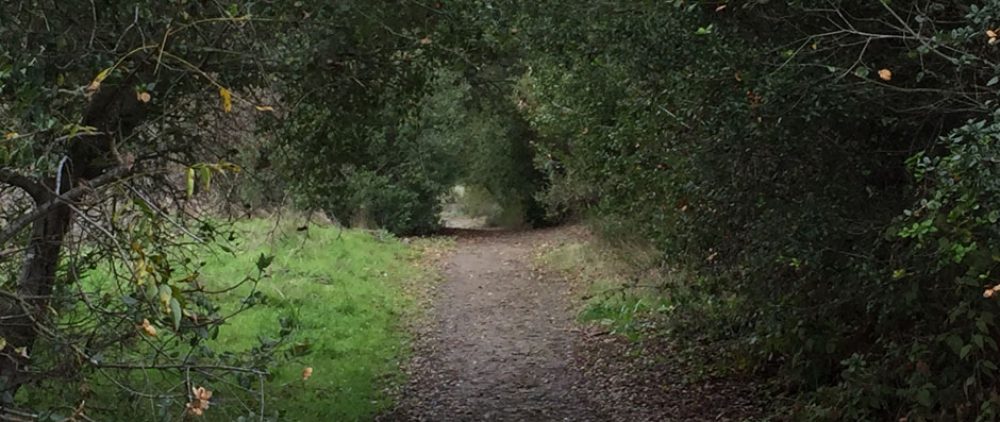
The Tassajara Bread Book

Three decades ago, I stumbled into a three year period in my working life where I had time to pursue all the extra-cirricular activities I desired.  Through a spectacular right place/right time moment, I landed a part time teaching job.  We lived in a small but cozy and affordable house in Chico, California where we could walk to the market and downtown.  We got by with one car, a Beetle that I maintained with the help of the Idiot’s Volkswagen book.  We grew veggies, and somewhere along the line, I started making bread, not just to save a few pennies, but because I found it satisfying and delicious.  That was one of several things that went by the wayside when I joined the high-tech workforce – until two days ago.

In a recent post I wrote of attending a retreat with Edward Brown, a long-time Zen student, teacher, chef, and the author of The Tassajara Cookbook and The Tassajara Bread Book.  I purchased both books.  This was not an impulse buy – I attended a workshop with Edward a year ago and almost bought the books then, but worried that I didn’t have enough time.  This year I decided to make time, with the results you can see above.  The loaves taste as good as they look.

I’d show you the Orange Whole Wheat Pancakes, but unlike the bread, they did not have to cool before eating, so they didn’t last long enough for snapshots.

The directions in the Breadbook are clear and lively.  Brown takes the time to explain why you do things this way and not that, a feature lacking in many cookbooks.  There is something elementally satisfying in baking one’s “daily bread,” and I cannot think of a better book on how to do it.