What do these movies have in common: Alien, Fatal Attraction, and Godzilla? How about these: Star Wars, The Bad News Bears, and Lord of the Rings? The first trio belong to the genre that Blake Snyder called “Monster in the House.” The second set are “Golden Fleece” films in Snyder’s terminology.
He assigned distinctive genre names to help us think about films in a different manner and see connections we might miss with more familiar and less specific tags. Some of the names came from Snyder’s love of the roots of our story traditions. The Golden Fleece, for example, was the object of Jason’s quest in the myth of the Argonauts, while Theseus and the Minotaur is a “monster in the house” tale that is thousands of years old.
Snyder described his approach in Save the Cat, where he presented his top-down approach to writing a movie script, from idea to logline to pitch to outline to finished screenplay. He presented a model of 10 movie genres and 15 critical plot points. Save the Cat Goes to the Movies rounds out these concepts with detailed discussions of 50 well known and well respected movies – a valuable addition. Here’s an example:
“Monster in the House” stories have three three key elements, a monster, a house, and a sin. The monster often has seemingly “supernatural” powers: Jaws is an uber-shark, while insanity lends a lot of power to human monsters. The house may be a literal house, a spaceship, a town, or a planet, as long as escape from the monster is not an option. The sin is often greed (closing the beaches would hurt the tourist economy) or lust in a teenage slasher film. In the case of Victor Frankenstein and the atomic tests that spawned Godzilla, it is scientific hubris. Sometimes ignorance is the “sin.”
“Golden Fleece” movies are quest stories that span the millennia between Homer’s Odyssey and Bob Hope road movies. The elements Snyder identifies are a road, a team, and a prize. These movies run the gamut from comic (Planes, Trains, and Automobiles) to deadly serious (Saving Private Ryan), but in every case, winning the prize is less important to the story than the lessons the (surviving) team members learn.
In my previous post, I discussed Snyder’s “Fool Triumphant” genre. His remaining seven categories also reveal unexpected similarities between movies where we don’t expect to find them. It is also illuminating to look for his plot points in our favorite films. Some of them are familiar through the names he assigns – “The bad guys close in,” “All is lost,” “Dark night of the soul.” Others require explanation, which this second book in the Cat series provides.
A map is not a territory, as an outline is not the gripping story our hearts and minds crave. That doesn’t mean a map isn’t useful in helping us reach our destination. Blake Snyder’s Save the Cat Goes to the Movies is a useful and stimulating map to help us navigate the wilderness of a stack of blank paper.
As I worked on a recent post, Favorite Fictional Detectives, I realized I didn’t remember the details of Skinwalkers, a key Tony Hillerman novel that I read soon after it was published in 1986. I read it again and found it to be a thoroughly satisfying mystery. I offer this brief review to encourage others who may not know Hillerman’s work to give it a look.
***
Officer Jim Chee, of the Navajo Tribal Police, tosses and turns one night in the airstream where he lives in the desert. When his closest neighbor, a feral cat, shoots through the pet door, Chee gets up to peer out the window at what might have scared it so badly. Probably a coyote, he thinks. For a moment, thinks he sees a shape in the darkness. Then the night explodes. Three shotgun blasts tear holes in the trailer just above the bed where Chee was sleeping moments before.
In the morning, as he cleans up his trailer, Chee makes a frightening discovery. Among the shotgun pellets that litter the floor is a small bone pellet. Navajo witches, or skinwalkers, inject bone into the bodies of people they want to kill. The bone produces the fatal “corpse sickness.” This bone fragment links three apparently separate killings that Lt. Joe Leaphorn, a senior tribal detective, has been trying to solve without success. When Leaphorn and Chee join forces, their first problem is persuading anyone to talk, when tradition holds that speaking a skinwalker’s name will attract his harmful attention.
Chee is learning to be a traditional Navajo healer. With a background in college psychology classes, he understands his role to be restoring people to the core Navajo values of beauty and harmony. Skinwalkers have fallen away and try to take others with them.
Leaphorn is not a believer, but he learned by hard experience that other people are. Early in his career, when he ignored talk of witches, three murders and a suicide were the result. As he and Chee grope through the dark, a very real menace is watching from a direction they do not expect.
This book represents fine storytelling, with characters and a setting that are outside our normal experience. It’s one of the best mysteries I’ve read, and I suspect it will make you want to read more of Tony Hillerman’s work.
In literary gatherings, I usually introduce myself as part of the fantasy camp, but I’ve probably read and enjoyed just as many mysteries over the years. In my previous post, I gave a lukewarm review to James Patterson’s latest Alex Cross thriller. I think the real reason is that I’ve never bonded to Alex Cross the way I have to other favorite detectives.
Character is key to detective novels just as it is to other types of fiction, and this is separate from an issue that has surfaced over the last decade, the distinction between plot driven and character driven stories.
In character driven tales, some attribute of the protagonist begins and sustains the action, the way Katniss Everdeen’s sacrifice for her sister gets things moving in The Hunger Games. Mysteries are almost always plot driven – the story begins when the first body is found.
These days, agents and editors say they’re looking for character driven tales. Dan Brown wasn’t listening when he wrote TheDaVinci Code, now one of the five best selling books of all time, a distinction shared with The Bible and Harry Potter. Like much advice for writers, I think it misses the point. Regardless of what moves the action, we love novels with characters we love, in worlds we’d love to visit. Have you ever imagined yourself in Baker Street when Holmes jumps up and cries, “The game is afoot?”
If so, read on! I’ve listed a few of my favorite detectives, not necessarily in order, for that, like everything else, is subject to change.
Sherlock Holmes: This is obvious. How many popular books of today will still be read and loved 100 years from now, spawning a lively stream of new presentations in all the popular media of the future? I seldom reread mysteries – often there is no point when you know the criminal’s identity, but I still dive into Holmes for recreation. Has there ever been a more dastardly villain than Dr. Grimesby Roylott in “The Adventure of the Speckled Band?” And for chills up the spine, one sentence has never been beaten: “Mr. Holmes, they were the footprints of a gigantic hound!”
I enjoy all the presentations of Holmes in film, but my favorite movie Holmes is still Jeremy Brett for his perfect blend of genius and madness, without the slightest trace of modesty:
Cadfael: The Brother Cadfael mysteries were the creation of Edith Pargeter, under the pseudonym, Ellis Peters. In early 12th century England, during a period of contention for the crown known as The Anarchy, Cadfael, a middle aged and disillusioned veteran of the crusades, becomes a Benedictine monk. With keen powers of observation, a scientific turn of mind, and an in depth knowledge of herbalism, he solves the many murders that just happen to happen whenever he is near.
I enjoy the film versions more than the books, thanks to renowned Shakespearean actor, Derek Jacobi, who plays Cadfael.
Hercule Poirot and Miss Marple: Most writers are lucky if they can create a single unforgettable character. Agatha Christie gave us two. Sometime in the early 90’s, I went on an Agatha Christie binge, and over the next few years, read all the stories of both characters I could find, some 80 novels in all. Poirot and Miss Marple turn up often in films and on TV. I’ve enjoyed several versions of Murder on the Orient Express and Death on the Nile.
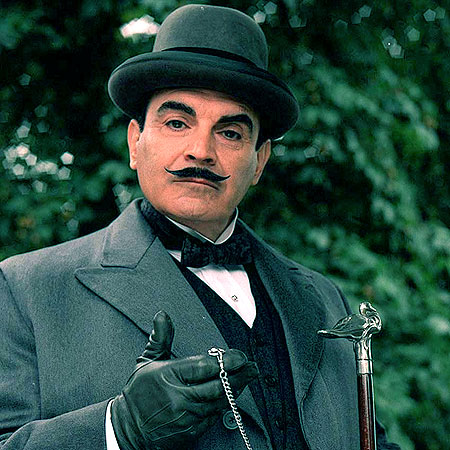
The bad news is that Miss Marple stories are usually classed as “cozy mysteries,” a sub-genre with a distinctly unmanly name. The good news is that I’m too old to care. There is no definitive movie Miss Marple, but British actor, David Suchet takes the honors for his portrayals of Hercule Poirot:
David Suchet as Hercule Poirot
Wallender: To re-establish my manly credentials, I add Kurt Wallender to the list. Wallender is sort of a Swedish, existentialist, high plains drifter, and the most angst-ridden detective in the history of the world. The creation of Swedish novelist, Henning Mankell, Wallendar was adapted for British TV, beginning in 2008. Episodes are show up here on PBS.
The series stars Kenneth Branagh, another great Shakespearean actor. Branagh says Wallender is “an existentialist who is questioning what life is about and why he does what he does every day, and for whom acts of violence never become normal. There is a level of empathy with the victims of crime that is almost impossible to contain, and one of the prices he pays for that sort of empathy is a personal life that is a kind of wasteland.”
Don’t watch this guy when you’re feeling blue!
Kenneth Branagh as Wallender
Jim Chee and Joe Leaphorn: These officers in the Navajo Tribal Police star in 18 mysteries Tony Hillerman wrote between 1970 and 2006. The grandeur of the American southwest and Navajo tribal beliefs are the background against which these unique detective stories unfold. Chee, the younger officer, struggles to hold on to tribal traditions in 20th century America. Leaphorn is more world weary and cynical, but he knows that where there is talk of witches and taboos, trouble erupts.
Hillerman, who died in 2008 loved the four corners and wrote about it so vividly that it’s really another character in the stories. His books won many awards, but he always said what pleased him most was being named a Special Friend of the Navajo Nation in 1987. Adam Beach and Wes Studi starred in three movie versions of Hillerman’s novels, including Skinwalkers, (the Navajo name for malevolent sorcerers), that is regarded as Hillerman’s breakout novel.
Amelia Peabody: Elizabeth Peters’ 19 book series centers on the adventures and detective skills of independently wealthy and independently minded Egyptologist, Amelia Peabody and her family, which at first includes her husband Radcliff Emerson (who hates his first name and refuses to use it), and their son Ramses, who was born as stubborn as his parents. Later Amelia and Emerson take in two wards, David, the son of a Muslim and a Christian whom they rescue from semi-slavery, and Nefret, a red headed former priestess of Isis who will eventually marry Ramses.
Set in the years between 1884 and 1923, there are rascals, rogues, adventurers, tomb robbers, mummy’s curses, and Sethos, aka, The Master Criminal. Historical Egyptologists and archeological events are woven into the series which ends with the 1922 discovery of the tomb of King Tut. The author has said that Amelia herself is based in part on Amelia Edwards, a Victorian novelist and Egyptologist, whose 1873 travel book, A Thousand Miles up the Nile was a best seller.
The middle east has changed since Peters began writing her novels, but they remain among my favorite beach reads of all time. For anyone who enjoys a good mummy movie or has ever fantasized lost tombs, pith helmets, and midnight at the oasis, these are great adventure stories, ever complicated by the corpses that turn up wherever Amelia goes.
I’ve only listed detective series here because I cannot remember every good singular mystery novel I’ve read. Please add any favorites of yours to the list. There’s always room for more, since the game is always afoot somewhere!
In the 15 years since Morgan Freeman starred in the first Alex Cross movie, Kiss the Girls, I’ve enjoyed quite a few James Patterson thrillers in films, books, and audiobooks. He knows how to keep you on the edge of your seat, whatever the medium. Alex Cross, Run, the 20th tale in the series, is no exception.
When I’m doing a lot of driving, I often choose Patterson audiobooks – they make the miles fly, but once I started this one, I kept the earbuds plugged in while fixing breakfast, walking the dogs, and even late at night. It wasn’t exactly pleasure that kept me listening. It often felt like drinking coffee when nervous.
There’s an amped up quality to Alex Cross, Run that couldn’t quite hide a formulaic quality, even though Patterson created much of the formula. Throw in enough serial killers – Alex Cross Run had three – and an author like Patterson will create plenty of tension, but I often felt manipulated. Every book tries to manipulate an audience; successful ones do it with subtlety. Here, elements like bad guy motives and family interludes felt somewhat perfunctory, like I might do if I started with a list of plot points and checked them off one by one.
Alex Cross, Run is not a bad book by any means. I’d give it three and a half stars out of five. It’s a thriller by any measure, but it adds nothing new to the series or the genre.
Perhaps it simply felt rushed compared to books I’ve read in Patterson’s other signature series, the “Women’s Murder Club.” I find Lindsay Boxer a more rounded character, with a richer circle of friends and environment than Alex Cross.
Any reader who likes thrillers and any writer who wants to learn about tension will be rewarded by reading James Patterson, but Alex Cross, Run is not where I would advise them to start.
The title of this post comes from a new book reviewed on NPR, One Nation Under Stress: The Trouble With Stress as an Idea, by Dana Becker, PhD.
According to Dr. Becker, “stress” is a recent concept. The first article on stress in the New York Times was published in 1976. The first diagnoses of “nervous disorders” or “neurasthenia,” came from the work of Dr. George Beard ca 1869. In the NPR interview, Becker says that physicians of the time considered “American nervousness” to come from outside factors, related to the increasing pace of life after the civil war. “Stress,” as we understand it today, is the polar opposite.
Now we have internalized stress, focusing on the risks to our health and the ways we should cope with it, through diet, exercise, yoga, and so on. Our experience of stress derives from our ideas of stress, Becker says. The internal emphasis on health is necessary, but we let it divert us from questioning the external causes of stress. She gives an example in the NPR interview: many articles are written to help working mothers cope with stress – far fewer are written about the need for affordable daycare. We may eat kale and do yoga to survive the 24/7 world, but we seldom ask why this is the norm and what the alternatives are.
This argument echoes a major concern of James Hillman, who I frequently write about here. Though he was once Director of Studies at the Jung Institute in Zurich, in 1992 he co-authored a book called We’ve Had a Hundred Years of Psychotherapy and the World is Getting Worse. In it, he said:
“Every time we try to deal with our outrage over the freeway, our misery over the office and the lighting and the crappy furniture, and the crime in the streets, whatever – every time we try to deal with that by going to therapy with our rage and our fear, we deprive the political world of something.”
In her NPR interview, Dana Becker presented a balanced view of stress – it’s fine to treat the symptoms, which are personal, as long as we don’t gloss over the underlying causes, many of which are not. The promise of new view of a modern ailment is enough to put One Nation Under Stress near the top of my “to read” list.
I started reading The Alchemist soon after its publication in 1988, but I didn’t finish it then, for reasons I don’t clearly remember. I picked it up again after author and writing friend, Amy Rogers, recommended the book for its affinity with the folk and fairytales I’ve recently spent so much time writing about.
She was right. This time the story drew me in with its “Once upon a time” feeling. It is not a fairytale by any measure; it’s far too sophisticated, yet it’s filled with folklorish magic. The hero, Santiago, is named just once, when we meet him. Through the rest of the tale, he is simply “the boy.” Ironically, this generic quality, so typical of fairytales, allows us to identify with his journey, project our own yearnings into his far more closely than a modern, “three dimensional” characterization would have allowed. In addition, the plot twist that ends The Alchemist is drawn directly from a folktale that appears around the world.
The Alchemist is a tale of spiritual self-realization. From the start, Santiago tries to follow his “personal legend,” a term taken from alchemy. At first, it is an instinct. His search becomes explicit after a gypsy tells him his treasure lies near the pyramids. A “chance” meeting with Melchizedek , the mysterious priest and king mentioned in Genesis, sets him on the path after he witnesses the unrequited longing of those who abandon the quest for their legends for the sake of expediency. In order to follow his personal legend, Santiago learns to listen to the Soul of the World in his heart. The world soul, or Anima Mundi is one of the key principles in the alchemical manuscripts that survive.
Anima Mundi, or Soul of the World, in alchemy
Paulo Coelho was born in 1947 in Rio de Janeiro. When he was a teenager and told his mother he wanted to be a writer, she praised the steadiness of his father, an engineer, and asked if he knew what it meant to be a writer. After research, Coelho concluded that a writer, “always wears glasses and never combs his hair” and “has a duty and an obligation never to be understood by his own generation.”
At age 16, because of his introversion and refusal to follow a traditional career path, his parents had him committed to a mental institution from which he escaped three times before his release at age 20. He agreed to attend law school but dropped out to become a hippie and travel through South America, Mexico, North Africa, and Europe. Upon his return to Brazil, he worked as a song writer, an actor, journalist, and theatre director.
In 1986, he walked the 500 mile pilgrimage road of Santiago de Compostela to the cathedral where St. James the apostle’s remains are believed to be buried. Since the middle ages, it has been one of three major Christian pilgrimage destinations, along with Rome and Jerusalem. On the way, Coelho had a spiritual awakening, which he described in his autobiographical novel, The Pilgrimage, 1987. He published The Alchemist the following year, with a small Brazilian publisher that ran 900 copies and decided against a reprint. Sales now total 65 million.
Paulo Coelho, 2012, by Sylvia Feudor. Copyright free.
I do not clearly remember why I disliked The Alchemist when I first read it more than 20 years ago. I suspect, to put it in Santiago’s language, that at the time, I feared I’d lost hold of my own personal legend. I’m glad I picked up The Alchemist again. Our world is darker, harder, and more cynical now, and more than ever I think we need Coelho’s gentle parable. However difficult it may be, it’s good to try to remember this conversation between King Melchizedek and Santiago:
“What’s the world’s greatest lie?” the boy asked, completely surprised.
“It’s this: that at a certain point in our lives, we lose control of what’s happening to us, and our lives become controlled by fate. That’s the world’s greatest lie.”
Thanks to a recent comment by Sara Lier, I have the correct attribution for one of my favorite quotes. It was Muriel Rukeyser, the American poet and activist, who said, “The universe is made of stories, not atoms.”
I think Anam Thubten Rinpoche would agree. In his latest book, The Magic of Awareness 2012, he says enlightened consciousness is available any time we can let go of our story lines. He talks a lot about meditation as resting, as a cessation of effort including all efforts to meditate, to get enlightened, or collect any other spiritual goodies:
“Deeply resting is the point where we are no longer looking for anything else. As long as there is an act of searching for God or truth or eternal self, it is not only that we haven’t found it; we are actually moving away from it with great speed.”
We can all remember moments when we were “no longer looking for anything else.” They areoften our most joyous moments. Anam Thubten’s teaching centers on this experience, on the deep truth and joy it contains.
The illusion of separation of self and other, self and the world, lies at the heart of all our troubles according to Buddha’s teaching, which Anam Thubten restates for the 21st century. Good or bad, any concept of “I” leads to a friend-or-foe, fight-or-flight relationship with the world. Yet “this ‘I’ is a fictitious entity that is always ready to whither away the moment we stop sustaining it…All we have to do is simply sit and pay attention to our breath, allowing ourselves to let go of all of our fantasies and mental images.” (from No Self, No Problem, 2009).
There’s nothing dumb about statements like that, since the teachers who make them never confuse the relative and ultimate levels of truth. This is my car and that one is yours, and things work out better between us if we remember which is which. The problem comes if I decide your car is better than mine. If I conclude I’m the kind of person who never gets what he wants. Maybe I’m undeserving…
The ego, the sense of a separate self, can spin such stories forever. Fortunately, it doesn’t take much to glimpse the alternative vision. “Try this,” says Anam Thubten. “Pay attention to your breath in silence. Look at your mind. Immediately we see that thoughts are popping up. Don’t react to them. Just keep watching your mind. Notice that there is a gap between each thought. Notice that there is a space between where the last thought came to an end and the next one hasn’t arrived yet. In this space there is no “I” or “me.” That’s it.” That, he says, is our ultimate and eternal nature.
Ideas like this do not demand belief, just consideration and perhaps later exploration. The books listed here are a good place to start, as well as the website for Anam Thubten’s Dharmata Foundation, located in Point Richmond, California.
Einstein once said the only important question is whether or not the universe is a friendly place. It is, according to Anam Thubten, as soon as we let go of our conditioned ideas that it is something else. That realization, or at least a glimpse of it, is always closer than we think, no matter who we are and what we are doing.
Until the 20th century, most people in the western world believed in objective memory, that what we remember is an accurate mirror of events that actually happened.
With the birth of psychoanalysis and concepts of the Id and unconscious mind, that began to change. Modern brain research confirms that not only do memory and imagination overlap, but that memories can be deliberately changed or altered. Such manipulation is a core element of The Cloud by Matt Richtel, a page turning thriller I started to read after seeing this interview with the author on Sciencthrillers.com http://www.sciencethrillers.com/2013/author-interview-matt-richtel-the-cloud/
The Persistence of Memory by Salvadore Dali, 1931
Freud was ambivalent about the accuracy of his patients’ memories. At the start of his career, he attributed several several cases of hysteria to real childhood sexual abuse that his methods uncovered. Later he said that such episodes were patient “phantasies.”
The issue surfaced again at the end of the 20th century, with “recovered memory” therapy causing tremors in the field, to say nothing of lives disrupted by allegations of sexual abuse, in what is now widely viewed as abuse by helping professionals who implanted memories in the course of trying to treat patients. “False memory syndrome” still evokes passionate disagreement in the field. The AMA and the American Psychiatric Association, as well as the Royal College of Psychiatrists in Britain have condemned recovered memory therapy, and in the late 90’s, a number of patients who once believed they’d been victims of childhood abuse successfully sued the therapists who had led them to that belief.
Since the turn of the century, the “hard science” of biology has confirmed what most therapists since Freud have known – that memory is always mixed with imagination. The area of the brain that perceives an object overlaps the part of the brain that imagines the same object. In 2009, scientists implanted memories (involving smells) in flies by using light signals to trigger “genetically encoded switches.”
The day after I started reading The Cloud, I heard “Sure, I remember that,” on Marketplace, in which the work of Elizabeth Loftus was highlighted. Loftus, of UC Irvine, is one of the key researchers who have demonstrated how easy it is to implant memories, in this case using altered photographs. http://www.marketplace.org/topics/life/freakonomics-radio/sure-i-remember. I invite you to listen to this timely piece, which is only five and a half minutes long.
Yep. We now something new to worry about – hacking at the cellular level! I’ll have to remember to worry about it later, though. Right now I have to get back to my novel…





 The First Gates