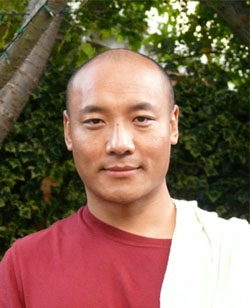
July 6 is the Dalai Lama’s birthday

His Holiness with a participant at the Young Minds Conference in Sidney, Australia, June 17, 2013

His Holiness with a participant at the Young Minds Conference in Sidney, Australia, June 17, 2013

His Holiness the Dalai Lama is 78 today.  Regarded by many as an emanation of Avalokiteshvara, the Buddha of Compassion, here is a summary of the Dalai Lama’s mission in the world from the website of the Gyuto Vajrayana Center in San Jose.

Three Main Commitments of His Holiness

Firstly, on the level of a human being, His Holiness’ first commitment is the promotion of human values such as compassion, forgiveness, tolerance, contentment and self-discipline. All human beings are the same. We all want happiness and do not want suffering. Even people who do not believe in religion recognize the importance of these human values in making their life happier. His Holiness refers to these human values as secular ethics. He remains committed to talk about the importance of these human values and share them with everyone he meets.

Secondly, on the level of a religious practitioner, His Holiness’ second commitment is the promotion of religious harmony and understanding among the world’s major religious traditions. Despite philosophical differences, all major world religions have the same potential to create good human beings. It is therefore important for all religious traditions to respect one another and recognize the value of each other’s respective traditions. As far as one truth, one religion is concerned, this is relevant on an individual level. However, for the community at large, several truths, several religions are necessary.

Thirdly, His Holiness is a Tibetan and carries the name of the ‘Dalai Lama’. Therefore, his third commitment is to work to preserve Tibet’s Buddhist culture, a culture of peace and non-violence.
Permission to be ourselves

Not long ago, I came upon a post by Zen practitioner, Tomas Qubeck, called “Zen: How to Recalibrate Myself Back to Zero.”  Tomas discusses his love of solitary retreats.  I’m with him on that score, but then he adds an unusual twist – “Just recently I have realized that this ‘zero’ refers to ‘zero purpose’.”

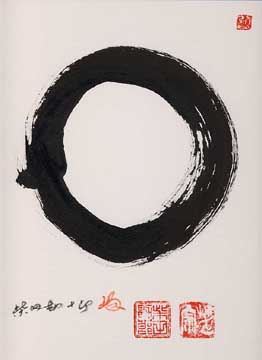
Enso circle.  CC-by-SA-3.0

Enso circle. CC-by-SA-3.0

I know from experience that letting go of purposeful action for any length of time is a very difficult practice.  Why would one even bother?  Tomas observes that an urge to be purposeful often “shows up in my mind, [as] an image or…a sense of how I want to feel or be. All of this necessarily involves a moving away from how and what I am just at this very moment.”  Sometimes busy-ness can be an addiction, he says.

I’ll leave you to read his reflections, which have nothing to do with quitting our jobs, living in caves, or any other oddball decisions his title might suggest if you take it literally.  My own thoughts veered in a different direction.  Thinking of “purposeful action,” reminded me of something I heard Zen teacher, Edward Espe Brown say at a day long retreat:

“No matter what you do, your inner authorities will not be pleased.”

I’ve written several posts about Edward Brown.  I enjoy his humor, the deceptively “simple” depth of his insights, as well as the wisdom he gained as a chef and the recipes he shares in his Tassajara Cookbook.  I’ve attended three retreats with him in as many years and jotted down some of his pithy statements.  In Zen, one carries such sayings in the mind, turning them over until fresh meaning emerges.  Here are four others I’ve found valuable.  I often remember them at interesting moments.

What is precious in us doesn’t come and it doesn’t go.  It is not dependent on performance.

Are you going to be a rule follower, or are you just going to be you?

No one else can give us permission to be who we are.

There is no by-the-book way for you to be you.

As you might guess, Edward Brown, who was trained in traditional Zen by Shunryu Suzuki Roshi, is charting his own course these days.  If you want to learn more about his style of cooking and Zen, you can visit his home page and and listen to some of his teachings at The Peaceful Sea Sangha website.

The Secret of Getting Ahead?

Those who are old enough to have watched “Hee-Haw” will remember a song that Tennessee Ernie, Buck Owens, and the gang sang almost every week, “Gloom, Despair, and Agony on Me.”  One of the lines was, “If it weren’t for bad luck, I’d have no luck at all.”

These days, it sometimes seems like if it weren’t for bad news, we’d have no news at all, especially on the economic front.  I’ve been thinking about this a lot lately – not the economy per se, but the news, that is, the stories we tell about the economy.  I’ll have more to say about this later, but it’s increasingly clear that what we have beneath the headlines are dueling paradigms, different core assumptions of what is good and bad, what works and what doesn’t.

Here is a core assumption that never has gotten much air time:  altruism rather than self interest may be the greatest motivational force for people at work.  This is the thrust of the teaching and writing of Adam Grant, 31, the youngest tenured and highest ranked professor at the Wharton School of Business.  Sarah Dominus, a writer for the New York Times Magazine, profiled Grant in a March 27 article,  Is Giving the Secret to Getting Ahead?.

Grant first made a name for himself in the field of economics as a 22 year old grad student in organizational psychology, when he applied himself to boosting motivation and output at a university fund raising call center, a notoriously unpopular student employment option.

Realizing that the call center helped fund scholarships, Grant invited a scholarship recipient to address the callers to give them an idea of the value of their work.  Even Grant was amazed when the next month, revenues were up 171%.  In later studies, the jump was as high as 400%.  Since then, Grant designed other studies in other fields that gave parallel and equally quantifiable results.

Grant’s work has drawn criticism as well as praise, much of it centered on the potential for abuse of the findings.  Will corporations try to use them to keep workers happy while cutting their wages and benefits?  According to Sarah Dominus, Grant is skeptical of corporate motivation as well and says his effort is to understand the mechanism, not necessarily suggest implantation.

Two weeks ago, I attended a day long retreat with Norman Fischer, a long time teacher and former abbot at the San Francisco Zen Center.  The subject of his retreat was compassion.  “Self-cherishing never makes anyone happy,” he said.  “In the long run, concern for others is very practical.  It’s our only chance for living a satisfying life.”

I started thinking of the how and why of our bad news headlines when Fischer said he remains optimistic.  Despite the chaos and breakdowns of our traditional systems, he believes that interactions based on compassionate regard for each other are the future.  “Not in my lifetime and maybe not in yours, but I think it’s coming,” he said.

That’s why I was so pleased to discover Adam Grant’s work.  I don’t often think of economics as a likely field of compassionate action, but if, as the Buddha asserted, it’s an impulse at the core of our being, we should expect to find the evidence everywhere.  Adam Grant seems to have found it at the heart of “the dismal science.”  His first book for a wide audience, Give and Take, was published on April 9.

A retreat with Anam Thubten, January, 2013

Thanks to a recent comment by Sara Lier, I have the correct attribution for one of my favorite quotes.  It was Muriel Rukeyser, the American poet and activist, who said, “The universe is made of stories, not atoms.”

I think Anam Thubten Rinpoche  would agree.  In his latest book, The Magic of Awareness 2012, he says enlightened consciousness is available any time we can let go of our story lines.  He talks a lot about meditation as resting, as a cessation of effort including all efforts to meditate, to get enlightened, or collect any other spiritual goodies:

“Deeply resting is the point where we are no longer looking for anything else.  As long as there is an act of searching for God or truth  or eternal self, it is not only that we haven’t found it; we are actually moving away from it with great speed.”

The magic of awareness cover

We can all remember moments when we were “no longer looking for anything else.”  They are often our most joyous moments.  Anam Thubten’s teaching centers on this experience, on the deep truth and joy it contains.

The illusion of separation of self and other, self and the world, lies at the heart of all our troubles according to Buddha’s teaching, which Anam Thubten restates for the 21st century.  Good or bad, any concept of “I” leads to a friend-or-foe, fight-or-flight relationship with the world.  Yet “this ‘I’ is a fictitious entity that is always ready to whither away the moment we stop sustaining it…All we have to do is simply sit and pay attention to our breath, allowing ourselves to let go of all of our fantasies and mental images.” (from No Self, No Problem, 2009).

There’s nothing dumb about statements like that, since the teachers who make them never confuse the relative and ultimate levels of truth.  This is my car and that one is yours, and things work out better between us if we remember which is which.  The problem comes if I decide your car is better than mine.  If I conclude I’m the kind of person who never gets what he wants.  Maybe I’m undeserving…

The ego, the sense of a separate self, can spin such stories forever.  Fortunately, it doesn’t take much to glimpse the alternative vision.  “Try this,” says Anam Thubten.  “Pay attention to your breath in silence.  Look at your mind.  Immediately we see that thoughts are popping up.  Don’t react to them.  Just keep watching your mind.  Notice that there is a gap between each thought.  Notice that there is a space between where the last thought came to an end and the next one hasn’t arrived yet.  In this space there is no “I” or “me.”  That’s it.”  That, he says, is our ultimate and eternal nature.

Ideas like this do not demand belief, just consideration and perhaps later exploration.  The books listed here are a good place to start, as well as the website for Anam Thubten’s Dharmata Foundation, located in Point Richmond, California.

Einstein once said the only important question is whether or not the universe is a friendly place.  It is, according to Anam Thubten, as soon as we let go of our conditioned ideas that it is something else.  That realization, or at least a glimpse of it, is always closer than we think, no matter who we are and what we are doing.

Who is it that can tell me who I am?

This line from King Lear is part  of the title of a 1999 lecture by Dr. Joanne Stroud, one of the founders, along with James Hillman, of The Dallas Institute of Humanities and Culture.

Lear:  Who is it that can tell me who I am?
Fool:  Lear’s shadow.  (Act 1, Scene 4)

The exchange is a fitting lead in to Stroud’s lecture which centers on ideas of identity in the western tradition, especially in Jungian psychology.  For Jung, “the shadow,” comprised of the disowned parts of a person or culture, is one of the first archetypal energies we encounter when we begin to look within, hoping to find out what and who we are.

I recommend Stroud’s transcript for its outline of Jung’s ideas as they bear on the western imperative, “Know Thyself,” which was inscribed at the entrance to Apollo’s temple at Delphi.

Temple of Apollo at Delphi by Navin Rajagopalan, CC By-SA 2.0

I’m guessing that the question “Who can tell me who I am,”  is an undercurrent in the lives of everyone who has read this far.  In addition to our own introspections, don’t we ask friends, teachers, novelists, religions, therapists, books, and even politicians in certain election years?

There is much to be learned from these sources, information that’s useful when choosing a career, a spouse, a place to live, or when plotting a novel or writing a poem.  But that’s not what Lear asked or Apollo demanded at Delphi.  The answer to the question of identity is like a rainbow, sometimes visible on the horizon, but elusive no matter how we chase it.  The time comes when we have to ask the Dr. Phil question,  “How’s that working for you?”  Could it be that “identity,” as it is commonly imagined – as a kind of cosmic birth certificate – cannot be found?

That’s very good news according to Anam Thubten Rinpoche, a Tibetan Buddhist master I have written about before.  I’ve taken some half-dozen daylong retreats with him since 2005, most recently in January of this year.  I’ve wanted to write about the event, but it isn’t easy.  Rather than add to our store of beliefs and concepts, Anam Thubten suggests we try letting them go.  In his second book, The Magic of Awareness 2012, he says, “Good concepts are like a golden chain.  Bad concepts are like an iron chain.  They all equally bind you in the end.”

Reading that, I always think of meeting new people in social settings.  “What do you do?” is usually one of the first questions.  Do you ever resist being pigeonholed when that happens?  At such moments don’t we understand that “I” am more than my roles and my vital statistics.  Anam Thubten would add that we are greater than all our ideas of identity, which are just more sophisticated pigeonholes.

Anam Thubten

Next time I will try to describe the simple ways he invites us to drop our stories long enough to glimpse the reality that lies behind them.  If that’s biting off much more than I can chew, at least it’s easier than trying to answer Lear’s question.

Happy Losar

losar 2013

Monday, February 11, marks Losar, the Tibetan New Year, and the start of 2140, the Year of the Water Snake.  The new year festivities begin with prayers and good wishes for family, friends, and all sentient beings.  Tibetans believe that Shakyamuni Buddha performed miracles during the first 15 days of  Losar, so this is a time of ritual and celebration.

His Holiness Sakya Trizin, leader of one of the four schools of Tibetan Buddhism, offered these words in his 2013 Losar greeting:

“Now we start a new year, the Year of the Water Snake.  In Buddhism, whilst the snake represents anger, one of the three poisons that keeps us trapped in samsara (delusion), water symbolizes purification.  And so we are invited to look upon this year as one of transformation, where our negative emotions can be purified and transmuted into enlightened qualities, and where we can apply this transformation to our everyday life, bringing light and kindness to everyone around us.”

Losar altar at Gyuto Vajrayana Center, San Jose, CA

Tibetan astrological signs are more complicated than ours.  The astrological year does not begin at Losar, a lunar holiday, but on the preceding winter solstice.  Babies born between Dec. 22, 2012, and Dec. 21, 2013 have the water snake as their sign.  So do people turning 60 this year:  with 12 animal signs and five associated elements (wood, fire, earth, iron, and water), there are 60 possible combinations.  A quick trip to google brought up a list of celebrity water snakes, including Hulk Hogan, Pat Benatar, Tim Allen, Pierce Brosnan, Cindi Lauper, Kim Basinger, Kathy Lee Gifford, Tony Shalhoub, John Malkovich, and Tony Blair.

On a deeper level, nothing in us or the world is fixed and immutable.  Nothing is predestined.  We are all “self-made” men and women, and that making is always going on.  Because of this, the energy of new beginnings is prized at this time of year.

I offer everyone the traditional Tibetan greeting, Tashi Delek, which means “Blessings and good luck.”

Thich Nhat Hanh on climate change

On monday, in his inaugural speech, President Obama said that ignoring climate change amounts to betrayal of our children and future generations.

Also on monday, Justin Gillis, a New York Times writer, published the findings of geologists whose study of the location of fossil deposits adds some real numbers to the threat of rising oceans.  With a rise of “only a couple of degrees Fahrenheit, enough polar ice melts, over time, to raise the global sea level by about 25 to 30 feet.  But in the coming century, the Earth is expected to warm…perhaps 4 to 5 degrees, because of human emissions of greenhouse gasses.” http://tinyurl.com/bz4qkry

And again, on Monday, Thich Nhat Hanh, the Vietnamese Zen master who Martin Luther King nominated for a Nobel Peace Prize, was quoted in an article in The Guardian speaking of climate as the great crisis facing civilization over the next century.

“The 86-year-old Vietnamese monk, who has hundreds of thousands of followers around the world, believes the reason most people are not responding to the threat of global warming, despite overwhelming scientific evidence, is that they are unable to save themselves from their own personal suffering, never mind worry about the plight of Mother Earth.”  http://tinyurl.com/atdu2dz.

Thich Nhat Hanh

Thich Nhat Hanh

Hanh, who is known by the nickname, Thay, has been a proponent of “engaged Buddhism” since the 60’s, when he came to this country to speak out against the Vietnam war.  Now he refuses to sidestep the seriousness of our environmental crisis.  Noting that people with vested interest in the status quo are unlikely to change, he says we need the kind of grassroots movement Gandhi organized, but insists it will only work if “activists first deal with their own anger and fears, rather than projecting them onto those they see at fault.”

Thich Nhat Hanh has written more than 100 books, the most popular being The Miracle of Mindfulness.

His writing often seems deceptively simple, but it’s a hard won simplicity, forged in daily meditation over the seventy years since his ordination. His concepts are born of realization rather than doctrine “By recognising the inter-connectedness of all life, we can move beyond the idea that we are separate selves and expand our compassion and love in such a way that we take action to protect the Earth.”

What are the alternatives?  This is an important article and an important issue to face, since the potential cost of ignoring it continues to rise.

A life lived for others

This has been a season of losses.  A friend recently died of something that should not have been fatal, and after the special treatments stopped working, we had to let go of our dog, Holly, who I wrote about in June.  That’s partly what motivated my recent reflections on what matters most in our lives.  The question comes up as well in the experience of a great friend and teacher who recovered from a serious illness this year.

Lama Kunga Thartse Rinpoche was born in Tibet in 1935.  At the age of eight, he entered Ngor monastery where he was ordained as a monk at 16.  In 1972, Rinpoche emigrated to the United States and later founded Ewam Choden Tibetan Buddhist Center in Kensington, CA (see the link on my blogroll).

Early this year, he was diagnosed with lymphoma.  He underwent chemotherapy while his nearby friends and students saw to his diet and daily needs.  Friends the world over offered prayers and traditional healing ceremonies.  His cancer is now in remission and he just returned to a full teaching schedule seeming more vigorus than ever.

Lama Kunga Thartse Rinpoche

A week ago Sunday, I joined some of Lama Kunga’s students and friends in the bay area to celebrate his birthday and his return to health.  This is a man who had lots of help in his time of need because he lives his life as everyone’s friend.  In Buddhism, compassion for all sentient beings is the most important attribute we can cultivate.  The Dalai Lama has said, “We can live without religion and meditation, but we cannot survive without human affection.”

Buddha gave different teachings for different kinds of practitioners.  The first was Hinayana, the “lesser vehicle,” which aims at enlightenment to end suffering for the individual.  Of far greater importance today is Mahayana, the “greater vehicle,” where the goal is to reach enlightenment for the benefit of all sentient beings.  People are naturally drawn to those who fully embody such an ideal.

His Holiness, the Dalai Lama

Though not nearly as well known as the Dalai Lama, Lama Kunga also has the magnetic personality of one who sincerely tries to benefit all other beings.  I hadn’t seen him in almost a year, but at his birthday party, we fell into conversation as if it had been just a week.  We talked about things like Tibetan ways of cooking  potatoes, but I found myself as uplifted as I have been after hearing him speak about subtle points of philosophy.

Some instructors teach with their whole being and not just their words, yet remain very human too.  Lama Kunga is an avid golfer.  In a 2002 interview in Golf Digest he said, “I would like to be reincarnated as a better golfer someday.”  One of his golfing buddies reports that he sometimes uses “colorful sounding phrases in Tibetan” on the course.

When I was a junior in high school, one of my teachers said, “I really think life is only satisfying when we live for something greater than ourselves.”  In the decades since then, the people I’ve most admired lived that ideal.  “Rinpoche” is an honorific that means “precious one,” a title that friends of Lama Kunga know he richly deserves.