A classic trickster woman

A blogging friend, Calmgrove, commented on my previous post, saying how strange it is that in modern times, despite an abundance of comediennes, there are no female tricksters. Then it struck me – and it’s so obvious, I can’t believe I didn’t think of this earlier.

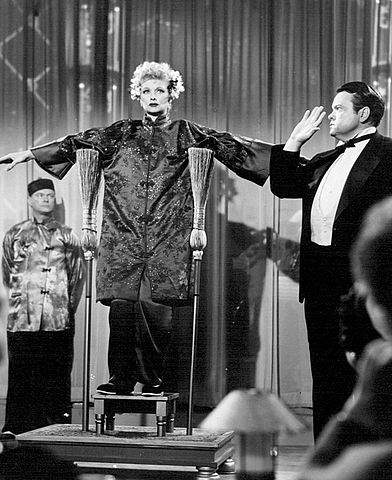
In an era when tricksters come to us on screens rather than stories told around a campfire, we cannot forget Lucille Ball’s role in “I Love Lucy.” The show ran from 1951 to 1957 and was the most watched the American television program during four of those six seasons. It is still in syndication in dozens of countries around the world.

Lucille Ball and Orson Welles.From a 1956 episode. Public domain.

Lucille Ball and Orson Welles.From a 1956 episode. Public domain.

Lucille Ball, with her clowning and physical comedy, set a tone that is still at the core of many sitcoms. Most of the best known women comics who followed cite her as a groundbreaker, an inspiration, a mentor, and often a friend. In terms of our “classic trickster” test, that is what she was, at all times. Never just a funny housewife, Lucy was an outrageous but charming disrupter, whose pioneering humor enlivened the spirits of millions who watched her.

I dare you to get through the chocolate factory scene with a straight face.

Quite a few full episodes of the show are available on YouTube.

Another note on tricksters

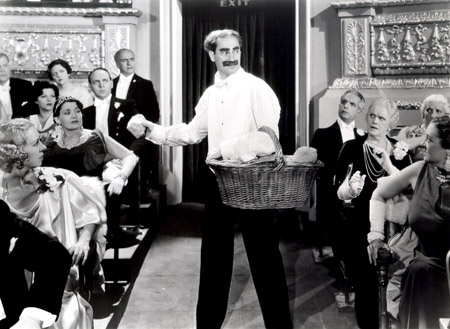
Groucho

I want to argue a paradox…that the origins, liveliness, and durability of cultures require that there be space for figures whose function is to uncover and disrupt the very things that cultures are based on. – Lewis Hyde

It has always made sense to me that the 1920s, 30s and 40s, when times were hard for so many, gave birth to our great movie tricksters: Charlie Chaplin, Laurel and Hardy, The Marx Brothers, and The Three Stooges. Their send ups of the 1%, among other things, are still hilarious. Where are their equivalents today?

My self-imposed moratorium on negative blog themes has passed. As I caught up on news I had kept at arms length, I found myself thinking often of trickster stories. In part because they are funny, and most of the news is not. And partly because the folly of tricksters has a sacred dimension while the folly of our headline makers is often just foolish.  If you invite the Three Stooges to lunch and serve pie, the outcome is fairly certain. I read that the Georgia legislature voted to allow patrons to carry guns into bars; the result is likely to be just as predictable, but without the catharsis of laughter.

stooges pies

In his introduction to Trickster Makes This World (1998), Lewis Hyde emphasized several key points:

1) Tricksters both make and violate boundaries and live in relationship to them. Where there are no boundaries, trickster creates them, as in several Native American creation myths where Coyote makes the land and separates it from the sea. Where there are cultural boundaries, tricksters blur or invert the distinctions: right and wrong, friend or foe, male or female, living or dead.

2) Tricksters are usually on the road, and this makes them outsiders.
Through most of human history, solitary travelers have been rare. Until the last century, most people lived and died close to the area where they were born. Nomadic people travelled as tribes or clans, but Hyde says trickster is “the spirit of the doorway leading out, and of the crossroad at the edge of town. He is the spirit of the road of dusk,” who may pass through city and town but only to “enliven it with his mischief.”
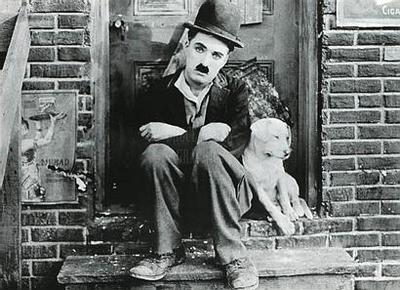
charlie chaplin and dog

Hyde points out that although there is an abundance of clever women who know how to be deceptive in world mythology, they are seldom full-time tricksters. Once the evil is vanquished, the curse lifted, they tend to settle down. Coyote and Loki do not domesticate, and the older cultures who gave us these stories would have had trouble imagining a woman who opted for a solo life on the road.

3) Tricksters are liars and thieves, but they are not petty criminals.
Tricksters steal things like fire and cattle, and according to Hyde, are often honored as creators of civilization. “They are imagined not only to have stolen certain essential goods from heaven and given them to the race but to have gone on and helped shape this world so as to make it a hospitable place for human life.”

We cannot be too doctrinaire about these things, for there is a distinction between “large” stories, like creation myths, and “small” folktales, where trickster sometimes steals cattle for himself. When he does so, however, in tales like “The Little Peasant” from Grimm, it is usually a case of swindling a swindler, or people who are dishonest and greedy to start with.

For obvious reasons, trickster isn’t welcome in corporate boardrooms. Like Robin Hood, he is into redistribution of wealth. He’s the patron of whistle blowers everywhere, and will gladly gum up the machine when it is no longer serving the greater good.

Perhaps that is why we need him now more than ever. We don’t even have to do anything. Hermes travels as fast as thought. For good and for ill, trickster is already here.
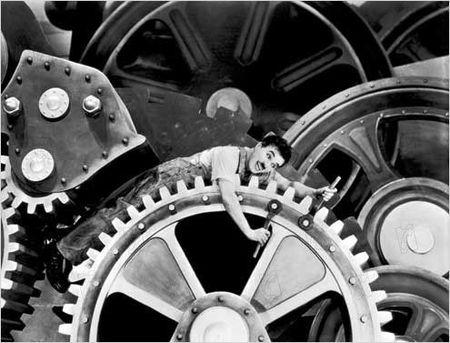

Chaplin modern times

Gabriel García Márquez, 1927-2014

Gabriel Garcia Marquez, 2009. Creative Commons

Gabriel Garcia Marquez, 2009. Creative Commons

“On a day like today, my master William Faulkner said, ‘I decline to accept the end of man’. I would fall unworthy of standing in this place that was his, if I were not fully aware that the colossal tragedy he refused to recognize thirty-two years ago is now, for the first time since the beginning of humanity, nothing more than a simple scientific possibility. Faced with this awesome reality that must have seemed a mere utopia through all of human time, we, the inventors of tales, who will believe anything, feel entitled to believe that it is not yet too late to engage in the creation of the opposite utopia. A new and sweeping utopia of life, where no one will be able to decide for others how they die, where love will prove true and happiness be possible, and where the races condemned to one hundred years of solitude will have, at last and forever, a second opportunity on earth.”

– Gabriel García Márquez, from his Nobel Prize acceptance speech, December 8, 1982

No discouraging words revisited

Embed from Getty Images

In an earlier post, Where seldom is heard a discouraging word, I announced an experiment. Following my wife’s efforts to suspend negative thinking and speech during Lent, I decided to refrain from critical posts through Easter. Here is the first of several observations I will share.

Avoiding negative and pessimistic topics leaves me a lot fewer subjects to blog about! Many of my posts begin with news stories, but often it seems, to paraphrase the old Hee-Haw song, “If it weren’t for bad news, I’d have no news at all.” More nights than not, when I’ve checked my usual source websites (CNN, NPR, USA Today, etc.), I haven’t found a single upbeat or funny or quirky post that I wanted to write about. Sure, there was the girl scout who sold 12,000 boxes of cookies, but even if it’s a good thing for a kid to become a marketing wizard, that isn’t my kind of story.

The real question for me, however, is not the content of this weeks’ or that weeks’ news, but the systemic nature of our news media, which makes trials and tribulations endemic. These are news stories, after all, and a good story demands tension, upping the stakes, and all that. The question is not whether these are gripping stories, but the degree to which they mirror “reality.”

I’m thinking of a book I have often cited here, Neal Gabler’s, Life the Movie: How Entertainment Conquered Reality (2000), in which the author says we are not just a post-modern culture but a “post reality culture.” Gabler locates the beginning of news-as-entertainment in America as “the penny press.” Prior to 1830, newspapers were single page “broadsheets” which appealed to the upper classes. Most of them cost six cents and the average daily circulation in New York City was 1200. Beginning with the Sun, which cost a penny, newspaper sales exploded. Gabler cites various reasons for the success of the penny press, but says that above all, it meshed with other sensational forms of entertainment:

“…for a constituency being conditioned by trashy crime pamphlets, gory novels and overwrought melodramas, news was simply the most exciting, most entertaining content a paper could offer, especially when it was skewed, as it invariably was in the penny press, to the most sensational stories. In fact, one might even say that the masters of the penny press invented the concept of news because it was the best way to sell their papers…”

In it’s first two weeks of publication, in 1835, the New York Herald ran stories that centered on “three suicides, three murders, the death of five persons in a fire, a man accidentally blowing off his head, an execution in France by guillotine and a riot in Philadelphia.” Needless to say, the Herald became wildly successful.

If it’s true that what we think of as “news” is an “invented concept,” we have to ask to what degree it mirrors reality and to what degree it creates it? Think about that the next time you open the paper or check your Tweets.

What I have discovered is how deep the contagion goes, even though I normally limit my sources, never watching the local news on TV, for instance. I confess that while I have cut negative posts from theFirstGates since March 7, I’ve probably doubled the number of depressing subjects I’ve posted on Twitter. In a way, I feel like I did a month after I quit smoking, and found that a nasty cough was still there. This is more serious than I thought at first. I’ll have more to say about it, but meanwhile, let’s change the tone as we end with a classic that came to mind at the start of this post.

Media musings

I find most alliterative titles, like “Media musings,” to be about 40% cute and 60% annoying, but in this case, it’s a good match for the headline that inspired this post: “Ellen’s Oscar ‘selfie’ a landmark media moment.”

“A what moment?” I mused.  “A landmark media what?”

Because the media is falling over itself to celebrate Ellen’s tweet, and because nature abhors a vacuum, it has fallen to me to be the curmudgeonly voice of this “event.”  One of the first things a curmudgeon does is reach for the dictionary.  A “landmark event” is “an event, discovery, etc. considered as a high point or turning point in the history or development of something.” 

At first I thought it must be the high point of product placement.  The picture in question was taken with a Samsung phone, Samsung was a big Oscar sponsor, and the Academy Awards are the biggest post-Super Bowl marketing event.  But that’s not really new news.  Reading on, I realized the article referred to a landmark social media event. Since tweeting about TV isn’t new, an expert, in this case an Oscar co-producer, had to explain it to the likes of me:

“What it’s all about right now is creating a conversation, and social media allows for the conversation as it’s happening.”

Oh thanks, now I understand.

The dogs don’t like me being a curmudgeon, so while I was writing this post, Kit grabbed my (non-Samsung) phone and snapped a selfie, hoping to create a new conversation.

Kit snaps a selfie

Kit snaps a selfie

“It’s all about what’s happening now,” she says, explaining why she wants to establish a social media presence.

So the price I pay for being a curmudgeon is having to ask all you loyal readers to give my dog a tweet (she accepts treats as well).  After all, she is cuter than Ellen’s crew, and she hasn’t been real annoying since puppy days when she chewed up my wife’s phone.  That really happened, but it’s a story for another day, and right now I need to let you log onto your twitter accounts.  Don’t forget – it’s all about right now.

An unplanned television fast

CC BY-NC-ND 2.0

CC BY-NC-ND 2.0

We are a week into a major home reconstruction project that has about 2/3 of our living space sealed off against dust.  Bedroom, study, kitchen, and bath are available.  Internet too, since I carried the modem down to this end of the house.  A little cramped at times, but overall, just fine for a short period of time.

What surprises me is how little I miss TV.  More than that, it’s refreshing in many ways not to have it.  The sound was on at one of the TV’s at the gym and I found it so irritating I moved away.

It hasn’t been a completely video-less week.  One day we ventured out to the cineplex to watch Frozen.  Another evening we viewed an Agatha Christie mystery on youTube (the 13″ screen of my mac was ample).  On Friday, I watched a 20 minute Newshour segment on pbs.org.  And last night, we clambered through the dust curtains, out to the living room where the furniture is clumped, to watch the finale of Downton Abbey.

I’m not going to waste any time with polemics against television.  I enjoy several shows and of course, Turner Classic Movies.  I expect to watch those when the house is back to normal.  But a cautionary story came to mind as I looked for images for this post.

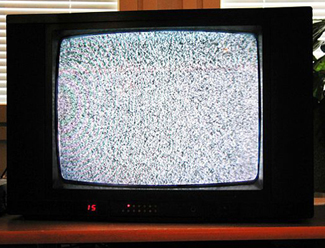
It’s possible some readers may not remember analog TV and the pre-404 no-signal pattern called “snow.”

Snow.  CC BY-NC-ND 2.0

Snow. CC BY-NC-ND 2.0

This always reminds me of Neal Stephenson’s visionary novel, Snow Crash.  Published in 1992, Stephenson envisioned a post-nation state world in which people lived as citizens of corporate territories.  The former United States still excelled at two things, computer micro-code and high speed pizza delivery, the latter because the mafia had taken over the business.

In 1992, the year I first got a windows computer, an 8K modem, and an AOL membership, Stephenson imagined virtual worlds where people created avatars to jack in and interact.  Then someone launched a virus that messed with people’s brains.  Anyone who opened this malware saw a pattern based on ancient glyphs that led to the Tower of Babel.  Viewing these symbols scrambled their neurons, in essence, turning their minds to snow.

What struck me this past week were the parallels to our current media world.  I can’t help thinking of all the ways that commercials, local news, political debates, and most of what passes for entertainment scramble our neurons, though much more slowly and in ways that leave us perfectly able to buy stuff.

I could say more, but this is enough – something to think about.

Remembering Kate Wolf

Lately I’ve been thinking about Kate Wolf (1942-1986), a singer and songwriter from this part of the country who was just beginning to draw national attention when leukemia took her at the age of 44.  Growing up, she listened to Dylan, The Weavers, The Carter Family, and Merle Haggard (1).  Her poetic lyrics celebrated backroads and small towns and her music wove the “high lonesome” sound of bluegrass into landscape of northern California.

Once I loaned a friend one of Kate’s albums.  When she returned it she mentioned that her 10 year old son listened to several songs and said, “Wow, that music is really sad.”  Pothos comes to mind, a Greek word I have used here before, that signifies a restlessness, an unrequited and unrequitable longing for what lies beyond the horizon.  Pothos is the affliction of dreamers and it’s woven as a minor chord through much of this music, even when it seems most concrete:

Here in California fruit hangs heavy on the vines,
But there’s no gold, I thought I’d warn you,
And the hills turn brown in the summertime.
– from “Here in California” by Kate Wolf

In April, 1986, Kate was diagnosed with leukemia.  After chemotherapy, she went into full remission, started work on a retrospective album, and scheduled another tour.  The disease returned in the fall, however, and we lost her on December 10.  Her long time friend and touring partner, Utah Phillips covered the remaining shows she’d booked, including one in Placerville Mary and I had tickets for.

He led the crowd in singing her songs and said something I’ve never forgotten. “At the end of her life, Kate told me she knew why she’d gotten cancer.  She took in people’s pain, the pain of living.  It was the source of her art, but she realized too late that she never learned to let it go.”  Phillips warned everyone to beware of clinging to grief and reminded us of the threads of hope and joy we also find in her music.

Kate’s music has been covered by musicians like Emmy Lou Harris, Nanci Griffith, and Peter Rowan.  You can sample her songs on katewolf.com, a website her family maintains, as well as on iTunes. Once you listen, these songs find a home in your head and heart, for as Kate Wolf put it in “Brother Warrior:”

We are crying for a vision
That all living things can share
And those who care
Are with us everywhere.

The Monuments Men: a movie review

George Clooney;Matt Damon;John Goodman;Bob Balaban

The Monuments Men, based on a 2009 book of the same name by Robert Edsel, tells of a small group of mostly middle aged men who risked their lives to recover thousands of looted works of art from the retreating Nazis in the final days of WWII.

George Clooney co-wrote, directed, and starred in the film.  A Washington Post review suggests why the project mattered to Clooney, saying the movie “continues his long-standing — even heroic — effort to preserve a certain kind of movie in the American filmmaking canon…the classical, even old-fashioned kind of film that, we’re so often depressingly reminded, Hollywood doesn’t make anymore.”

If you’re like me, that means movies that center on story and even dare to depict personal heroism.  Explosions and digital effects, if present, are subordinate elements.

The Monuments Men has not fared well with reviewers.  In an obvious comparison to Saving Private Ryan, another quest/buddy movie set in WWII, The Monument Men lacks tension at many points.  The Post review gives a plausible analysis of the structural cause of a lack of focus in the central part of the movie, that resolves in the ending sequence where the team races to save several key artistic treasures from destruction by the Nazis and capture by the advancing Russian army.

Whatever its flaws, I enjoyed The Monuments Men and recommend it as a good story that poses key questions on the way a people’s art and history is central to their identity, something Hitler knew very well when he tried to erase it from the lands he conquered.