
Something is happening here…

Readers of a certain age will recognize the title of this post as part of the chorus of one of Bob Dylan’s iconic songs of the ’60’s, “Ballad of a Thin Man.”

And something is happening here
But you don’t know what it is
Do you, Mister Jones ?

What brought the song to mind was another simple phrase which seemed to sum up our own time in a similar pithy way.  Strangely enough, it came from a piece on CNN.com called “Why the best thing you can do is fail,” by Eddie Obeng, founder of a virtual business school  http://www.cnn.com/2012/12/30/opinion/obeng-business-disruption-ted/index.html.  Here is the passage that caught my attention:

“What’s happened in business is that the rules of the real 21st century aren’t clear to us, so instead we spend our time responding rationally to a world which we understand and recognize, but which no longer exists.”

We can substitute many other words for “business” and find the phrase rings equally true.  Try it.  “What’s happened in [publishing, school safety, government, warfare, economics, international relations] is that the rules of the real 21st century aren’t clear to us, so instead we spend our time responding to a world which we understand and recognize, but which no longer exists.”

Both the Dylan lyrics and Obeng’s observation put into simple words what we’ve known for some time but could not express so clearly.

One of my favorite words, liminal, stands for times like these, times of uncertainty and change in the life of an individual or a culture.  Webster’s Dictionary defines liminal as: “1 of or at the limen or threshold 2 at a boundary or transitional point between two conditions, stages in a process, ways of life, etc.”

I started a post in December concerning what fairytales have to say about living in liminal times.  Fairytales always happen in times of transition or crisis times.  Your father will die if you don’t find the water of life.  Your stepmother wants to kill you, or you find your new husband is a serial killer.  The king will cut off your head if you fail to capture  the firebird.

Can this be relevant to the 21st century?  I’m convinced that it can.

Right now I’m reveling in one of my Christmas presents, The Annotated Brothers Grimm, a fine new collection published to celebrate the bicentennial of Grimm’s fairytales.

Reading so many stories at the same time raises a number of questions.  What does it take for a character to survive their otherworld challenges?  Sometimes you have to obey a witch, and at other times you need to push her into the oven.  Sometimes not knowing is an asset and sometimes a fatal flaw.  You should listen to animals by the side of the road unless they are wolves and you’re wearing red.

I don’t expect to come up with definite answers, but I do expect to turn up some interesting questions.  This is my immediate plan; after that, I’ll do as I’ve always done on this blog, make things up as I go along.

I very much hope you’ll stay tuned.  And now, I’ll leave you with my wish for a joyous and prosperous 2013, and with a very old clip of Bob Dylan doing “Ballad of a Thin Man” in 1966 in Copenhagen…
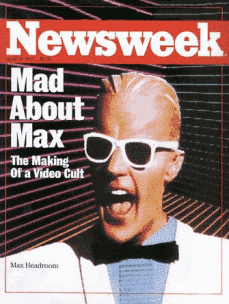
Remembering Max Headroom, a visionary TV show

max headroom newsweek

In 1984 I joined Intel as their graphic workstations  were shrinking from video arcade sized units to large desktop computers. In my spare time, I sometimes played with a Commodore64 and saved quarters for Space Invaders. The first IBM personal computer did not roll out until the following year.

That was the state of technology when Max Headroom was born.  The creation of a British trio, George Stone, Annabel Jankel, and Rocky Morton, Max was an artificially intelligent, disembodied personality who lived in cyberspace before the term was coined.  Computer animation wasn’t advanced enough to portray the computerized look the group was after, so filming Max required a four hour makeup session that actor Matt Frewer described as “a very painful, torturous and disgusting enterprise.”

Rocky Morton described Max as a “very sterile, arrogant, Western personification of the middle-class, male TV host,” but he was also “media-wise and gleefully disrespectful,” which endeared him to younger viewers.

Max appeared on American TV in 1987, as a talking head – literally – in a TV newsroom in a dystopian near-future dominated by large corporations and television.  Although he became a spokesman for “The New Coke,” and appeared on Sesame Street, only 13 shows aired.

Part of the problem was that Max was down right irritating, with his visual and vocal stutter and an op-art background that was the best computer animation could do at the time.  Here is a 3o second sample from his Coke commercial:

The fact remains that Max Headroom was decades ahead of his time. In one episode, for instance, terrorists blow up all TV towers in the city, pushing the population to riot when they find they have nothing to watch. In the nick of time, city officials pacify everyone by distributing hand-held video viewers loaded with old reruns.

Remember, this was 1987, when the best technology Hollywood had to offer wasn’t enough to capture the vision of Max’s creators.

So what brought Max Headroom to mind right now?  Beyond Max’s “dystopian future dominated by large corporation and television” that is.  Why today, December 3, 2012?

Yesterday, after  a series of storms, I ventured out to the supermarket and walked in just as they played the Christmas carol holiday song I hate most, “Little Saint Nick,” by the Beach Boys.  I had to compliment the store, however – the sound was just barely audible.  Not loud enough to cause real annoyance, I thought, but enough to keep silence at bay, which might cause people to riot.

That brought Max to mind.  “Ha-ha-ha-happy Ho-ho-holidays, everyone.”

All quiet on the holiday front

The chief of security at one of the largest area malls reported that this year’s Black Friday was the smoothest in 13 years.  He didn’t speculate on why that was true, so here’s a poll.  Pick whichever explanation(s) seem most plausible:

  1. The population has grown more civil.
  2. More people are shopping online.
  3. After all that’s happened this year, including the election, we’re too numb to respond to the usual holiday trappings.

Yesterday, I thanked the waitress at a local waffle place for the lack of “holiday” music.  “I know,” she said.  “Isn’t it great?  I’m hoping management keeps it up.”

I distinguish between Christmas music, which I enjoy at this time of year, and Holiday music.

People reading this blog in other countries may not be clear on the distinction.  Because of our nation’s diversity, in the public sphere, both at work and in stores, we say “Happy Holiday’s” instead of “Merry Christmas.”  The intent is not to offend people of other faiths.  The result is largely to trivialize the whole thing.  If you’ve ever gotten a song like “Little Saint Nick,” or “Rockin’ Around the Christmas Tree,” stuck in your mind, you know what I mean.

For helping spark the trend toward silence or simply generic music in stores, I present my 2012 Corporate Hero award to Shoppers Drug Mart, a popular Canadian pharmacy chain.  They started playing Holiday music the day after Halloween, but received so many complaints that they pulled the plug “until further notice.”

One comment on their Facebook page read, “Starting this music so early takes the sacredness and meaning out of what should be such a beautiful season.”  That sums up “the Holidays” in their entirety.

Luke’s gospel tells us that after the shepherds saw the baby Jesus, they ran off to Bethlehem to tell everyone, “But Mary treasured up all these things and pondered them in her heart”  Lk 2:19.

Pondering things in our heart is how an event becomes an experience.  It’s how we come to appreciate things, even simple acts like buying a gift or having waffles with a friend.

I never begrudge our merchants the chance to make a living at this time of year, and I appreciate them even more for pulling the plug on noxious music so I can treasure more of these things in my heart.

Remembering an icon

When I was in grade school, the lucky kids had Hostess snack foods in their lunch. I remember one guy who would shove an entire Twinkie into mouth, partly to gross out the girls and partly to gloat over those whose mothers, like mine, packed boring things like carrots and celery.

Once I got to junior high, with its snack bar window, I could indulge, and that was when I made a terrible discovery – Twinkies just weren’t that good.  Oblivious to the dangers of breaking a filling, I generally spent my pocket money on corn nuts instead.  And yet, I will miss Hostess.  Not just because the cupcakes are good, and you gotta love any snack food called “Ding Dongs.”  Not just because the local Hostess bakery will close and thousands of people around the country will lose their jobs.

There’s something endearing about the little gold icon, an image of youth, when there were do-overs in terms of diet and teeth and most other things.  I would also argue that the same font of creativity that brought us Twinkies and Elvis impersonators brought us microchips and iPhones as well.  Say it loud and say it proud:  “Only in America!”

Hostess cared about its customers!  I remember hearing on NPR’s Science Friday that the company conducted experiments to determine how long you could safely nuke a Twinkie.  Seems that many enjoyed warming their Twinkies, but when left in the microwave too long, they would explode.  After careful research, Hostess reported that 60 seconds or less was generally safe.

The reputation of Twinkies was forever tarnished by the notorious “Twinkie defense” used in a sensational murder trial in 1978.  On November 27, disgruntled San Francisco City Supervisor, Dan White, climbed into City Hall through a first floor window, circumventing the newly installed metal detectors.  He carried a pistol and fatally shot Mayor George Moscone and fellow Supervisor, Harvey Milk, the first openly gay man ever elected to California public office.

At the trial, White’s defense attorneys argued diminished capacity resulting from depression and a steady diet of junk food, most notably Twinkies.  In what is widely regarded as a great miscarriage of justice, the jury found White guilty of manslaughter rather than first degree murder.  After serving five years of a seven year sentence, White – “the most hated man in San Francisco history,” according to the Chronicle – committed suicide.

None of this was the fault of Twinkies, and yet the growing awareness surrounding the trial, that sugary snacks, like cigarettes, might not be in our best interests helped doom the little “Golden Sponge Cake with Creamy Filling.”  I gotta confess, I long ago joined the bran muffin crowd.  I munch on carrots voluntarily now.

Twinkies were the brainchild of James A. Dewar of the Continental Baking Company, makers of Wonder Bread and the Hostess line of snack foods.  Machines used to make cream-filled strawberry shortcakes were idle when strawberries were out of season, so in 1933, Dewar used them to make banana cream filled snacks which sold, two for a nickel.  During WWII, when bananas were rationed, Hostess switched to vanilla creme, a move so popular they never went back.

Twinkies popularity grew in the 1950’s when Hostess sponsored the Howdy Doody Show. During the nuclear scare of the ’60’s, Twinkies were stored in bomb shelters, because according to Hostess, they “stay fresh forever.”  If Twinkies are as iconic of my generation as Howdy Doody, it’s also true that now we worry more about preservatives than thermonuclear war.

So long, little guy, and happy trails! Someday, enterprising history students will rediscover you in the course of their doctoral research in 20th century popular culture. They will come to know, as we do, that there are worse ways to meet the challenges of life than with a smile on your face and a golden bread-thing in your hand!

Cloud Atlas: a movie review

Synopsis by author David Mitchell: “An exploration of how the actions of individual lives impact one another in the past, present and future, as one soul is shaped from a killer into a hero, and an act of kindness ripples across centuries to inspire a revolution.”

***

One viewing isn’t sufficient for a comprehensive “review” of a movie like this.  Like Roger Ebert, who called Cloud Atlas “one of the most ambitious films ever made,” I knew before it was half over that I wanted to watch it again.  Different critics have praised and panned the movie.  I want to offer a brief synopsis and weigh in with a solid two thumbs up.

It’s harder to move around in time in movies than in books. Inception 2010, notably altered the linear flow of time, with four levels of dreaming that unfolded simultaneously, yet fundamentally it was structured as a frame-tale.  Scheherazade did the same thing centuries ago in the The Arabian Nights.

British author, David Mitchell tried something more ambitious in his novel, Cloud Atlas 2004.  Six stories take place in different times and places, with implications that past, present, and future interconnect in ways that are too complex for a linear narrative.  For one thing, Mitchell says that the main characters in the different tales that bear an unusual birthmark are reincarnations of the same character.  Somni~451, the clone-turned-visionary in the dystopian future scene voices what I take to be the core theme of the movie:  “Separation is an illusion.  All our lives are interconnected.”

Counter to what I expected, the different stories were not hard to follow.  Anyone interested in fresh ways of imagining novels and movies should not miss Cloud Atlas.  I’m pretty sure you’ll want to see it more than once.

Stories, Dreams, Politics, and Baseball

Yesterday, I struck up a conversation with another San Francisco Giants fan about the possible conflict between the National League Championship Series and Monday’s Presidential Debate.  The Giants are down three games to two.  If they pull off a win tonight, the final game will be Monday.

Later, considering which program I want to watch vs. the one I should watch, I thought of how clear it’s become to me that this election is not about the candidates themselves, but about the visions, or perhaps more accurately, the stories about America they embody.  Most people seem less than thrilled by the candidates themselves, but everyone takes the stories seriously.

A high school history teacher planted the seeds of this understanding decades ago.  At the time of another presidential election, he suggested that most voters are swayed by an image of times past, a story of “the good old days,” which probably never existed.  He argued that the imagination of the conservatives of his day echoed the television show, Bonanza.

The Cartwrights (l-r), Adam, Little Joe, Ben, and Hoss. Public domain.

Ben Cartwright and his three sons carved a fine spread out of the wilderness – they did it on their own, by the sweat of their own brows, thank you very much.  The only hint of government was the Virginia City sheriff, and generally the Cartwrights told him what to do and not vice versa.

In a similar manner, liberals dream of Kennedy’s “Camelot” and its precursor, The New Deal.  For the generation that came of age during The Great Society and the War on Poverty, “less government” is a codeword for Charles Dickens’ London: “Are there no prisions?  Are there no workhouses?”

Scrooge meets Ignorance and Want. Public domain.

And whenever you hear a politician of any persuasion invoke “family values,” you can bet their story embodies the world of Norman Rockwell.  Anyone grow up in a family like this?

Norman Rockwell mural. Public domain, courtesy Oregon Historical County Records Guide.

We’re dealing with powerful stuff here – nothing drives us more than our dreams, which means we need to be careful.  I liked Bonanza and still enjoy Norman Rockwell, but I try not to bring them into the voting booth.  Kids learn how to separate dreams from the world of make-believe:  they know that “I want to be a doctor” is different from “I want to fly like Super-man.”  What kids know, politicians seem to forget.

Tomorrow night, the presidential candidates are scheduled to discuss “foreign policy.”  Webster’s Dictionary defines policy as, “1.  wise, expedient, or prudent conduct or management.  2. a principle, plan, or course of action, as pursued by a government, organization, or individual, etc.

I expect to hear a story that goes like this:  “We are number one and if you want to keep it that way, vote for me.”  I’m not so sure we’ll hear much about policy, aka, “wise, expedient, or prudent conduct or management.”  For that we often have to look to outsiders.

I’ve done precisely that over the last few months, and was startled to find a clear and feasible foreign policy articulated with very similar features from both a liberal and a conservative point of view.  There’s a beautiful story in there too, one involving national renewal through shared effort and dedication.  A dream, to be sure, but it doesn’t require Superman.  This will be the topic of a post in the coming week.

Meanwhile, though I’ll be watching the debate, I’ll have my phone set to the instant scoreboard app.  “The Giants are number one,” is a dream that could happen, but if Superman is listening, we’re not above asking for help!

*** Update, Sunday Night ***

The Giants won, 6-1, so there will be a game 7!

Njal’s Saga: some concluding remarks.

1879 title page in Swedish. Public domain

It took me a while to get the gist of  Njal’s Saga. The first time through, I could have used a Cast of Characters; much of the effort was just keeping track of people whose names I couldn’t pronounce.  In rereading key sections aloud with the group in Iceland – the mode of presentation the author intended – the drama and human passion began to emerge.  And as I read these passages again while writing posts for this blog, a larger picture appeared.

Njal’s story is framed by the end of an era.  The best minds of the time made wrong decisions and couldn’t hold back the tides that swept outworn institutions away.  The suffering was intense and the body count was high.  “Things fall apart, the center cannot hold,” said Yeats at a similar time.

As I read of the battle at Thingvellir, a moment of near civil war, I kept thinking of similar periods.  Of the fall of Troy, the Mahabharata war, the end of the Roman Empire, and the “great war” in Europe.  And I thought of our own time, that Andrew Bacevich likens to the period of the Peloponnesian War, when the Athenian empire bled itself dry.  We know our current mode of living cannot be sustained.  We know that our leaders don’t have the wisdom the times demand, and like Matthew Arnold, we find ourselves, “Wandering between two worlds, one dead the other powerless to be born.”

Does Njal’s Saga offer any insight for times like these?

Not directly, for simple platitudes would be of no help.  It does offer up a number of vivid characters, some of whom manifest courage and generosity in the face of disaster, and others whose self-centered designs bring the disasters about.  We can’t help but ask ourselves who we want to emulate.  And something very interesting happens at the end of the tale.

By the end of the saga, Kari, who survived the killing of Njal, and Flosi, the chieftan who led the killers, have hunted and fought each other across Iceland, Scotland, and Ireland.  Both crossed Europe on foot to seek absolution in Rome.

Flosi returns to Iceland first.  Kari’s ship is wrecked on the coast in a winter storm, though his crew survives.  They wash up near Flosi’s homestead, and make their way there during a blizzard.  When they arrive, the saga tells us Flosi recognized Kari at once and “jumped up to meet him and kissed him, and then placed him in the high seat by his side.  He invited Kari to stay there for the winter.  Kari accepted.  They made a full reconciliation.  Flosi gave Kari the hand of his brother’s daughter, Hildigunn.”

The next summer, Flosi set out for Norway in a ship in bad condition, that he said was “good enough for an old man doomed to die.”  The ship was never seen again.  Kari named one of his sons, Flosi, and this Flosi’s son grew up to be “the most distinguished man of that line.”

Marriages like this, in folklore and myth, are never one dimensional affairs – a sacred marriage also takes place that brings new life to our broken world.  The Pandava line survives the Mahabharata war, and Aeneas leads the survivors out of Troy.  Monks on the coast of Ireland preserve the wisdom of Rome, and poppies grow in Flanders field.

The sacred marriage in alchemy. Public domain.

For the rest of us, who won’t see a new dawn anytime soon, we can remember the words of Tolkien, who was inspired by the sagas of Iceland as he wove his own account of surviving Mordor, a hell he experienced first-hand at the Battle of the Somme.

“I wish it need not have happened in my time,” Frodo tells Gandalf.

“So do I,” said Gandalf, “and so do all who live to see such times.  But that is not for them to decide.  All we have to decide is what to do with the times we are given.”

Two hundred years of The Brothers Grimm

Statue of The Brother’s Grimm, Hanau Germany, by Syrius Eberle, 1895-96. CC-by-SA-3.0

In honor of the bicentennial of Children’s Household Tales (1812) by the Brothers Grimm, the University of Florida presents Grimmfest this month and next.  The university is home to the Baldwin Collection of Historical Children’s Literature, which features 2500 digitized children’s texts and a virtual exhibition of 19th century children’s book covers.

The Grimmfest page, http://www.clas.ufl.edu/cclc/fairy-tales.html, has links to other fairytale resources, including related contemporary books and movies.

Grimm’s Fairy Tales, 1865 cover. Public domain.

“Traditional fairy tales have their roots in our oldest stories, in myths and legends, in those primal tales that were formed when human beings first began to speak…However we may wish to define fairy tales, they remain an inescapable part of our psyches and our cultures.  They are why we celebrate the underdog, and secretly acknowledge “The Ugly Duckling” as our own autobiography.  Through their flights of fantasy, fairy tales set us free to seek our happiness, to follow our bliss — if only for the few minutes we are enfolded in a particular tale.”

This is a marvelous resource for anyone wishing to delve into the roots of the stories we love.