The Day of the Locust at Walmart

Nathanael West (1903-1940), author of “The Day of the Locust.”

USA Today reported that Friday, in a Detroit area Walmart, a woman with a concealed carry permit pulled a gun after two other women started pulling her 20 year old daughter’s hair in scuffle over the last available notebook in a back-to-school-sale.

The gun brought this to national attention, but after I got the snide comment about “well ordered militias” out of my system, I sat with the underlying question, far more mundane and depressing at the same time: why does violence over a notebook come as no surprise in our nation today?

I thought of Nathanael West , a little known author during his lifetime, who worked as a screenwriter on hack movies in Hollywood, and wrote four novels, filled with biting social satire. His friend, the poet, W.H. Auden coined the phrase, “West’s Disease,” for the angst that comes from realizing the spiritual and economic poverty of much of what passes for “the American Dream.” Continue reading

The Summer of Love, Repression, and Stuff.

USA. Washington DC. Seventeen year old Jan Rose Kasmir, confronts the National Guard outside the Pentagon during the 1967 anti-Vietnam march. This march helped to turn public opinion against the war in Vietnam.

Dissatisfaction with the status quo gave birth to our nation, and has been part of our heritage every since. Fifty years ago this summer, this undercurrent burst into the loud and colorful limelight as 100,000 people gathered in San Francisco’s Haight Ashbury with mottos like Timothy Leary’s, “Tune in, turn on, drop out.”

I was a high school kid in San Jose, wearing torn jeans and love beads, reading the literature of discontent by authors such as Thoreau, Sinclair Lewis, and Nathanial West. After Saturday excursions to the head shops on Haight Street, with their incense and posters of Lakshmi and Ganesh, I bought a copy Zen Mind, Beginner’s Mind, a book I still have, and one which, fifty years later, I more or less understand, because doing so became one of the core priorities of my life.

“We are all outlaws in the eyes of America,” sang Grace Slick, and in the explosion of new music, art, literature, and the ideas of change embodied in The Whole Earth Catalog, there was a sense of expansion, a sense that we could stop the war, and we could leave the world of ticky-tacky houses, and create a nation where Peace and Freedom would reign as supreme values.

We didn’t understand our own shadows. We didn’t knew that Charles Manson was roaming the Haight during the summer of ’67, winning friends and influencing people with techniques he had learned from Dale Carnegie’s book, which he studied in prison. We didn’t know that “Do your own thing” was a double-edged sword, and that we would see bitter fruits of that motto fifty summers later.

*****

When I turned 40 in 1990, I was halfway through a Masters program in Psychology, which I’d entered in part because in the wake of the Summer of Love, I’d discovered Jung, Joseph Campbell, and Tolkien, and I couldn’t get enough of that stuff. And also because, the ethos of “Sex, drugs, and rock ‘n roll” doesn’t really work very well.

Yet when in that course of study, we came to look at the psyche’s defense mechanisms, most of us thought repression was a bad thing, inhibiting self-expression and individuation. I gotta do my own thing, man!

“Don’t be so fast to put down repression” said the instructor. “It’s one of the glues that holds a culture together.”

I’ve thought of this statement many times since then, never more so than when I read a woman’s letter to the editor in the local paper sometime in the mid-nineties, reporting on an incident she’d seen at a local multiplex. For whatever reason, no one was behind the concession counter, so some of the patrons clambered over the counter, help themselves to popcorn and drinks and then dash into the theaters.

That’s not quite what we meant by “Do Your Own Thing,” but it’s a pretty telling, canary-in-the-coal-mine kind of snapshot of the kind of societal breakdown parading through our streets this summer.

One of the four major functions of a living myth, according to Joseph Campbell, is “the sociological function,” which teaches us the norms of living together. “Thou shalt not kill,” for instance. Other roles are more dicey – gender and class roles for instance. These get rigid as times change, and are then modified by pioneers or movements, or in extreme cases, by revolutions if leaders are really stupid and tell their starving masses to eat cake.

Perhaps with enough acts of popcorn theft, large and small, because we feel entitled and we want what we want and we want it now – perhaps the kind of president we have was inevitable. Sooner or later, just as inevitably, he’ll go.

What will we do then? Will we be sickened enough by current events to turn in another direction together? What does a culture do when it’s fragmented by so many contradictory stories that Campbell’s sociological function of myth has completely broken down? What will it take to restore a genuine sense of “us” in our national life, a sense that we’re all in this together? The most obvious and frightening answer is a shared disaster.

Ironic to realize that the youthful idealism that brought us the Summer of Love, and two years later, the high water mark at Woodstock, carried the seeds of its own demise, partly because of the self-righteous sense of “us and them” that still drives our national life. And yet, it is profoundly valuable to review those youthful ideals, that sense of a better world within reach. Without such dreams, we are left with little better to do than rail at each other on social media.

“It’s been a long time coming,” sang Crosby, Stills, and Nash. “It’s going to be a long time gone.” It will come around again, sooner or later, but the question is, how long a time will that be?

Happy Fourth of July

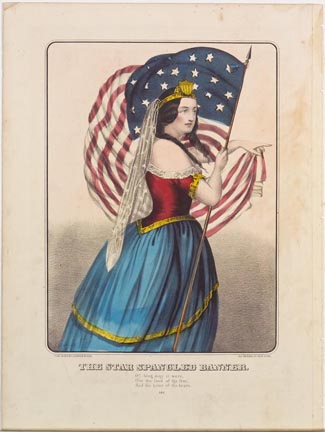
The Star Spangled Banner, Currier and Ives, undated.

In a recent NPR/PBS/Marist poll, only 77% of Americans correctly identified Great Britain as the country we declared independence from on July 4. Fewer (70%) knew that we did so in 1776.

Aside from what that says about our “informed electorate,” it’s a shame because history, in all it’s messy complexity, becomes more fascinating to me as time goes on.

I was not that interested in colonial American history until I came upon Benson Bobrick’s superb history of the revolution, Angel In the Whirlwind, 2011. In contrast to the present, Bobrick notes that colonial citizenry was generally well informed on matters of politics.

Lest we grow nostalgic for such “good old days,” when (white) men were men, and nobody else had any rights, we can look at another fascinating history, Drinking in America: Our Secret History, by Susan Cheever. We learn that the “shot heard round the world” in 1775 may have been fired by a farmer who was three sheets to the wind. The “minute men” had gathered at 5:30 that morning, at the tavern on Concord green, and by the time the British arrived more than four hours later, they had downed a fair amount of ale.

In a related tidbit, Bobrick says the original duty of congressional pages was to keep the beer steins of our legislators filled. Since reading that, I’ve wondered how many brewskis John Hancock had downed when he famously said, “I’ll sign my name so large that King George will be able to read it without his spectacles.”

This Fourth of July finds most us, I suspect, without the stomach for the usual flag waving piety. Piety is a siren song that traps us into believing our own PR and turning away from difficult questions, and nothing else will serve in times like these. For individuals, tribes, political parties, and nations, there are times when things fall apart. Such crossroad periods end with movement, either toward renewal or destruction, and a key determining factor seems to be a willingness to search for and accept the truth.

This is a time to ponder the words of truth-tellers. I’ve been thinking about this week’s buzzword, “civility,” and realizing that it’s much more than being “nice” or “polite” or “politically correct.” It’s nothing less than a pre-requisite for hearing the truth.

Buried in the paper on September 12, 2001, was a statement by Zen master, Thich Nhat Hahn, a champion of peace and the truth in the world for more than five decades. In the wake of the terrorist attacks, he said, “We will not have peace with the people who did this until we are willing to sit down and ask them why they hate us so much.” After nearly 16 years of constant warfare, with no victory or exit strategy in sight, it is worth remembering his words. As none of our leaders show an inclination to do so, guess what the future holds in store?

Seeds for the divisions that are tearing our nation apart were planted even before our current middle eastern wars, though I think they’re related. Another truth teller, Jimmy Carter told us in 1979 where American Greatness lies and what can destroy it:

“In a nation that was proud of hard work, strong families, close-knit communities and our faith in God…too many of us now tend to worship self-indulgence and consumption.  Human identity is no longer defined by what one does, but by what one owns.  But we’ve…learned that piling up material goods cannot fill the emptiness of lives which have no confidence or purpose.”

Unless we as individuals and as a nation, including our elected leaders and their moneyed overlords, are willing to sit down and really listen to each other, things will get more and more dysfunctional. It feels like a worldwide transition is underway, and an unsustainable way of life is ending. Historically, such endings and new beginnings occur at times of disaster, war, pestilence. Are such hard landings inevitable?

I like to think not. I like to think that if enough of our leaders had the wisdom and genuine faith of Jimmy Carter and Thich Nhat Hahn, we as people of America and earth, could steer toward a new course, healthier for the the planet and all its creatures.

I’m not optimistic. With our opportunistic leaders, in a nation where a quarter of us don’t know who we fought in our revolution, I’m afraid it will take more disasters to chasten us enough for any kind of concerted, positive action.

So Happy Fourth of July!  Enjoy the day and your family. Have another hotdog or slice of apple pie. I fear that before long we may look back on these as the “good old days,” and remember how good we had it on July 4, 2017…

Truth will out, murder will out – The Two Sisters

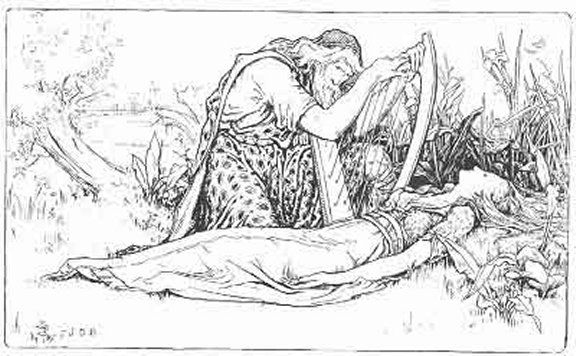
“Binnoire,” by John D. Batten, for “English Fairy Tales,” 1898

Our theme, over the next few posts, is folklore and ballads that feature the theme of, “truth will out,”  We begin with a popular Childe Ballad, “The Two Sisters,” that has been covered, under various names, by Bob Dylan, Jerry Garcia, Pentangle, Tom Waits, Loreena McKinnett, Clannad, Steeleye Span, Gillian Welch, and others.

“The Twa Sisters,” Childe ballad #10, was published as a broadside in Northumbria in 1656. A girl is drowned by her sister over love of the same man. Finding her body, a minstrel makes a harp of her breastbone and golden hair that will only play the tale of the murder. The theme is echoed in Swedish, Norwegian, and Icelandic ballads. There are 21 variants in the British isles, with names that include, “The Miller and the King’s Daughter,” “Binnoire,” “The Cruel Sister,” “The Wind and Rain,” “The Dreadful Wind and Rain,” and “The Bonny Swans.” (1)

Here’s my favorite version, from Jerry Garcia and Dave Grisman at the Warfield Theater in 1992:

From: The Twa Sisters,” Childe Ballads #10C

10C.22 He made a harp of her breast-bone,
Whose sounds would melt a heart of stone.
10C.23 The strings he framed of her yellow hair,
Whose notes made sad the listening ear.
10C.24 He brought it to her father’s hall,
And there was the court assembled all.
10C.25 He laid this harp upon a stone,
And straight it began to play alone.
10C.26 ‘O yonder sits my father, the king,
And yonder sits my mother, the queen.
10C.27 ‘And yonder stands my brother Hugh,
And by him my William, sweet and true.’
10C.28 But the last tune that the harp playd then,
Was ‘Woe to my sister, false Helen!

*****

In the east, we have the concept of karma. In the west we have a comforting theme in folklore, that behind even the most dire events and appearances, there’s a harmony, a natural order that tries to assert itself, the way our bodies, if conditions are right, will push out infection.

Now that our body politic is infected by an American president who would destroy the basic concept of Truth and Fact for his own ends, I find it refreshing to dwell on such tales. Weeds break through concrete. In the end, truth will break through lies and corruption.

No Is Not Enough

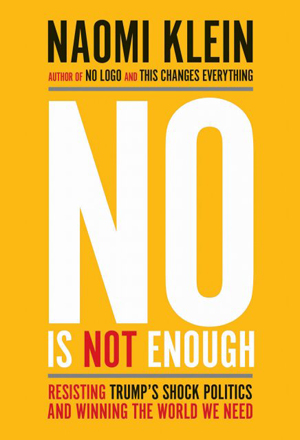
Klein’s new book, “No is Not Enough,” will be released on June 13. http://www.naomiklein.org/main

James Hillman (1926-2011), who I regard as a mentor, always sought the fantasy, the imagination that underlies the literalism of what we take as facts. Quoting Jung, he said, “The psyche creates reality,” (Revisioning Psychology).

The Buddhist teachers I’ve met would agree. Here is an important discussion of some of the fantasies which underlie our current climate crisis, from an interview with Naomi Klein called “Capitalism versus Climate,” which appeared in the Fall, 2015 issue of Tricycle, The Buddhist Review.

Klein (b. 1970) is a Canadian author, climate activist, and critic of global capitalism who looks underneath the current climate debate. She was invited to the Vatican to give input during the formulation of the Pope’s encyclical on climate change.

In the Tricycle interview, Klein traced our current crisis to the western view of nature as an inert resource to be exploited for human convenience and profit, an outlook that emerged from the confluence of the Age of Reason and the first wave of industrialism. Climate change ultimately results from a false narrative, says Klein:

“It turns out that all this time that we were telling ourselves we were in charge, we were burning fossil fuels and greenhouse gases that were accumulating in the atmosphere. So now comes the earth’s response of climate change, which is a delayed response but a ferocious one that, frankly, puts us in our place. The response is this: ‘You’re just a guest here, and you never were in charge.’”

The vicious cycle that results from our sense of separation creates an insatiable hunger that can never be filled. We see it daily in our headlines. “Part of what fuels manic consumption is the desire to fill gaps in our lives that emerge because of severed connections of various kinds—with community, with one another, and also with the natural world.”

What can turn things around? Only a major shift in values and worldview, says Klein. Climate change is “already a moral catastrophe. We’re already writing off island nations because their GDP isn’t big enough. We’re already basically saying, Sub-Saharan Africa can burn.

Within that sacrifice zone mentality, it’s really easy to imagine the fortressing of our borders. Easy to imagine how our nations will seal themselves off from climate refugees. Climate change is not just about being afraid of sea levels rising. It’s not just about the weather. It’s about how an economic system that glorifies individualism—and one that is based on an often unstated but very real hierarchy of humanity—will respond to heavy weather. And it’s that cocktail that scares me.”

At the same time Klein says she’s hopeful:  “What powerful forces fear most is not what we do as individuals, like changing our lightbulbs or going vegan. They fear what we do when we act together as organized and mobilized groups. As groups we can go after the legitimacy of their profits. This is what the student-led fossil fuel divestment movement is doing, and it has these companies pretty panicked. They care when we come together to block their pipelines. They care when we demand that our governments build the infrastructure that will get us to 100 percent renewable energy.”

Naomi Klein

I’ve already pre-ordered her new book, No Is Not Enough: Resisting Trump’s Shock Politics and Winning the World We Need.

I’ve also added Naomi Klein’s website to the FirstGate blogroll – her’s is a voice we need to hear at a time when the ruling party of the United States offers only a steady diet of lies.

Signs of difficult times

March for Science, Sacramento, CA, April 22, 2017

It’s clear that a war for the soul of the nation is underway. The March for Science on Saturday reminded us that the stakes are even higher than that. I snapped this photo because I liked the right-hand sign, “Science – Because you can’t just make shit up.” Only later did I notice the sign to the left – “All Life on the Planet is Counting on US.”

That evening, I noticed a Denver Post article: junior Trump is off to Montana to help a GOP special election candidate by joining him in a prairie dog hunt. Greg Gianforte, the congressional candidate said, “What can be more fun than to spend an afternoon shooting the little rodents?” Apparently, real men think it’s fun to kill the animals during the season when the females nurse their young.

Prairie dogs are considered “agricultural pests,” and ranchers kill them because they damage crops. They are, however, listed as “a species of concern” by the Montana Department of Fish, Wildlife and Parks because their numbers are in decline.

The Humane Society of the United States has condemned the hunt, noting that prairies dogs are a key species in the ecology of the great plains, and “more than 100 other animals depend on the prairie dog as food or move into the burrows they dig.”

In response to HSUS concerns, congressional-hopeful, Gianforte says, “Clearly they’ve never shot a prairie dog. They don’t know how much fun it is.”

Think about that. Think about Gandhi’s words, “The greatness of a nation and its moral progress can be judged by the way its animals are treated.”

Gianforte’s opponent in the May 25 special election is Rob Quist, a popular musician. Who would you rather have in congress – who is more likely to move our country to greatness – a creative artist or someone who thinks killing small creatures is fun?

There are likely to be opportunities for online contributions to Quist’s campaign as the election approaches. I plan to give as much as I can.

The current president and all of his minions and congressional lapdogs represent the greatest threat to the physical, spiritual, and ecological health of this nation of my lifetime. Nothing is more important than resisting their agenda as vigorously as possible and removing them from office as soon as we can.

Notes on Truth

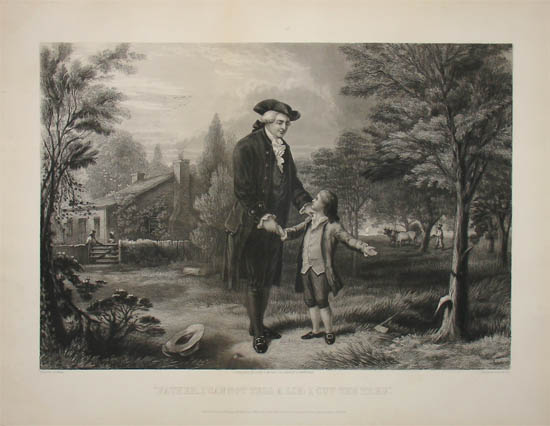
George Washington and the cherry tree

One time when I was four or five and caught in a lie, my parents admonished me with the story of George Washington and the cherry tree. I do not know if they thought the event really happened. I suspect they did, although historians have long known the story was invented by Washington biographer, Mason Weems.

Such stories are part of the fabric of the myth of American exceptionalism, and here I use the word “myth” as Joseph Campbell did. One of the four main functions of myth for Campbell was the sociological view,”supporting and validating a certain social order.” At their best, such myths can inspire us to greatness.

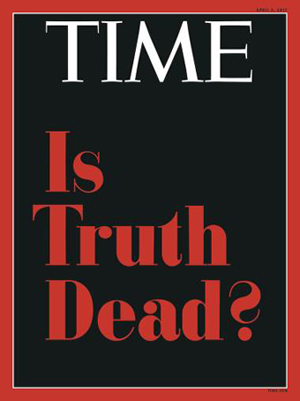
Many sociological fictions are not benign, which motivated Time Magazine’s current cover, and its cover story, “Can Trump Handle the Truth,” by Michael Scherer (Time, Apr. 3, 2017, pp 33-39).

Scherer says, “Trump has discovered something about epistemology in the 21st century. The truth may be real, but falsehood often works better.”

Except when it doesn’t…

As a sometimes writer of fiction, I remember a news report from the seventies, when “The Six Million Dollar Man” was a popular TV series. A five or six year old boy jumped off the roof of his home, believing that if he sustained serious injuries, he’d receive bionic limbs and implants like Colonel Steve Austin (Lee Majors) in the series. The news report said the boy was in traction, but expected to make a full recovery. He discovered something our president and many politicians have yet to learn – that physical reality enforces it’s own truths.

The most important truths of life, truths of the spirit and truths of the heart, are non-material and non-visible, yet to enjoy them, we need to survive, and this involves understanding the truths and laws of a material universe:

If we jump off a roof, we’ll get hurt, and no one will spend six-million dollars to make us bionic.

Oil pipelines leak, and oil trains sometimes explode. Climate change is not a Chinese hoax. The US just killed at least 112 civilians in airstrikes in Mosul.

The man who used the “birther” lie to launch his career in politics does indeed seem incapable of appreciating the truth, and as a result, is propelling this nation, at breakneck speed, into the very “loss of greatness,” he promised to turn around.

Notes from 2017 – Infrastructure

Infrastructure: in·fra·struc·ture – ˈinfrəˌstrək(t)SHər/ French noun
the basic physical and organizational structures and facilities (e.g., buildings, roads, and power supplies) needed for the operation of a society or enterprise.

This phrase comes dramatically to mind with the spillway failure at the Oroville dam, 100 miles north of here, which resulted yesterday in the evacuation of almost 200,000 downstream residents.

I lived near the dam in the ’80’s, so I followed #OrovilleDam on social media. Most of the messages were touching offers of places to stay for evacuees, tweets about open gas stations, and so on. As you would expect in today’s climate, some tried to politicize the event. A few moron messages blamed the crisis on illegal immigrants and were not worth reading, but one message caught my attention.

The San Jose Mercury News reports that in 2005, environmental organizations including the Sierra Club, warned federal and state officials that the emergency spillway was “fragile,” needed to be reinforced. That sounded like negligence, but putting this news in perspective on a PBS Newshour report, is Jeffery Mount, senior fellow with the California Public Policy Institute.

According to Mount, the request was reviewed, but finally rejected in a cost vs. probabilities decision. The benefit of coating the hillside in concrete seemed too costly for an event that was not expected to happen, and in fact happened this year for the first time in the 50 year history of the dam.

The issue now will be for reservoir engineers to review what we know of climate studies, which suggest that future storms will be more frequent and more intense than in the past.

Which brings us to the issue of infrastructure…

The Oroville dam, the tallest in California, was built in 1968, in a decade that saw America build it’s interstate highway system, open dozens of affordable public colleges, build dams, and bridges throughout the country, and put a man on the moon.

One of the ways we did this was with a 70% tax rate on the wealthiest 1%.  Nowadays, 70% is the percentage of US bridges with serious structural flaws. Since 2001 we’ve cut taxes on the wealthy and waged constant unfunded wars.  This is what our national infrastructure looks like:

Broken concrete, which makes the main spillway unusable.

Broken concrete, which makes the main spillway unusable.

If we continue down this same road, the Oroville dam and evacuations will be our future.

The new president backed off his campaign promise for an infrastructure program after learning how much it would actually cost. So much that it would behoove his fans to ask him to pay his taxes again. And forget about the Mexican wall PR stunt.

A few people, modeling their communication style on the new president tweeted that the damn failure at least would “wash the liberals away.” Aside from the blatantly cruel sentiment when thousands of people could loose their homes when the rains return on Wednesday, these morons failed to realize that the counties affected were red – they voted for Trump.

Look at the broken dam – it’s not a party issue. Is there’s an aged dam or bridge or a risky overpass near you? Wouldn’t you like it addressed? Wouldn’t you for once like to see leaders of both parties consider what is truly good for “the American people?”

Might be time to let them know how you feel…

oroville-dam