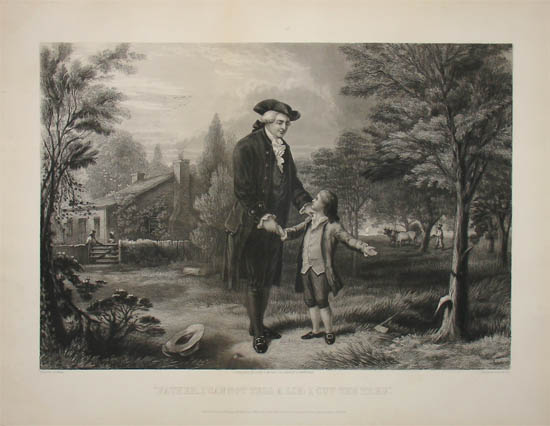
The story goes that George Washington received a hatchet for his sixth birthday. With it, he damaged a cherry tree. When his father confronted him, young George said, “I cannot tell a lie. I cut it with my hatchet.” His father embraced him and said, “Your honesty is worth a thousand trees.”
Ironically, this paean to honesty was the fabrication of Mason Weems, an itinerant preacher and one of Washington’s first biographers (the cherry tree myth). Politically expedient falsehood has been with us from the dawn of our Republic.
Readers of theFirstGates and movie buffs will recognize the other part of this post’s title as a partial paraphrase of the Jack Nicholson line, “You can’t handle the truth,” in A Few Good Men, 1992, which I referenced through a link on August 8.
It came to mind last night as I watched Nixon, the third PBS documentary on American presidents I’ve seen this week. It’s a fascinating series for those interested in history, and especially during this disheartening election year. The truth I find hardest to handle is that even the pretense of truth has become optional during elections.
After his discharge from the navy after WWII, Richard Nixon ran for congress against five-term Democratic representative, Jerry Voorhis. Nixon won 60% of the vote, after, among other things, spreading the word, via anonymous telephone calls, that Voorhis was a communist.
“Of course I knew Jerry Voorhis wasn’t a communist,”Nixon later confided to a Voorhis aide. “But I had to win. The important thing is to win.” I was actually happy to learn that the lies that permeate this campaign are not a new aberration, but more a case of deja vu all over again. The only difference is that in earlier times, people caught in blatant lies were certain to lose – the appearance of honesty was a matter of style and decorum.
Political lies cross party lines, of course. Feeling compelled to be as “tough on communism” as Barry Goldwater in the 1964 election, Lyndon Johnson engineered the Gulf of Tonkin “incident” – a supposed torpedo attack on a US destroyer by North Vietnamese ships. We now know the event never happened, but the lie won Johnson almost unlimited power to escalate the war in Vietnam, with tragic consequences for millions of people. It also set the precedent for fighting undeclared wars that remains a national disaster 50 years later.
*****
I remember a hatchet incident when I was a kid in upstate New York. A boy who lived nearby chopped down a neighbor’s dogwood sapling with a hatchet. This was an especially serious act of vandalism, since dogwood trees were protected by law.
Not the brightest kid on the block, he did so while the lady of the house was home; she heard the chopping, looked out the window, and recognized him. When confronted, however, the boy’s mother said, “It couldn’t have been my son. He told me he didn’t do it, and he doesn’t lie.”
I’ve often wondered if that kid is in politics now. He’d be a natural…
Our Public Broadcasting System is re-running a series on recent American presidents, first aired in 2013. I missed it then, but caught the second episode of “Kennedy” last night (you can watch the entire program here).
The show was excellent. It outlined several glaring failures of the Kennedy administration: the disastrous Bay of Pigs invasion; JFK’s failure to back the emerging civil rights movement; starting us down the slippery slope in Vietnam through mistaking a nationalist revolution for a global communist conspiracy.
Successes included staring down Khrushchev in the high-stakes Cuban missile crisis, and motivating the nation to put a man on the moon, which led directly to the high tech boom, and the laptop or smartphone on which you are reading this post.
Successes and failures aside, the most striking thing I noticed in watching “Kennedy” was that he looked and acted presidential in a way that current presidents do not! Somewhere along the way, the stature and dignity of the office has been diminished.
It’s not that the presidents of my youth were exemplary human beings: Kennedy and Johnson were notorious philanderers, and Nixon was an angry alcoholic, who sometimes gave orders to “bomb the shit” out of countries that annoyed him (see Drinking in America). It’s silly to imagine that those who aspire to the office have changed that much in 50 years. It’s rather that the regard we hold for office has diminished.
True, some people exude charisma, or in Johnson’s case, power. It’s also true that an aura often aura celebrities who die young – Kennedy, Marylin, Elvis, Princess Di, and Prince.
I’m tempted to quote what mythologists like Joseph Campbell and Robert Bly have said about the deflation of the archetypes of king and queen, but I think the answer is far simpler, staring us in the face, in our voracious need to pull presidents down to our level, and their willingness to cooperate.
At the start of the primary season, this year’s crop of contenders gathered in mass for the Iowa State Fair, and one reporter detailed which candidates were truly “just folks,” as opposed to wannabe’s, based on whether or not they knew how to eat ribs.
The cover story on the August 1 issue of Time was, “In Search of Hillary?” What exactly are we searching for? “Likes poetry, puppies and moonlight walks on the beach?”
I remember Cokie Roberts describing a meeting where Lyndon Johnson got angry and chewed someone out. “It took five years off my life,” she said, while noting that recent presidents, wielding the same power, do not command anywhere near that respect. It’s hard to imagine LBJ on Saturday Night Live or with Stephen Colbert, and during this election year especially, I’m not sure that trade of respect for laughter and buddy vibes has been a good deal for anyone.
Whether the loss of respect moves top-down, or bottom-up, or both, when presidential debates begin to look like the Jerry Springer show, and the rest of us behave accordingly, we’re in a world of trouble!
War reporter, Sebastian Junger, author of, Tribe: On Homecoming and Belonging, outlined one consequence for us in a PBS interview.
A war reporter, Junger was with troops during “hellish deployments,” but noted that some of the soldiers did not want to go home. Junger says that for most of our history, we humans have lived and thrived most in tribes or clans and, “The real an ancient meaning of tribe is the community that you live in that you share resources with that you would risk your life to defend.”
Only at war did many of the young men that Junger met experience this kind of connection. The lack of it, in our culture, is deadly in his opinion. Looking at our current election season, Junger says we look like opposing tribes, that hold each other in contempt.
“No soldier in a trench in a platoon in combat would have contempt for their trench mate. They might not like them. They disagree with them, but you don’t have contempt for someone that your life depends on. And that’s what we’re falling into in the political dialogue in this country. And in my opinion, that is more dangerous to this country than ISIS is, I mean literally like more of a threat to our nation.”
“I wish I had a tribe,” Junger says, “But we don’t. We just don’t. That’s the problem. That’s why our depression rate, our suicide rate, all that stuff is through the roof. That’s the tragedy of modern society.”
I remember watching Kennedy on TV as a kid. I remember walking to grade school in 1962, past a neighbor who was digging a bomb shelter. I remember “duck and cover” hydrogen bomb drills, which we all knew were ludicrous even then. But through all the fear, what I really remember, was growing up in a neighborhood, in “one nation” as we said during the pledge of allegiance.
I don’t know anyone who lives in a neighborhood or one nation anymore. Perhaps that realization is what makes this election so sad – an election like this couldn’t happen if values like “community,” and “nation,” to say nothing of “tribe,” weren’t so completely fractured.
I have some notions of what happened, but that is for another post. And as they say, we cannot even begin to imagine solutions for a problem until we admit that it exists and what it costs.
Cemetery at Poziers, France, in the Somme River Valley
“I’ve never met a grandson of someone who fought on the Somme, or a granddaughter, who hasn’t said to me, ‘My grandfather never recovered.'” – Sir Martin Gilbert, historian.
One hundred years ago this morning, at 7:30am in northern France, 150,000 British, Canadian, Australian, and French troops went “over the top” to attack German trenches along a 40 km. front in the Somme river valley. Six months in planning, the assault was designed to break through the German lines and end the war in the west.
When the battle ended four and a half months later, more than a million men on both sides lay dead or wounded. British and French troops had gained just six miles of mud, strewn with corpses, many of which had lain unburied for months.
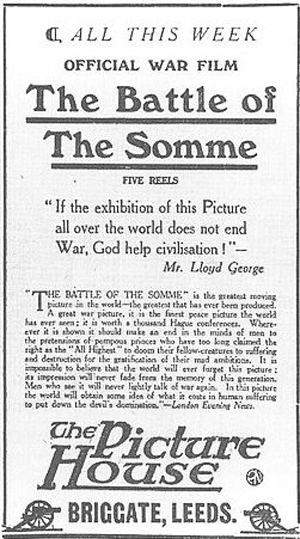
“The most gigantic, tenacious, grim, futile and bloody fight ever waged in the history of war.” – Lloyd George, on the Battle of the Somme.
When the first day’s casualty reports – 19,240 dead and 38,230 wounded – reached British headquarters, the high command assumed the figures to be mistaken; the battle plans, in the making for six months, were foolproof – they couldn’t go that wrong! The generals ordered the attacks to continue.
British Field Marshal Douglas Haig had launched a massive artillery barrage through the week before the assault to destroy the German trenches, not realizing that during the months of stalemate, the Kaiser’s troops had worked tirelessly on their fortifications. Some trenches were 30 feet deep in the chalky ground, reinforced with concrete and steel, with electric lighting, running water, and ventilation. An estimated third of the British shells fired were duds, and many that did explode were the wrong kind of shell – shrapnel rather than high explosive charges, which failed to damage the trenches or cut the barbed wire as planned. Quality control had suffered during the British effort to ramp up production of war material.
A few minutes before the attack began, the British detonated a series of mines that engineers had tunneled to place near the German lines. The effects were limited and not worth the clear signal they sent that the attack was about to begin. The craters soon became killing fields as the British troops struggled to cross them, with no cover, under fire from German machine guns placed along the eastern rims.
Many of the British troops were new volunteers and draftees. On the assumption that to keep order, the inexperienced troops needed to march in close formation – and assuming the artillery barrage had cleared the barbed wire and dispatched the German defenders – the infantry was ordered to walk, not run, in close, shoulder-to-shoulder formations, carrying 70 pound packs which made dodging and weaving impossible anyway. Nine out of every ten men in a Newfoundland battalion were cut down in the first 40 minutes of the assault.
The units that fared best were those with young commanders, who ordered their troops to drop the packs, duck, and run forward. Before the day was over, German gunners in the center of the lines, where the carnage was the worst, shut down their guns, unable to keep firing. They simply watched in silence as the British retreated with as many wounded as they could carry.
“When we started to fire we just had to load and reload. They went down in their hundreds. We didn’t have to aim, we just fired into them. – German machine gunner.
July 1, 1916, was and remains, the worst day in British military history. A generation later, during the Normandy invasion, it was a full 20 days before the combined British and American casualties would equal those of the first day of the Somme offensive.
One of the inexperienced members of “Kitchener’s army,” at the Somme was a young second lieutenant named J.R.R. Tolkien. Fortunately for millions of book lovers, his unit was held in reserve for the first week of the battle. Although he saw action and served to the best of his ability, he survived, unlike most of his school and university friends.
In October, Tolkien was struck down with Trench Fever, a serious illness related to Rocky Mountain Spotted Fever, and also carried by ticks, fleas, and lice. This was likely a godsend. He was evacuated to Britain weeks before Haig broke off the offensive. While recuperating in a hospital in Birmingham, Tolkien began a story about three mystic gems called the silmarilli in the first age of a place called Middle Earth.
While celebrating Tolkien’s survival, we can only wonder how many other gifts we have never seen because those who might have given them died in France.
The first American casualty of the first world war was Alan Seeger, a 28 year old poet. Seeger graduated Harvard in 1910, spent two years in Greenwich Village, and then moved to Paris, where he thrived in the bohemian atmosphere of the Left Bank. When war broke out, he joined the French Foreign Legion to defend the land he loved so much.
In his last letter, dated June 28, 1916 Seeger said:
“We go up to the attack tomorrow. This will probably be the biggest thing yet. We are to have the honor of marching in the first wave. I will write you soon if I get through all right. If not, my only earthly care is for my poems.”
Seeger did not advance with the first wave; his regiment was held in reserve until 4:00 pm on July 1, then ordered to advance on the village of Belloy-en-Santerre. His friend, John Keegan, wrote in his diary: “How pale he was! His tall silhouette stood out on the green of the cornfield. He was the tallest man in his section. His head erect, and pride in his eye, I saw him running forward, with bayonet fixed. Soon he disappeared and that was the last time I saw my friend. . . .”
These prophetic lines are from one of Seeger’s last poems, “I Have a Rendezvous with Death.”
Alan Seeger
God knows ’twere better to be deep Pillowed in silk and scented down, Where love throbs out in blissful sleep, Pulse nigh to pulse, and breath to breath, Where hushed awakenings are dear… But I’ve a rendezvous with Death At midnight in some flaming town, When Spring trips north again this year, And I to my pledged word am true, I shall not fail that rendezvous.
From “I Have A Rendezvous with Death” by Alan Seeger
Between July 1 and November 18, 1916, there were 420,000 British, 200,000 French, and 500,000 German casualties along the Somme. Though we only know and can tell a few of those stories, it is good to do so at the time of this centennial. Lest we forget their sacrifice. And lest we again entertain the delusion that a war can end all wars…
The Pilgrims who came to America on the Mayflower were headed toward Virginia, where they had a land grant from King James. Instead, they landed illegally in Massachusetts because they were running out of beer. So says historian, Susan Cheever in her just-released Drinking in America: Our Secret History. Cheever, a sober alcoholic, documents the pendulum swings of our national love-hate relationship with alcohol as she explores an important but little-known aspect of our past.
Alchohol was a factor at critical turning points in American history. It is likely that the shot heard round the world was fired by one of the seventy militiamen awakened by Paul Revere, who passed the time while waiting three hours for British troops at the Buckman Tavern on Lexington Green.
According to Cheever, for all the volumes written on the civil war, no one has documented the considerable effect of alcohol on this conflict. General George McClellan wrote, in February, 1862, “No one evil so much obstructs this army…as the degrading vice of drunkenness.” McClellan, who did not drink, was relieved of command for indecisiveness in battle – or sanity, as Cheever suggests, while “His colleagues who succeeded on the battlefield – Grant, Meager, and Hooker, for example – were drinkers whose performance was often affected by their whiskey intake.”
Most who have studied the war know about Grant, but not as many realize that because of the riotous condition of his camps, some credited General Hooker for lending his name as an epithet for prostitute. General Thomas Meager fell off his horse while drunk as he led his troops into action at Antietam. He drowned in 1867, after drunkenly falling off a riverboat in Montana.
Grant managed to sober up before his election as president, while Richard Nixon is revealed as an angry blackout drinker whom National Security Advisor, Henry Kissinger, Defense Secretary Melvin Laird, and White House Chief of Staff H.R. Haldeman had to protect from his own drunken rages. They “danced around the president’s homicidal, drunken orders to bomb the shit out of this or nuke the shit out of that – orders usually not even remembered the next morning. ‘If the president had his way,’ Kissinger told his aides, ‘there would be a nuclear war each week.‘”
Cheever’s survey not only covers political and military history, for drinking plays a part in our folklore and arts as well. John Chapman, aka, Johnny Appleseed, did not tramp around the countryside planting apples for pies, but for cider, and five of the seven 20th century American writers who won the nobel prize – Sinclair Lewis, Eugene O’Neill, William Faulkner, Ernest Hemingway, and John Steinbeck – were alcoholics. That there is no inherent connection between writing and alchohol is shown by a similar list of 19th century literary greats who did not drink to excess: “Melville, Emerson, Thoreau, Hawthorne, Longfellow, the Alcotts, and…Whitman.”
This underscores the paradox of the poles in our cultural history: “temperance and intemperance, drinking and abstinence, liquor and sobriety, addiction and recovery. Our country has been, at times, the drunkest country in the world; our country has been, at times, one of the least drunk countries in the world.”
As she sums up the “objective” view of modern historical authors, Susan Cheever notes that the “broad, dispassionate view,” often misses the “moments that make up our lives.” One of those things often missed by American historians is the effect of drinking on our history and national character.
“What is history?: a way to sift through the past in an effort to comprehend the world we live in; a way to understand ourselves; a way to make meaning of our lives by finding meaning in the past. How can we do that without acknowledging something many of us do every day, the thing that we use to punctuate our lives in celebrations and in sadness; how can we do it without acknowledging that glass of wine or whiskey neat or dry martini that has been such a powerful and invisible part of our life as a nation?”
Last week, as I drove home on Hwy. 99, on the outskirts of a small central valley town, I saw a billboard similar to this one, marking the centennial of the 20th century’s first genocide. It is one of two dark centennials we will mark next week. Ones that no one wants to think of, but which we ignore at our own peril.
The Ottoman Empire had been in decline well before the start of the first world war. Their initial military efforts were disastrous. Six months after the start of fighting , they had lost the Balkans, and ruin threatened.
Well before the start of fighting, nationalist Turks and some religious extremists declared that to be saved, the Empire must purge itself of non-Muslim elements. By early 1915, as the government feared that Armenian Christians might seek a separate peace with Russia, it became policy.
On April 24, 1915, notable Armenians in Istanbul were rounded up, a move that historians agree was the first step in a wider plan of annihilation. One and a half million Armenians would die in 1915 and 1916, and the killing would not stop completely until 1922. Though headlines around the world reported the atrocities at the time, Turkey denies responsibility to this day.
No one would ever be punished, a fact not lost on a young German corporal named Adolf Hitler, who paid attention to world events. After the war, victorious nations, including the United States, found it more advantageous to seek trade agreements with oil producing nations than to seek redress for a scattered and decimated populace. The U.S. House of Representatives came close to a resolution condemning the killings as genocide in both 2007 and 2009, but Presidents Bush and Obama respectively, fended off passage of the bill, which they feared would upset our alliance with Turkey.
Denial is still the order of the day for nation states with strategic interests, but as individuals, we fortunately still have the option of recognizing the truth.
A poison gas attack in World War 1
The other sad centennial we will mark next week is the first use of poison gas on the western front, on the evening of April 22, 1915, a day we now celebrate as Earth Day.
Seeking a tactical advantage at the second battle of Ypres, the Germans launched a two day artillery barrage. When the guns fell silent, instead of the infantry charge that usually followed such a volley, the British soldiers saw a white cloud moving toward their trenches.
One hundred and sixty-eight tons of chlorine gas wafted on the western breeze. Only when it struck did the soldiers experience the horror that hid in the cloud. Chlorine renders the lungs incapable of absorbing oxygen; the victim drowns in his own bodily fluids. Those who could ran for their lives.
The gas opened up a four mile hole in the British lines, the kind of breakthrough the warring armies always sought, but as usually happened, confusion and inept command kept the German army from exploiting their advantage, which was soon neutralized.
A British soldier with a background in chemistry, saw that the gas had turned brass buttons green. Realizing it was chlorine, he supplied the troops with an instant antidote – breathing through a urine-soaked cloth would neutralize the effects. Both sides rushed gas masks to the front, and any strategic advantage was lost.
Most casualties in “The Great War” came from artillery, but poison gas somehow haunts our imagination as we think of the conflict that opened the 20th century. Nations entered the war with 19th century illusions of bravery and heroism. Such conceits were swept away in the first few months of mechanized carnage.
For me, Earth Day, 2015 is a time to consider the warring impulses which live within the human heart. Every thought and every action of each individual matters. What can I do, now, on Earth Day, and every day, to aim in the direction of the world I would like to live in, rather then one where mass horrors on the evening news no longer cause us to raise an eyebrow?
This day began on a solemn note. Personal business had taken me to the city where my parents are buried. I stopped by the cemetery on my way out, pulled some dandelions and left some flowers. Such a visit puts me in a reflective mood, but even seeing my dad’s WWII veteran headstone didn’t jog my memory and remind me of what a solemn day this is for the whole world.
Only during my ride home, with my iPod playing music at random, did I recall the importance of August 2 when I heard Andy Stewart’s song, “Young Jimmy in Flanders.” World War I began one hundred years ago today.
Andy Stewart was frontman for “Silly Wizard,” a Scottish folk-rock group. He also released four solo albums. Fire in the Glen, 1985, features a song about his grandfather, Jamie, who served as piper with a Scottish regiment in the first world war, and somehow survived.
There’s poignancy at the very thought of bagpipers versus machine guns, and Stewart pulls no punches in condemning the blindness and stupidity that embroiled the world in slaughter:
Jimmy went to Flanders so many years ago,
To the Somme, to Ypres, and Arras, not so many years ago.
He played his pipes to battle,
And the laddies died like cattle,
And the brandy was drunk in Whitehall,
A million miles away.
This week, by choice and circumstance, I was on a media fast except for CNN during the time it took to eat in the motel breakfast. That was time enough. Eggs and toast and chaos in Gaza for breakfast nook; war as reality TV; we’ll be right back after this message. Today, I reflected that “The Middle East,” as it exists today, is a direct result of the first world war.
On August 2, 1914, German cavalry crossed into Luxembourg to seize control of railway lines. In a very real sense, one could say there is no end in sight to the conflict that was ignited that day.
As I looked at the front page of a recent local paper, featuring yet another account of the lurid sex/murder scandal du jour, I thought of the striking parallels to the situation in France 100 years ago.
By mid-July, 1914 the crisis building in the wake of Archduke Ferdinand’s assassination was roiling Berlin, Moscow, London, Vienna, and Sarajevo, but the French remained focused on the murder trial of Henriette Caillaux, second wife of former premiere, Joseph Caillaux. Madame Caillaux was accused of shooting a newspaper editor antagonistic to her husband. The trial was a full blown media circus, the O.J. trial of the day, for then as now, it is much easier to gawk at messy personal lives than messy international conflicts.
Public domain
Henriette’s husband, Joseph Caillaux, had lost the previous election to conservatives, and was running for re-election in 1914, insisting that France roll back its aggressive militarism. In addition, as a former accountant, he was convinced that an income tax was essential to run a modern state. The campaign grew vicious. The editor of the conservative paper, Le Figaro, obtained and published a letter Caillaux had written to his first wife, when she was his mistress and married to another man.
Henriette, who cared deeply about her position in society, was terrified at the prospect of publication of letters she and Joseph had exchanged when both were married to others. On the afternoon of March 16, Henriette rode in a chauffeured car to a gun dealer, bought a Browning automatic pistol, and had the dealer take her to a basement firing range to teach her how to use it. She then demanded to see the editor of Le Figaro, with the gun hidden in her muff. She fired six bullets, hit the editor four times and killed him.
At her trial, Henriette claimed she only intended to frighten the man. She closed her eyes, she said, and aimed at the floor, but missed and hit the editor. Her defense team must have been stellar, for as G.J Meyer put it, on July 29, “A chivalrous jury found Madame Caillaux not guilty, and France’s newspapers awoke from their trance to discover that Europe was on the brink of war.”
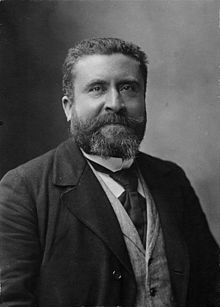
By July 29, there was probably only one man in Europe who could have averted war. Jean Jaures’ ideas paralleled those of Joseph Caillaux. As a socialist, he was beyond the pale of “repeatable” politics, but I think of him as the Jimmy Carter of his day. Meyer writes, As a leader, a thinker, and simply as a human being, Jaures stood out like a giant in the summer of 1914. Like Caillaux he was widely hated, but only for the most honorable of reasons: he had dedicated his life to the achievement of democracy and genuine peace not only in France but across the continent.”
Jean Jaures, 1904, by Nadar. Public domain.
Jaures was the greatest orator of his time, and clearly saw that a European war would be a disaster with no winners, only losers. In his last newspaper column, published on July 31, he wrote, “The danger is great but not insuperable if we keep our clearness of mind and strength of will. If we show the heroism of patience as well as the heroism of action.”
That day he went to Brussels to speak to an emergency gathering of socialists, including a delegation from Germany. He and a group of colleagues spoke to Abel Ferry of the French foreign ministry, demanding action to stop Russia from mobilizing. Ferry said it was too late. “Everything is finished, there is nothing left to do.” When Jaures protested, Ferry said, “You won’t be able to continue. You will be assassinated on the nearest street corner.”
Two hours later, Jaures and a friend entered a cafe on the Rue Montmartre where an unemployed 29 year old named Raoul Villain recognized him. Villain, though well educated, was aimless and confused. He had a gun and a plan to travel to Germany to kill the kaiser. Seeing Jaures take a seat with his back to an open window, he changed his mind. A few moments later he fired two shots into Jaures’ head. The next day, France and Germany mobilized and the following day, World War I began.
_______________________________
The first world war was a tragedy that no one wanted to happen. Accounts of the run-up to war read like a Thomas Hardy novel, where the smallest “innocent” action leads to a huge tragedy. More than any other historical event, the first world war haunts me with a sense of evil pervading human affairs. To be sure, in the next war, in the holocaust, evil is more obvious. We can point to a small group of bad men and believe, or at least hope, that we are different from them. That’s not so easy to do with world war I.
None of the heads of state wanted this kind of war, but they consistently made wrong decisions, which pushed the world over the brink. The litany of “if only’s” is haunting as well. If only someone had told the Archduke’s driver of the change of route, the “inciting incident” might not have happened. And what if some dark karma or twist of fate had not brought Raoul Villain to the Rue Monmartre at the same time as Jaures?
History gives a perspective missing from the present moment, but the history of July 1914 poses a fearful question – what sinister future may be coiling behind the scenes while we distract ourselves with this year’s latest scandal?
“One day the great European War will come out of some damned foolish thing in the Balkans.” – Otto von Bismarck, 1888.
“To have to go to war on account of tiresome Serbia beggars belief.” – Queen Mary of England, August, 1914.
By all accounts, the summer of 1914 in Europe was the sweetest anyone could remember. To many, it seemed like the new century had ushered in an era of prosperity and peace. Everywhere, the middle classes were growing. Globalization was the order of the day. There hadn’t been a continental war in 50 years, and you could travel the world without a passport.
The Sketchers by John Singer Sargent, 1914, public domain
Below the idyllic surface, a storm was brewing. At the beginning, as at the end of the20th century, the Balkans were the least stable region in Europe. In 1908, Austria-Hungary annexed Bosnia from the Turks, whose influence was waning. Nationalistic fervor ran high through the region, and the Bosnian Serbs longed to reunite with the nation of Serbia. During the last weeks of June, 1914, six young Serbian men, members of The Black Hand, a radical nationalist group, slipped into Sarajevo with the intention of killing Archduke Franz Ferdinand, heir to the throne of the Austro-Hungarian empire, on his scheduled visit to Bosnia. By a strange coincidence, five of the six would-be assassins were tubercular teenagers, including, Gavrilo Princip, 19, whose ambition was to die as a martyr.
On the morning of June 28, the six positioned themselves along the route Franz Ferdinand and his wife, Sophie, would travel by motorcade. The first assassin hurled a pocket bomb at the Archduke’s car, but the driver, alerted by the detonation of the bomb’s percussion cap, accelerated and the device exploded under a following car, injuring two other passengers. The motorcade rushed past three more assassins who did nothing; when they were captured, two made excuses while the third confessed that he’d lost his nerve.
After a speech at the city hall, Franz Ferdinand announced his intention to cancel the rest of the parade and go to the hospital to visit the two wounded men. Unfortunately, no one told the driver of the change in plans. He continued along the original route, past another assassin who did nothing.
Franz Ferdinand and Sophie leave City Hall in Sarajevo, June 28. Public domain.
When the driver was finally alerted to his mistake, he stopped the car to turn it around – by a fateful coincidence, just five feet away from the sixth assassin, Gavrilo Princip. Princip fired two shots, hitting the Archduke in the throat and Sophie in the abdomen. “It is nothing, it is nothing,” Franz Ferdinand said. An hour later, he and his wife were dead.
Initially, the assassination caused little stir in the capitals of Europe – it was all too common in the early years of the century. In the previous two decades, presidents of the United States, France, Mexico, Guatemala, Uruguay, and the Dominical Republic had been assassinated, as had Prime Ministers of Russia, Spain, Greece, Bulgaria, Persia, and Egypt. So had kings, queens and empresses of Austria, Italy, Serbia, Portugal, and Greece (source: A World Undone by G.J. Meyer).
No one went to war over assassinations. Franz Joseph, Emperor of Austria-Hungary, did not even like his nephew, Franz Ferdinand, who had become the heir after his own son committed suicide. The emperor seemed almost relieved that the Archduke was gone. First the nephew had defied his uncle by marrying Sophie, who, as “mere” countess, was not of a suitable rank to be wife of a head of state. Even more onerous, the Archduke espoused progressive ideas which his uncle, born in 1830, could not tolerate.
While the rest of the world and the Emperor himself moved on, other high ranking officials within the Austro-Hungarian government sought to exploit the assassination, as an excuse to punish Serbia. By the turn of the century, Austria-Hungary was a second-rate Empire in decline, economically, militarily, and in the eyes of the other western powers. Field Marshal Franz Conrad was convinced that the empire could only recover its standings by asserting itself in the Balkans, beginning with ending the “Serbian problem,” which ideally meant, ending Serbia itself. He had proposed war against Serbia 25 times in 1913.
Count Leopold von Berchtold, the Austrian foreign minister, was a wealthy, pleasure loving aristocrat who owned a racing stable and was famous as a ladies man. “He was also widely regarded as weak, lazy, frivolous and unreliable,” according to G.J. Meyer. Knowing he needed to boost his reputation, he too saw war on Serbia as an opportunity. In Meyer’s words, he had become dangerous – “a weak man, determined to appear strong.”
Conrad and Berchtold drafted a 10 point ultimatum so strict they were sure the Serbs would reject it. For a number of reasons – internal wrangling as well as external political considerations – the ultimatum was not delivered until 25 days after the assassination, when its connection to the event had grown even more tenuous.
Serbia’s powerful ally, Russia, had been led to expect a milder response. Sergei Sazonov, the Russian foreign minister, flew into a rage. “You are setting fire to Europe!” he told the Austrian ambassador. Advisors told the Tsar that failure to help their Slavic brothers in Serbia might trigger a revolution.
After almost a month of quiet following the Archduke’s assassination, the crisis burst upon all the nations of Europe. Forty-eight hours after receiving the Austrian ultimatum, Serbia announced it could not accept all of the demands. Diplomatic relations were severed, and both countries began to mobilize. Adding to the chaos at the end of July, “mobilization” meant different things in different countries.
In Russia, the process took weeks. Thousands of peasant reservists had to be notified, some living hundreds of miles from the nearest railroad. In sharp contrast, German mobilization was based on “the Schlieffen Plan,” which assumed the nation would face a war on two fronts. Mobilization meant war, with a lightning attack to the west, designed to defeat France in 40 days so the armies could turn east to face Russia. Frantic last moment diplomacy failed. Persuaded of the necessity by the military, Kaiser Wilhelm gave the order to proceed. On August 2, German troops crossed into Luxembourg, and the shooting began.
Fired by nationalism and 19th century ideas of honor and glory, young men in all the combatant nations flooded recruiting centers. French troops, boarding trains for the front, called, “A bientot” (“See you soon.”) to those who waved from the platform.
Not everyone was so sanguine. On August 3, after Germany declared war on France and invaded Belgium, Sir Edward Grey, the British foreign secretary stood at his window as dusk fell and the lamps were lit. “The lamps are going out all over Europe,” he said. “We shall not see them lit again in our lifetime.”
If we think of the current chaos in the middle east – the use of poison gas and the crumbling of national boundaries that were drawn in the wake of the first world war – we have to say that the lights have still not come back on…







 The First Gates