Dylan Thomas reading, “A Child’s Christmas in Wales”

Here is the poet himself, reading one of my all time favorite pieces of Christmas writing.  Enjoy!

“One Christmas was so much like another, in those years around the sea-town corner now and out of all sound except the distant speaking of the voices I sometimes hear a moment before sleep, that I can never remember whether it snowed for six days and six nights when I was twelve or whether it snowed for twelve days and twelve nights when I was six…”

“…Looking through my bedroom window, out into the moonlight and the unending smoke-colored snow, I could see the lights in the windows of all the other houses on our hill and hear the music rising from them up the long, steady falling night. I turned the gas down, I got into bed. I said some words to the close and holy darkness, and then I slept.” 

The Princess Mary box and the Christmas Truce

When I was between the ages of 15 and 17, my family lived in France. One day in the flea markets outside Paris, I found a little brass box that bore my initials, MM, as well as a woman’s head in profile.  The inscription above the head read, “Imperium Britannicum” and below that, “Christmas 1914.”  The names of Britain’s WWI allies were printed around the perimeter:  France, Russia, Belgium, Serbia, Monte Negro, and Japan.

princess mary box

I bought the box – I don’t remember how much it cost – and have always kept little treasures inside.  Thanks to the internet, I discovered what it really is:  a Princess Mary Box, one of 400,000 gift boxes sent to British troops on the western front in time for Christmas 98 years ago [108 years ago in 2022].  The campaign to distribute the presents was led by Mary, the seventeen year old daughter of King George V.

***

In December, 1914, the first world war was four months old.  The German invasion of France had been stopped at the Marne that fall.  Both sides dug in for the winter, confident of a breakthrough in the spring that would end the war.  The first trenches were hastily dug, with no provision for drainage.  The winter was wet and cold, and the men spent their days knee deep in freezing water, with no way to get warm.

As Christmas neared, gifts began to arrive, which lifted the spirits of the troops.  According to firstworldwar.com, the men of the British Expeditionary Force got plum puddings and:

“Princess Mary boxes”; a metal case engraved with an outline of George V’s daughter and filled with chocolates and butterscotch, cigarettes and tobacco, a picture card of Princess Mary and a facsimile of George V’s greeting to the troops, “May God protect you and bring you safe home.” 

Princess Mary was 17 when she arranged for gift boxes for the troops.

The Germans got presents too, like meerschaum pipes, food, and small Christmas trees which they attached to the top of the trenches. A British Daily Telegraph correspondent reported that somehow the Germans slipped a chocolate cake into one section of the British lines, along with a request for a cease-fire that evening for a concert. The British agreed and sent gifts of tobacco in return.

That night, at 7:30, the German’s lit candles.  They raised their heads above the trenches and began to sing.  Later they called to the British to join in.  One Tommy yelled, “I’d rather die than sing in German.”  “It would kill us if you tried,” came the reply.

The British line stretched south from Ypres for 27 miles.  In some places, the trenches were only 30 yards apart.  Towns and fields and other reminders of civilian life had not yet been completely destroyed.  Every soldier stuck in the freezing mud longed for home and knew their foes did too.  The rain stopped on Christmas Eve.  The day was clear, and that night as they joined in Christmas carols, soldiers in ones and twos, then in groups, climbed out of the ground to greet each other in no man’s land.

British and German soldiers together, Dec. 25, 1914

In some places, the shooting never stopped, but in others the truce extended through Christmas day and beyond.  The men played soccer, traded uniform buttons and other souvenirs.  Barbers offered haircuts and shaves for free.  When the British high command, a safe 27 miles behind the lines, heard of the truce, they were outraged and issued stern orders forbidding fraternization.  Most field commanders on both sides ignored such orders.

Though in a few spots, things stayed quiet through New Year’s, in most places the truce ended when Christmas was over.  Captain J.C. Dunn, medical officer of the Royal Welch Fusiliers, recorded how the war started up again:

“At 8.30 [on Christmas night] I fired three shots in the air and put up a flag with ‘Merry Christmas’ on it, and I climbed on the parapet. He [the Germans] put up a sheet with ‘Thank you’ on it, and the German Captain appeared on the parapet. We both bowed and saluted and got down into our respective trenches, and he fired two shots in the air, and the War was on again.”

The story was squelched in the British papers until an account ran in the New York Times on December 31.  Word then spread around the world.  Nothing like it on that scale happened again.  Bombardments were ordered on future Christmas Eve’s to prevent it, and after the slaughter of 1916 and the introduction of poison gas, opposing troops grew more bitter toward each other.

I look at the Princess Mary Box and wonder about the soldier who opened it almost a century ago.  If the box turned up in a French flea market, I doubt that he made it home – many sent to the front in 1914 did not.  The brass of the box still shines.  It must have reflected lantern light in trenches and the flare of matches as the men lit up cigarettes sent from home.

princess mary detail

It’s nice to know how closely connected the box is with the Christmas truce, a moment in history that has always held a haunting fascination for me. Cynics claim the lull in fighting was used by both sides to spy out each other’s defenses.  I am not convinced.  People do not remember spying operations 100 years later, and the truce has never been forgotten.  As the men sang “Silent Night” in both languages, many in no man’s land must have truly experienced the peace of the holy day.

Firstworldwar.com concludes it’s account of the truce by saying:  “Perhaps this is the most important legacy of the Christmas Truce today.  In our age of uncertainty, it comforting to believe, regardless of the real reasoning and motives, that soldiers and officers told to hate, loathe and kill, could still lower their guns and extend the hand of goodwill, peace, love and Christmas cheer.” 

The text on this cross left near Ypres in 1999 reads, “1914 – The Khaki Chum’s Christmas Truce – 1999 – 85 Years – Lest We Forget.”

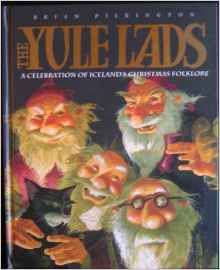
The Yule Lads: Icelandic Christmas folklore.

The Yule Lads

In most Christian countries, Christmas was slower to catch on than other major church holidays.  The clergy may have been wary of pagan solstice celebrations which happened at the same time of year and included serious revelry.  Some early Christmas festivities mimicked the custom.  They were banned in 17th century England, and American Puritans outlawed them too.

According to Brian Pilkington, author of The Yule Lads, Iceland was ahead of the curve. A 16th century law stated that “All disorderly and scandalous entertainment at Christmas and other times and Shrovetide revels are strongly forbidden on pain of serious punishment.”

Icelandic winters are long and dark, with fewer than five hours of daylight at this time of the year.  Imagination tends to fill the darkness with what we fear, and Pilkington’s book describes “the lads” that kept Icelandic children awake at night.  The gentlemen pictured on the cover are not our shopping mall Santas!

The matriarch of the clan was the ogress, Gryla, who loved to eat stewed children.  It couldn’t be just any kid though.  It had to be one who was “naughty, lazy, or rude.”  In one 13th century account, Gryla had 15 tails, and tied to each was a sack full of naughty children.  It was not “the most wonderful time of the year” if you were young!  The Icelandic word for icicle is “grylukerti” which means “Gryla’s candle.”

Gryla. CC-by-SA-2.5

Gryla had three husbands and 80 children, though legend now boils it down to 13 sons who visit the homes of children on successive nights from Dec. 12 – 25.  Time and the law have taken the edge off the Yule Lads, for a 1746 decree said “The foolish custom, which has been practiced here and there about the country, of scaring children with Yuletide lads or ghosts, shall be abolished.”  By the 19th century, the Lads had morphed from cannibals into rascals and petty thieves, who even began to leave gifts for good children who left their shoes on a window ledge.

The first to arrive was Stekkjarstaur, the “Sheep Worrier.”  He would visit the the sheep cot and try to suck milk from the ewes.  That doesn’t work in December and led author, Brian Pilkington to suggest that Sheep Worrier’s IQ is “somewhat less than three digits.”  These days  he heads for the fridge to get his milk.  If a child has been good, Stekkjarstaur leaves a sugary sweet.  Bad children get a potato.

Next comes Giljagaur, aka, “Gully Gawk” who travels through gullies and ravines, also in search of milk, but he looks for cow barns and inattentive milkmaids.  “Stubby” arrives the third night, as short as his name suggests.  He likes to raid the kitchen, as do the brothers that follow, “Spoon Licker,” “Pot Licker,” and “Bowl Licker.”  In their present forms all they do is mischief, but food thieves were no joke in earlier times.  For northern farming families, the time between Christmas and the spring thaw in April or May could be times of famine if food or fodder for livestock ran short.

The next lad to show up is Hurdaskellir, or “Door Slammer,” one of only two of Gryla’s sons who isn’t out to fill his belly.  Imagine loud bangs in the dead of night and you know how he gets his jollies.

And as if the sons of Gryla were not bad enough, children also had to contend with Jólakötturinn, the Yule Cat, a huge feral creature who hunts children on Christmas Eve instead of mice. Like the lads, the cat discriminates in choosing his victims, eating only those who have not received a new item of clothing for Christmas. Pilkington says that “Until fairly recently in Iceland, all clothing came directly from sheep. The wool had to be washed, combed, and spun before it was painstakingly crafted into a garment. It was a long, arduous process.”  Fear of the Cat induced lazy children to do their part!

This is a fun book and a fine counterbalance to the usual TV holiday movies.  You can picture families gathered around the fire as the wind howls outside, thinking as we do when hearing a good ghost story, “This can’t be true…can it?”  Something within the listeners then and within us now loves to be scared, to confront monsters and vanquish them in imagination.  On that score, Gryla & Sons and the Yule Cat satisfy!

A click on the book cover at the top of this post will take you a site where you can order The Yule Lads.

All quiet on the holiday front

The chief of security at one of the largest area malls reported that this year’s Black Friday was the smoothest in 13 years.  He didn’t speculate on why that was true, so here’s a poll.  Pick whichever explanation(s) seem most plausible:

  1. The population has grown more civil.
  2. More people are shopping online.
  3. After all that’s happened this year, including the election, we’re too numb to respond to the usual holiday trappings.

Yesterday, I thanked the waitress at a local waffle place for the lack of “holiday” music.  “I know,” she said.  “Isn’t it great?  I’m hoping management keeps it up.”

I distinguish between Christmas music, which I enjoy at this time of year, and Holiday music.

People reading this blog in other countries may not be clear on the distinction.  Because of our nation’s diversity, in the public sphere, both at work and in stores, we say “Happy Holiday’s” instead of “Merry Christmas.”  The intent is not to offend people of other faiths.  The result is largely to trivialize the whole thing.  If you’ve ever gotten a song like “Little Saint Nick,” or “Rockin’ Around the Christmas Tree,” stuck in your mind, you know what I mean.

For helping spark the trend toward silence or simply generic music in stores, I present my 2012 Corporate Hero award to Shoppers Drug Mart, a popular Canadian pharmacy chain.  They started playing Holiday music the day after Halloween, but received so many complaints that they pulled the plug “until further notice.”

One comment on their Facebook page read, “Starting this music so early takes the sacredness and meaning out of what should be such a beautiful season.”  That sums up “the Holidays” in their entirety.

Luke’s gospel tells us that after the shepherds saw the baby Jesus, they ran off to Bethlehem to tell everyone, “But Mary treasured up all these things and pondered them in her heart”  Lk 2:19.

Pondering things in our heart is how an event becomes an experience.  It’s how we come to appreciate things, even simple acts like buying a gift or having waffles with a friend.

I never begrudge our merchants the chance to make a living at this time of year, and I appreciate them even more for pulling the plug on noxious music so I can treasure more of these things in my heart.

The end of the world as we know it

Having slept through Black Friday, the next big event on my calendar is the Mayan apocalypse, scheduled for December 21.

I had no intention of blogging about this until I received the Winter 2012 issue of the University of Oregon Quarterly, where an article by Alice Tallmadge, “Doomsday or Deliverance?” discusses this prophecy in the context of end-of-the-world folklore.

Associate professor Dan Wojcik, director of the UO folklore program, plans to travel to Chichen Itza, one of a huge number of visitors expected for the event, which for some heralds the shift to a higher world age, in the same spirit as the Harmonic Convergence of 1987.  The main organizer of that event, as well as the biggest publicist of 12/21/12, was Jose Arguelles (1939-2011).  In his obituary, the New York Times described his philosophy as “an eclectic amalgm of Mayan and Aztec cosmology, the I Ching, the Book of Revelation, ancient-astronaut narratives, and more.”

On the other end of the spectrum, Alice Tallmadge reports that sales of survivalist goods have spiked in recent months.  A recent Reuters poll found that 15% of people worldwide, and 22% of Americans believe the world will end during their lifetime.  The apocalypse has been a feature of Christian theology from the start, but professor Wojcik notes a recent uptick in secular end-time beliefs:  pandemics, overpopulation, and climate change are seen as threats to the planet without any hope of spiritual redemption.

Things that have a beginning have an end, from gnats, to humans, to stars, and all of creation in the western view of time as linear.  When the world survives a predicted ending date, the error is put down to miscalculation; the expectation persists.  What is it about end-time predictions that continue to fascinate most of us and motivate many believers?  The old saying, “Fool me once, shame on you, fool me twice, shame on me” doesn’t hold in this realm.

I wonder if it parallels our continuing love for disaster film?  Stories of terrible struggle and danger where we get to imagine ourselves among the survivors or among the happily raptured, coming through the ordeal to enjoy “a new heaven and earth.”  The ultimate do-over.

They don’t get any better than one of my all time favorite “disaster films,” made decades before the phrase was coined:  San Francisco (1936), with Clark Gable, Spencer Tracy, and Jeanette MacDonald surviving the 1906 earthquake.

Here’s hoping all our December disasters turn out as well!

And finally, for extra credit, here’s a different kind of celebration, with REM performing “It’s the End of the World As We Know It (and I Feel Fine).  Enjoy!

A brief history of Labor Day

Labor Day Parade, New York, 1882. (Public Domain)

Labor Day was first proposed as a national holiday in 1882, by one of two members of early labor unions (historians are not sure which one).  Some say the idea came from Matthew Maguire, a New York machinist and secretary of the Central Labor Union.  Others credit Peter J. McGuire, of the American Federation of Labor, who had seen a Canadian labor festival in Toronto.

Oregon was first to make it a state holiday in 1887.  In the next few years, 29 more states did the same, but Labor Day did not become a national holiday until after the bloody Pullman strike of 1894.

The trouble began in May, 1894, when 4000 employees of the Pullman Palace Car Company protested a reduction in the wages, sixteen-hour workdays, and high rents in the company town of Pullman, IL.  Company owner, George Pullman refused to talk to the workers.  The workers struck, and in June, members of the American Railway Union, led by Eugene Debs, announced a boycott, refusing to switch Pullman cars onto trains.  Within a few days, 125,000 workers on 29 railroads had walked off the job rather than handle Pullman cars.

After a peaceful rally led by Debs in Blue Island, IL, some groups of workers set fire to buildings and derailed a locomotive.  Across the country, workers in sympathy with the strikers blocked the transportation of goods, and attacked strikebreakers.  President Grover Cleveland sent U.S. Marshalls and 12,000 army troops to break up the strike.  They fired on crowds, and before the disturbance was over, 13 workers were dead and 57 wounded.

Troops fire on Pullman strikers, 1894 – Public Domain image

Fearing further trouble, legislation to create a national Labor Day holiday was rushed through congress and signed into law by Cleveland just six days after the strike ended.

Because trains carried the mail, Eugene Debs was accused of conspiracy against the US Postal Service and tried for this and other criminal and civil charges.  After a brilliant defense by Clarence Darrow, he was acquitted of everything except violating an injunction, which carried a six month sentence.  While serving his time, Debs read the works of Karl Marx and became a socialist.  He ran for president on the socialist ticket in 1900.

Eugene Debs, 1912 (Public domain photograph)

During the strike, Illinois governor, John P. Altgeld had offered the President the use of the Illinois National Guard to maintain order.  He was incensed that Grover Cleveland ignored his  plan and put federal troops at the service of company management.  Altgeld used his influence at the 1896 Democratic convention to deny Cleveland a second nomination for president.

President Grover Cleveland (Public domain photograph)

A federal commission found the Pullman company’s town to be “unAmerican,” and in 1898, the Illinois Supreme Court forced it to divest.  The township was annexed by the city of Chicago.

When George Pullman died in 1897 he was buried at night in steel-reinforced crypt, surrounded by tons of concrete, in fear that veterans of the strike might try to desecrate his grave.

***

A friend who is active in a hospital union  insists we have to remember that people died to win us an eight hour day, vacations, health care, pensions, and other benefits workers could only dream of 100 years ago.  Employers didn’t give us these things from the goodness of their hearts.

It’s safe to say that western nations would not have a middle class without the efforts of organized labor.  And it’s no coincidence that both institutions are now on the ropes.

Something to think about this Labor Day.  Those who forget the past…

Happy Losar

Today, February, 22, is Ash Wednesday, the beginning of Lent on the Christian calendar.  It is also Losar, the beginning of 2139, the Year of the Water Dragon on the Tibetan calendar.  The dates of Lent and Losar both involve lunar calculations, so it’s just coincidence that they align this year.

Water Dragon

Tibetan astrology predates Buddhism but was adapted by that tradition.  There are 12 signs and five elements, for a total of 60 combinations. The astrological year begins not at Losar, but around the time of the Winter Solstice, so children born since December 22 are Water Dragons.  So are those celebrating their 60th birthday.

Here is a good introduction to Tibetan astrology. http://www.tactus.dk/tacom/.  It’s a complicated system, so this is a newspaper horoscope version.  One website predicts 2012 will be “an eventful, mixed blessing year” – what year isn’t?   Another says, “The year of the Dragon is full of energy and surprises.  The element of water symbolizes calm and receptivity.”

The Chinese government has closed the borders of Tibet to foreigners during the traditional 15 days of Losar celebration.  In recognition of recent unrest, some Tibetan leaders in exile are asking that traditional celebrations not go forward.  Prayers and ceremonies will still mark the event worldwide.  Tibetans believe that the power of both positive and negative actions during the first month of the new year are greatly multiplied in their effect on the year to come.

In any event, Losar is a time when the traditional greeting, Tashi Delek, is given, a phrase that is sometimes translated as, “Blessings and good luck.”

Peace

It almost seems like the world pauses around the time of the solstice, the way an out-breath stops for a moment before the next in-breath begins.  To catch the stillness, we may have to make an effort to step outside the noise of the season, but it can be done.

People finally get to slow down on Christmas Eve.  Maybe they go to church and look at the stars afterwards,or just step out for a breath of air when the family gathering gets too loud.  Or take the dogs for a walk in the late afternoon, hands in pockets, and notice how quiet the park is, almost as if it is waiting for something.  The soccer players and kids on the swings will be back soon, but now they’re gone.

This can be a hard season.  Individually and collectively, many are wondering when the next blow is going to fall.  And by this time of year, everyone is weary of trying to be as happy as people in Hallmark movies.  Yet I believe that by some mystery, stillness surrounds and pervades our busy-ness, and silence permeates the noise.  There is a well of renewal we can touch at this time of year.  By whatever name you call it, may it be yours.