The Devil’s Sooty Brothers

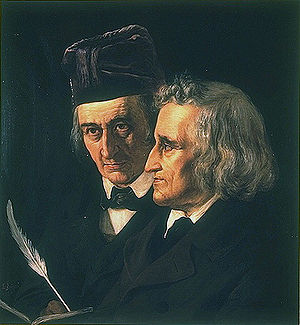
Wilhelm and Jacob Grimm, 1855. Painting by Elisabeth Jerichau-Baumann

Wilhelm and Jacob Grimm, 1855. Painting by Elisabeth Jerichau-Baumann

“People think stories are shaped by people. In fact, it’s the other way round.” – Terry Pratchett

“The Devil’s Sooty Brother” is the catchiest name among a group of tales from the Brothers Grimm about career soldiers who are discharged when they are wounded, or peace breaks out, or for no given reason. They find themselves on the road, with a loaf of bread and a few coins if they’re lucky, and no clear path to making their way in the world.

Most of the best known Grimm tales feature young people – a lad or a maiden, just starting out in the world. In contrast, we imagine these soldiers as middle aged career men, whose services are no longer needed. I thought of these stories when I heard that Oreo, “America’s favorite cookie,” will now be produced in Mexico, where Nabisco expects to save $130 million a year. Six hundred people join the hundreds of thousands before them whose working lives have been disrupted by technical, financial, and social changes that continue to accelerate in speed.

Do the old stories have anything practical to say to 21st century people when the world turns upside down?  Maybe…

These stories have elements in common:

  1. The protagonists are combat veterans. They’ve been around the block.
  2. They take up with shady, trickster-like characters, who take them underground, into the darkness, or other trials.
  3. They either are, or must learn to be, trickier than their tricky benefactors. In modern terms, they need to think outside the box, and there, if anywhere, is the relevance for us now. Circumstances may change, but the value of seeing the world afresh, free from habit and preconception, is probably even more vital now than in the “simpler” times when these tales emerged.

I will consider two of the tales of discharged soldiers that depend on wit. I’ll skip several others that hinge more on religious piety and luck. Piety and luck may pay off in real life, but they aren’t satisfying story elements.

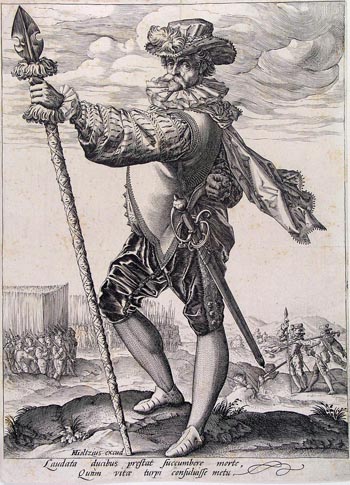
German mercenary pikeman. Wikimedia Commons

German mercenary pikeman. Wikimedia Commons

In our title story, The Devil’s Sooty Brother, (Grimm Tale #100), Hans, a hungry and penniless out of work soldier, meets the Devil in the woods. This Devil is a dark trickster and initiator rather than a personification of evil. If the soldier agrees to the terms of a seven-year contract, he’ll be set for life.  If he violates the terms, he will die, and presumably, be stuck in hell. Continue reading

A kinder, gentler, Jurassic World

psittacosaurus, at the Prehistoric Gardens, Port Orford, Oregon

psittacosaurus, at the Prehistoric Gardens, Port Orford, Oregon

Dinosaurs continue to fascinate. My first ambition in life, after a trip to the New York Museum of Natural History, was to become a paleontologist. Eventually, my life goals changed, and the T-Rex envy faded.

calvin-hobbes-dinosaur-005

Yet decades before Jurassic Park was a gleam in some screenwriter’s eye, Ernie Nelson, of Eugene, Oregon, did not outgrow his fascination with dinosaurs. He made them his life’s work in a most unusual way.

In 1953, Nelson gathered his family and left Eugene, where he worked as a CPA and owned a Mill supply company, to relocate to a valley near Port Orford, where rainfall averaged seven feet per year – he needed a rain forest.

In 1955, he opened the Prehistoric Gardens, and over 30 years, built 23 full size and anatomically correct dinosaurs. This unique roadside attraction is still in the family. Ernie’s granddaughter welcomed Mary and me in August, after we’d driven down from Bandon to see the dinos.

Not what you expect to see when you round the bend on the coast highway, but then, to paraphrase Monty Python, no one EVER expects a Tyrannosaurus!

Not what you expect to see when you round the bend on the coast highway, but then, to paraphrase Monty Python, no one EVER expects a Tyrannosaurus!

Nelson’s process was painstaking. His research was constant and thorough, and included a  trip back east to visit the Smithsonian. Each dinosaur began with a steel frame, which was then covered with a metal lath. A layer of concrete followed, and then another layer to define the visual features.  The Brachiosaurus, 86′ long snd 46′ high, took four years to complete and was his pride and joy.

Ernie working on the peterandon

Ernie working on the peterandon

The Prehistoric Garden’s website says the 23 sculptures were painted according to available scientific research. We normally don’t think of dinosaurs as colorful, though plenty of lizards, chameleons, and snakes in our world are.

I’m willing to trust Ernie on his color choices, but what I liked best was the aspect where I think imagination overrode research. Some of these critters are just so darn cute in, a wide-eyed sort of way.  I don’t want make Ernie turn over in his grave by calling his critters “cute,” but there’s just no other word for this triceratops, which has the same expression as one of my dogs!

triceratops small_edited-1

Some of us can remember the days of wacky roadside attractions on Route 66 or Hwy. 99 – giant oranges, strange animals, and gas stations designed to look like flying saucers.  There were animal parks, fairytale towns, and north pole villages in the days when Ernie Nelson moved his family to southern Oregon to shape his dream in concrete and steel.

The ichthyosaurus is suffering from the drought this year just like we are.

The ichthyosaurus is suffering from the drought this year just like we are.

Nowadays the most frequent sights, as we blow past towns on the interstate, are fast food joints and the same old big-box stores. Santa’s Village has long been shuttered, and the kids have video games and DVD’s to mitigate the boring view out the windows.

Like the dinosaurs, the Prehistoric Gardens speaks of a different era, one in which peace had come, America was unrivaled, and more people than ever before had jobs, cars, money, cheap gas, kids, health care, and paid vacations.

All those attributes can ebb and flow, but there is one precious thing we can always borrow from Ernie Nelson – the example of what an individual can do when he rolls up his sleeves, opens his mind and heart, and lets his creativity flow.

Character

Here is a wonderful meditation on character, both general and personal, from Debra, who shares with me a keen interest in the writings and world view of James Hillman. It makes a great companion piece to my previous post on Hillman. Thanks Debra!

ptero9's avatarTheoria

“A man’s character is his fate.” Heraclitus (540 BC – 480 BC), On the Universe

“If the final purpose of aging is character, then character finishes life, polishes it into a more lasting image.” James Hillman

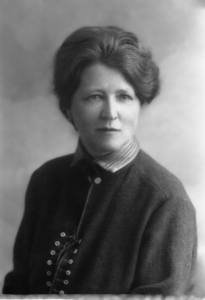
Anna Rebecca Smith

If I have felt compelled towards living life closer to the margins, seeking out what is obscure, liminal, or for understanding more deeply the nature of life, I might trace these loose threads back to childhood and the memory of my dear Great, Great Aunt Bunny. The family myth taking root early in my life often compared my oddness to hers. Maybe another child would not have taken the myth to heart and some may say a child should be left without a myth or vision handed down by an ancestor, but I remain grateful.

Although long since passed on, her presence fosters in me a love of life’s oddness. Through the legacy…

View original post 791 more words

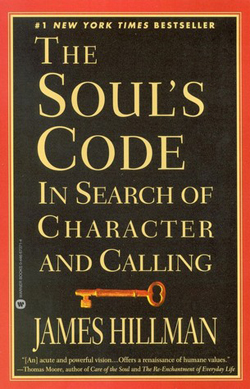
The Soul’s Code by James Hillman

the soul's code

James Hillman (1926-2011), a prolific post-Jungian psychologist, thinker, and cultural critic, wrote more than 20 books, but The Soul’s Code: In Search of Character and Calling (1997) is probably his best known work.

In a head-on attack upon the reductionist nature of both the nature and nurture camps of western developmental psychology, Hillman proposes a view of individual destiny based on Plato’s Myth of Er. Are we nothing but helpless products of our mothers in the first year of life or our luck-of-the-draw genetics? Or is there a deeper meaning to how we grow and unfold?

Hillman proposes an “acorn theory,” arguing that each acorn holds the pattern of the oak it may become, just as each soul that enters the world may bear a destiny shaped by intelligence rather than random chance: “what is lost in so many lives and what must be recovered [is] a sense of personal calling, that there is a reason I am alive.”

Hillman expounds his theory in a number of biographical sketches. He writes of Manolete, the most famous bullfighter of 20th century Spain. As a child, he was sickly and frail. “He stayed so much indoors and clung so tightly to his mother’s apron strings that his sisters and other children used to tease him.” Then, at the age of 11, he became fascinated with bulls.

Current psychology theory would hold that Manolete chose a macho vocation to compensate for his mama’s-boy childhood. Hillman wonders if somewhere deep inside, was “the acorn” that realized his destiny was to face down charging, thousand pound bulls, including the one that gored him to death at age 30. Of course that was too frightening a vision for a boy of 8 or 9 to hold!  Of course he held tight to his mother!

Hillman also discusses the childhood of Eleanor Roosevelt, one of the 20th century’s most influential women. As a child, Eleanor was “funny,” as well as “sullen, stubborn, spiteful, [and] sour…She lied; she stole, she threw antisocial tantrums in company.”

She lost her mother, a brother, and her “playboy father” before she was nine, but all the while carried on a vivid fantasy, “the realest thing in my life,” in which she lived with her father in a large household and traveled the world with him.

Psychotherapy would have regarded her fantasies as delusions and prescribed psychotropic medications to try to return her to normal. But what of the possibility that her visions meant something? What if her fantasies were “invented by her calling,” Hillman asks, and “were indeed more realistic in their orientation than her daily reality.”

“Imagination acted as a teacher, giving instruction for the large ministering tasks of caring for the welfare of a complex family, of a crippled husband, of the state of New York as the governor’s wife, the United States as its first lady, and even of the United Nations. Her fantasies of attending to “Father” were a preliminary praxis into which she could put her call, her huge devotion to the welfare of others.

Hillman is always provocative, inviting us to look deeper into, or “see through” the ideas that limit soul and it’s individual expression. Psychological literalism is often in his crosshairs, as when he says, “Our lives may be determined less by our childhood than by the way we have learned to imagine our childhoods.”

James Hillman, 1926-2011

James Hillman, 1926-2011

The Soul’s Code is a challenging book, but valuable as it sheds new light on many unquestioned assumptions about development, the individual, and destiny that need to be questioned.

How to Fail at Almost Everything and Still Win Big by Scott Adams

How to Fail

“Don’t let reality control your imagination. Let your imagination be the user interface to steer your reality.” – Scott Adams.

How to Fail at Almost Everything is a quirky, funny, irreverent, and often inspiring “sort of autobiography” from the creator of Dilbert, that quirky, funny, irreverent, and often inspiring comic strip that lays out the truth of working in the trenches cubicles of corporate America.

This is not another collection of Dilbert cartoons or Dilbert philosophy.  It’s more of a Dilbert origin story.  We know we’re in for a different kind of kind of how-to-book when Adams begins by advising us to make sure our bullshit detectors are working before we take advice from a cartoonist.

He dismantles many self-help cliches in order to clear the way for fresh perspectives.  “Goals are for losers,” he says, and recommends strategy instead.  “I will finish my first novel,” is a goal. “I will write for an hour a day,” is a strategy.  Every day we don’t attain a goal is slightly depressing, he says, and soon after we reach it, the “what next?” question arises.  A strategy, on the other hand, brings a daily sense of satisfaction as we move in the right direction.

“I tried a lot of different ventures, stayed optimistic, put in the energy, prepared myself by learning as much as I could, and stayed in the game long enough for luck to find me…with Dilbert it did.” – Scott Adams

Adams gives a chronology of his many failed careers and entrepreneurial ventures. Shining through the story is a positive attitude that allowed him to find key lessons and life experience in every failure.  His optimism is gold, and he spends a lot of time writing of health, especially, diet and exercise, although he cautions that there is a “non-zero chance” that health advice from a cartoonist could be fatal.

“I’m here to tell you that the primary culprit in your bad moods is a deficit in one of the big five: flexible schedule, imagination, sleep, diet and exercise.”  The “big five” benefit mood, which builds personal energy, which is the driver of aspiration and effort.

Scott Adams shares his ideas at IBM Connect 2014.  Photo by Greyhawk68, CC BY-NC-ND 2.0

Scott Adams shares his ideas at IBM Connect 2014. Photo by Greyhawk68, CC BY-NC-ND 2.0

Adams packs an abundance of topics into his book. Not every one resonated, and several dragged for me, but much of my copy is highlighted and underlined, and I’ve reread several chapters already.  If you like Dilbert, you will value this story of the life twists and turns of his creator, and you will benefit from the lessons he learned along the way.

More notes from the Wasteland

Joseph Campbell considered the Wasteland and the quest for the Grail that heals it to be a core myth for our time.  During “The Power of Myth” series at the end of his life,  Campbell said the Wasteland results from a worldview that divides matter and spirit.  Referring to the Fisher King’s wound he said:

“the Christian separation of matter and spirit…has really castrated nature. And the European mind, the European life, has been, as it were, emasculated by this separation. The true spirituality, which would have come from the union of matter and spirit, has been killed.” (1)

Generations of western thinkers, culminating in Descartes, built upon the split Campbell cites to elaborate a mechanistic view of nature that made the world ripe for human exploitation.  Results of this world view are visible everywhere, both in the headlines and in the landscape around us.  This part of California, for instance, still bears the scars of hydraulic mining 150 years after the gold rush.
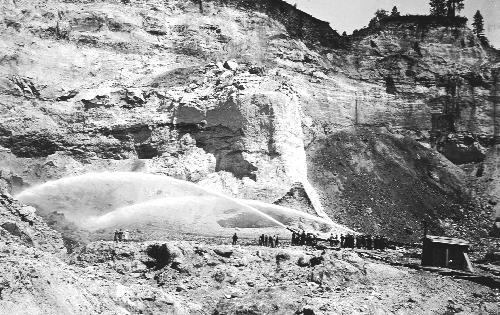
Hydraulic mining along the Yuba river.  Malakofdigginsstatepark.org

Hydraulic mining along the Yuba river. Malakofdigginsstatepark.org

Deliberate exploitation isn’t always the culprit.  We think of Native Americans as attuned with nature, but even they made mistakes.  From AD 900-1150, such a large concentration of Pueblo people lived in Chaco Canyon, NM that they cut an estimated million trees from the surrounding Colorado Plateau.  The resulting erosion, loss of game habitat, and flooding is thought to be one reason why they abandoned the site.  The surrounding landscape, once forest, has been desert ever since.

Pueblo Bonito ruins, Chaco Canyon.  Photo courtesy of Scott Haefner, scotthaefner.com

Pueblo Bonito ruins, Chaco Canyon. Photo courtesy of Scott Haefner, scotthaefner.com

Now that humans have the power to disrupt the environment on a global scale, the question of whether the harm is deliberate or inadvertent may be moot, but serious differences still lie at the heart of competing world views.  Campbell touched on this issue in Creative Mythology, the last book of The Masks of God, a four volume study of world mythology that he wrote between 1962 and 1968.  In this series, he ascribed four functions to myth (2)

  1. The Metaphysical Function: Awakening a sense of awe before the mystery of being
  2. The Cosmological Function: Explaining the shape of the universe
  3. The Sociological Function: Validate and support the existing social order
  4. The Pedagogical Function: Guide the individual through the stages of life

The Grail story resonates on all of these levels, but since I want to consider the Wasteland myth in light of our current environmental crisis, the third and fourth functions have the greatest relevance here.

Campbell points out that humans are born too soon, “absolutely helpless,” and unlike most other animals, learn how to survive from a social group.  Our earliest myths derive from the hunter/gatherer era, “hardly greater than large families, of which every adult member was in possession of the entire cultural heritage.”  

These earliest myths “served a fostering, educative function, bearing the unfinished nature product to full, harmonious unfoldment as an adult specifically adapted for survival in a certain specific environment, as a fully participating member of a specific social group; and apart from that group he would neither have come to maturity nor have been able to survive.”  There was room for diversity, but no one who threatened the group was tolerated.

The next strata of myth emerged when humans settled into agricultural communities, beginning around 7500 B.C..  Villages grew into towns and then into cities and “it was precisely at this point of space and time, in the Near East, and specifically Sumer, c. 3500-3000 B.C., that the evidence first appears among the ruins…first, of a disciplined social order imposed from above by force, and next, of deliberate expeditions of military conquest against neighbors…campaigns of systematic conquest and subjugation.”  The principle here, said Campbell, was “greed for more than one’s share.”

Imposed social orders are not inherently bad, says Campbell.  Despite romantic fantasies of the noble savage, few people really want to live in caves or give up such boons as advanced medicine, arts, spirituality, and transportation, to say nothing of indoor plumbing.  Like conventions in writing, music, or painting, cultural conventions may spark creativity when they are new and later stifle it as they atrophy.

“The Waste Land, let us say then, is any world in which…force and not love, indoctrination not education, authority not experience, prevail in the ordering of lives, and where the myths and rites enforced and received are consequently unrelated to the actual inward realizations, needs, and potentialities of those upon whom they are impressed.”

This was the situation when the European Grail myth emerged; the first written version was composed in the 12th century by Cretien de Troyes at the very time the inquisition began.  The Grail legend served as a counterpoint to the institutional church; the tale can be read as the map of a quest for personal realization, safely couched in a story of ladies and knights.  In the earliest versions, the Grail was not the cup of the last supper but a stone or a large stone dish, which like the philosopher’s stone of alchemy, granted the heart’s deepest desire.

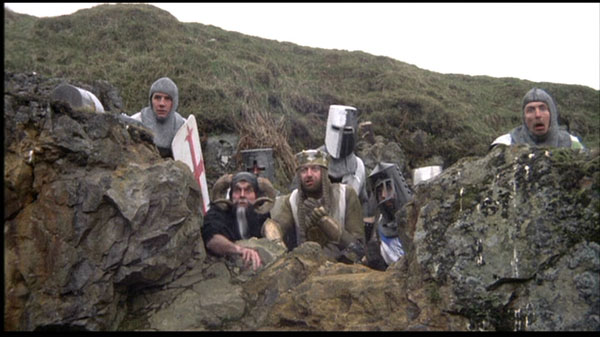
Even at our remove from the middle ages when the stories emerged, the Grail remains one of our living myths, at least if you pay attention to popular fiction and movies.  Think of The Da Vinci Code, Indiana Jones and the Last Crusade, and even Monty Python and the Holy Grail.
Pythons on the quest: at the lair of the Killer Bunny

Pythons on the quest: at the lair of the Killer Bunny

As much as the population of the middle ages, we are, in the words of 19th century poet, Matthew Arnold, “Wandering between two worlds, one dead, the other powerless to be born.”  The Grail continues to speak to such eras, especially one in which the Wasteland is not just the metaphor of an inner desert, but a world in which that desert is visible around us.

The Grail remains a shining image, never quite clear, but unforgettable, of the kind of life and world we seek among the confusion of possible futures.  At the end of “The Power of Myth” series, Bill Moyers asked Joseph Campbell what the myth of the future might be.

“You can’t predict a myth anymore than you can predict what you’re going to dream tonight,” Campbell replied (3).  “Dreams and myths come from the same place.”  Then he went on to say, “The only myth that’s going to be worth thinking about in the immediate future is going to be one that is talking about the entire planet.”

Earth from space

“You don’t see any divisions there of nations or states. This may be the symbol of the mythology to come. That’s going to be the country we are celebrating.” – Joseph Campbell, 1987″

Next:  Some people who are already question for the Grail.

A teller of sacred stories

Robert Béla Wilhelm, storyteller

Robert Béla Wilhelm, storyteller

In 1965, a young New Jersey college student, in need of money for rent and tuition, took a weekend job as a tour guide at $25 a day, for a charter company that specialized in high school class trips to Washington, DC.  The company gave him a binder of facts and statistics to learn, but the student, Robert Béla Wilhelm, quickly realized that only a story makes facts and statistics come alive.

Sixteen years later, Bob was a university professor and had written his PhD dissertation on the craft and philosophy of storytelling.  His wife, Kelly’s, PhD centered on travel and leisure.  Both had grown up in storytelling families, and in 1981, they founded Storyfest Journeys (see their Facebook page too) with an inaugural trip to Ireland.  After more than 50 storytelling oriented, small group tours to Europe, the Pacific, and destinations in the US, they are still at it.  It was thanks to the Wilhelms that Mary and I traveled to Iceland in 2012.

Over time, Bob and Kelly have focused their energy on mentoring storytellers and specializing in sacred stories.  I just received word that Bob has completed a 17 year labor of love that he calls, “Parables Today, A Weekly Lectionary Storybook.”  For every Sunday of the three year lectionary cycle of the Catholic church, he presents stories from around the world along with artwork, and reflections.  The tone is open and ecumenical; many of the tales will appeal to people of any faith or none at all.  They  are now freely available at sacredstorytelling.org.

I was thinking of Robert Wilhelm when I wrote my second post on this blog, which featured a poem called “Story Water” by Rumi.  I think it’s safe to say that Robert has carried on Rumi’s tradition, which centers on the understanding that our spiritual dreams and longings are woven of stories.  Abstract understanding may sometimes move the heart, but more often it is The Prodigal Son, or Arjuna at Kurukshetra, or Coyote coming along that opens our eyes of understanding.

If you love stories, take a look at the stories that Robert Wilhelm loves.

Another great story rediscovered: Bamboo Charlie

Here is another inspiring tale that I bookmarked some time ago and then forgot.  Coincidentally, like the previous post, its subject is a uniquely creative folk artist.  I read about Bamboo Charlie in a memorial published in the L.A. Times in September, 2012.

Bamboo Charlie and his whimsical paradise

Bamboo Charlie and his whimsical paradise

Twenty years ago, a homeless Texan named Charles Ray Walker noticed a bamboo grove along a narrow stretch of land by the Los Angeles River in Boyle Heights.  The property owner told Charlie he could stay there if he kept the place clean.

On the strip of land, about 40′ x 200′, squeezed between a parking lot and a warehouse, Walker grew fruits and vegetables.  He carved stairs into the bare slopes and decorated them with hundreds of discarded toys and signs.  He built a shack under a tree, with a TV, bed,and sofa, and then he invited guests to visit: graffiti artists, children and their parents, musicians, police officers, and homeless friends.  He assembled a library out of salvaged books, including best sellers and one called The Semi-Complete Guide to Sort of Being a Gentleman.  Bamboo Charlie was featured on the front page of the L.A. Times in 2010.

"Bamboo Charlie"

During the 20 years he spent on the parcel, he collected cans for money, sometimes working late into the night. Duruing occasional trips back to Texas to visit his family, he operated a crane at a steel company. “I’m not going to ask another grown man for money. I never have, and I never will,” he said. “People expect that from a homeless man.”  

That pride may have contributed to an early death.  He suffered greatly from ulcers during his final years, but insisted he was fine when friends suggested he see a doctor. On Aug. 26, 2012, a young friend named Teyuca found him dead in his shack, of what the coroner determined was heart disease.  He was 61.

“I really think what he did was folk art, built out of scraps and things found, things that people gave him,” Teyuca said.  “He was a mad genius.  He had such a wild imagination.”