
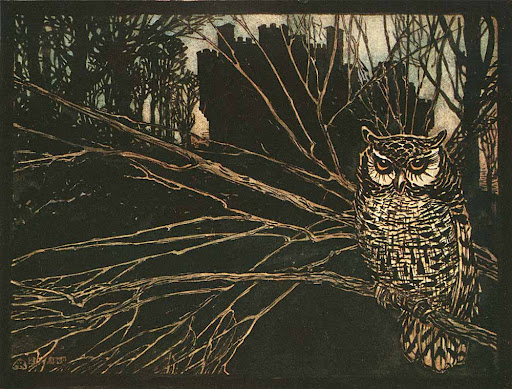
The witch as an owl by Arthur Rackham
I have seen Jorinda and Joringel (sometimes spelled Jorindel) in many folklore collections, but I always passed it by. A cursory glance led me to think it was much like Hansel and Gretel, not one of my favorite tales. I’m not alone in skipping it: I’ve never seen it discussed or analyzed by any of the writers on folklore I read.
I picked it up recently, intending to read myself to sleep, but stayed awake instead. Jorinda and Joringel is a scary story with unexpected depths as well as features found in other celebrated stories. One key image strikingly parallels a central symbol from India, which raises other questions. Here is a summary of the tale:
***
Synopsis of “Jorinda and Joringel” in The Annotated Brothers Grimm
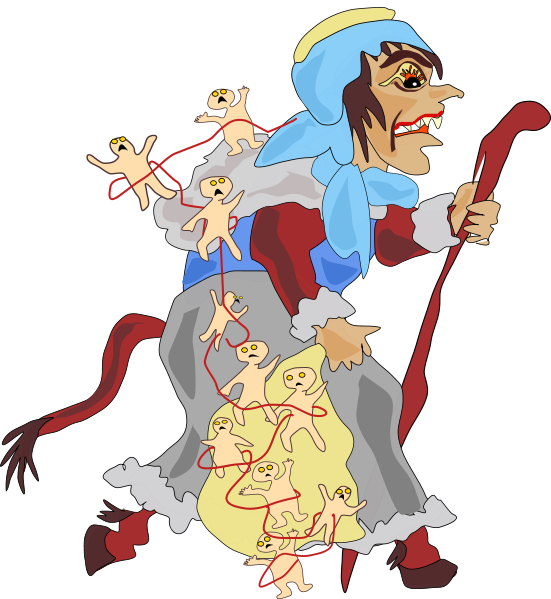
Once there was a witch who lived in a castle in the depths of a thick forest. By day she took the shape of a cat or and owl, but at night she appeared as an old woman whose nose curved down to touch her chin. She would kill and eat any bird or animal that ventured near. If any human came within 100 feet of the castle, she would freeze them on the spot; they’d be unable to move until she released them. She turned innocent girls into songbirds and keep them in cages inside the castle; she had 7000 birds and counting.
A beautiful maiden named Jorinda was betrothed to a youth named Joringel. They enjoyed nothing more than spending time together, and one day they decided to walk in the woods. “We just have to stay away from the castle,” Joringel said.
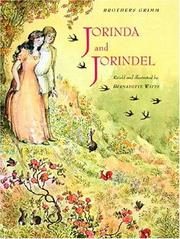
As the sun began to set, they heard the plaintive song of a turtledove. Jorinda began to weep while Jorindel sighed and felt oppressed with sadness. He noticed the wall of a nearby castle, but before he could utter a warning, Jorinda was turned into a nightingale. An owl with flashing eyes flew around them thrice and Joringel was frozen in place, a living statue unable to move.
The owl flew into a bush and a moment later an old woman emerged to carry Jorinda into the castle. When she returned, she freed Joringel from the spell. He fell to his knees and begged the witch to return his beloved, but she only said, “You will never see her again,” and departed.
Joringel wandered aimlessly in great despair. He came to an unknown village where he worked for a long time tending sheep. Sometimes he would circle the castle there but never too closely.
One night he dreamed of a blood-red flower with a beautiful pearl inside. In the dream, he was back at the witch’s castle, and everything he touched with the flower was disenchanted. When he woke in the morning, he started to search for the flower. For nine days he roamed wilderness and village, and at last he found a blood-red flower with a large drop of dew inside that was as bright as any pearl.
He returned to the witch’s castle, boldly strode up, and touched the gate with the flower. It flew open. He found the room where the sorceress was feeding her birds. When she saw Joringel, she was filled with rage, but she couldn’t come within two feet of him. There were several hundred nightingales – how would Joringel find the right one? Then he noticed the witch sneaking toward the door with a single cage.
Joringel ran to touch both her and the cage with the flower. In an instant, Jorinda stood beside him and the witch lost her magical powers forever. After freeing the other birds, Jorinda and Joringel departed. They were married and lived with great happiness for a very long time.
***
After reading the story several times, I jotted down a few of the questions that came to mind:
- Why are Jorinda and Jorigel depicted as being so young? In several translations, they are called “girl” and “boy” rather than “maiden” and “youth.” Of the three illustrations I found, one depicts them as children. Why?
- People are frozen or turned to stone in stories all over the world. I thought of The Water of Life which I discussed here, as well as the ice queen in The Lion, the Witch, and The Wardrobe by C.S. Lewis. What does it mean to be frozen like that?
- Why were the girls turned into songbirds? Enchanted fairytale people usually wind up in far less appealing shapes.
- Another widespread motif is doing menial work for a very long time. Here it is tending sheep. More often it’s kitchen work. Cinderella worked in the ashes for as long as it took a hazel twig, watered with her tears, to grow into a large tree. Fairytale heroes and heroines wind up doing menial work when they are stuck or stalled in their quest. If they do it well and for long enough, they find solutions. Can this tell us anything useful?
- My final question concerned the pearl in the blood-red flower. In western stories, such flowers are always roses; in the east, it would be a lotus. Om Mani Padme Hum, is probably the world’s best known mantra and is usually (though incorrectly) translated as, “The jewel is in the lotus.” Are the parallel images merely coincidence? Or diffusion of stories? Or the collective unconscious, or what?
These are the kind of things I always wonder about in stories like this. I hunted and found a reference that doesn’t discuss this particular tale but casts light on these issues. I’ll discuss them next time. Meanwhile, if the story raised other questions for you, please post them. Maybe someone here or a songbird in the tree outside will have an answer for you.
To Be Continued






 The First Gates