The Gettysburg Battlefield

I spent the spring and summer of 1973 working at IBM and living with my parents in the western New York factory town they had moved to a year before.  I had just gotten a VW van and while I was there, I offered to take each of them camping to the place of their choice.  My father chose the Jersey shore.  My mother wanted to tour Gettysburg, so that’s where she and I went.

My mother was born in Richmond and remembered seeing old gray-bearded veterans rocking on porches in nursing homes when she was a girl.  Her Uncle Bob was an avid Civil War historian and inspired the same passion in her, which she in turn passed on to me.  I think she first took me to see Gone With the Wind when I was six.  On a summer visit to Richmond, Uncle Bob toured us around local battlefields and bought me a minnie ball.  He had a civil war musket over his fireplace and gave my mother a first edition of General Sherman’s Memoirs.

It was natural then, for us to set out for Gettysburg, but it turned out to be far more than either of us expected.  Growing up on the east coast, I had visited other battlefields, but Gettysburg is about something more than history.  Everyone I have ever met who who has been there has the same thing to say:  Gettysburg is sacred ground.  These are the exact words people use.

Little Round Top, courtesy of TripAdvisor.com

First of all, the battlefield is incredibly beautiful.  In early June, 1973 everything was in bloom.  At the Devil’s Den, my mother said it looked like a team of Japanese gardeners had been working the land for a hundred years.  There was a distinct oriental feel to the granite boulders, the blooming dogwood, and the surrounding fields of wildflowers.

But our nation is filled with natural wonders, and the feeling at Gettysburg is not about beauty alone.  It is like the feeling of peace you sometimes experience in old cemeteries, especially the old ones on the east coast, with statues of sad angels silently keeping watch.  At the start of July, 1863, 150,000 men fought on this ground.  In the next three days, they suffered 50,000 casualties; one out of every three men was killed, wounded, or captured.

In a place of so much horror, you would expect a negative vibe, but Gettysburg is the opposite.  In some places, you lower your voice, as if you were standing in church.  Lincoln got it right in his address:  in some inexplicable way, the blood of so many young men forever hallowed this ground.

***

I think of Gettysburg and often watch the movie again at this time of the year.  Gettysburg was released in 1993 and was based on the best historical novel I’ve ever read, The Killer Angels, 1974 by Michael Shaara.  The book won a Pulitzer prize, and I believe it is still required reading in military academies.  Over the next few days, I am going to post about what happened there.  This was the turning point of the war.  At moments, the outcome depended on just a few men who did the right or the wrong thing under fire.  Some of these stories are better than fiction.

***

The soldiers of both armies showed incredible courage, but the south had dominated the battlefields for the first two years of the war.  They had brilliant generals, while the north put the wrong men in leadership roles at precisely the wrong times.  By the summer of 1863, Lee was convinced that a victory on northern soil would finish the north’s already flagging will to fight.

It was just at this pivotal moment that Lee’s own judgement and that of some of his key commanders failed.  At the same time, several Union field commanders made precisely the right moves, and all these actions combined to tip the outcome.  Part of Lee’s problem was beyond anyone’s control – he had lost Stonewall Jackson, the general he called his “right arm,” at the battle of Chancellorsville in May.  The new commanders of the Stonewall brigade did not have Jackson’s uncanny instinct for always doing the right thing.

What was avoidable was the serious lapse in judgement of Lee’s cavalry commander, J.E.B. Stuart.  Cavalry was the eyes and ears of the army, but Stuart had gone “joyriding,” as some of the other commanders put it – tearing through Pennsylvania, trying to sow confusion and panic in the population.  He succeeded, but left Lee without knowledge of the Union army’s location and strength.

On July 29, 1863, Lee’s army was stretched over miles of Pennsylvania roads, vulnerable to attack.  Late that night, an actor-turned-spy named Harrison reported to Generals Longstreet and Lee that elements of a stronger Union force were no more than four hours away.  Lee send word to all his commanders to assemble at a sleepy little town called Gettysburg where all the highways happened to meet.

To be continued.
High School Confidential

The day after our local graduation made me pause and consider high school for the first time in a long while, an interesting article arrived in the June 20 issue of Time.  In “Life After High School,” Annie Murphy Paul says, “We’re obsessed with those four years.  But new research shows we’re not defined by them.”

“Obsessed” will seem an appropriate word if you follow and enjoy popular media as I do.  Think of Rebel Without a Cause, Grease, Fast Times at Ridgemont High, The Breakfast Club, and any number of recent TV shows, some of which I really enjoyed, like Buffy and Joan of Arcadia.  Think of all the new authors piling into young adult fiction.  Think of Springsteen’s “Glory Days,” or “Married With Children’s” Al Bundy, whose life has been downhill since the day when he caught three touchdown passes (or was it four?).

At the core of Annie Paul’s article are a number of studies, now yielding results, on high school experience as a predictor of futures.  The longest running study, sponsored by the National Institute of Aging, followed 10,000 members of the class of 1957 in Wisconsin for 50 years.  There seem to be correlations, but they are not all that clear cut.  “Coveted as they are in high school, brains and popularity get you only so far in the real world,” says Paul.

Author Alexandra Robbins coined the term, “quirk theory,” to explain the fact that, “Many of the differences that cause a student to be excluded in school are the identical traits or real-world skills that others will value, love and respect…in adulthood and outside the school setting.”   In her recent book, The Geeks Shall Inherit the Earth, Robbins says, “I’m still a dork,” but believes that helps her connect with those she was interviewing and her readers.

Nothing is fixed, the various researchers seem to be saying, except the ideas we may hold of ourselves.  Such considerations may have motivated a University of Virginia psychologies to say, “Our work shows that popularity isn’t all that important.  The key is finding a group of people with whom you can feel at ease being yourself.”

In that respect, nothing much has changed.

Kung Fu Panda 2: A Movie Review

Figuring that the return of Captain Jack Sparrow was an excuse to venture out to the movies again, I suggested to Mary that we see the latest Pirates of the Caribbean, but she had other ideas.  She showed me the 4-star review of Kung Fu Panda 2.  Ever since Up, 2009 I have been ready to see any animated movie with that kind of review, so off we went.

Here’s my summary:  if you trust any book or movie review I have posted here; if you think there is any chance my opinions align with your own, see this wonderful film.  Take the entire family.  This is an absolute gem.

Po the Panda seems like an unlikely Dragon Warrior – think of Jack Black, who does his voice – but likely or not, there he is with his allies, the Formidable Five, defending the Valley of Peace.  That peace is shattered by Shen, the evil peacock, who has a terrible weapon and the ambition to conquer all of China.

Po has other concerns as well.  His kung fu master tells him he must find inner peace to have any hope of success.  “Inner piece of what?” Po asks.  Memories from his past arise too, drawing Po into the question of who he is and where all the other Pandas have gone.

I didn’t see the first Kung Fu Panda (I plan to now), so I cannot comment on the comparisons between the two movies other bloggers make, but I can say this story was flawlessly paced, the visuals were spectacular, and the 3D did not bother me as it has in the past.  In addition to being marvelous entertainment, I was delighted to see a “family film” pose some very serious spiritual questions and values in a completely non-preachy way:

  • Upon a foundation of inner peace, you can accomplish what needs to be done.
  • “Who am I, really?” is perhaps the most important question we all have to ask.
  • Courage matters, as does loyalty to your friends and a worthy cause.
As I left the theater, I thought of one of my heroes.  Recently I said on this blog that I didn’t have any heroes, but that was not correct – Jim Henson (1936-1990) has always been a hero of mine, and I thought of his breakthrough animated movie, Dark Crystal.  Anyone who harbors a lingering notion that animation is somehow “less than” other sorts of films should check out this pioneering effort, made in 1982.  I like to think how much Henson, who died tragically at 53, would have loved the newest developments in animated filmmaking, and how much he would have enjoyed this offering.

Water for Elephants: A Movie Review

There surely has been a drought this spring of movies worth venturing out to see, so I was pleased when Water for Elephants, based on a best selling novel, hit the theaters.

The story is narrated by ninety year old Jacob Janowski after his family forgets to show up at the “home” where he lives to take him to the circus.  He relates how a personal tragedy interrupted his plans in 1931 and sent him out on the rails where he joined the Benzini Brother’s Circus as a vet.  Times were tough and circus life was gritty and often violent.

Jacob falls in love with Marlena, wife of August, the ringmaster, whose brutality sparks the biggest disaster in circus history.  Jacob and Marlena survive, rescue Rosie the elephant and a Jack Russell terrier, and after a successful stint with Ringling Brothers, settle down to raise five sons who forget about Jacob when he is 90.  The circus boss he tells the story to offers him a job, and Jacob feels like he’s coming home.

It’s a decent story, but…

The “but” is that I never really engaged with the characters.  What is the magic that causes us to bond and identify with a character in a movie or a novel?  You can’t say what it is, but you know it when it happens and you know when it doesn’t.  I actually felt worse when Rosie the elephant was beaten that when the goons beat up Jacob.

In contrast to Water for Elephants, my heart was really gripped by another movie about an old man who loses his wife and home but reinvents himself at the end of life.  This was the animated feature, Up (2009).  Up required a surreptitious kleenex in the theater.  Water for Elephants?  Not even close.

I would be curious to hear a response to the movie by someone who read the book first.  In retrospect, I feel like the movie made unsuccessful attempts to manipulate me.  Take August, the villain.  At one point during the movie, Mary leaned over and whispered, “bipolar.”  I said, “alcoholic.”  On the way home we agreed on a dual diagnosis, and now, on Wikipedia, I read that in the book he was pegged as a paranoid schizophrenic – not that circus roustabouts in 1931 knew what that is.  And regardless, if understanding of the villain’s bad behavior depends on a diagnosis, something is missing from the story.

I’m not sorry I went to see this movie, but unfortunately, I have to suggest that others save their money.

Throughlines in Novels and Screenplays

I have posted before on how much I learn from screenwriters.  I would even argue that film has become the groundbreaking medium in the world of storytelling.  Yesterday, for instance, I received a newsletter on writing for children with a front page article entitled, “E-Books Go Hollywood:  Readers Are Ready for Books to Sing & Dance.”

Regardless, I would not want to try to write a novel these days without a grasp of such screenwriting basics as “High Concept,” and “Three Act Structure.”  Another key term from stage and film is, “Throughline.”  Unfortunately, many definitions of the phrase are overly simplistic, like this from dictionary.com:  “a theme or idea that runs from the beginning to the end of a book, film, etc.”

A more useful description is given on Wikipedia, which traces the word back to Constantin Stanislavski, the great proponent of method acting, who:  “believed actors should not only understand what their character was doing, or trying to do…in any given unit, but should also strive to understand the through line which linked these objectives together and thus pushed the character forward through the narrative.”

Even this definition is rather abstract, and we need some examples.  The clearest discussion of Throughlines I know was written by Nancy Lamb in The Writer’s Guide to Crafting Stories for Children (2001). The section of the book dealing with Throughlines is reprinted in the February, 2011 issue of Writer’s Digest, which brought the subject to mind.

The Throughline, says Lamb, is “the central plot point that propels the hero from beginning to end, from one scene to the next, from one act to the next.” A key point she makes is the frequent breakdown of the initial, conscious motivation of the protagonist near the middle of the story:  “What he wants is denied him,either by his choice or by the force of outside circumstances.  The breakdown exposes a deeper motivation that propels the character forward, a motivation he was originally unaware of.” (emphasis added).

Lamb cites the classic Bridge to Terabithia as an example.  Jess Aarons wants to be the fastest runner in the fifth grade.  This motivation breaks down when he meets Leslie Burke, the new girl in school, who is a tomboy and a faster runner then he is.  The two become best friends and build a world of imagination together, and the Troughline deepens.  Not a single minded goal, but “Jess’ multi-faceted desire for self-realization becomes the primary Throughline that runs through the story.”

A third Throughline becomes central when Leslie dies in a tragic accident:  “Jess must learn to cope with his grief and believe in himself.  Until that point, he was convinced he needed Leslie to ‘make the magic.’  Now Jess is alone and must learn to call upon his own creative spirit without the help of his friend.”

Lamb uses the analogy of a train to to demonstrate that the Throughline may “change tracks,” but it is always there, and always moving toward the destination.  It lends force and cohesion to a story, and ties together what might otherwise be  a series of disparate episodes.

“From beginning to end, the Throughline is a constant in your story.  You can have any number of other things happen in the book.  But the matter of what drives the hero and compels him to act is never in question because the Throughline is there to maintain your readers’ attentions and pull them through the story.”

Lamb calls the Throughline the “spine” of a story, a good analogy, because the spine of people and animals is hidden.  As long as everything is working, we don’t give it much thought.  It is instructive to try to identify the Throughline in your favorite tales.

In Fellowship of the Ring, Frodo agrees to carry the Ring of Power to Rivendell, a task which is heroic enough; it almost costs him his life, but that is just the beginning.  Sam is ready to return to the Shire, but Frodo cannot.  Grasping the danger to Middle Earth, he reluctantly says, “I will carry the ring to Mordor, though I do not know the way.”  It is like the ground opening under the hobbit’s feet, dropping him into a far more dangerous world.

The initial Throughline in The Da Vinci Code is Robert Langdon’s need to prove himself innocent of a murder he did not commit.  The simple imperative to survive is gradually eclipsed by his desire uncover a hidden mystery that is central to western culture and religion.

The Throughline is one of those elements it is fun to watch for in books and movies – fun and valuable, for it is a tool that can only make our own writing stronger.


The Golden Raspberry Awards

I enjoyed the Academy Awards on Sunday night. The nominations and the winners made sense.  On Monday morning, however, I read the rather sad story of a once-celebrated director’s fall from grace.

The night before the Oscars, the Golden Raspberry Foundation announced its Razzie awards for the “worst of” filmmaking in 2010.  Making a pretty complete sweep was M. Night Shyamalan, who was singled out as worst director of the worst movie, The Last Airbender, based on the worst screenplay, which he wrote.

Shyamalan wowed audiences and received six Oscar nominations, including Best Picture and Best Director in 1999,  for The Sixth Sense, starring Bruce Willis as a psychiatrist who, in the course of the movie, discovers he was murdered.  Willis plays opposite Haley Joel Osment, the boy who famously says, “I see dead people.”  The following year, Shyamalan worked with Willis again, and with Samuel L. Jackson, to make Unbreakable, which also received positive reviews.

The director’s career has gone downhill from there, both in terms of critical reviews, and in my own reaction to the two other movies of his I have seen.  What went wrong?

The next Shyamalan movie I saw, The Village, 2004, begins with an engaging premise:  the people in an isolated 19th century village live in fear of a race of beasts that roam the surrounding forest.  After a child dies, Lucius Hunt (Joaquin Phoenix) asks the village elders for permission to pass through the forest to “the towns” for medical supplies, but his request is denied.  The beasts paint the doors of village cabins with blood as a threat and warning after Lucius makes a short foray into the forest.

The beautiful Ivy Walker (Bryce Dallas Howard), blind daughter of the chief elder, becomes engaged to Lucius.  When he is stabbed by a rival, the prognosis is dire:  Lucius will die without medicine.  Ivy begs her father, Edward Walker (John Hurt), to allow her to go to the towns.  He agrees, against the wishes of the other elders.  Before she leaves, he reveals a secret:  the monsters do not exist.  They are a fabrication created by the elders to frighten children so they will not enter the forest.  Yet when Ivy ventures into the woods alone, a beast attacks her.

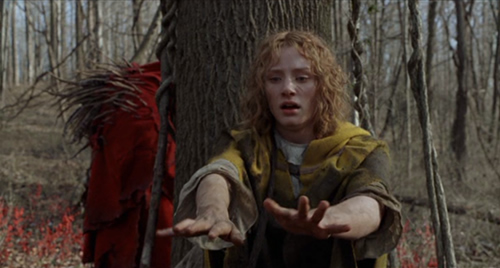
Ivy Walker and monster in The Village

So far so good. We are well into the movie and gripping our seats, but then, Shyamalan’s penchant for twists runs amok. Ivy manages to escape the beast, who turns out to be the boy who had stabbed Lucas, wearing a monster suit.  Ivy comes to a concrete wall, finds a handy ladder nearby, climbs up and over and winds up at the edge of a highway where a ranger in an SUV picks her up, looks at the list of needed medicine her father had written out, gets it for her (they have a bit of trouble), then helps her back over the wall with a warning to be careful.

We learn that the village elders are actually refugees from the culture of violence in America, who bet their lives and livelihoods on the grand experiment of trying to raise a peaceful generation in a peaceful agrarian culture.

You can check out the theme and logic behind the events at http://en.wikipedia.org/wiki/The_Village_(2004_film), but from my perspective, these elements were buried in a flawed story, one that would never ever, ever, ever, ever – as in, no way – have gotten past the the two writing critique groups I sit with.  In other words, not even the least experienced among us would get away with the plot flaws that pepper Shyamalan’s screenplay.

That, I believe, is the key to the disappointing trend of this director’s movies.  He tries to do it all – write the screenplay and direct the movie, and his early success must have isolated him from, or deafened him to, the collaborative voices that could have asked questions that should have been posed before the first scene was shot.

Questions like why Ivy’s father, a seemingly decent and caring man, would let his blind daughter brave the woods and the modern world alone?  And if simple antibiotics could save his future son-in-law, the town golden boy, why wouldn’t he just go out and get some.  And no matter how large his personal fortunre, (see the wikipedia page), who on earth is going to believe he could have bought secrecy for an entire village?  We’re supposed to believe that Homeland Security hasn’t studied the satellite photos in a post 9/11 world?

Contemplating this set of Razzies, I was struck with a deep appreciation for the members of my critique groups and all of their comments – those that seem pertinent and those that don’t.  They help keep me honest.  These are not the “discouraging words” I mentioned in my previous post.

Discouraging words sound like this:  You can’t.

Good criticism from people who value each other’s efforts sounds very different:  You can, and here are some ideas on how to proceed.

And The Winner Is: Some Excellent Oscar-Related Resources

Here are some very neat Academy Award links for writers, thanks to the folks at the Gotham Writer’s Workshop, http://www.writingclasses.com/mailing.php?id=2008.  There are hoopla links to articles in Variety and the New York Times, links on books compiling the history (and “secret history”) of the Academy Awards, as well as info on Gotham’s online courses in screenwriting and writing for TV.  (Note:  I have not taken any of their courses so I cannot comment on them one way or another).

What I appreciated most is the list of Academy Award winning screenplays from 1928 to the present.  Quite a few have links to PDF files you can click on and study:  http://www.simplyscripts.com/oscar_winners.html.  Those who have followed this blog know I am a huge fan of screen-writing, and though I do not (yet) aspire to do it, I can think of few better places to study plot structure.

Speaking of which, I happened on a great quote on the difference between story and plot from E.M. Forster’s, Aspects of the Novel:

A story is a narrative of events arranged in their time sequence.  A plot is also a narrative of events, the emphasis falling on causality.  “The king died, and then the queen died” is a story.  “The king died and the queen died of grief” is a plot.

I’ll be out of town for much of Sunday, but I hope to make it back in time for the awards.  This year in particular, I’m interested in some of the movies, writers and actors.

The King’s Speech

I confess that despite the academy award nominations and four-star reviews, I wasn’t really looking forward to The King’s Speech.  In the back of my mind was the thought – “Come on – a full length movie about stuttering?”  The first two minutes of the film changed all that as the genius of Colin Firth and Helena Bonham-Carter pulled me into the pain this affliction brings to sufferers.  There are certain expressions you never forget in the movies, but I cannot recall such expressiveness, such anguish conveyed with so much restraint.  For an actor of the calibre of Firth, a glance or a momentary twist of the mouth can speak volumes.

Firth plays Prince Albert, the Duke of York, second son of King George V, and father of the current Queen Elizabeth.  As the film unfolds we glimpse the life-long pain “Bertie” has experienced – the badgering of his father and brother, and the failure he experiences at every “minor” address he cannot avoid.

Out of sheer desperation, Bertie seeks the help of Australian speech therapist, Lionel Logue (Geoffrey Rush) – and none too soon, for history is about to raise the stakes to a higher level than most of us ever have to experience.  His father’s death and his brother’s abdication leave Albert no choice but to ascend to the throne as King George IV.

“I am not a king, I am not a king,” Bertie cries again and again in the most moving scene of the film.  “I’m just a naval officer!”  But a king he must become in a hurry.  In the climactic scene of the film, he has to address his subjects all over the world when war breaks out with Germany.

Bertie and Logue on their long walk to the radio room made me think of Frodo and Sam on their final ascent to Mt. Doom, and why not?  Both are stories of people who feel completely inadequate to the demands of their fate, but who find the strength to act for their own salvation and that of their nation.  The difference, of course, is that these events really happened.