
The Government and the Marx Brothers

Where's the Seal?

Back in college, one of my professors gave me an idea I’ve never forgotten.  He spoke of myths that shape and inspire our national consciousness, and how they always relate to a past that is not only gone but may not even have happened.  It must have been back in the 70’s, because he referenced the gun-in-the-rack, survivalist twist on the rugged individualism that Bonanza brought into our living rooms once a week.

The Cartwright boys get the job done

I’ve been thinking of myths of politics lately for one simple reason.  In following the current debate in Washington on the debt ceiling, I’ve come to a conclusion I have never reached before, through good times or bad – until now.  Quite simply, I think we are fucked.

Perhaps not over this particular crisis, for I don’t think any politician who wants to get re-elected – all of them, in other words – wants to get stuck with the blame for a national default.  But I think this “debate” reveals how utterly disfunctional our system has become.  Handwringing over the gummint has probably always been a national pastime – I finally believe it is justified.  Still, I prefer laughter and even creative thinking to handwringing, so I have been mulling over what myths I believed about about our leaders in the past, and what might be a better fit now.

Back in the days when my favorite TV show was “Leave it to Beaver,” I watched  Mr. Smith Goes to Washington with my parents: a rugged individualist from Montana takes on the system, and proves that right and integrity still can prevail.

Jimmie Stewart fights the good fight

Soon after I saw Mr. Smith, for a few brief years, we had Kennedy’s Camelot:  “Ask not what your country can do for you; ask what you can do for your country.”   Fast forward six years and there was Kent State and with Crosby, Stills, and Nash singing, “Soldiers are gunning us down.”  It’s been a roller coaster ride since then with ups and downs, times of malaise and times of letting the good times roll, but all along, at least for me, there was the faith that we can make things better.  Our system may be flawed but it works.  There was always someone to believe in, someone like Senator Robert Byrd, a real-life Jimmie Stewart who carried a copy of the Constitution in his pocket.

Sen. Robert Byrd, one of my heroes

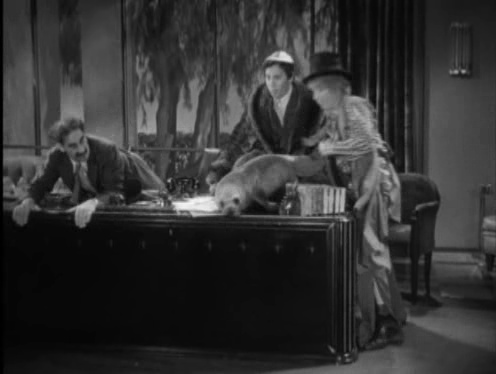
Senator Byrd is gone now, and so is my faith that we can right ourselves in time to avoid driving off a cliff.  What kind of myth fits that?  I’ve been mulling it over for several weeks, and it came to me yesterday, thanks to Turner Classic Movies.  They aired my favorite Marx Brothers film, Horse Feathers, and there it was:  my latest take on the current state of our government:

Do you think there’s a kinder way to depict our current crop of elected “servants?”  If so, please let me know!

After Potter

Of course it is happening in your head, Harry, but why on earth should that mean it isn’t real?  –   Albus Dumbledore

The fact that everyone is weighing in on Harry Potter stands as a tribute to the impact the saga has had on us all.  There’s no doubt the release of the final movie is most poignant for those who grew up with the series; a span of 13 years for the books or 10 for the movies is huge when you are young.  Some of those who picked up The Sorcerer’s Stone in grade school have finished college.

Annie Ropeik, an intern at NPR suggests three adult fantasies for the “Hogwarts Grad.”  She calls one of them, The Magicians by Lev Grossman, a cathartic examination of the nature of magic and our relationship to the stories we wanted to live in as kids — required reading for anyone trying to recover from a lifelong love affair with a fictional world.  http://www.npr.org/2011/07/14/137802346/3-grown-up-books-for-the-hogwarts-grad

Note the language Ropeik uses, especially the word, “recover,” which suggests that a love affair with a fictional world is something we should fight the way someone “in recovery” uses the 12 steps to fight for freedom from an addiction.

I’ve been sensitive to this kind of nuance ever since one of my psychology professors, a colleague of James Hillman and Joseph Campbell, recommended The Neverending Story by Michael Ende with the comment that, “It’s about our culture’s war on imagination.”  Can we graduate from the fictional worlds we have loved and lived in?  Should we even want to?  According to Hillman, our greatest danger is literalism, the mind that is closed to fantasy, or rather, refuses to see the fantasy in all our realities and the reality of our fantasies.

Today may be a day to mourn the end of an era, but it is also a day to celebrate the gifts we have received from Rowling, the young actors, and everyone who worked on the movies.  They have given us an unforgettable world of imagination and dreams where courage and friendship matter, even when the odds are bad, in the struggle of good against evil.

Harry Potter Fan Fiction

Harry, Ron, and Hermione in The Sorcerer's Stone, 2001

Fan fiction did not begin with Harry Potter or the internet.  According to Lev Grossman’s article, “The Boy Who Lived Forever,” in the July 18, issue of Time, xeroxed fanzines appeared after the premier of “The Man from U.N.C.L.E.” in 1964, and really took off with “Star Trek.”

In the broader sense, telling original stories with borrowed settings and characters is nothing new at all.  Homer did not create the Trojan War, Achilles, or Odysseus.  Shakespeare did not make up either King Lear or Henry V.  But with the internet and Harry Potter, fan fiction has exploded.  There are more than 2 million pieces on fanfiction.net and more than a quarter of these are based on Potter – everything from short stories to full length novels.

The final movie will not be the end of original Potter creations

Grossman explodes most of the stereotypes of those who write and read these tales.  One 38 year old writer and actress says it’s like character improvisation.  A best selling fantasy writer whose novels have been optioned by Peter Jackson says, “Fanfic writing isn’t work, it’s joyful play.”  This raises the key question of why writer’s of fiction write.  Joyful play, a platform, and an appreciative audience are there – and it’s not like many creators of “original” stories get to leave their day-jobs.

Well known authors fall on both sides of the unanswered copyright issue.  J.K. Rowling and Stephanie Meyer encourage new fiction based on their characters and worlds.  Orson Scott Card, Anne Rice, and George R.R. Marin, author of A Game of Thrones do not, and threaten lawsuits.  It may or may not be coincidence that the authors Lev Grossman names as supporting fanfic are more recent and write for a younger audience than those who are in opposition and write for adults.  So far, all cease and desist requests have been honored, so there are no legal precedents in the world of fiction, though court cases involving music have been liberal in their interpretation of what constitutes “fair use.”

This begs the interesting question of who a character or world belongs to.  Groosman says that until recently:

Writers weren’t the originators of the stories they told; they were just the temporary curators of them.  Real creation was something the gods did…Today the way we think of creativity is dominated by Romantic notions of individual genius and originality and late-capitalist concepts of intellectual property, under which artists are businesspeople whose creations are commodities they have for sale.

Personally, I have always loved the poet’s invocation at the start of The Odyssey:  Sing in me, muse, and through me tell the story… 

In my experience, the “I” does not invent worlds or characters.  Whether you call it the muse, the gods, or the collective unconscious, fictional worlds and imaginal people come from somewhere else.  With a bit of luck and humility, the “I” may get to witness what happens, and may even get adept at finding new rabbit holes.  To me, the idea of “owning” a “product” of imagination smacks of hubris.

There is no real data on whether fanfic hurts an author economically.  Intuitively, I can only imagine it benefits Rowling and Meyer.  I hope so.  Creativity is creativity, regardless of what spark ignites it.  I’m thinking of dropping by some of the sites to see what these authors are up to.  For those who write for the joy of it, I wish them a lot more.

Midnight in Paris: A Movie Review

https://i0.wp.com/cdn2-b.examiner.com/sites/default/files/styles/image_content_width/hash/48/f6/48f651f5883697520af2afd5b5372777.jpg

Midnight in Paris, written and directed by Woody Allen, is a delightful romantic comedy and another of Allen’s meditations on the relationship between art and life, this time with time-travel in the mix.  Want to see Ernest Hemingway speaking exactly the way he wrote?  Kathy Bates holding forth as Gertrude Stein?  Want to see an insufferable pseudo-intellectual get his comeuppance, and the right couple go walking off together in Paris in the rain?

Gil (Owen Wilson), a successful screenwriter visits Paris with his fiance, Inez (Rachel McAdams), and her family.  Gil dreams of moving to Paris to finish his novel about a man who opens a nostalgia shop.  Inez wants her parents to help her talk sense into Gil and get him to settle down in Malibu.  Gil wants Inez to walk with him in Paris in the rain.  Inez tells him not to be silly, they would get wet.

After a wine tasting with Paul (Michael Sheen), the sort of pompous know-it-all that Allen loves to parody, Gil decides to walk home by himself.  At the stroke of midnight, an old-time car pulls up beside Gil.  Revelers invite him in and transport him to a party where he meets F. Scott and Zelda Fitzgerald, who introduce him to Hemingway, who takes him to Gertrude Stein, who agrees to read his novel.

Even Inez notices how strangely Gil begins to act – sequestering himself to write by day and taking long walks at night.  He tries to demonstrate how he travels into the past, but she stalks off just before midnight and misses the car when it pulls up.  Gil meets Pablo Picasso and his beautiful mistress, Adriana (Marion Cotillard), who instantly captures his heart.

While shopping for furniture with Inez, Gil meets a sweet young antiques dealer, Gabrielle (Lea Seydoux), who shares his love of the 20’s and Cole Porter.  He discovers a battered copy of Adriana’s diary and finds a loving passage describing himself.  Returning to the past, he confesses his love to Adriana, who has left Picasso.  That night an ancient coach pulls up to carry the pair to her Golden Age, La Belle Epoque.  They stop at Moulin rouge and meet Toulouse Lautrec, Degas, and Paul Gauguin.

Adriana begs him to stay, but as Gil sees the famous painters dreaming of the Renaissance, he sees through his Golden Age illusion and decides to return to his present.  On the way, he stops off to see Gertrude Stein, who has finished his novel.  She likes it but thinks it needs a touch of the supernatural.

Back in his own time, he confronts Inez about her affair with Paul (Hemingway brought it to his attention).  She and her family leave.  Gil is left by himself in a storm, on his own, in the “ordinary” streets of Paris – which might not be so ordinary.  He runs into Gabrielle who loves to walk in the rain and says she would like it very much if he walked her home.

My brief description does not do justice to story and all the whimsical sub-plots – like the detective that Inez’s father hires to follow Gil, who makes a wrong turn and winds up lost in the court of Louis XIV.  This is a delightful movie.  If the story seems at all intriguing, I guarantee you will laugh out loud during the movie and walk out with a smile on your face.

Gettysburg Day: The Third Day, July 3, 1863

On the afternoon of July 3, 1863, 15,000 men of General George Pickett’s division sheltered behind McPherson’s Wood during the fiercest artillery bombardment of the war.  Ninety minutes later, when the cannons fell silent, they passed through the wood and and marched over a mile of open ground to attack the Union center.

Numbers identify trees the War Dept. has identified as survivors of the battle

As you stand beneath the boughs of the trees, and gaze at the stone wall marking the Union position, it is almost beyond imagining what those men were feeling as they formed their ranks.  They were all veterans.  They probably knew what would happen as well as their commander, General James Longstreet, who did his best to talk Robert E. Lee out of the attack.  Lee would not budge.  His men had repeatedly done the impossible; maybe they would do it again at Gettysburg.

Where some of the generals wore plumes in their hats, talked of the bravery of southern manhood, and thought in terms of Napoleonic tactics, Longstreet was a pragmatist who knew that warfare had changed.  He had already invented a new kind of trench, anticipating the tactics of WWI.  He knew that bravery wouldn’t keep you alive when facing the fire of rifled muskets that were lethal at half a mile or when charging into cannons loaded with ball bearings.  He told Lee that no 15,000 men ever assembled could take the ridge, but he was overruled.  When Pickett asked, “Shall I go,” Longstreet could not even answer; all he could do was nod his head.

In one of the most tragic events of the Civil War, the men of Pickett’s division formed their ranks and moved over the fields in lines the northern men found stunningly beautiful, even as they fired their cannons and blew them apart.

Pickett’s 15,000 men suffered 60% casualties that afternoon.  As the survivors staggered back to the woods, Lee met them.  “It is all my fault,” he told the troops.  “All my fault.”  The south never had another chance to win the war.

The only brigade to reach the wall was led by General Lewis “Lo” Armistead.  His story illustrates the brother-against-brother tragedy of the Civil War.  Armistead and Union General John Hancock were close friends during the Mexican War and later in California.  On the night before they took separate trains to join opposing armies, they gathered with other officers to drink and sing and make tearful toasts to each other.  Armistead said, “May God strike me dead if I ever lift a hand against you.”  When he learned that he would have to march against Hancock, who commanded the Union center, Armistead did not think he would survive; he sent his family bible to Myra Hancock, his old friend’s wife.

Armistead was shot three times as he crossed the wall.  As union solders gathered around him, he said, “Tell General Hancock that General Armistead is so very sorry.”

This clip from Gettysburg is one of the most moving of the film and represents one of the saddest events in American history.  It is Armistead who gives the order to March.  It is worth noting that this scene, like most in the movie, was filmed on the Gettysburg battlefield, with the help of thousands of Civil War re-enactors who bring tremendous realism into all of the scenes involving the armies.

On the next day,  July 4, the Confederates reformed their lines as driving rain fell.  Lee hoped Meade would attack, mirroring his own mistake of the day before, but no attack came.  That night, the southern troops left the field and started their march back to Virginia.  Meade pursued the retreating Confederates, but half-heartedly, allowing the remnants of Lee’s army to escape.  WIth vigorous action, he might have ended the war – instead it dragged on for another two years.

Gettysburg: The Second Day, July 2, 1863

By the morning of July 2, both armies were in place on ridges facing each other about a mile apart, but the Union forces, arranged in the shape of a fishhook, had the advantage of easily defensible terrain and ease of communication.  The Confederate line was five miles long and messages were harder to transmit.

Lee planned a series of coordinated, “en echelon” attacks on both flanks.  Timing was critical.  One attack was to follow another, to confuse the enemy and prevent men from reinforcing other parts of the line.  The distance worked against Lee.  So did his unfamiliarity with the terrain.

Battle lines on the afternoon of July 2

The assault was supposed to begin in the morning, but it took Longstreet longer than expected to position his men.  At one point the column came into view of the Union troops, and to preserve the element of surprise, they doubled back and  took a roundabout way to reach their objective.  The assault did not launch until 4:00pm, and Ewell’s planned diversionary attack on the right did not begin start 7:00pm, too late to confuse the northern forces.  To make things worse for Longstreet, his commanders were not in position to roll up the Union flank as Lee had expected.  Instead, the ground before them was well defended.

In the course of the bloody afternoon, both sides realized the hill called Little Round Top was undefended.  Union commanders rushed Joshua Chamberlain’s 20th Maine, including the 114 former-mutineers, into position, with orders to “hold to the last.”

Some historians now dispute the assertion that the Union army would have fallen if Little Round Top was lost, but everyone who ought for the hill that day believed it.  Chamberlain’s men repulsed repeated assaults.  They started the battle with 60 rounds each, but even taking the cartridges of the fallen, they ran out of ammunition before the battle was over.  Under orders not to retreat, but with his men unable to shoot, Chamberlain ordered a bayonet charge, a tactic from the books of military history he had studied.

The Confederates were exhausted.  The day was hot, and many of them had been fighting all afternoon with empty canteens.  When the Union forces came charging downhill out of the trees, many gave up the fight and surrendered.  The others fled.

Chamberlain was wounded in the foot that day, one of six wounds he would receive in the course of the war.  One, in 1864, was so serious he was promoted to brigadier general where he was fallen, since no one believed he would survive the day.  He recovered and his regiment was chosen by Grant as the honor guard at Appomattox when Lee surrendered.

Joshua Lawrence Chamberlain served four terms as Governor of Maine, and thirty years after his stand on Little Round Top, he received the Congressional Medal of Honor.  After retiring from politics, Chamberlain became president of Bowdoin College.  He died in 1914, a few months before the guns of August signaled the world’s descent into another round of the folly he had survived.

Gettysburg: The First Day, July 1, 1863

By the summer of 1863, Major General John Reynolds was regarded by officers of both north and south as the best general in the Union army.  In a confidential meeting on June 2, Lincoln is said to have offered Reynolds command of all northern forces.  Reynolds supposedly said he would only accept if he could have free rein and be shielded from Washington politics, conditions Lincoln could not meet.  This left Reynolds at front of the Union army when Buford sent urgent messages requesting assistance in holding a strong field position against vastly superior forces.  Where many other northern generals would have dithered and delayed, Reynolds understood the gravity of the situation and moved his troops forward with all possible haste.

Gen. John Reynolds. Public domain

He arrived just in time.  After repeated assaults, Buford’s line was ready to break when Reynolds arrived with two corps to counterattack.  Buford and Reynolds’s bold moves preserved the Union position on the heights, which in the end decided the battle.  Reynolds bought the advantage at the cost of his life, for as he urged his men forward, he was shot through the neck and died instantly.

About the time that Reynolds fell, Confederate General Richard Ewell’s troops arrived from the north.  Attacked on two sides, the Union forces fell back through the town and reformed on Cemetery Hill.  When Lee arrived on the field, he ordered Ewell, who commanded Stonewall Jackson’s old brigade, to take the hill, “if practical.”  Jackson undoubtedly would have found it practical.  Ewell did not, and also did not send troops to neighboring Culp’s hill, which the northern forces occupied under the cover of darkness.

The vision and courage of Union generals Buford and Reynolds, combined with the hesitation of Ewell, gave the northern army a huge advantage in field position after the first day of fighting.

John Buford died in December, 1863, in part from the effects of old wounds.  On the last day of his life, Lincoln promoted him to Major General in recognition of his service at Gettysburg.  Buford asked, “Does he mean it?” and when assured that he did, he said, “It’s too late now.  I wish that I could live.”  He died in the arms of fellow cavalry officer, Miles Keogh, who would later ride with Custer to his death on the Little Bighorn.

John Buford monument at Gettysburg

To be Continued

Gettysburg: The Eve of Battle

On the morning of June 30, 1863, Col. Joshua Lawrence Chamberlain, awoke with the aftereffects of the heat stroke he had suffered while marching the day before.  Chamberlain, 34, was a professor of rhetoric at Bowdoin College who spoke seven languages, but had always wanted to be a soldier.  He had asked for a leave to join the army the year before but was denied, so he applied for a sabbatical to study language in Europe.  When it was granted, he went instead to the Governor of Maine, who commissioned him a Lt. Colonel in the newly formed 20th Maine regiment.

Col. Joshua Lawrence Chamberlain

On the morning of June 30, Chamberlain had other problems as well:  120 men from another Maine regiment had refused to fight because of a controversy involving their enlistment papers.  They had been sent under guard to Chamberlain, with a note from the commander of the army saying Chamberlain could shoot them “if necessary.”

Instead, Chamberlain used his rhetorical skills to persuade 114 of these men to join the 20th Maine, which had lost more than 700 of its original strength of 1000 men to battle and to smallpox.  This was one of those destiny moments in history; two days later, Chamberlain and the men of the 20th Maine would save the Union army at Little Round Top.

***

Another key bit of destiny was in play the day before the battle.  Union general John Buford, a cavalry officer who loved the western territories, didn’t know how to curb his tongue, which has never been a good survival tactic in Washington – it got him assigned to a desk.  Just two weeks earlier, he had won command of a cavalry troop of 2500 men and 6 cannons.  His orders had been to shadow Lee’s army from a safe distance and communicate their movements back to the infantry.  But Lee had changed directions during the night.  Suddenly, at noon on June 30, as Buford rode into Gettysburg, that safe distance was gone!  He was faced with Confederate general Harry Heth’s column of 8000 infantry entering the town.

Then, incredibly, Heth retreated.  Buford correctly reasoned that Heth was under orders not to attack until the troops were in place with greater strength.  He could see that the heights around Gettysburg offered excellent field position and whoever occupied them first would have a huge advantage.  He had seen the slaughter that resulted from fruitless charges against such positions.  He sent couriers galloping to the main force and ordered his own vastly outnumbered troops to dig in and prepare to hold until help arrived.

To Be Continued