Straight croissants

Even to me, this title seems to refer to the sexual preference of breakfast pastries, rather than its real subject, their shape. This is because “croissant” is French for “crescent,” and who ever heard of a straight crescent outside of higher mathematics?

straight croissant 2
Well, our cousins across the water are embroiled in a debate on this very subject.

Tesco, the largest supermarket chain in Britain, will no longer sell curved croissants. Tesco croissant buyer, Harry Jones, spoke of “the spreadability factor.” Curved croissants typically require three strokes to cover their surface with jam, the preferred topping of most Brits, while a straight croissant can be covered by a single sweeping stroke, thus cutting the risk of sticky fingers or table cloths. (1)

As a veteran of many sticky finger incidents involving restaurant marmalade containers, I can attest a Daily Telegraph editorial is wrong: it is not necessarily safer to eat toast!

Discussions of ease of use and symbolism fail to consider health implications. French law declares that straight croissants must be made with butter, while the curved varieties can use margarine.

In a world where so many familiar structures are in flux, curved croissants are now one less thing we can count on.

I guess there’s no help for it. Benjamin Turquier, last year’s champion Parisian butter croissant maker, said “I can understand the importance of symbolism and tradition, but straight croissants are more practical to make.”

Sigh…we’ll just have to learn to deal…

Trust no one!

Paranormal conspiracy theorists and science fictions fans from Area 54 to Roswell will recognize my title as the motto of FBI Special Agents Fox Mulder and Dana Scully, whose whimsical escapades have returned to television.

x-files-2016-premiere

On a less amusing note, it’s the American attitude toward virtually all institutions, according to journalist, Jeff Greenfield, whose essay,”In Nothing We Trust,” aired on the PBS Newshour on Friday, February 5.

Greenfield cites a recent Pew Research poll showing that Americans mistrust most institutions; only 19% of us trust the government to do “what is right most or all of the time.”

In 1964, with a strong economy, the passage of the Civil Rights bill, and an easing of the cold war, the number was 77%. Ten years later, after a decade of war in Viet Nam and a scandal that drove a president from office, the number was 36%, and it has never topped 50% again.

It isn’t just our government, according to Greenfield. We don’t trust churches. Labor Unions. Banks. Large corporations.  Medicine. Greenfield notes, in his TV news segment, that only 21% of us have “a lot of faith” in TV news.

In great measure, says Greenfield, there are good reasons to mistrust these institutions. Think of the movie, Spotlight. The government of Michigan and the City of Flint.  Yesterday’s congressional hearings on 5000% price hikes in the pharmaceutical industry.

In a similar editorial, I once heard a journalist say that the first act of colonial governments was an attempt to discredit all the institutions of the colonized people; “obviously your god, your army, your government are not as good as ours or we wouldn’t be here.” We may be, said the journalist, the first nation in the history of the world to have colonized itself!

Our pervasive mistrust, according to Jeff Greenfield, makes things especially difficult, in a political year, for those seeking to gain the public trust. It may, in fact, reward those who fan the flames of discontent.

But how, he asks, can a republic long survive when it’s motto is, “In nothing we trust?”

American Tragedy of Greek Proportions?

The word, “tragedy,” is one of those words, like “awesome” that overuse has drained of meaning. It parallels the way overload has numbed us to the realities behind the headlines, so that our horror, just three years ago, over Sandy Hook has become a shake of the head and a, “Shit, not again,” as we grab our busy morning coffee. And maybe look over our shoulder at the sound of a backfire. And even listen to morons who say, “This is a hunting state,” as if that has anything to do with anything.

Yes, when I lived in Oregon, not far from Roseburg, you would sometimes see cows in the outlying fields, with COW written in big red letters during hunting season, by farmers who had no great trust in the wisdom of “hunters.” But that is another story.

To once more quote the great Walt Kelly, and Pogo, his voice, “We has met the enemy and he is us.”

gpicone's avataripledgeafallegiance

Since the Sandy Hook Elementary School shooting on December 14th, 2012 over 80,000 people in the US have been shot dead. There have been more than 140 school shootings over that span of time, and more mass shootings this year (298) than there have been days on the calendar (293).

There have been 1,516,863 gun-related deaths since 1968, compared to 1,396,733 cumulative war deaths since the American Revolution. That’s 120,130 more U.S. gun deaths than U.S. war deaths. And that’s including the use of the most generous estimate of Civil War deaths, the largest contributor to American war deaths.

And even though homicides represent a minority of all gun related deaths, with suicides comprising the biggest share, that’s still a lot of people shot and killed with guns. According to CDC data, 63 percent of gun-related deaths were from suicides, 33 percent were from homicides, and roughly 1 percent each…

View original post 420 more words

The medium is…

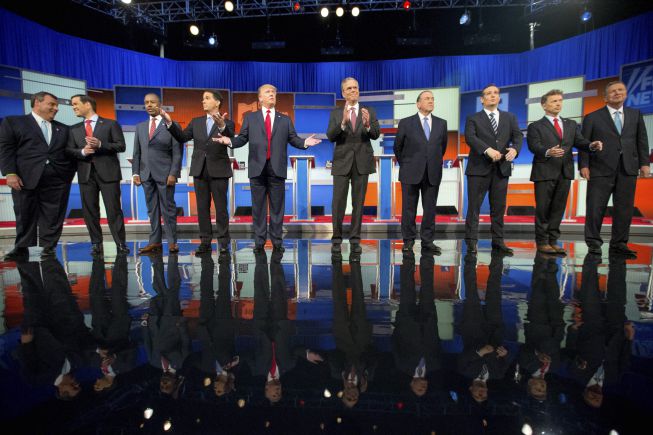
Republican debate

“The medium is the message”, said Marshall McLuhan in Understanding Media, 1964. Fifty-one years later, I’m still not certain we understand media, but a light bulb went on for me Thursday night regarding McLuhan’s iconic phrase. While watching the Republican presidential debate, I had a minor epiphany; that television cannot help transforming politics into entertainment.  

I am not suggesting that either party has a monopoly on show business.  Yes, the Republicans are likely to be funnier this year, with their Jerry Springer moments, and The Donald, who’s public persona is a weird combination of Rodney Dangerfield and Don Rickles.  I expect the Democrats to be far less interesting, more like infomercials on the home shopping channel.

There’s nothing new about politics as entertainment. If we believe television and movie depictions of pre-television and movie campaigns, there was plenty of bunting, and bluster, and brass bands in “the good old days.” But every now and then, wouldn’t it be refreshing to see something real happen on political TV?

The last time I saw reality break through was during the 2004 Democratic convention in Boston.  The Democrats had barred one of my heroes, the late Senator Robert Byrd, from the podium. Byrd could not be trusted to stay on script. Massachusetts Senator Kennedy invited Byrd to speak at the Old North Church, where Paul Revere worshipped, and his address was broadcast on Democracy Now. Byrd held up his well-worn pocket copy of the US Constitution and warned us that it was under attack…

Politics, of course, is not the only thing that TV flattens out. I recall several surreal moments with TV news. One early evening in college days, when I was living in an off-campus house, my roomies and I were watching a shoot out on Mod Squad on an old black and white TV. I went to the kitchen to fix a sandwich, and when I returned, the shootout had grown more intense; the house where the bad guys were hiding was on fire. But it looked different.  “Did somebody change the channel?” I asked.

“Nah, man,” said a house mate. “The news cut in. The cops are having a shootout with those guys who kidnapped Patty Hearst.” The visceral difference between watching a fictional versus a non-fiction firefight on TV was nonexistent without the dialog or voice over!

In a very real sense, that’s simply the nature of things according to both western depth psychology and Buddhist psychology. Every experience we have, noted James Hillman, begins as an event in the psyche. And Buddhist thinkers will tell you that our so-called realities are far more like the dreams we have at night than most of us dare to believe. Yet, as a practical matter, in order to make the right decisions, we have to be able to tell them apart, and that means turning a critical eye on the stuff we see on television.

I have recommended it before, but as we begin another presidential election mini-series, I can think of no better guidebook than Neal Gabler’s Life the Movie: How Entertainment Conquered Reality, 2000.  In it, he says:

“the deliberate application of the techniques of theater to politics, religion, education, literature, commerce, warfare, crime, everything, has converted them into branches of show business, where the overriding objective is getting and satisfying an audience.”

Unless we choose to live with the wolves, we’re going to be part of that audience, but at least we can remember that wonderful Buddhist bumper sticker:  “You don’t have to believe everything you think.”

Does daylight savings time save energy?

Public Domain

Public Domain

Ok, now that daylight time is here for us in the new world, and coming in a few weeks for the EU, it’s time for a pop quiz: who invented daylight savings time?

Yes, fellow Googlers, it was Benjamin Franklin who reasoned it would save candles in the colonies. It was not mandated in the US until we entered WWI, when the intent was to preserve resources.

According to Scientific American, the first study of the effectiveness of daylight savings time was conducted in the 70’s, during our first “oil crisis.” The same article notes that a study in Indiana in 2006, the year that state mandated daylight time in all rather than just some of its counties, showed an increase in energy usage.

Similar results were seen in California in 2007, when daylight time was lengthened by four weeks. California Energy Commission researchers found an energy savings of only 0.2% with a margin of error of 1.5%. Changes in air conditioning patterns as well as the pervasiveness of electronic controllers in homes and businesses are possible causes of the flat or negative results.

I, for one, enjoy the light in summer evenings. Farmers dislike daylight savings time, for it disrupts their schedules. Sports enthusiasts favor it. In the late ’90’s, for instance, representatives of the golf industry said daylight time earned them and extra $400 million in fees each year.

For it or against it, the odds of it’s changing are practically non-existent. Unless you live in Arizona, you’ve lived with it all your life. Besides, there are more pressing issues for Congress to fail to act on than this.

Daylight time is one of those things, like the Superbowl and plum blossoms, like St. Patrick’s day, and the start of baseball season, that signal the coming of another spring and summer. I’m not inclined to complain too much if that costs me an hour of sleep.

The Bell Tolls

Sometime during the first semester of graduate work in psychology, our clinical practice professor made an interesting observation. “The funniest people I know,” she said, “have all deeply experienced sorrow.” Her words came back when I heard we had lost Robin Williams.

They say he suffered from alcoholism and depression, both progressive, fatal diseases that  can be arrested. Interestingly, the media has done much to remove the stigma from both conditions. Ted Danson, as bartender, Sam Malone on Cheers, helped normalize an alcoholic abstaining and going to meetings. And the constant din of TV antidepressant commercials has probably primed millions to “Ask their doctor” about this oh so modern affliction.

Untreated depression, like untreated alcoholism, puts a person at risk for suicide, accidents, and poor health choices that end too many lives far too early. It’s futile to speculate on why some people reach out for help and others do not, but no individual, not you nor I, is a statistic. We are not bound by any kind of odds.

In this world where information is so easy to come by, it is my hope than anyone who sees in themselves the conditions that took Robin Williams from us may hit google and check out the mountains of information on what they may have and what can be done about it.

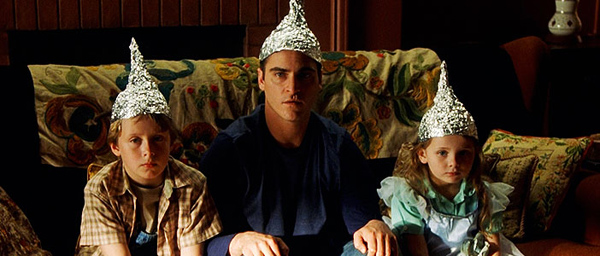
Break out the tinfoil helmets!

From "Signs," 2002

From “Signs,” 2002

I find the tinfoil helmet image is always good for a laugh – don’t want those pesky aliens messing with our thought patterns! At the same time, we all know aliens aren’t the problem. I recently read a statistic that in the US, we see as many advertisements in a year as people 50 years ago did in their lifetimes. Advertisers explicitly set out to mess with our thought patterns. Now an NPR post reveals that “Facebook scientists” have messed with our thoughts as well.

The Bride of Frankenstein, 1935

The Bride of Frankenstein, 1935

Here’s the gist of their experiment:

“For one week back in 2012, Facebook scientists altered what appeared on the News Feed of more than 600,000 users. One group got mostly positive items; the other got mostly negative items.

Scientists then monitored the posts of those people and found that they were more negative if they received the negative News Feed and more positive if they received positive items.”

Experimental methods rapidly followed the birth of psychology in the last century as social scientists sought acceptance into the real community of science. Freud, after all, won his Nobel Prize in literature, not science.

Back in the day, psych experiments were conducted on helpless animals and hapless college students who needed to make a buck. Now, Facebook Scientists (don’t you wish you could see their credentials?) can run such tests on all of us for free, because no human being now living has ever read the Terms of Service for anything online that they wish to join.

I actually find it interesting that this particular test confirmed a hunch I’ve been working out on this blog over the last few months:  Reading negative news makes me crabby, while reading positive news improves my disposition. Only took me four years of blogging to work that out, a truth that could also be summarized by these wise words of British author, Kingsley Amis:  “Nice things are nicer than nasty ones.”

Oh yes, and I was being precise when I said four years – I launched this blog four years ago on June 28. They say most blogs don’t last that long, and I know I’m posting less often lately – it seems like I always get lazy in summer, especially in June. But all of you readers keep me hunting for interesting things, or weird things (like Facebook scientists) to share.  So thanks, I appreciate it, and please stay tuned!

No discouraging words revisited

Embed from Getty Images

In an earlier post, Where seldom is heard a discouraging word, I announced an experiment. Following my wife’s efforts to suspend negative thinking and speech during Lent, I decided to refrain from critical posts through Easter. Here is the first of several observations I will share.

Avoiding negative and pessimistic topics leaves me a lot fewer subjects to blog about! Many of my posts begin with news stories, but often it seems, to paraphrase the old Hee-Haw song, “If it weren’t for bad news, I’d have no news at all.” More nights than not, when I’ve checked my usual source websites (CNN, NPR, USA Today, etc.), I haven’t found a single upbeat or funny or quirky post that I wanted to write about. Sure, there was the girl scout who sold 12,000 boxes of cookies, but even if it’s a good thing for a kid to become a marketing wizard, that isn’t my kind of story.

The real question for me, however, is not the content of this weeks’ or that weeks’ news, but the systemic nature of our news media, which makes trials and tribulations endemic. These are news stories, after all, and a good story demands tension, upping the stakes, and all that. The question is not whether these are gripping stories, but the degree to which they mirror “reality.”

I’m thinking of a book I have often cited here, Neal Gabler’s, Life the Movie: How Entertainment Conquered Reality (2000), in which the author says we are not just a post-modern culture but a “post reality culture.” Gabler locates the beginning of news-as-entertainment in America as “the penny press.” Prior to 1830, newspapers were single page “broadsheets” which appealed to the upper classes. Most of them cost six cents and the average daily circulation in New York City was 1200. Beginning with the Sun, which cost a penny, newspaper sales exploded. Gabler cites various reasons for the success of the penny press, but says that above all, it meshed with other sensational forms of entertainment:

“…for a constituency being conditioned by trashy crime pamphlets, gory novels and overwrought melodramas, news was simply the most exciting, most entertaining content a paper could offer, especially when it was skewed, as it invariably was in the penny press, to the most sensational stories. In fact, one might even say that the masters of the penny press invented the concept of news because it was the best way to sell their papers…”

In it’s first two weeks of publication, in 1835, the New York Herald ran stories that centered on “three suicides, three murders, the death of five persons in a fire, a man accidentally blowing off his head, an execution in France by guillotine and a riot in Philadelphia.” Needless to say, the Herald became wildly successful.

If it’s true that what we think of as “news” is an “invented concept,” we have to ask to what degree it mirrors reality and to what degree it creates it? Think about that the next time you open the paper or check your Tweets.

What I have discovered is how deep the contagion goes, even though I normally limit my sources, never watching the local news on TV, for instance. I confess that while I have cut negative posts from theFirstGates since March 7, I’ve probably doubled the number of depressing subjects I’ve posted on Twitter. In a way, I feel like I did a month after I quit smoking, and found that a nasty cough was still there. This is more serious than I thought at first. I’ll have more to say about it, but meanwhile, let’s change the tone as we end with a classic that came to mind at the start of this post.