Informed Citizen Disorder

Words can sometimes illuminate.  Bill Moyers’ recent interview with Marty Kaplan, Professor of Entertainment, Media, and Society at USC, gave me a phrase that crystalizes the sense of despair that increasingly follows attending to current events.  “Our spirits have been sickened by the toxins baked into our political system,” Kaplan says.  That’s one definition of what he calls, “Informed Citizen Disorder.”

Marty Kaplan by adamrog, CC-by-SA-3.0

Marty Kaplan by adamrog, CC-by-SA-3.0

Kaplan has an impressive and varied resume; a degree in Microbiology from Harvard; a Ph.D in Modern Thought and Literature from Stanford; twelve years as a Vice President at Walt Disney Studios.  Kaplan wrote speeches for Walter Mondale and co-authored the screenplay for The Distinguished Gentleman (1992) starring Eddie Murphy.  He was the founding Director of the Norman Lear Center at USC, which studies “the social, political, economic and cultural impact of entertainment on the world.”

In the interview with Moyers, called Weapons of Mass Distraction, Kaplan spoke of the weeks he recently spent in Brazil, watching the widespread protests against “political corruption, economic injustice, poor health care, inadequate schools, lousy mass transit, [and] a crumbling infrastructure” while the government spends billions to host the 2014 World Cup and the 2016 Summer Olympics.

One of the obvious questions Kaplan asks is where are the protests in our country?  With ills so blatant and parallel to Brazil, where is our outrage?

“Sickened spirits,” is one of his answers.  Another is misdirection; what passes for journalism often has us asking the wrong questions as it feeds us “the infotainment narrative of life in America.”  Learned helplessness is another factor that Kaplan often cites.

Learned helplessness entered the language of psychology in a now-famous experiment conducted by Martin Seligman in 1967.  Dogs were subjected to electro-shocks with no means to avoid them.  Eventually, they stopped looking for an escape and entered a passive and “hopeless” mode.  In the experiment’s final phase, when means of avoidance were introduced, the dogs did not discover them, because the helplessness had been so thoroughly learned they no longer even tried.  Researchers had to retrain them to manipulate their surroundings again.

The analogies to our situation are obvious.  Citing incidents like the lack of change after Sandy Hook, Kaplan wonders how many times can we stand to have our hearts broken?  Answering a question from Moyers on “Informed Citizen Disorder,” he adds:  

“Ever since I was in junior high school, I was taught that to be a good citizen meant you needed to know what was going on in your country and in your world. You should read the paper, you should pay attention to the news, that’s part of your responsibility of being an American.

And the problem, especially in recent years, is the more informed I am, the more despondent I am, because day after day, there is news which drives me crazy and I want to see the public rise up in outrage and say, no, you can’t do that, banks. You can’t do that, corporations. You can’t do that polluters, you have to stop and pay attention to the laws, or we’re going to change the laws.

…every time that doesn’t happen…something bad happened and nothing was done about it…the sadder one is when you consume all that news…all the incentives are perverse. The way to be happy, to avoid this despondency is to be oblivious to it all, to live in Aldous Huxley’s ‘Brave New World.'”

Despite everything, Kaplan remains an optimist.  “I have kids,” he says, “I have to be.  The world has kids, we have to be.”  The alternative to optimism, Kaplan warns, is to “medicate yourself with the latest blockbuster and some sugar, salt, and fat that’s being marketed to you.  The only responsible thing that you can do is say that individuals can make a difference and I will try…”

Not the happy-happy answer we’d get from the “infotainment” world, but though Kaplan is an optimist, he’s not going to feed us bullshit.  I urge everyone to listen to the interview or read the transcript.  A key finding with learned helplessness that researchers discovered and Kaplan cites, is that since it is based on perception rather than fact, it can be quickly reversed.  We’re not there yet, he thinks, but maybe as people become more and more unhappy with the state of affairs around them, a critical mass is building that will lead ordinary citizens to demand change as we have done in the past.

Good News on the Food Front

In several recent posts I’ve expressed the opinion, and quoted others expressing the opinion, that traditional institutions and governments are no longer able to deal with the most serious problems facing nations and the world (see Notes on Tricksters, The North Wind’s Gift, and The Unwinding book review).  An image that comes to mind is the Titanic, whose rudder was simply too small for her bulk.

Titanic at Southampton (public domain).

Titanic at Southampton (public domain).

At the same time, I’ve been watching for stories of positive change that appear under the radar when people and organizations try out new things in new ways.  One of the most dramatic was a series on agricultural innovations called “Food for 9 billion” that aired on the PBS Newshour the week of June 10-14.

Those who watch PBS, as well as those who have read Dan Brown’s Inferno, know what the title means:  nine billion is the UN projection of world population in 2050.  Eighty percent of those billions will live in cities, dependent on food from shrinking acres of arable land.  Food will have to be trucked or shipped in even as oil supplies decrease.  Dickson Despommier, an ecologist at Columbia University, puts it in simple terms:  “We’re going to reach a tipping point really soon where traditional agriculture can no longer provide enough food for the people living on the planet.”

One of the PBS stories centered on Singapore, where five million residents crowd an island with only 250 acres of available farmland.  Jack Ng, a 50 year old engineer,  founded Sky Greens, a vertical farming configuration that features four story greenhouses.  Stacked beds of vegetables rotate through nutrient baths, then back into the light, like slow-motion ferris wheels.  They are driven by gravity-fed water wheels, and the energy cost of each greenhouse is $3 a month!  Singapore’s population embraces the fresh vegetables Ng provides, and the Directer of Singapore’s National Institute of Education says, “I think, eventually, urban factories for vegetable production will take the place of electronic factories in Singapore.”

Each greenhouse stands 30' high and costs $12,000 to build.

Each greenhouse stands 30′ high and costs $12,000 to build.

Another Newshour account centered on farmers along the coasts of India and Bangladesh who directly experience the effects of climate change.  Rising oceans take 600′ of land a year along the fertile Ganges delta, and increasingly powerful storms, like Cyclone Aila in 2009, flood rice fields and farms with saltwater.  Four years after the cyclone, the only crop that will grow where the storm surge reached is a salt-tolerant strain of rice, developed by small farmers a century ago.  Crops promoted by government and agribusiness, which promised high yields with the use of chemical fertilizers, were the first to fail.

One farmer on the Ganges delta says the old seeds are worth more to him than gold.

One farmer on the Ganges delta says the old seeds are worth more to him than gold.

The so called “green revolution” in India, the introduction of high yield and sometimes genetically modified seeds along with nitrogen fertilizers, began in response to the loss of agricultural land to growing cities.  After several decades, however, yields are falling, the required amount of chemicals are rising, and scientists like rice conservator, Debal Deb, are trying to collect the old seeds, adapted to local conditions and weather extremes.  One 64 year old farmer grows 30 different traditional varieties of grains and vegetables on two acres of land, using seeds developed a thousand years ago.  The crops can withstand salt, drought, flooding, and local pests, so they need no chemical fertilizer or pesticides.

A third program in the PBS series shows efforts to improve dry land farming in the desert nation of Qatar.  It shows that agribusiness can play a positive role in adapting farming to a changing climate.  Two large fertilizer companies helped fund the The Sahara Forest Project, which has an experimental desalination plant in an urban industrial zone.  The plant also aims “to produce food and water and energy that actually reduces the amount of carbon dioxide in the atmosphere.”  

Jonathan E. Smith, now with the Qatar National Food Security Program, grew up on an Oklahoma farm, with grandparents who were dust bowl survivors – he knows about drought.  Saying it would be foolish for the nation to place all its hope in a single technology, he demonstrated a low tech solution developed by one desert farmer, who reduces water usage and waste with a series of inexpensive plastic greenhouses.

Notably absent in this series are agricultural innovations from the developed nations, which have not, in any collective sense, admitted there is a problem.  Countries already familiar with scarcity and rising food import costs do not have the luxury of delaying work on long term solutions.  Here, as in many other arenas, innovation tends to come from outside the status quo.

This echoes the European trickster stories I recently discussed (links at the top of this post).  In this genre, the heroes are often middle-aged or older, having worked on a farm or served as a soldier for decades.  The stories begin when these protagonists wake up to find they are on their own.  Increasingly, I think this is the story of people in all modes of life, from all countries, who no choice but to find new paths through the world.

Paranoia stikes deep

My title comes from a phrase Stephen Stills used 46 years ago in the lyrics of, “For What it’s Worth,” a song The Buffalo Springfield released in January, 1967.

Paranoia strikes deep
Into your life it will creep
It starts when you’re always afraid
You step out of line, the man come and take you away

Those lyrics came to mind today around noon, when the dogs started barking. I found a UPS package on the doorstep, lightweight, about 10x8x8, from a local address I didn’t recognize.

“Expecting a package from a place called ‘Copperfield?'” I called to Mary, who was in the other room.

“No,” she yelled back. “Be careful opening it.”

“Honey, if it’s a bomb, being careful won’t help.”

“No,” she said. “I mean that poison.”

“OK,” I called. “I’ll start with the packing slip. That’s probably where they put the ricin.”

It turned out to be the can of black touch-up paint I’d ordered for our wood-burning stove. As you might have guessed, I wasn’t really scared of being blown up, but it was the first thing that came to mind. And why not? “They” consider my phone calls worth logging, and my internet hits, and my credit card use. Those of you with newer high-definition TV’s should realize there is a built-in feature that allows a 3d party to peer into your living room. That’s old news, as in posted at least a year ago, to a collective yawn.

There’s something happening here
What it is ain’t exactly clear

That’s the heart of our problem: what’s happening ain’t exactly or even a little clear, except maybe, “step out of line, the man come and take you away.”

One of the few people in Washington I admire, Sen. Bernie Sanders, Independent from Vermont, posted a survey on his website. Here are the four questions:

  1. Do you favor or oppose the National Security Agency’s program to monitor online communications in order to protect the nation from terrorist threats?
  2. Is it appropriate for the federal government to collect millions of phone records from American citizens, if doing so could potentially disrupt a terror plot?
  3. Do you think the president should or should not have the power to authorize the National Security Agency to monitor the electronic communications of American citizens without getting warrants?
  4. Do you favor or oppose changing the PATRIOT Act, which allows the government to collect the phone records of American citizens without a warrant?

I haven’t taken the survey yet, because I’m still “Unsure” on two of the questions. I find that upsetting, given that Sanders also posted the text of Amendment IV to the Constitution:

The right of the people to be secure in their persons, houses, papers, and effects, against unreasonable searches and seizures, shall not be violated, and no Warrants shall issue, but upon probable cause, supported by Oath or affirmation, and particularly describing the place to be searched, and the persons or things to be seized.

Decades ago, H.L. Mencken wrote, “The whole aim of practical politics is to keep the public alarmed (and hence clamorous to be led to safety) by menacing it with an endless series of hobgoblins, all of them imaginary.”

Right now, I think we are all numb. More precisely, I think this is what psychologists call “learned helplessness.” When a creature perceives that it’s powerless to prevent harmful events, it becomes listless and depressed. Or disgusted with politics. One of these days I expect that listlessness and disgust to erupt as outrage. When and if it does, I don’t think it’s going to be pretty or the stuff of songs – there is too much we have collectively stuffed, and for too long a time.

Remembering Ritchie Havens

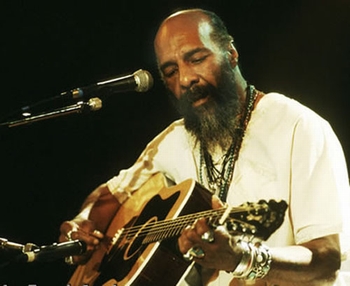
richie-havens_esc

Lots of people are writing memorials to Ritchie Havens who died today at the age of 72.  “Folk singer and guitarist” is what the newspapers say.  Factually correct but nowhere near the experience of hearing his music, especially for the first time.

I was just a kid who found himself, through a strange karmic twist, at the Village Theater in New York, for the first show of Cream’s first American tour.  First we had to sit through a set by some folksinger none of us had ever heard of.  Some Ritchie something guy – and he stunned us. Left the main act in the dust  On our feet, open mouthed, one of those “never heard anything like this before” musicians.

A few years later he did the same thing for half a million at Woodstock.  All I can think to do now is pass on a couple of songs, especially for those who may not be familiar with his music.

Ritchie Havens at Woodstock

Ritchie Havens at Woodstock

Freedom was a theme that ran through most of his music.  One of his best known songs bore that name, but here is one of my favorites that isn’t as well known. He recorded this version of “Follow the Drinking Gourd” for an album of Civil War songs following Ken Burns’ documentary.  Slaves escaping north on “the underground railroad” were told to travel only at night and “follow the drinking gourd,” the constellation we know as the big dipper, where the north star would show them the way.

His songs songs were woven with hopes and dreams.  Here’s another one someone just posted, wanting to share some expression of this beautiful soul.

I keep wanting to say, “Rest in peace,” but for Ritchie Havens, I think it’s a given.

The North Pond Hermit

He was just arrested on Tuesday, but already they’re writing ballads about the North Pond Hermit:

Nobody seen his face in twenty-seven years,
Since that day in ’86 when he up and disappeared.

The story has travelled around the world, and unless you are living in the woods, you’ve heard the rudiments of Christopher Knight’s story:

At the age of 19, he disappeared and set up a camp in the woods near Rome, Maine, where he lived for 27 years by stealing sleeping bags, food, propane, and books from nearby vacation cabins and a summer camp.  He spent the long winters wrapped in multiple sleeping bags and never made a campfire for fear of being discovered.  He spent his time reading and meditating.  His only conversation in 27 years was a greeting exchanged with a hiker he met on the trail in the ’90’s.

Christopher Knight

Christopher Knight

When he was arrested, Knight was neatly groomed and clean shaven.  He’s up on current affairs thanks to a transistor radio he used to listen to rock music, news, and Rush Limbaugh.  That’s about all we know, since Knight politely refuses to talk to journalists or explain himself to anyone.  This guy is going to pass on his 15 minutes of fame, his shot at a spot on Letterman, and the chance for a best selling ghost-written bio!

He walked away into the pines to live out in the woods
He turned his back on everything and he was gone for good.

I think the story resonates so deeply because part of us too, wants to walk away from all that crap.  “Lives of quiet desperation” in the words of Thoreau, who lived for two years in relative solitude at Walden Pond, but never made or intended to make a break as complete as that of Christopher Knight.

Into an unimaginable mystery like this, each of us will project our own biases.  For me, Knight’s practice of meditation aligns him with spiritual seekers who have sought out caves of one sort of another for millennia, but they never threw off all human connections.

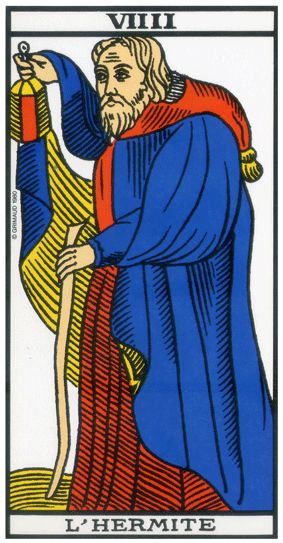
The Hermit, from the Tarot

The Hermit, from the Tarot de Marseille

Christians have maintained a hermit tradition from the desert fathers through Thomas Merton, but none of them relinquished all human company.  Milarepa, a famous Tibetan yogi, lived in a cave for years eating boiled nettles, which gave his skin a greenish cast, yet once he attained awakening, he returned to teach what he’d learned to others.

Did Christopher Knight intend to return someday, to tell us what he’d discovered about the mushrooms and eagles who were his only companions?  We don’t know and won’t unless he decides to tell us.  In a way, I hope he doesn’t.  Whatever his story may be, it will be trivialized and forgotten a week after the tabloids get ahold of it.  I don’t want Christopher Knight’s tale to be forgotten.

Some of his old friends have said he was “intelligent, quiet, and nerdy” in high school – just like millions of us, in other words.  What could make an intelligent man who is one of us, simply decide to walk away, to opt out?  I hope we will wonder about that for a long, long time.

The North Pond Hermit, livin’ in the woods,
The North Pond Hermit, they’d catch him if they could.

You can listen to The North Pond Hermit Song here.

*** UPDATE after posting the original article ***

Troy Bennet and his dog, Hook, who brought you this great ballad, have posted a link to an MP3 version we can download for an optional contribution via Paypal.  Bennet says it isn’t his very best song, but it’s the one he’s written about a hermit this week.

The Secret of Getting Ahead?

Those who are old enough to have watched “Hee-Haw” will remember a song that Tennessee Ernie, Buck Owens, and the gang sang almost every week, “Gloom, Despair, and Agony on Me.”  One of the lines was, “If it weren’t for bad luck, I’d have no luck at all.”

These days, it sometimes seems like if it weren’t for bad news, we’d have no news at all, especially on the economic front.  I’ve been thinking about this a lot lately – not the economy per se, but the news, that is, the stories we tell about the economy.  I’ll have more to say about this later, but it’s increasingly clear that what we have beneath the headlines are dueling paradigms, different core assumptions of what is good and bad, what works and what doesn’t.

Here is a core assumption that never has gotten much air time:  altruism rather than self interest may be the greatest motivational force for people at work.  This is the thrust of the teaching and writing of Adam Grant, 31, the youngest tenured and highest ranked professor at the Wharton School of Business.  Sarah Dominus, a writer for the New York Times Magazine, profiled Grant in a March 27 article,  Is Giving the Secret to Getting Ahead?.

Grant first made a name for himself in the field of economics as a 22 year old grad student in organizational psychology, when he applied himself to boosting motivation and output at a university fund raising call center, a notoriously unpopular student employment option.

Realizing that the call center helped fund scholarships, Grant invited a scholarship recipient to address the callers to give them an idea of the value of their work.  Even Grant was amazed when the next month, revenues were up 171%.  In later studies, the jump was as high as 400%.  Since then, Grant designed other studies in other fields that gave parallel and equally quantifiable results.

Grant’s work has drawn criticism as well as praise, much of it centered on the potential for abuse of the findings.  Will corporations try to use them to keep workers happy while cutting their wages and benefits?  According to Sarah Dominus, Grant is skeptical of corporate motivation as well and says his effort is to understand the mechanism, not necessarily suggest implantation.

Two weeks ago, I attended a day long retreat with Norman Fischer, a long time teacher and former abbot at the San Francisco Zen Center.  The subject of his retreat was compassion.  “Self-cherishing never makes anyone happy,” he said.  “In the long run, concern for others is very practical.  It’s our only chance for living a satisfying life.”

I started thinking of the how and why of our bad news headlines when Fischer said he remains optimistic.  Despite the chaos and breakdowns of our traditional systems, he believes that interactions based on compassionate regard for each other are the future.  “Not in my lifetime and maybe not in yours, but I think it’s coming,” he said.

That’s why I was so pleased to discover Adam Grant’s work.  I don’t often think of economics as a likely field of compassionate action, but if, as the Buddha asserted, it’s an impulse at the core of our being, we should expect to find the evidence everywhere.  Adam Grant seems to have found it at the heart of “the dismal science.”  His first book for a wide audience, Give and Take, was published on April 9.

More on Robot Surgery

In a strange synchronicity after my robot post yesterday, our Sunday paper business section carried an article called “Robot surgery faces lawsuits.”

The source for the piece is listed as Bloomberg News, and this appears to be original story, posted on their website March 5.  No cute robot pictures this time, and no comments from me except to suggest everyone read this: Robosurgery Suits Detail Injuries as Death Reports Rise

Pandora’s box, repression, and gun violence

From my perspective, the big news this week was the start of senate hearings on gun violence, which evoked a wide range of passions across the spectrum of public opinion.  More poignant than any testimony in Washington was the death of Hadiya Pendleton, a 15 year old honor student who performed at President Obama’s inauguration on the 21st.  The day before the speechifying began, Hadiya was shot and killed in public park in a “nice” section of Chicago, about a mile from the president’s house.  Police think it was a case of mistaken identity.

I thought of Hadiya Pendleton as I was out walking the dogs in a “nice” local park.  I remembered a lecture one of my psych professors gave 20 years ago.  We were studying defense mechanisms, and of these, repression gets a lot of bad press.  Nobody wants to be repressed or live in a repressive society.

My professor expressed an alternate view in his lecture:  repression kept a lid on many antisocial behaviors.  He quoted James Hillman who said, “What used to be the darkest dreams of Freud’s neurotic patients are now played out on our streets.”

The human psyche has not changed in 100 years, but our world has altered dramatically.  Men no longer need to wear boiled shirts, and women are free to bare their ankles.  We’ve learned to embrace the individual conscience and the search for an “authentic me,” but we don’t know what to do if someone’s “authentic me” turns out to be a sociopath.

We’ve found out the hard way that you  can’t just unrepress the good stuff.  When we let our angels out of the box, the demons get a pass too.  Which brings to mind the story of Pandora.

In order to punish humans for Prometheus’ theft of fire, Zeus sent Pandora to earth with a sealed jar (later mistranslated as “box”) and instructions not to open it.  We all know what happens in folklore with orders like that.

Pandora by John Waterhouse, 1896

By the time Pandora got the lid back on, all the evils of the world had been released.  Only hope remained in the jar.  Pandora’s dilemma is ours.

When it comes to our violent behaviors, inhibition was not such a bad thing.  Now that it’s out of the box, the question becomes, what do we do with our hope?