A Conference and a Resolution

“If we had more stories as children, we would need fewer psychiatrists as adults.” – James Hillman

On Saturday, I attended the Spring Spirit Conference of the North/Central region of the SCBWI – Society of Children’s Book Writers and Illustrators.  This all day event took place in Rocklin, just 20 minutes from home.  It featured seminars and critiques by writers, editors and agents, aimed at people who write for children and young adults.  I had registered at the end of December, but as the day rolled around, I wasn’t that anxious to go.

Part of it was simple fatigue, the after-effect of this spring’s flu.  Part of it was a kind of burnout.  Earlier this week, as I was reviewing a manuscript for one of my critique groups, I caught myself writing a comment out of habit – a knee jerk response I was not even sure was true.  I’ve found myself doing that several times recently, and as a result, I was feeling an impulse to step away and sort out some ideas that didn’t feel like mine.  I wasn’t sure I needed a professional gathering where I was likely to pick up more.

I was pleasantly surprised by the keynote speaker, author and teacher, Bruce Coville.  “Take everything the presenters say with a grain of salt,” he said.  “Your job is to find your own truth.”  Those words turned my day around.  They set the tone of the day, as did his later seminar on writing fantasy, a genre he notes is snubbed by some literati as less than properly serious.  “Tell that to Homer, to Dante, Milton, and Shakespeare,” Coville said.

Sometimes I write fairytales because it’s the best way to tell the truth.” – C.S. Lewis

As I went through they day, an ongoing problem that is really mine came into focus.  I’ve been stalling out on my current book because several key plot elements need to be re-imagined.  Slogging away is not going to do it this time.  I’ve known I need to take a break, take a step back, but that isn’t easy for an A-Type, yankee-ingenuity, roll-up-your-sleeves mentality.  I needed some kind of plan to make it okay to take a break.  And I found one.

When in doubt, read, read, read.  That in itself is a great idea, but I find it hard to study really compelling books when the great ones sweep me into the story from the start – I’ll do the objective stuff later, and later never comes.  I happened to flip through the first book I ever bought specifically to help with plot and structure, called (would you believe) “Plot and Structure,” by James Scott Bell.

Toward the back of the book, Bell addresses that whole issue in a section called, “How to Improve Your Plotting Exponentially.”  It involves getting half a dozen novels, ones you have read or new ones.  Read them first for pleasure, then read them again with a stack of 3×5 cards and note the events, characters and purpose of every single scene.  Review them when done (like “forming a movie in your head,” says Bell).  Finally, lay out the cards and see how the scenes fit into the traditional three-act structure.  Where are the key plot points?  Where is “the door of no return?”  Where is the final battle joined?

This will take eight to twelve weeks, Bell estimates, but because of all that I earlier learned from him, I’m willing to test his estimation that during those weeks “you will jump ahead of 99 percent of all the other aspiring writer out there, most of whom try to find out how to plot by trial and error.” Trial and error has always been iffy for me.

So I’m giving myself permission to take a reading break.  I’ve already downloaded three books to my Kindle:

1)  The Hunger Games by Suzanne Collins, an acclaimed, post-apocolyptic story for young adults.   I started it yesterday and found to my delight, a YA story I can’t put down – I haven’t come upon too many of those recently.

2)  Gone For Good, by Harlan Coben.  This violates Bell’s instructions to stick with the type of book I want to write, but I’ve meant to read this ever since I saw Donald Maass praise the story in his Breakout Novel Workbook.  Besides, I really enjoy action/adventure and believe the genre contains elements that can improve any sort of writing.

3)  Hollowland by Amanda Hocking.  About time I read something by her!

From time to time I will report back on how this goes and probably review at least some of the titles, but right now, I have to get back to  The Hunger Games!

Young Adult vs. Middle Grade Fantasy

I know a sure-fire way to depress myself – visit the young adult section of the local Barnes & Noble.  I should explain.  None of my favorite authors or books like the ones I want to write are out on the shelves; everything is far too market researched, too hip, slick, and cool for the likes of moi.

I made my semi-annual visit recently, and went through my usual chain of thoughts.  Should I take a pseudonym and try my hand at vampire romance?  Should I do like Marcel Duchamp and spend the rest of my life playing chess?

Sooner or later – in this case, the same day – I come to a solution that works.  I stopped by the local library and went to the “middle-grade” stacks.  For readers in this range, roughly older grade school through middle school, fantasy never goes out of style.  Reading these books is like dipping into the fiction that really made me love fiction.

The YA/middle grade distinction is anything but exact.  Harry Potter is usually found in the middle grade section, and in thinking about that, a few differences became clear.  There is less introspection and more action, of course, but there is also a different quality to the characters’ introspection.

A middle grade hero like Harry worries that he is not adequate to take on Voldemort.  A young adult hero worries that he is not adequate.  They are just on different spots of the whole arc of coming of age, which I don’t think anyone ever fully outgrows.  I’m sure that is one reason why people of all ages love Harry.

Here is a brief synopsis of three middle grade fantasies I have thoroughly enjoyed, and which you may as well.

The Sisters Grimm: The Fairy-Tale Detectives by Michael Buckley

Two years ago I drove to a nearby Borders to hear Michael Buckley discuss his popular middle grade fantasy series, The Sisters Grimm. Buckley was snowed in on the east coast and forced to cancel, but interestingly, there were five adults and two seventh grade girls waiting when the news came.  The girls told us how disappointed they were, and gave a synopsis of the series.  Both said they liked these books better than Harry Potter.  When articulate young readers tell me they like something better than Harry Potter, I pay attention; I brought home the first three books of what has grown to an eight book series.

In book one, after their parents mysteriously disappear, Sabrina and Daphne Grimm are sent to live with their Granny Relda in the Hudson River town of Ferryport Landing.  Suspicious Sabrina has no patience with the tall tale this “grandmother” spins – that the sisters are descendants of the famous Brothers Grimm, whose fairytales were actually case files of the activities of “The Everafters.”  These strange and sometimes dangerous creatures of story actually exist in Ferryport Landing, where they were brought and contained by Wilhelm Grimm to ensure their survival.  When Sabrina sees Granny Relda taken by a giant who almost catches her and Daphne, she can no longer doubt.  The sisters must team up with Puck and Jack the Giant Killer to dodge the town police (the three little pigs), rescue Granny Relda, and get to the bottom of a shady real estate deal engineered by the foppish Prince Charming, the mayor of Ferryport landing.


Inkheart by Cornelia Funke

When she is twelve, Meggie Folchart discovers that her father, Mo, is a “Silver Tongue,” a person with a dangerous gift.  When he reads a tale aloud, characters from the book are drawn into our world, while people from our world disappear into the the story.  Meggie learns that her mother, Resa, vanished when Mo read from a rare book, Inkheart, while the evil Capricorn came here from the story.  He has since found his own Silver Tongue to read his henchman into this world, even as he seeks to destroy all other editions of the book, so that Mo cannot send them back.

Mo, desperate to rescue Resa, seeks out the author of Inkheart who still has one copy of the manuscript.  Mo, Maggie, and the author, are captured by Capricorn, whose personal Silver Tongue is of the poorest quality.  When Meggie proves to have the gift, Capricorn threatens to kill her mother unless she reads “The Shadow,” the ultimate evil, into this world.

Inkheart was made into a fun movie in 2009, starring Brendan Frazer, Helen Mirren, and Eliza Bennet as Meggie.  There are two additional titles in this series.  I have not read them, but a friend says each book is better than its predecessor.

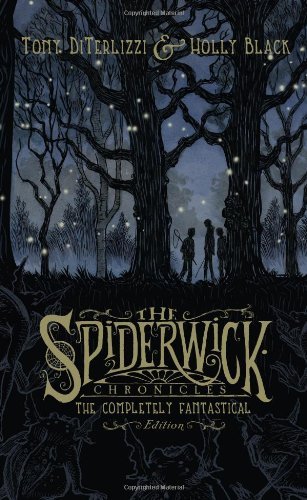
The Spiderwick Chronicles by Tony DiTerlizzi and Holly Black

After his parents split up, Jared Grace, his mother, his twin brother Simon, and his older sister Mallory, find themselves in the broken down Spiderwick Estate.  It’s a dump, and even worse, right on the edge of Faerie.  When the Grace siblings find a mysterious Field-Guide to the nice and not so nice denizens of this other world, some very unsavory creatures are determined to get it back.  At first, poor Jared, with a history of anger issues after the divorce, is blamed for the mischief.  Later  the whole family joins together in a fight for survival.

The Spiderwick Chronicles consist of five thin books.  The edition pictured above contains all of them, because you won’t be able to read just one.  I started the books after seeing an enjoyable movie version in 2008.

What I am reading Next:

I love libraries, where I am free to choose a book by its cover, or in this case, by its title.  Next in my middle-grade book queue is The Faceless Fiend:  Being the Tale of a Criminal Mastermind, His Masked Minions, and a Princess with a Butter Knife, Involving Explosives and a Certain Amount of Pushing and Shoving, by Howard Whitehouse.  I’ll let you know how I like it.

The Cypress House by Michael Koryta

Arlen Wagner, son of a West Virginia undertaker, knows about death, but nothing prepares him for that midnight in the Belleau Wood when he sees a squadron of skeletons marching toward his position and understands that every one of those men is going to die. In the years after the first world war, Arlen relies on whisky and manual labor to try to live with his unwanted “talent” for seeing death before it strikes.

In the summer of 1935, as Arlen and 19 year old Paul Brickhill, travel to a CCC camp in the Florida Keys, everyone on the train suddenly appears as a dead man. At the next stop, only Paul heeds Arlen’s warning to wait for the next train, and only Paul survives.

After that, things get strange…

That comment is not just meant to be facetious but points to one of the tactics Koryta uses to weave supernatural elements into his tale in a seamless fashion that is too often missing from the “urban fantasy” sub-genre that I once enjoyed but which soon became predictable.  Koryta is a master of mood who plants the vision of dead men on a train among a wealth of ordinary details:  the ever present heat, the smell of unwashed bodies, the cigarette smoke, the card games, and Arlen’s surreptitious sips from his flask.  In the next moment, he can make a simple walk down an empty road in the dark of the tropical night burst with menace.

He delivers on the promise of menace – and secrets.  Everyone has secrets – layers of them.

Arlen and Paul catch a ride with a man who takes them to The Cypress House, a roadhouse in the middle of nowhere, owned by a stunningly beautiful woman.  A few minutes after their arrival, the man who gave them a ride tries to slip away, but is incinerated when a bomb explodes in his car.  Why?  Why are Arlen and Paul arrested for the crime?  What secrets hide in the Cypress House – cypress house – another name for a coffin, Arlen remembers his father saying.  The very best kind of coffin, the coffin of choice for ancient kings and for popes.  Arlen’s father, who claimed he could talk to the dead.  He was insane – wasn’t he?

Michael Koryta, author of five mystery novels, charted a new direction by introducing supernatural elements into So Cold the River, which I praised on this blog last summer.  The Cypress House just came out.  Like its predecessor, this is one of those rare books I could not put down.

How Garth Nix Writes a Novel

Who is Garth Nix?  He is a prolific Australian writer of young adult fantasy, whose “Abhorsen Trilogy,” (1995-2003) more than any other fiction, inspired my own current efforts, and “gave me permission” to write the stories I’m working on now.

Garth Nix and Yokimo at World Fantasy Con 2009

Writing anything is better than not writing something perfect – Garth Nix

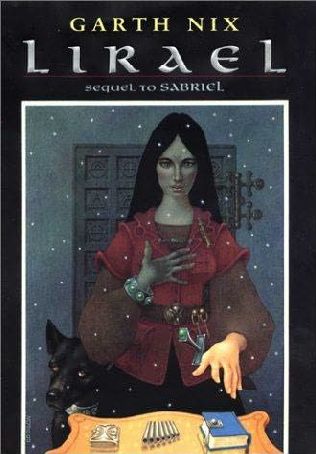
Abhorsens (there is only one at a time), are necromancers charged with keeping the dead, dead – the nastiest dead do not want to stay that way. We’re talking zombies before zombies were cool. In Liraeal (2001), my favorite book of the series, a young woman, apparently a washout from an academy of magical women, sets out with her only friend, the Disreputable Dog, and an inexperienced prince, to save a thinly disguised England and Scotland from several “Greater Dead” leaders of an army of reanimated corpses. Great stuff, like I said!

You can’t write if you don’t read – Garth Nix

Tonight I was browsing Garth Nix’s website (there is a permanent link on my Blogroll) and I came across the author’s account of the nine general stages he has gone thorough in the creation of his 14 novels.  http://www.garthnix.com/Nine%20Stages%20of%20a%20Novel.htm/a>

The nine stages are:

  1. Daydreams and Musing
  2. A Small Vision
  3. Building the Bones
  4. That First Chapter
  5. The Long, Hard Slog
  6. Sprinting Home
  7. Rest and Revision
  8. Revulsion and Dejection
  9. Parting Company

It is instructive to read all of his comments, but here is a summary:

Daydreams and Musing

This is about gathering ideas.  Nix says many people think coming up with ideas is difficult, but he says it’s easy, the fun part.  The difficulties come later.  Images, snatches of conversation, a hunch of a character, these are the the sort of things he gathers, like picking up rocks which “may or may not contain a useful gem.”   He gives examples:

  • The look of the sky in summer when a light rain is falling at sunset
  • Two old men bickering light-heartedly on the street about something that occurred forty years ago
  • The Venetian agents who stole the body of St Mark from Alexandria
  • A car with a cracked speedometer

A Small Vision

This, says Nix, is like a still from a movie he knows nothing about, but it will evoke a mood:

“Two old men are watching the rain from inside a car (with a cracked speedometer) as the sun sets in the distance, discussing their famous expedition to Alexandria to recover the body of St Mark and take it to Venice. The mood is somber and melancholic, something terrible is about to happen.”

Out of this, he is likely to build a scene, often, but not necessarily, the first one.

Building the Bones

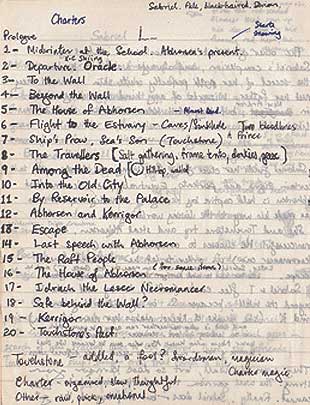
After weeks or months or even years, Nix will review any notes he has made, and write a very simple chapter summary.  He says he often does not know why he does this, since he usually diverges from any such plan within a few chapters, and by the half-way mark the book has little if any relation to the outline, but he notes that an outline serves other purposes:

…it makes me think about the overall structure of the novel, which I think kickstarts some subconscious process that will continue through the writing, monitoring the narrative structure. The second purpose is that it serves as a psychological prop. If I have a chapter outline, I presume I know where I’m going, even when I don’t really.

Chapter Outline for "Sabriel"


The First Chapter

By “first chapter,” Nix says he usually means “prologue,” and that once that and the chapter outline (in whichever order) are complete, the book usually rests for weeks or months.   During the interval he works on other things, and continues to think about the project, but doesn’t actually work on it.

The Long, Hard Slog

Nix always used to write first drafts longhand before copying them to a computer.  Now he is not likely to do an entire draft longhand, but usually the opening chapter(s) are first written in notebooks.  I never tell myself I am writing a 100,000 word book. When I sit down to write, I focus on the fact that I am writing a 2,000-4,000 word chapter. A chapter is a do-able thing. Even so, he calls it a slog, and says 90% of his writing time is an uphill battle to complete the first 2/3 of the novel.

Sprinting Home

At a late stage in the narrative, the writing will kick into overdrive, and the author will find himself working both day and night (he ordinarily likes to keep regular office hours and spend evenings with his family.  I think there is some relationship between the energy put into a book and the energy of the narrative, and when everything is building to the climax and resolution of the story I think that for me at least, it helps to keep at it, to write fast and really charge for the finish line.

Rest and Revision

Nix likes to let the story lie fallow for several weeks before doing revisions, though he says now that’s he is often working on deadline, he has only so much time before he has to send it off to an editor.

Revulsion and Dejection

Nix says, …halfway through a book I usually doubt my work, but I get over it and keep going. Often, when the book is done and has gone off to the editor, this doubt returns and I think that not only have I lost the ability to write, I’ve demonstrated this lack in the latest manuscript. He mentions several of his strategies for getting past this mindset on the website.

Parting Company

The final point he makes is the importance of letting go.   Before breaking into print, Nix worked as an editor at HarperCollins, and says,  In my years in publishing I often met authors whose whole self was entirely bound up in a single book, usually their first. Their lives would rise or fall depending solely on that book’s fate, and in this business, that’s an incredibly foolhardy and dangerous gamble to make.

Garth Nix first came to my attention through an interview in the arts section of the local paper.  I liked his matter-of-fact tone about his writing process then, and I like it on his website now.  He simply offers his process as one approach, not the approach, and the message is, you really do know what to do – now go do it.

Just write one chapter at a time and one day you’ll be surprised by your own finished novel – Garth Nix

The Forgotten Garden by Kate Morton

I choose new books in a variety of ways. Over the last year, I drove frequent round trips to the bay area and became a big fan of audiobooks. Earlier this month, while roaming iTunes, I came across this description of  The Forgotten Garden:

A foundling, an old book of dark fairy tales, a secret garden, a maze, an aristocratic family, a love denied, a mystery – The Forgotten Garden is a captivating, atmospheric, and a compulsive listen about the past, ghosts, family, and memories…

Ghosts, memories, identity – these are hot-buttton themes for me lately, and I did the download. As I got into the story, I wanted to study certain passages in detail, so being a newly-equipped Kindle wonk, I downloaded the eBook.

In 1913 London, a mysterious woman, “the authoress,” leaves a four-year-old girl aboard a ship bound for Australia, with strict instructions to wait for her on the deck.  The authoress never returns.  The child, who hits her head during the voyage, lands with no idea who she is.

A dockmaster takes her home, and he and his wife name her Nell.  On her twenty-first birthday, the dockmaster tells Nell the story, plunging her into a search to learn who she truly is:

Pa’s secret had changed everything.  His words had tossed the book that was her life into the air and the pages had been blown into disarray, and could never be put back together to tell the same story…This person she was, or thought she was, did not really exist.  There was no Nell O’Connor.

Nell never quite unravels the mystery, but when she dies in 2005, with “The authoress…I was supposed to wait,” on her lips, her granddaughter, Cassandra takes up the search.

The book spans over a century, largely focusing on the years 1913, 1975 when Nell travels to England to search for her past, 2005 when Cassandra does the same, and the turn of the century, when we meet the authoress, the mysterious Eliza Makepeace, as an impoverished child in the London of Jack the Ripper.  Eliza lives with her brother Sammy, a changeling….

A what???  A changeling – one of the strange creatures the fairies leave behind when they take a human child.

Some reviewers fault The Forgotten Garden for it’s slow buildup, its rambling style, its sheer length and focus on detail, but I think those very elements may add to the subtle strength of a story that can smoothly fuse what we think is real with what we think is not.  This is not your typical urban fantasy, in the way that Buffy is urban fantasy.  There are still places in Britain where you can walk outside on a moonless night and understand why people believe in other worlds.  Cornwall, where Nell lived as a child, is one of them, and Morton brings this into her story.

It is often the custom these days, for books and movies to open with white-knuckle action.  Perhaps that’s why I like audiobooks so much.  Something about the speaking voice, its rhythms and pauses, slows us down enough to allow the teller to weave the tale.  The point is magic, after all, and there are many ways to get there, some of them in danger of being forgotten.

Kate Morton - Authoress

Kate Morton’s website:  http://www.katemorton.com/

The Dream-Maker’s Magic

I have loved fantasy since I was little, growing up on a diet of Norse Mythology, British folklore, and Godzilla.

For years, I helped bankroll the fantasy genre; I patronized specialty bookstores, and even (introvert that I am) went to conferences and Renaissance Faires.  I probably ate up every Tolkien-spinoff quest series ever written.  Eventually, I burned out and wandered to other sorts of reading, but over the last decade, several wonderful books revived my love of fantasy.  One of those gems was Sharon Shinn’s, The Dream-Maker’s Magic.

Shinn’s first book, The Shape-Changer’s Wife, (1995)was critically acclaimed. With her Samaria series, she went on to make a name for herself as an author of adult fantasy. In 2004 she launched a trilogy of thematically connected young-adult fantasies, publishing one a year: The Safekeeper’s Secret in 2004, The Truth-Teller’s Tale, 2005, and The Dream-Maker’s Magic in 2006.

The stories are set in the same world, where magic is part of the fabric of life, and yet it plays a surprisingly minor role. These are not sword-and-sorcery tales. They are more akin to Shakespearean comedy. They are coming of age stories with romantic intrigue, complicated by plot twists and questions of identity, some even resulting from babies swapped at birth.

In The Dream-Maker’s Magic, Kellen Carmichael’s mother almost dies in childbirth. Two weeks later, when she is well enough to care for Kellen, she becomes hysterical, convinced beyond reason, that she gave birth to a boy – and Kellen is a girl.

Kellen says: I was that baby. I was that strangely altered child. From that day on, my mother watched me with a famished attention, greedy for clues. I had changed once; might I change again?  Into what else might I transform, what other character might I assume?  As for myself, I cultivated a demeanor of sturdy stoicism…It was as if I hoped my unvarying mildness would reassure my mother, convince her to trust me.  It was as if she was some animal lured from the wild lands and I was the seasoned trainer who habitually made no sudden moves.

But, Kellen concludes, She never did learn to trust me…or accept me for who I was. It was my first lesson in failure, and it stayed with me for the rest of my life.

If life is hard for her as a child – growing up in boy’s clothing, with sugar-bowl haircuts and a mother who refuses to acknowledge what she is – it becomes even worse in adolescence. Luckily, Kellen begins to meet allies, none more important than Gryffin, a boy who was born lame, whose legs are getting worse, and whose uncle periodically beats him.  Kellen initially scoffs at his unquenchable optimism, at his belief that with an education, he can be anything he desires.  Several days after they meet, however, these two broken people are inseparable friends.

Betsy Palmer, an innkeeper, and her daughter, Sarah, also befriend Kellen, and teach her such arcane mysteries as how to sew a dress that fits and how to do her hair, yet that alone does not end Kellen’s confusion:

…there was one person who was not fooled by my new looks or my modulated personality, and that was Gryffin…He did not seem to notice what I was wearing or how I had arranged my hair…I did not bewilder or surprise him.  He did not think I was trying to be something I was not, as my mother did; he did not think I was trying to break a chrysalis and become something I was meant to be, as Betsy and Sarah surely believed.  He just thought I was Kellen.

I found this the most comforting thing that had ever happened to me.  At times, when I lay awake at night, confused myself about what role I should take and what direction I should try to follow, all that kept me from slipping into tears was knowing I was not completely lost if Gryffin knew how to find me.

That was the point where I put the book down on my first reading, and have every time since, to marvel at the simple way Shinn breaks through all the limits of genre, to evoke something everyone probably longs for:  I was not completely lost if Gryffin knew how to find me.

The Dream-Maker’s Magic is about magic, but it cuts both ways when it appears, and separates Kellen and Gryffin.  The story is a lyrical romance, though you have to watch for the two kisses that Kellen and Gryffin exchange at the very end of the book.  It is a novel whose ending surprises Kellen and the reader; she is not the person she and we imagine her to be.

The ending satisfies in the way that Shakespearean comedies satisfy: what was lost is found, those who were separated are reunited, and poetic justice is meted out.  The story ends on Wintermoon, the holiday when people attach tokens of their hopes and dreams to a wreath, and burn it at midnight, to let the smoke carry their desires to heaven.  Kellen asks Gryfinn what he wishes.  “That every Wintermoon be better than the last,” he says.

Not a realistic wish, as anyone could have told him – but I would not be the one to say so.  Why limit your dreams, after all?  Why not hope for the grandest and the best?  I watched Chase throw the wreath into the bonfire, and I saw the flames scrawl secrets on the sky, and I closed my eyes and knew no end of dreaming.

Be sure to check out Sharon Shinn’s website.  There’s a permanent link in my Blogroll.

Donald Maass and the Breakout Novel

I first heard about Writing the Breakout Novel by Donald Maass in a notice from Amazon, but dismissed the book, reasoning that writing a novel is hard enough without the added burden of trying to invent the next Harry Potter.

Later, a friend in one of my critique groups recommended the book and passed around his copy. I found it interesting enough to order and  give a quick read, but it wasn’t until a few months later that I really started to pay attention.   In that time, my friend’s fiction improved so dramatically that I gave the book a second reading and ordered its companion, the Writing the Breakout Novel Workbook.

As a literary agent for 25 years, and the author of 14 novels (under pseudonyms), Maass knows the publishing industry. In the Breakout Novel introduction, he says good enough is not good enough anymore: “the midlist has been in crisis since I was a green editorial assistant in 1977. Its demise has been pronounced many times. I never believed it…until now.”

The reasons he cites pale beside the experience of another critique group friend, author of ten published biographies for children.  She passed around a rejection letter she had received from an editor for a novel she recently submitted:  I loved your story.  I stayed up late to finish it.  Unfortunately, I do not think it has the qualities that will allow it to break out.

It’s not hopeless, according to Maass, and as a matter of fact, we not simply pawns at the mercy of the publishing industry, or demographics, or new technologies spinning out of control.  In a 2007 interview, Maass insists that “99% of success is in the manuscript.  Everything else flows from that.” http://writerunboxed.com/2007/11/30/interview-donald-maass-part-1/.  Not that he claims that anything about it is easy.

One of Maass’ motives in writing these books was to explore why some novels, regardless of genre, are dramatically successful and others are not.  What are the qualities of those stories we come back to read and reread?  The ones we can’t wait to share with our friends?

I actually prefer the Breakout Novel Workbook, since it breaks the humongous task of creating “cut above” fiction into manageable chunks. Here is one from the second part of that interview, an exercise he presents at his fiction seminars, which are clearly not for beginners, but for those who actually have a manuscript in hand and want to take it to “the next level:”

Maass: The absolutely essential exercise that everyone should do, with every novel, is to toss the manuscript pages in the air and collect them again in random order. (The pages must be randomized or this won’t work.) Next, go through the manuscript page-by-page and on each page find one way to add tension. Now, that sounds easy enough but most people are quickly stymied. That is because they do not truly understand what tension means. In dialogue, it means disagreement. In action, it means not physical business but the inner anxiety of the point-of-view character. In exposition, it means ideas in conflict and emotions at war. Study your favorite novelists. If they make you read every word, even while turning pages rapidly, it is because they are deploying tension in a thousand ways to keep you constantly wondering what’s going to happen. Tension all the time is the secret of best selling fiction, regardless of style, genre or category. If it sells big, it’s got tension on every page. http://writerunboxed.com/2007/12/07/interview-donald-maass-part-2/

One page at a time – the same way any writing is going to happen.  I got hooked on the Workbook in the first exercise, which starts with the importance of a character we can identify with and care about.  From Winnie the Pooh on, the books in my life that have mattered have all had living characters that shaped my imagination and personality. How does that come about?

Who are your heroes? What are their special qualities? How can your own fictional characters manifest those qualities? These are the first exercises in the workbook, and…hey, I can do that!

For anyone writing fiction, in any genre, I seriously recommend that you take a look at both of these books.

More on, “So Cold the River”

(Warning: spoilers ahead)

It is rare and delightful to find a book I hate to see end.  It is rarer to find a creepy book I hate to see end, and this is the first time ever I have hated to see a story end when the most compelling character is the villain.

Campbell Bradford, the villain of Michael Koryta’s,  So Cold the River, is no ordinary bad guy; he not just a bad man, he is evil. This important distinction is made by eighty-something, Edgar Hastings.  “He [Bradford] put a chill in your heart. My parents saw it; hell, everybody saw it. The man was evil.” The only fictional villain I can think of in his class – as evil and fascinating – is Hannibal Leckter in Silence of the Lambs

The evil Campbell Bradford is not the ninety-five year old Campbell Bradford who freaks out when hero, Eric Shaw, shows him a bottle of haunted “Pluto Water.”  This faux Bradford whispers, “So Cold the River,” and dies a short time later, sending Eric, a failed Hollywood filmmaker, to West Baden, Indiana, to learn the story of Bradford, Pluto water, and the newly restored West Baden hotel, (which actually exists), a once famous spa that was the domain of presidents, prize fighters, royalty, and gangsters.

The West Baden Hotel

The evil Campbell Bradford is a ghost, a very malevolent ghost, who possesses his great-great-grandson, Josiah, and later tries to possess Eric.  Bradford’s era is the roaring twenties, but his voice and tone suggest an earlier time.  Perhaps it is his fictional distance, the sepia toned feel of the old west that surrounds this villain, that works like the glass that allows us to watch a cobra in a zoo with an equal degree of fascination.  Imagine the Clint Eastwood of the sphagetti westerns as an angry psychopath, ready to sacrifice anything and anyone for his ambitions.  The ambitions of Campbell Bradford’s ghost drive the story.

“Look for the artifacts of their ambitions.”  That is Eric Shaw’s philosophy of documentary filmmaking, announced at the opening of the book.  The artifacts of Bradford’s ambitions are dead people. In the end, the mysterious Pluto Water, which carried Bradford’s spirit back to West Baden, allows Eric to survive his onslaught to tell the tale.

But Eric stops short of trying to unravel the whole story.  He will not seek the honey-flavored spring where Bradford lost his life.  Is the spirit really gone? Apparently. And yet, as Anne McKinney, who has devoted her life to watching the weather and waiting for the big storm cautions, “You can’t be sure what hides behind the wind.”

Sequeul anyone? I will definately read it if it comes.