A Novel Planning Method

There seem to be two general approaches to plotting a novel. When I was younger, my efforts consistently ran aground because I tried to fit myself into the outlining and pre-planning camp.

When I first learned to trust imagination and revel in the lets-see-what-happens-next process, I finished a 90,000 word draft in seven months of evenings and weekends. The good news is, I’d found my natural way of working – the bad news is it took me seven months to see the gaping plot flaws an outliner could have flushed out in a couple of weeks.

I undertook a study of plot and learned about the three act structure, the key plotpoints, and various other fundamental concepts.  What I still didn’t have was a method of planning that didn’t inhibit imagination, the way an armature supports a ceramic sculpture but doesn’t inhibit expression.

I found something very useful online, Randy Ingermanson’s “Snowflake Method,” a literary brainstorming practice  that takes its name from the simple to complex process of designing a snowflake fractal:

http://www.advancedfictionwriting.com/art/snowflake.php

Ingermanson begins by suggesting a one-sentence synopsis of the entire story – something that may seem impossible at first, but which I now believe is absolutely necessary.  The process clicked into place for me when I saw, on another web site, the following example offered for  The DaVinci Code: A late night murder in the Louvre leads to the discovery of a secret the Vatican has tried to suppress for 2000 years. Very high-level like that.

Ingermanson then suggests growing this story summary to a paragraph and then a page, in the spirit of discovering what the story is really about.  If the villain isn’t bad enough or is too easily defeated, it’s worth knowing upfront rather than thousands of words later.

Once I have gone as far as I wish with the Snowflake Method, I’ve got a decent high level map of plot and perhaps my protagonist and villain, but for me, something is still missing – how do I find out what’s going to happen next?  How do I dream up new complications, discover and weigh alternative endings, without writing those thousands of practice words?

I’ve recently begun to explore something I saw a decade ago, the “storyboards” Peter Jackson and his team developed to map the scenes of The Lord of the Rings. This was part of the “making of” section of the DVD’s. I dug them out and watched again after recently reading Syd Fields’ excellent, Screenplay: The Foundations of Screenwriting, which recommends using 3×5 cards to work out plot.
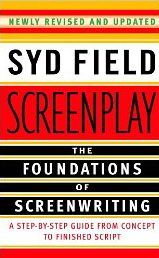
Screenplay

I find that either a quick sketch or a few words can sum up a scene in a graphic manner that appeals to imagination. I can carry a few cards in a shirt pocket and glance at them over a cup of coffee or mull them over while driving home.

Two Towers Storyboard

They do not need to be nearly this detailed, because we are not planning camera angles.  This could be summed up as:

After witnessing Frodo confront the Nazgul, Faramir releases Frodo, Sam, and Gollum to pursue their mission to Mordor, or simply, After Nazgul, Faramir lets them go.

I find that if I let the images play around in the background of my mind long enough, the next step will come, and often surprise me.  I fully expect this process to evolve and change, but for now, this is a huge step forward.
Angelology

When I first read the March 15, Time Magazine review of Danielle Trussoni’s, Angelology,  ( http://www.time.com/time/magazine/article/0,9171,1969720,00.html )I was struck by the killer premise: the heroic battle of an art historian and a young nun against the Nephilim, nasty, arrogant human-angel hybrids who have dominated world affairs for thousands of years.

When the reviewer compared it favorably to The DaVinci Code, I put it in my Amazon cart. Now I wish I had listened to the 100+ Amazon reviewers who gave the book 3 1/2 out of 5 stars.  They were too generous.

The characters, Sister Evangeline and Verlaine are good enough as action adventure heroes go.  Not every protagonist can be or must be unforgettable.  We like them enough to want to see them prevail.

Where the story really breaks down is in the interminable backstory, that fills the entire middle section of the book.  It slows the action to a full stop, and doesn’t really succeed in creating a suspension of belief.

There are several ways to draw readers into a fictional world that has fantasy elements.  One is simply to spin things that exist in our world, as Brown does in The DaVinci Code. The Gospel of Mary Magdalene, and DaVinci’s “Last Supper,” are real, and we’re all too ready to believe in nefarious religious cults.

The other classic tactic is to simply drop us into an alternate universe, as Orson Welles did in the famous/infamous War of the Worlds broadcast – simply announce that aliens have landed in New Jersey.

Trussoni begins Angelology in this manner – with a flashback to the discovery of a Nephilim corpse during  the “second angelological expedition” of 1943.  We’re hooked, especially when Nephilim menace Verlaine and Sister Evangeline before we quite know why.  All the elements of an exciting chase and forbidden romance are in place…and then the author manages to snatch defeat from the jaws of victory.

The story just stops.  If only an editor had reviewed the manuscript and suggested the simple, time tested device for action-adventure tales – sprinkle the backstory into the main action, but keep things moving.  Do not bore your reader to distraction.

Did I say Trussoni failed?  Well that may be an exageration – she has a movie contract and I don’t.  But as a reader, I have to conclude that a writer has failed when I skim or skip huge sections of their book and in the end regret the time and money I have invested in their story.  The following Amazon review by “MWA” sums up my reaction:

This Author may have had an interesting idea but the publisher’s rush to print to catch the wave of Vampire/Mythological/Faux Religious related sales certainly squashed it. The fact that the book is so poorly written is the fault of the people who are supposed to EDIT things prior to publication. This is actually painful to read up until about page 88 and then it is as if the absent editor came back from lunch and skimmed the rest. The worst thing about it is how obviously it is a set-up for another to follow! And a movie deal etc. etc. Enough is enough already.

http://www.amazon.com/Angelology-Novel-Danielle-Trussoni/dp/0670021474/ref=sr_1_1?s=books&ie=UTF8&qid=1280940731&sr=1-1

So Cold the River

Just arrived from Amazon and in my book queue (the short one): So Cold the River by Michael Koryta, which I learned about from an NPR interview/review during a recent homeward commute.

http://www.npr.org/templates/story/story.php?storyId=127561248

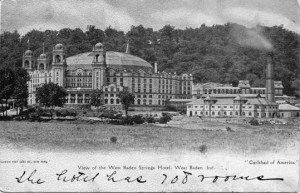
Koryta is a crime novelist whose father took him, at age eight, to see the ruins of the West Baden Springs Hotel in Indiana, once called the eighth wonder of the world.  He tried and failed to work the hotel into a crime novel, but it wasn’t until he decided on a venture into the supernatural that his story took off.

West Baden Springs Hotel, West Baden Indiana

The story involves a filmmaker hired to uncover and document the history of a dying man, and one of the clues is a bottle of “Pluto Water,” apparently from the lost river, “an evil force” that flows around and under the hotel.

It sounds like a tale to read around the fireplace on a dark and stormy night, but I’m not going to wait that long.

Richard Peck’s Characters: Blossom Culp

One of the most compelling story openings I know in young adult literature comes from Richard Peck’s, Ghosts I Have Been:

“I tell you the world is so full of ghosts, a person wonders if there’s a soul to be found on the Other Side.  Or anybody snug in a quiet grave.  I’ve seen several haunts, and been one myself.

When I heard Richard Peck speak of his work at a local Borders, someone asked how many times he rewrote his opening paragraphs.  “Probably seventy times, on average,” he said.  Such dedication to craft is one reason Peck’s career spans more than 39 years, includes 39 novels, a Newbery Medal, and the National Humanities Medal.

Of the many other reasons for Peck’s success, one of the most notable is his unforgettable characters.  Peck writes about outsiders, and the heroine of Ghosts, by circumstance and choice goes her own way:

There are girls in this town who pass their time up on their porches doing fancywork on embroidery hoops.  You can also see them going about in surreys or on the back seats of autos with their mothers, paying calls in white gloves.  They’re all as alike as gingerbread figures in skirts.  I was never one of them.  My name is Blossom Culp, and I’ve always lived by my wits.”

Peck, who believes that “a novel must entertain first before it can be anything else,” leads his heroine through episodes both side-splittingly funny and tragic.  Blossom’s friend Alexander Farnsworth (not that she’s sweet on him, she assures us) has fallen in with a rough crowd, who plan to go outhouse-tipping on Halloween night, 1913.  She teams up with Old Man Leverette so save his privy.  As the boys begin to push at the structure, Blossom, dressed as a ghost, jumps out:

“The candle flickered and guttered between my white veil and [Alexander’s] suddenly white face.  His arms fell from the door jamb, and he let out the high whinny of a fire-crazed horse…He keeled backwards and fell flat on the ground.  ‘A HAUNT!  I AM CURSED!’ he screamed and lay on his back like a turned turtle, with his fists jammed into his eyes.”

That’s only the start of the night’s trouble for the vandals, for Old Man Leverette is hiding nearby, his shotgun loaded with rocksalt.  Blossom has a talent for righting wrongs and what is imbalanced.  Declaring that there is more to be learned on the wrong side of the tracks than the right, she next takes on the “mean girls” of the town, members of the exclusive “Sunny Thoughts and Busy Fingers,” club.

CONTINUED