Huh, what? Oh yeah, I remember

Until the 20th century, most people in the western world believed in objective memory, that what we remember is an accurate mirror of events that actually happened.

With the birth of psychoanalysis and concepts of the Id and unconscious mind, that began to change. Modern brain research confirms that not only do memory and imagination overlap, but that memories can be deliberately changed or altered.  Such manipulation is a core element of The Cloud by Matt Richtel, a page turning thriller I started to read after seeing this interview with the author on Sciencthrillers.com  http://www.sciencethrillers.com/2013/author-interview-matt-richtel-the-cloud/

The Persistence of Memory by Salvadore Dali, 1931

Freud was ambivalent about the accuracy of his patients’ memories. At the start of his career, he attributed several several cases of hysteria to real childhood sexual abuse that his methods uncovered.  Later he said that such episodes were patient “phantasies.”

The issue surfaced again at the end of the 20th century, with “recovered memory” therapy causing tremors in the field, to say nothing of lives disrupted by allegations of sexual abuse, in what is now widely viewed as abuse by helping professionals who implanted memories in the course of trying to treat patients.  “False memory syndrome” still evokes passionate disagreement in the field.  The AMA and the American Psychiatric Association, as well as the Royal College of Psychiatrists in Britain have condemned recovered memory therapy, and in the late 90’s, a number of patients who once believed they’d been victims of childhood abuse successfully sued the therapists who had led them to that belief.

Since the turn of the century, the “hard science” of biology has confirmed what most therapists since Freud have known – that memory is always mixed with imagination.  The area of the brain that perceives an object overlaps the part of the brain that imagines the same object.  In 2009, scientists implanted memories (involving smells) in flies by using light signals to trigger “genetically encoded switches.”

The day after I started reading The Cloud, I heard “Sure, I remember that,” on Marketplace, in which the work of Elizabeth Loftus was highlighted. Loftus, of UC Irvine, is one of the key researchers who have demonstrated how easy it is to implant memories, in this case using altered photographs. http://www.marketplace.org/topics/life/freakonomics-radio/sure-i-remember.  I invite you to listen to this timely piece, which is only five and a half minutes long.

Yep.  We now something new to worry about – hacking at the cellular level!  I’ll have to remember to worry about it later, though.  Right now I have to get back to my novel…

Ancient Roman greenhouse gasses

Before the industrial revolution, humans did not pollute the atmosphere, right?  That is what most scientists thought until a study of greenhouse gasses trapped in ice revealed that human activity has generated significant traces of methane dating back at least 2000 years.

In “Classical Gas,” an article in the Feb., 2013 issue of Smithsonian, Joseph Stromberg reports that a team of 15 scientists took samples from Greenland’s mile and a half thick sheet of ice, which dates back 115,000 years.  The researchers looked at the concentration of methane in microscopic air bubbles in the ice.  They expected to find that historical methane traces increased during warm-weather periods.  Instead they found that it varied with human activity, most notably, large-scale agriculture and metallurgy.  Methane began to spike around 100 B.C.  At this period, the Romans kept large numbers of methane-producing cows, sheep, and goats.

Orpheus surrounded by animals. Ancient Roman floor mosaic. Photo by Giovanni Dall’Orto. CC-by-SA

At the same time, the Han dynasty in China increased its rice production, which is associated with methane-producing bacteria.  Both empires burned large amounts of wood to produce metal for weapons.

Roman relief of blacksmith. Photo by Wolfgang Sauber. CC-by-SA-3.0

Results of the Greenland ice study showed that between 100 B.C. and 1600 A.D., world methane production rose by 31 million tons per year – which sounds like a lot until you realize that US methane production alone is 36 million tons per year, and that isn’t the only greenhouse gas. The discovery that humans have had a measurable impact on the atmosphere for 2000 years does not mean ancient cultures affected climate the way we do. It does mean researchers have to redefine baseline levels of methane – what we define as “natural.”

We tend to project a certain environmental wisdom onto older cultures, assuming they were better stewards of nature than we are in our mechanized world.  Yet I know of at least two other cultures, whose worldview included a reverence for nature, that got into trouble when populations grew too large for a given territory.  Ironically we may have a better chance, using the lens of science, of recognizing and correcting our impact on the environment than people who viewed aspects of nature as divine.

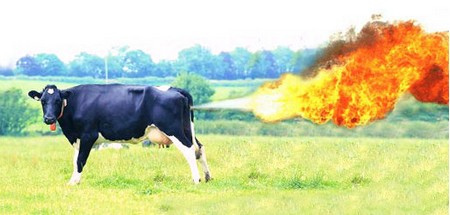
Some bloggers might be tempted to end this post with a fart joke, but that would be immature.

Photo by Alexander Herrmann, CC-by-NC-ND-2.0

Photo by Alexander Herrmann, CC-by-NC-ND-2.0

Thich Nhat Hanh on climate change

On monday, in his inaugural speech, President Obama said that ignoring climate change amounts to betrayal of our children and future generations.

Also on monday, Justin Gillis, a New York Times writer, published the findings of geologists whose study of the location of fossil deposits adds some real numbers to the threat of rising oceans.  With a rise of “only a couple of degrees Fahrenheit, enough polar ice melts, over time, to raise the global sea level by about 25 to 30 feet.  But in the coming century, the Earth is expected to warm…perhaps 4 to 5 degrees, because of human emissions of greenhouse gasses.” http://tinyurl.com/bz4qkry

And again, on Monday, Thich Nhat Hanh, the Vietnamese Zen master who Martin Luther King nominated for a Nobel Peace Prize, was quoted in an article in The Guardian speaking of climate as the great crisis facing civilization over the next century.

“The 86-year-old Vietnamese monk, who has hundreds of thousands of followers around the world, believes the reason most people are not responding to the threat of global warming, despite overwhelming scientific evidence, is that they are unable to save themselves from their own personal suffering, never mind worry about the plight of Mother Earth.”  http://tinyurl.com/atdu2dz.

Thich Nhat Hanh

Thich Nhat Hanh

Hanh, who is known by the nickname, Thay, has been a proponent of “engaged Buddhism” since the 60’s, when he came to this country to speak out against the Vietnam war.  Now he refuses to sidestep the seriousness of our environmental crisis.  Noting that people with vested interest in the status quo are unlikely to change, he says we need the kind of grassroots movement Gandhi organized, but insists it will only work if “activists first deal with their own anger and fears, rather than projecting them onto those they see at fault.”

Thich Nhat Hanh has written more than 100 books, the most popular being The Miracle of Mindfulness.

His writing often seems deceptively simple, but it’s a hard won simplicity, forged in daily meditation over the seventy years since his ordination. His concepts are born of realization rather than doctrine “By recognising the inter-connectedness of all life, we can move beyond the idea that we are separate selves and expand our compassion and love in such a way that we take action to protect the Earth.”

What are the alternatives?  This is an important article and an important issue to face, since the potential cost of ignoring it continues to rise.

The end of the world as we know it

Having slept through Black Friday, the next big event on my calendar is the Mayan apocalypse, scheduled for December 21.

I had no intention of blogging about this until I received the Winter 2012 issue of the University of Oregon Quarterly, where an article by Alice Tallmadge, “Doomsday or Deliverance?” discusses this prophecy in the context of end-of-the-world folklore.

Associate professor Dan Wojcik, director of the UO folklore program, plans to travel to Chichen Itza, one of a huge number of visitors expected for the event, which for some heralds the shift to a higher world age, in the same spirit as the Harmonic Convergence of 1987.  The main organizer of that event, as well as the biggest publicist of 12/21/12, was Jose Arguelles (1939-2011).  In his obituary, the New York Times described his philosophy as “an eclectic amalgm of Mayan and Aztec cosmology, the I Ching, the Book of Revelation, ancient-astronaut narratives, and more.”

On the other end of the spectrum, Alice Tallmadge reports that sales of survivalist goods have spiked in recent months.  A recent Reuters poll found that 15% of people worldwide, and 22% of Americans believe the world will end during their lifetime.  The apocalypse has been a feature of Christian theology from the start, but professor Wojcik notes a recent uptick in secular end-time beliefs:  pandemics, overpopulation, and climate change are seen as threats to the planet without any hope of spiritual redemption.

Things that have a beginning have an end, from gnats, to humans, to stars, and all of creation in the western view of time as linear.  When the world survives a predicted ending date, the error is put down to miscalculation; the expectation persists.  What is it about end-time predictions that continue to fascinate most of us and motivate many believers?  The old saying, “Fool me once, shame on you, fool me twice, shame on me” doesn’t hold in this realm.

I wonder if it parallels our continuing love for disaster film?  Stories of terrible struggle and danger where we get to imagine ourselves among the survivors or among the happily raptured, coming through the ordeal to enjoy “a new heaven and earth.”  The ultimate do-over.

They don’t get any better than one of my all time favorite “disaster films,” made decades before the phrase was coined:  San Francisco (1936), with Clark Gable, Spencer Tracy, and Jeanette MacDonald surviving the 1906 earthquake.

Here’s hoping all our December disasters turn out as well!

And finally, for extra credit, here’s a different kind of celebration, with REM performing “It’s the End of the World As We Know It (and I Feel Fine).  Enjoy!

The 2012 Ig Nobel Prizes

There’s still time to get tickets for the September 20 Ig Nobel Prize award ceremony at Harvard, where ten researchers will receive recognition for unusual discoveries.  The prizes are the brainchild of Marc Abrahams, editor and co-founder of “The Annals of Improbable Research” and author of a new book, This is Improbable: Cheese String Theory, Magnetic Chickens and Other WTF Research.

The ten Ig Nobel winners, whose identity has not been revealed, will receive their certificates from “real” Nobel laureates.  According to Abrahams, some dedicated scientists hold awards in both categories.  He cites Andre Geim  and Michael Berry, two UK physicists, who won an Ig Nobel in 2000 for using magnets to levitate a frog.  Ten years later, Geim and a student won a Nobel prize for producing graphene (two-dimensional carbon) in sufficient quantities to study.

Dr. Elena Bodnar, with her Ig Nobel prize winning bra that quickly converts to a protective face mask.

Past Ig Nobel winners who plan to attend this years ceremony include Dr. Bodnar, pictured above, as well as:

  • L. Mahadevan, a Harvard professor, for a “mathematico-physics analysis of how sheets get wrinkled.”
  • Dr. Richard Gustafson for research: “The failure of self-administered automobile-engine-supplied-electric-shock treatment for rattlesnake envenomation resulting from patient’s pet rattlesnake biting the patient on the lip.
  • Dr. Francis Fesmire, for an article in The Annals of Emergency Medicine entitled, “Digital rectal massage as a cure for intractable hiccups.”

Basile Audoly and Sebastien Neukirch won a 2006 Ig Nobel for research on why spaghetti, when broken, often splits into more than two pieces.

  • Dan Mayer for an article on the medical effects of sword swallowing.
  • John Perry of Stanford for his “Theory of Structured Procrastination.”
  • Don Featherstone, creator of the pink plastic flamenco.
  • Glenda Browne of Blaxland, Australia, for her study of the word “the” and the problems it creates for people who try to alphabetize things.

Marc Abrahams

Marc Abrahams says the Ig Nobel committee is looking for research and inventions that make people laugh and then make them think.  “We also hope to spur people’s curiosity, and to raise the question: How do you decide what’s important and what’s not, and what’s real and what’s not — in science and everywhere else?”

A very good question! To learn more about this year’s prizes, check here: http://www.improbable.com/ig/2012/

Man on the moon

Neil Armstrong on the Moon. (NASA photo, public domain)

There are moments we always remember.  Sadly, most of them are bad, like Pearl Harbor for my parents’ generation and September 11 for us.  Sometimes, however, the news is good, even fantastic.  Those of us who remember July 20, 1969 will never forget the thrill, the surge of optimism when Neil Armstrong stepped onto the moon.

I was driving home from the bay area yesterday afternoon when the radio said he had died at the age of 82.  In an instant, memory carried me back  back to a restaurant in Yosemite 43 years ago.  I was  up there for the summer, working to earn money to buy my first car.  It was slow at 4:30 that afternoon – the dinner crowd wouldn’t arrive for another hour.  The whole crew gathered in the kitchen where someone had placed a portable black and white TV with rabbit ears.

Later that evening, a friend and I lay on the ground near the river, gazing up at the summer moon, which was full that night, trying to wrap our imaginations around it.  The night was warm.  We lay there, not saying very much, until it was late.

Neil Armstrong. Photo by NASA, Public Domain

Several people who knew Neil Armstrong spoke on the radio.  A friend of his noted of the irony of a man who stood in the world spotlight but was one of the shyest and most retiring people she ever knew.  Everyone mentioned his patriotism and courage, as a combat pilot, a test pilot, and finally as a man who went where no one had gone before.

There are times in adolescence when we think we can do anything, like get a job in the mountains and earn enough money to buy a car.  There are times when nations believe they can do anything, like put a man on the moon.  The webs of cause and effect are far too complex to sort out, but both individual and collective achievements begin with strong intentions.  Even when we set out to find X and discover Z instead, some determination got us moving.

Neil Armstong seems to have been a decent and courageous man.  Now he is even more than that.  His smile from space will always remind us of how barriers can fall and new frontiers can be gained when we are motivated by deep and unswerving intention.

Bad Science

Besides Congressman Akin, who clearly ditched high school biology, my favorite member of the Congressional Science Committee is Dana Rohrabacher (R-CA) who is on record as saying:

“Is there some thought being given to subsidizing the clearing of rainforests in order for some countries to eliminate that production of greenhouse gases? … Or would people be supportive of cutting down older trees in order to plant younger trees as a means to prevent this disaster from happening?”

http://motherboard.vice.com/2012/8/21/congress-s-science-committee-doesn-t-get-science

According to Motherboard, the Congressional Science Committee is responsible for “the entire spectrum of national science interests, from energy, the environment and the atmosphere, civil aviation and nuclear R&D, and space.”

I wish I could say these are actors in a Mel Brooks movie, especially since Congressman Brooks (R-AL) said, in an interview with Science Magazine  that high levels of carbon dioxide means that “plant life grows better, because it is an essential gas for all forms of plant life.”

I’ll let the opportunity for an “essential gas” joke pass.  There’s enough to laugh and weep over in these words from our members of Congress.

The Serious Business of Play

As I worked on the previous post and began to envision a series of articles on imagination, the July-August issue of the Smithsonian Magazine arrived with a piece that fit the theme.  In “Why Play is Serious,” Alison Gopnik, a leading researcher in cognitive development, says play is “a crucial part of what makes all humans so smart.”

Alison Gopnik

Many of us intuitively know that play matters, but Gopnik and her colleagues at UC Berkeley have new theories and research on why it’s so important.  http://www.smithsonianmag.com/science-nature/Let-the-Children-Play-Its-Good-for-Them.html

How is it that very young children learn so much so quickly?  Gopnik’s research focuses on pretending, which she calls “counterfactual” thinking.  She gives the example of Einstein wondering what would happen on a train traveling at the speed of light.

Gopnik found that “Children who were better at pretending could reason better about counterfactuals – they were better at thinking about different possibilities.  And thinking about possibilities plays a crucial role in the latest understanding about how children learn.”

Photo by Don Bergquist, licensed by Creative Commons

Ms Gopnik is concerned about policymakers who “try to make preschools more like schools.”  In hard times, “frivolous” programs are always the first to go – disciplines like the arts, music and humanities – the very ones that stretch imagination and encourage us to envision new possibilities.

public-domain-image.com

By the time we are adults, we’ve learned how to sideline play in order to get down to business.  Even – or perhaps especially – in the creative realm, it’s no simple matter to let go of goal-oriented behavior when competition in the marketplace is so stiff.  Working for concrete or pre-defined results is the antithesis of the kind of free experimentation that opens up new vistas.

Some sort of strategy is usually needed for us to approach the unselfconscious freedom of children at play, but it doesn’t need to be anything dramatic.  At the end of his life, Joseph Campbell said an hour a day in a quiet room with a favorite book or a journal is enough for us to step into sacred space where the real hero’s journey always takes place.

Simple but never easy.  In a recent post on his own blog, Michael Meade quoted these marvelous lines penned by E.E. Cummings:

“To be nobody-but-yourself — in a world which is doing its best, night and day,
to make you everybody else — means to fight the hardest battle which any
human being can fight; and never stop fighting.”

The fact that the battle is hard is all the more reason why we cannot afford to forget how to play.