Hunting UFO’s and Your Chance to Tweet Outer Space

Tonight at 9:00pm, the National Geographic Channel will present “Chasing UFO’s,” with a team of three investigators checking out reported sightings in Texas, Fresno, and other hotspots of alien activity.

The National Geographic Team – move over Men in Black!

In a recent survey, National Geographic discovered that 80 million Americans – a third of the population – believe in UFO’s.  Seventy-nine percent of us think the government has kept UFO information hidden, and more than half believe there are real Men in Black who threaten people who report sightings.

Aliens grok Geena Davis in “Earth Girls are Easy,” 1988

But wait – there’s more going on tomorrow than just watching other people have all the fun.  There’s something to take our minds off wondering how to land a job as a UFO Chaser.  It’s the Wow Reply Project.

In August, 1977, Jerry Ehman, a researcher at the Ohio State Big Ear radio observatory, spotted a coherent alpha-numeric sequence on a computer printout of signals from deep space.  He grabbed a red pen, circled it, and wrote “Wow!” in the margin.

Tomorrow night, National Geographic gives us the chance to Tweet back to whatever alien intelligence may have tried to contact us.  You can schedule your reply at this link: http://channel.nationalgeographic.com/channel/chasing-ufos/the-wow-reply/.

And in case you’re a bit stuck in figuring what to say, the Geographic has solicited suggestions from several experts, including Stephen Colbert, to help us.  Check out Colbert’s recorded message, which begins, “Greetings intelligent alien life forms.  I am Stephen Colbert, and I come to you with an important message from all the peoples of the earth.  We are not delicious.”

From “The Day the Earth Stood Still,” 1951

It isn’t easy to make up a tweet for space beings.  What can you possibly say?  “Greetings, aliens. I had cheerios for breakfast, how bout you?” See, this is going to take some work, and there isn’t much time, so we better get busy!

Humans May Not Be the Original Artists

Don’t worry, I’m not suggesting a space alien theory – quite the opposite.  As reported on NPR, a new method of dating the paintings in Altamira and some of the other caves painted by prehistoric artists suggests that some of them may have been created before Homo Sapiens arrived in Europe.  This would mean that Neanderthals, who roamed Europe for at least 200,000 years, were the original artists.

Pedro Saura AAAS/Science

Alistair Pike of the University of Bristol says that some Spanish cave paintings are at least 40,800 years old.  Humans had just arrived from Africa.  Archaeologist, Joao Zilhao of the University of Barcelona, is convinced that some of these works were done by Neanderthals.  We know they engaged in symbolic behavior.  They made ritual burials, they decorated beads and other implements, and left caches of ground up colored minerals that may have been used for pigments.

Though not everyone agrees, these findings and theories appear in the journal, Science.  Pike says he and his Spanish colleagues just need to find paintings “a few thousand years older” to prove their point.  They’re planning a return to the region to continue their search.

Take a look at this and several related articles on the NPR website.  It helps put things in perspective for me to realize that we are not the only intelligent species that now walks, or has every walked the earth.

http://www.npr.org/2012/06/15/155009945/famous-cave-paintings-might-not-be-from-humans

What Ancient Bones Tell Us About Being Human

Last week a remarkable show ran on PBS, “The Bones of Turkana,” which documents Richard Leakey’s search for the origin of the human species. Convinced that the Turkana Basin in Kenya is the place where we all began, Leakey, his wife, Meave, and their team have excavated the region around Lake Turkana since the 1960’s.

Richard Leakey beside a scaled computer generated figure of Turkana Boy who lived 1.6 million years ago. Photo courtesy J.J. Kelly/National Geographic Television.

This documentary, largely narrated by Leakey, gives a real feel for the region and the painstaking work of uncovering our past, but the most interesting questions concern what it means to be human.  Computer simulations picture early hominids who lived hundreds of thousand years apart.  At what stage, at what point in time, did our ancestors become human?  What core attributes distinguish us from other mammals?  In the 1980’s, Leakey founded the Turkana Basin Institute to explore this and related questions.

Filmmaker, John Hemingway (left) and his crew filming, “The Bones of Turkana.” Photo by Katie Carpenter.

Language is one key attribute Leakey says, along with walking upright and using tools.  Communication, walking on two legs, and tool use are not  exclusively human traits, so Leakey expands on his nuanced criteria:

“We know birds use tools and chimps and insects and lots of mammals. But to take a block of very hard stone and to take another stone and fashion an object from it, that’s something different. You have to “see within” the stone to know what you’re fashioning before you fashion it. You have to project an idea.  That’s a step that no other tool maker uses.” http://boingboing.net/2012/05/15/bones-of-turkana-meave-and-ri.html

Leakey bases his final core criterion on the 1.6 million year old skeleton he calls, Turkana Boy.  This young person apparently suffered from spinal deformities.  He was not a robust adolescent and could not have warded off predators or hunted on his own.  Leakey identifies the final key human trait as compassion.  This is something he knows about first hand.  Since losing his legs in a plane accident in 1993, Leakey has had to rely on the kindness of others to help him survive and thrive.

PBS has made the entire program available to watch at this link:  http://video.pbs.org/video/2235479708/.  It’s a fascinating account.

Ancient Mayan Newsflash: The World is Not Going to End in December

We can all breathe easier on this score, according to a recent find at Xultan, in northeast Guatemala.  Archeologists discovered a wall in a small room that seems to have functioned as a blackboard for Mayan astronomers.  The 1200 year old calculations represent the oldest known Mayan astronomical tables, suggesting a future at least 6,000 years long.

Courtesty, National Geographic.

“Why would they go into those numbers if the world is going to come to an end this year?” asked Anthony Aveni of Colgate University, an expert on Mayan astronomy.  Aveni and others published their findings Friday, in the journal, Science.

Independent researchers call the find very significant.  The results of Mayan calculations of moon phases and the position of the Sun, Mars, and Venus were known from public monuments, but up until now, the means of calculation were unknown.  Aveni suggests the scribes may have been  “geeks … who just got carried away with doing these kinds of computations and calculations…”

Rain forest location of the find – Courtesy National Geographic.

At the end of the year, when we no longer have the the elections to worry about, and all your friends are starting to think of apocalypse, you can tell them about the Mayan geeks, and suggest they chill.

You can read more about the find here: http://tinyurl.com/cw4aqzx

People and the Planet: A Report by the Royal Society

On April 26, The Royal Society, the UK’s 350 year old academy of science, released the results of a 21 month study of patterns of population and consumption.  Sir John Sulston, chair of the working group, put it very simply:

“The world now has a very clear choice.  We can choose to address the twin issues of population and consumption.  We can choose to rebalance the use of resources to a more egalitarian pattern of consumption, to reframe our economic values to truly reflect what our consumption means for our planet and to help individuals around the world to make informed and free reproductive choices.  Or we can choose to do nothing and to drift into a downward vortex of economic, socio-political and environmental ills, leading to a more unequal and inhospitable future.”  http://royalsociety.org/news/Royal-Society-calls-for-a-more-equitable-future-for-humanity/

The Society issued a 132 page report that makes several key recommendations  http://royalsociety.org/policy/projects/people-planet/report/:

  1. The international community must bring the 1.3 billion people living on less than $1.25 per day out of absolute poverty, and reduce the inequality that persists in the world today. This will require focused efforts in key policy areas including economic development, education, family planning and health.
  2. The most developed and the emerging economies must stabilise and then reduce material consumption levels through: dramatic improvements in resource use efficiency, including: reducing waste; investment in sustainable resources, technologies and infrastructures; and systematically decoupling economic activity from environmental impact.
  3. Reproductive health and voluntary family planning programmes urgently require political leadership and financial commitment, both nationally and internationally. This is needed to continue the downward trajectory of fertility rates, especially in countries where the unmet need for contraception is high.
  4. Population and the environment should not be considered as two separate issues. Demographic changes, and the influences on them, should be factored into economic and environmental debate and planning at international meetings, such as the Rio+20 Conference on Sustainable Development and subsequent meetings.

Please look at this video clip of Sulston summarizing the findings of the report, which he will present at the United Nations on May 1, ahead of the Rio+20 conference.

Of special interest to me was Sulston’s critique of GDP as the key measure of economic wellbeing for nations.  GDP, he says, drives growth to levels that cannot be sustained.  Michael Meade once observed that unbridled growth in the body is cancer, and unbridled growth in the body politic is a parallel ill.

Growth is such an ingrained measure of wellbeing that re-imagining global socio-economics will not be simple or easy.  One tactic, according to the working group, is to factor in real costs:  what are the real costs of disappearing forests and species?  What is the real cost of water when the study predicts that 1.8 billion people will live with severe water scarcity by 2025?

The issue of water brings to mind my previous post, “Another Regulation Conundrum,” http://wp.me/pYql4-21e, which describes a couple’s 40 year effort to create an self-sustaining and non-polluting homestead.  One of their projects was recycling household “gray water.”  The county building codes have no provision for such experimental ways of doing things, and the couple has racked up large fines and an eviction notice.  In a very real sense, the status quo is the problem.  According to the Royal Society, not only our building codes but the mindset behind them must change or the quality of life for everyone will continue its spiral of decline.

One parting thought:  the study was released on Thursday.  Why haven’t we heard it mentioned on any US media?

Imagine by Jonah Lehrer: A Book Review

Update, July 31, 2012.

On July 30, author Jonah Lehrer admitted fabricating quotes in Imagine. He resigned his position as staff writer for The New Yorker, and Houghton Mifflin suspended sales of the book. You can read my full post on the topic here, which contains a link to the newspaper story. http://wp.me/pYql4-2hg

It is with much sadness that I’ve decided to remove the text of my review. Some of Lehrer’s observations on creativity remain insightful. At the same time, I think it is vital to stand up for ethics wherever we can find it in public life.

The California Wolf

On December 28, a 2 1/2 year old male wolf crossed the border into California after a 1,000 mile journey south through Oregon.  Wolf OR7, as he is called by Fish and Game, is the first wild wolf in the state in almost 100 years.  A young wolf will leave his pack to search for a mate to start a new one in situations like too many wolves competing for game in a certain region.

Wolf OR7

The new California wolf is a descendant of the 66 Canadian wolves who were relocated to Yellowstone in the mid 90’s.  He is one of an estimated 1600 wolves who now roam free in the Rocky Mountain states, in the southwest, and in Oregon.

According Tim Holt, a freelance writer in Dunsmuir, CA, “local ranchers and a few pandering elected officials have him in their cross hairs, saying he ought to be shot on sight.”   At the same time, “there are wolf advocates who practically worship this predator, seeing the wolf as symbol and martyr of a vanishing wilderness.”

Holt sees another possibility:

The removal of wolves, or their reintroduction, reverberates up and down the food chain. By culling deer and elk, new wolf populations help restore vegetation along streambeds, improving habitat for songbirds, beavers and river otters. And by going after weak and old members of deer and elk populations, they help strengthen their stock. Wolves, in other words, are instinctive wilderness restoration specialists.

So the wolves’ return to this state offers a litmus test of our commitment to the health of our remaining wildlands. But it goes beyond that. Allowing them to reintroduce themselves would be one more sign that we’re moving away from a human-centered view of nature, based on narrow economic interests, and have begun to see ourselves as a part of what might be called the broader economy of nature. http://www.sacbee.com/2012/01/29/4221053/wolf-can-help-us-balance-our-approach.html#storylink=cpy

Somewhere deep within us as well, is a fear of wolves that makes generations of children shiver at Little Red Riding Hood.  That thrilled me when I read Jack London’s stores of wolves battling men.  I didn’t know at the time that London’s stories were pure fiction.  No such incidents ever happened.  During the ’90’s, I volunteered at the Folsom City Zoo because I wanted to interact with the wild canines – the wolves and foxes and coyotes.

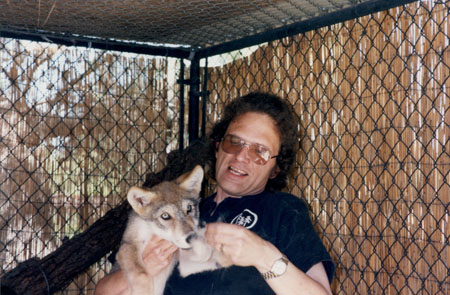
Helping to socialize Redbud, a wolf pup, ca 1995

During the 90’s, all the texts on wolves agreed there were no confirmed cases of a non-rabid wolf attacking a human in North America.  I don’t think that has changed.  A classic account is 50 years old.  Farley Mowat, a Canadian author and conservationist, spent a summer living by himself among wolves.  In his 1963 book, Never Cry Wolf, he wrote:  “We have doomed the wolf not for what it is, but for what we deliberately and mistakenly perceive it to be — the mythological epitome of a savage, ruthless killer — which is, in reality, no more than the reflected image of ourself.”

Never Cry Wolf by Farley Mowat, 1963

The book, and the movie made of it in 1983, deserve much of the credit for reversing public attitudes toward the wolf, and allowing reintroduction to happen at all.

Never Cry Wolf movie, 1983

Gandhi said the character of a nation is revealed in the way it treats its animals.  Let’s hope the way we treat OR7 reveals something compassionate, wise, and generous in us.

Sage, at the Folsom City Zoo, ca. 1995

The 21st Century May Be Bad For Your Mental Health

To appreciate this post, you need to know a little of how it came about.  Yesterday morning, in my dentist’s waiting room, I started reading an article in  the Nov. 14 Newsweek by Dr. Andrew Weil.  He and others have noted that modern affluence breeds depression.  They have also observed that the Amish, with a 19th century lifestyle centered on simplicity, have only 1/10 the amount of depression of other Americans.  Just as I hit this tantalizing statement, the dentist, who was running ahead of schedule, called me in.  After my appointment, I finished the article.  “Our brains aren’t equipped for the 21st century,” says Weil.

One of the things we are not equipped for is our 24/7, hi-tech, multi-tasking world, a point that made me chuckle as I pulled out my smart phone, photographed the pages, and emailed them to myself.  Just call me a poster boy for the legions of technically savvy neurotics.  It turns out I didn’t need to send the page to myself.  Weil’s article is available online, and I highly recommend it:  http://www.thedailybeast.com/newsweek/2011/10/30/andrew-weil-s-spontaneous-happiness-our-nature-deficit-disorder.html.

The article is taken from his latest book, Spontaneous Happiness, just released this month, where Weil says it’s not just technology that’s the cupric in our epidemic of depression.  Increasing numbers of psychologists and therapists identify one of our key problems as Nature Deficit Disorder.  Weil says:  

“Behaviors strongly associated with depression—reduced physical activity and human contact, overconsumption of processed food, seeking endless distraction—are the very behaviors that more and more people now can do, are even forced to do by the nature of their sedentary, indoor jobs.
………………………………………………
“Human beings evolved to thrive in natural environments and in bonded social groups. Few of us today can enjoy such a life and the emotional equilibrium it engenders, but our genetic predisposition for it has not changed.”

Weil discusses the bad news in detail, but doesn’t end there.  He is firmly in the camp of “positive psychology,” the discipline that concentrates on human wellbeing rather than pathology.  He summarizes positive measures we can take, things he discusses in greater detail in the book.

  • Find a mindfulness practice.  (I was impressed that Weil listed this as suggestion #1.  I’ll follow this up by posting some resources soon).
  • Spend as much time as possible outdoors.
  • Find some form of aerobic exercise.
  • Sleep in total darkness, if possible, and avoid very bothersome noise, even if it means wearing earphones.  Weil discusses why uninterrupted sleep, and freedom from noise pollution are important.
  • Attend to diet – he has written of this in detail in previous books.
  • Cultivate social relationships.
  • Spend some time each day unplugged from all forms of gadgetry.

Finally, Weil, like almost everyone else who writes on wellbeing, cites gratitude as a critical factor.  This morning I ran into an acquaintance who has had a number of physical problems.  He has paid a price, but also found something diamond-solid that is now at the core of his life:  three times he has been clinically dead, and he’s seen and experienced “the light,” that people in that extremity sometimes encounter.  He knows it is waiting for him, and meanwhile, shares his experience with others he thinks will benefit.  He says he intends to do so, “as long as God decides to keep me around.”

Simply encountering him put me in tune with the theme of the season, and reminded me of all I have to be thankful for.  That is my hope for everyone reading this – may you find unshakeable joy in your life just as it is, and may you be able to share it with others.