Give It Away to Keep It

The title of this post comes from Bill Wilson, co-founder of Alcoholics Anonymous, who tried repeatedly to get sober and only succeeded when he helped another problem drinker.  “In order to keep it, you have to give it away,” became an AA motto.

The title could have just as well come from Lama Thubten Yeshe who said, “According to Buddhist psychology, unless you dedicate yourself to others, you will never be happy.”

I could have quoted Jesus:  “Whoever tries to keep his life will lose it, and whoever loses his life will preserve it.” (Lk 17:33).

In my previous post, I tried to name something distressing I sense as part of the vibe of our time:  “a miasma of anger and greed, driven by fear and disillusionment.”  When I wrote it, I was recalling a couple of drivers I’d seen playing chicken for parking places earlier that day.  Gotta get mine – there might not be enough to go around.

In psychology, anger is understood as a “secondary emotion.”  The question becomes, what is hidden beneath the anger?  In a lot of cases, I think it is fear, which also drives greed:  it’s a jungle out there; a dog-eat-dog world;  a zero sum game.

Back in the eighties, before the Berlin wall came down, a retired military officer told me that if the Russians prevailed, they would soon “arrive on your doorstep and take all your private property.”  We still operate from that mindset; fill in the blank with the name of your favorite villain(s).

The problem is, fear and scarcity-consciousness often lead to bad decisions, individually and collectively.  During the 30’s, Paramahansa Yogananda taught that generosity creates a “prosperity consciousness” that is one of the keys to surviving difficult times.  He believed we attract what we hold in our minds, and he told a story that illustrates where grasping can lead:

In villages near the jungles in India, farmers used a simple trap to capture monkeys, a favorite source of meat. They would drill a hole in a gourd, just big enough for the monkey’s hand to pass through, then fill the gourd with rice and attach it to a stake.  When a monkey happened along, it would reach in and grab a fist full of rice and find it couldn’t withdraw its fist. The villagers would have it.  The monkey would die because it couldn’t let go of a handful of rice.

With that story in mind, and because everyone I want to emulate comes down on the side of generosity and letting go, perhaps I can trust the universe to provide me a parking place.  And take it from there and see where it leads…

A Day With Anam Thubten

Last summer I wrote about a retreat I attended with Anam Thubten. http://wp.me/pYql4-Wp .  Another time I posted about his first book, No Self, No Problem. http://wp.me/pYql4-gg.  Just over a week ago, I join a large group to attend another retreat with this Tibetan master.  The event coincided with the publication of his new book, The Magic of Awareness.

The magic of awareness cover

At first I was not going to write about the day because, in Anam Thubten’s own words, “I don’t have so much to say today.”  After a pause, he added, “I think you already know these things.”  A lot “happened,” that day, but not the sort of things you  can write about.

I thought of the Buddha’s flower sermon.  One day when a group of monks assembled to hear Sakyamuni Buddha, he simply held up a white flower someone had given him as he climbed onto the teaching dais.  One monk, Mahākāśyapa, smiled in understanding, and we date the practice of Zen from that moment.  A lot happened that day too – we remember it 2600 years later – but there is also not much to write about.  What are you going to “say” about holding up a flower?

That’s sort of the point.  And the point of this post.

For some reason, I was wide awake at 5:00am this morning.  I got up, made coffee, and dug into the Sunday paper – for some other unfathomable reason, I was really looking forward to catching up on all the news (what are they putting in the water these days?).  It only took one article on the presidential campaign to cure that delusion and cause me to trash a political post I almost had ready for Monday.  No way I wanted to add my $0.02 to the chatter.  There in the pre-dawn quiet, I thought again of Anam Thubten, the wisdom of silence, and the Buddha’s flower.

At the retreat, Anam Thubten gave few instructions on meditation beyond this: “The essence of meditation is doing nothing.” He elaborates in his first book:

“to rest means to pause, to pause from working very hard, to pause from continuously constructing this world of illusions, the dualistic world, the world that is based on the separation between self and other, you and me, good and bad.  When you completely take away the egoic mind, the creator of this illusory world, then realization is already there and truth is automatically realized.  Therefore, the heart of Buddhist meditation practice is to relax and to rest.”

When you think about it, those are really quite enough words for a lifetime…

Angels Incognito

The local California Writer’s Club branch hosts an annual short-short story contest every year.  I hadn’t intended to enter until this morning when one of those end-of-the-night inspirations slipped into awareness.  A story idea:  A reprobate is convinced that “they” are stealing our memories, and he is probably right.

I wrote the opening with relative ease.  We’ll see how it goes; openings are easy, but I also have a great fondness for this kind of character – the guardian or the wise one whose appearance is humble or even repulsive.  You meet him – he is most often male – in various guises in movies and fiction:

Mel Gibson in "Conspiracy Theory," 1997

He is found  in myth and scripture.  John the Baptist is a classic example, who must have dismayed a lot of the city people who came out to hear him.

John the Baptist

Tilopa, (989 – 1069) one of Tibetan Buddhism’s greatest teachers, was expelled from a monastery and made his living as a sesame pounder, a pretty low rung on the social ladder.

Tilopa

Once in a while, you meet someone like this in real life.  I read an account by a man who wanted to go to India in search of a guru, but then found his teacher, a Zen master, earning his living by fixing washing machines in a laundromat 12 miles away.

When my wife was a social worker at Loaves and Fishes, a local center that helps the homeless, she was startled one day as a small hispanic man climbed out of a dumpster in a parking lot. Significantly, his name was Jesus. Mary’s eye’s still light up when she tells what a joyful man he was.  The meeting was so unexpected, but left such a vivid memory, that she thinks of him whenever the subject of angels comes up.

These reflections led me to think of one of my all time favorite fantasy novels, King of Morning, Queen of Day, by Ian McDonald, 1991.  The story features a pair of otherworldly guardians who look a lot like bums as they craft powerful magical charms from bottle caps and debris.  McDonald came to mind when he published his latest novel in December.  I haven’t yet read the new one, but I’ll discuss King of Morning next time.

Meanwhile, has anyone else encountered an angel, a wise man or woman, a mentor or a guardian who showed up disguised as an “ordinary” person but then turned out to be anything but?

“Be a Lamp Unto Yourself”

Happy New Year!!!!  

I thought I would begin the 2012 blogging year with words that have long been an inspiration to me.  They come from advice the Buddha gave his disciple, Ananda:

“Therefore, Ananda, be a lamp unto yourself, be a refuge to yourself. Take yourself to no external refuge. Hold fast to the Truth as a lamp; hold fast to the Truth as a refuge.”  – Mahaparinibbana Sutta

Part of the problem, then as now, was knowing the truth when you found it.  The Buddha’s India of 2600 years ago was similar to ours in this respect – it was awash in competing and often conflicting philosophies, teachers, and religions, each claiming special access to the truth.

Gandhara Buddha (4th-5th c.)

Once, as the Buddha passed through a village called Keshaputta, the inhabitants, members of a clan called the Kalamas, approached him for advice.  The Kalamas were seekers of truth.  They were happy to welcome traveling yogis, holy men, and teachers of all sorts, but by the time Buddha arrived, they were thoroughly confused by contradictory teachings from too many “experts.”

In response, the Buddha gave the teaching known as the Kalama Sutta, a fuller version of the advice he later gave Ananda.  In his discourse, the Buddha listed ten ways of knowing that are not sufficient to indicate the truth:  oral history, tradition, scripture, news, ordinary reasoning, dogmatism, common sense, one’s own opinions, expert opinions, opinions of authorities.  Instead, the Buddha asserts our need to test such sources experientially, and trust our own conclusions:

“O Kalamas, do not be satisfied with hearsay or tradition, or any teachings, however they may come to you.  Only when you know in yourself when things are wholesome, blameless, commended by the wise, and when adopted and practiced lead to welfare and happiness, should you practice them.  When they lead to virtue, honesty, loving-kindness, clarity, and freedom, then you must follow these.” (as quoted in A Path With Heart by Jack Kornfield)

A teaching like this can be difficult with its demand for our own freedom and responsibility.  The teaching seems to throw us back on our own moment by moment awareness.  If we lose our way in the maze of conceptual thought, our own direct experience is one of the few things left to trust.

Most traditions and most of the world’s folklore suggest that we each have a deep way of knowing within us.  It goes by many names:  Higher Power, Buddha Nature, Christ Consciousness, Holy Spirit, Inner Guru.  How and when do we contact this wisdom?

This seems like a very good question to ask at the start of a brand new year.

Peace

It almost seems like the world pauses around the time of the solstice, the way an out-breath stops for a moment before the next in-breath begins.  To catch the stillness, we may have to make an effort to step outside the noise of the season, but it can be done.

People finally get to slow down on Christmas Eve.  Maybe they go to church and look at the stars afterwards,or just step out for a breath of air when the family gathering gets too loud.  Or take the dogs for a walk in the late afternoon, hands in pockets, and notice how quiet the park is, almost as if it is waiting for something.  The soccer players and kids on the swings will be back soon, but now they’re gone.

This can be a hard season.  Individually and collectively, many are wondering when the next blow is going to fall.  And by this time of year, everyone is weary of trying to be as happy as people in Hallmark movies.  Yet I believe that by some mystery, stillness surrounds and pervades our busy-ness, and silence permeates the noise.  There is a well of renewal we can touch at this time of year.  By whatever name you call it, may it be yours.

The Wasteland

One of the books I treasure is a battered old trade paperback with yellowing pages.  I value the book,  Creative Mythology, because of the author’s inscription: “For Morgan with all my good wishes. Joseph Campbell, 3/13/79.”  

joseph_campbell_4

You could say Campbell’s  four day lecture series that spring did much to open the path my imagination has followed ever since.  None of the stories Campbell unpacked in his lectures or books affected me more than Parzifal (or Parsifal) and his quest for the holy grail. The version of the grail story Campbell recounts is by Wolfram Von Eshenbach (1170 – 1220).  Wolfram was a German knight and poet, and his Parzivalis regarded as one of the finest medieval German epics.  Campbell looks to this version because it’s roots reach deeper than later Christianized versions where only the pious and chaste Galahad can attain the grail.  What matters for this post are those echoes we can see in the tale of the ancient legends of sacred kingship, and the ways an unfit or weakened king can blight the land.

Wolfram Von Eshenbach from Codex Manasse

Sometimes in youth we receive a vision or powerful experience that shapes much of the rest of our lives.  So it is with Parzival who finds his way to the mystical Grail Castle and meets its wounded king, Anfortas,  who is also known as The Fisher King.  As a young knight, a spear pierced the Fisher King’s “thighs” – a euphemism for testicles according to Campbell.  In ancient times, the virility of the king and the fertility of the land were one.  In the grail stories, Fisher King could not be healed and couldn’t die.  All the realm was barren.

Robin Williams as the Fisher King in the 1991 movie of that name, a contemporary retelling of the story

While in the castle, during a mysterious ritual, Parzival has a vision of the grail, which is described as a stone, though its shape isn’t fixed, and it brings everyone “what their heart most desires.”  Though he is intensely curious, Parzival does not ask the meaning of what he sees.  In the morning, the castle is empty.  All traces of life are gone.  He rides away, and when he tells his story, listeners turn away in disgust.  If Parzival had asked the right question, he would have healed the king and restored the land.    The young knight wanders the blighted realm for 20 year, enduring hardships and contemplating his failure.  Just like us, he watches time turn his youthful dreams of glory to ashes.

“Parsifal” by Odilon Redon

At last, one cold Christmas Eve, Parzival encounters a hermit, tells his tale, and learns the question he should have asked. After that, he achieves the castle again.  When the ritual ends, Parzival asks, “Whom does the grail serve?”   Everything hinges on asking the right question.  Anfortas is healed, spring returns, and Parzival becomes the new Grail King.

***

Hearing this old tale, we have to ask how the story plays forward.  “Wasteland” clearly describes the state of the world we read about in the papers, and “impotent” seems an apt description of most of the world’s governments.  This perception is not even new, for T.S. Eliot named it ninety years ago in his poem, The Wasteland:

What are the roots that clutch, what branches grow Out of this stony rubbish? Son of man, You cannot say, or guess, for you know only A heap of broken images, where the sun beats, And the dead tree gives no shelter, the cricket no relief, And the dry stone no sound of water.

Giving mythical weight to our latest headlines, storyteller and mythologist, Michael Meade says: “Like Parsifal, the modern world has awakened from a deep sleep to find that the castle of abundance has disappeared, that the financial markets are in ruins, that blind religious beliefs are once again producing mindless crusades, and that great nature itself threatens to become a barren wilderness. Like Parsifal, we failed to ask the right questions when surrounded by abundance.” From “Parsifal, the Pathless Path, and the Secret of Abundance,” first published in Parabola, Fall 2009.  http://www.mosaicvoices.org/index.php?option=com_content&view=article&id=72:essay4parsifal&catid=53:essays&Itemid=68

This has happened before, again and again, Meade reminds us – beginnings and endings, decay and renewal.  The castle of abundance waits for us, individually and collectively, somewhere in the wilderness, but old pathways won’t take us there.  There’s a time to do as Parsifal did – drop the reins and let the horse, an image of our instinctive wisdom, pick its way through the forest. The old stories were told in the winter, when the nights were long and the fires warm.  This winter, I am drawn to look at some of these tales, to see what they are still whispering to our souls, for they are wiser than the daily ephemera that passes for wisdom but is really the source of our confusion.

As Michael Meade puts it: “Despite the current confusions of dogmatic religions and the literalism common to modern attitudes, the earthly world has always been a manifestation of the divine. Call it the Grail Castle, the Kingdom of Heaven, Nirvana, the Otherworld; it has many names and each is a representation of the eternal realm that secretly sustains the visible world. When time seems to be running out it is not simply more time that is needed, rather it is the touch of the eternal that can heal all time’s wounds and renew life from its source.”

What Is Your Innermost Request?

On Saturday, Zen teacher, Edward Espe Brown, gave his second all-day retreat of the year for the Sacramento Buddhist Meditation Group.  Zen is not exactly “my thing,” but like the SBMG as a whole, I’m ecumenical, ready to look for insight wherever I can find it, and I really enjoy Ed Brown.  Zen is actually so free of doctrine that Catholic priests have become advanced practitioners, and Edward Brown is un-doctrinaire even for Zen.  At the start of the retreat, after the hostess introduced him and  listed his “credentials,” Brown said, “Yep, I’m certifiable.”

Edward Espe Brown

Edward Espe Brown

“I’m not going to give you very many instructions,” he said.  “If I do, there’s the danger of wondering, ‘Am I doing it right?'”  This is one of Brown’s constant themes:  no one else can tell you the right way to do Zen or life.  One statement framed both of Brown’s visits this year, a quote from his teacher, Shunryu Suzuki Roshi:  “When you become you, Zen becomes Zen.”  Zen is about “becoming authentically you,” Brown said.

Brown is an accomplished chef and uses lots of cooking metaphors.  One time a group of his students was tasting a dish and one of them asked, “What am I supposed to be tasting?”  To Edward Brown, that a question all of us ask in one form or another:  “What am I supposed to be doing?”  “What am I supposed to be feeling – or experiencing – or thinking?”  “What am I supposed to be writing?”

Understanding the point takes a bit of subtlety; it does not deny that we have an “ordinary” self that must operate in “relative” reality and know how to balance a checkbook, check the oil, boil an egg, or get a job.  Brown was directing remarks to that “unmanifest self,” the “big mind” within us, our Buddha nature.  “It’s the sky not the weather,” he says.  It’s the larger “us,” that can only say, “I am,” not “I am this or I am that.”

Because this silent knowing is so often drowned out by day to day concerns, it often requires a strategy to hear it.  Meditation is one strategy.  Another is learning to ask the right kind of question.  Brown posed one such question:  “What is your inmost request?”  What do we want in our depths?

He did not mean our ordinary wants and needs, however pressing.  He gave an example, saying that for many years, his inmost request was, “I want it to be ok for me to be here.”  Questions like this do not come with fast or easy answers.  There is nothing fast or easy about becoming authentic, especially in a culture that fears real individuals.  If we’re looking for others to tell us what to do, they will be glad to oblige.

Yet failing to ask what we really are and what we truly long for carries a greater risk.  William Stafford, the poet, put it this way:  “a pattern that others made may prevail in the world and following the wrong god home we may miss our star.”

Sacred Stones in Northern California

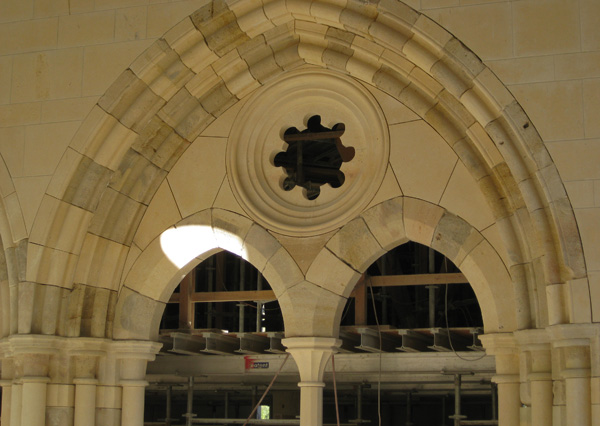
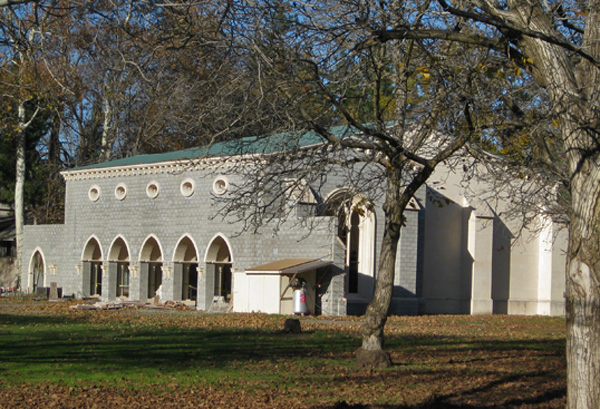
There are only two medieval structures in North America. Now a third is nearing the end of restoration in the small agricultural town of Vina, California, 100 miles north of Sacramento. It’s the 12th century Chapter House of Santa Maria de Oliva, a Spanish monastery that stood near Madrid. This building’s round the world journey makes an interesting tale.

The monks began their day in the Chapter House, where a chapter of the Rule of St. Benedict, an ancient guide to monastic living, was read and interpreted. This went on through the centuries until 1835, when the Spanish government closed all small monasteries and seized their lands. Santa Maria de Oliva was sold to a wealthy family that used the Chapter House to store farm equipment.

In 1931, William Randolpf Hearst bought the Chapter House for $285,000, intending to use the stones in the interior of a house he planned near Mt. Shasta. All the stones were marked for reassembly, and sent to California on 11 separate ships. The depression and WWII delayed Hearst’s plan, and in the end he donated the stones to the City of San Francisco to erect a Medieval museum in Golden Gate Park. This never happened and the stones lay outdoors in the park. Many were damaged, lost, or used for other projects

Meanwhile, the Cistercian Abbey of New Clarvaux was founded in Vina in 1955, and the first abbot began to make inquiries. In 1994, the Fine Arts Museums of San Francisco gave the stones to New Clarvaux with the stipulation that reconstruction begin in 10 years and the completed Chapter House be open to the public.

I first went to New Clarivaux in 1998 to stay for a few days at their retreat facilities. It’s an amazing place to unwind, and I have been there a number of times, so I saw the foundation of the Chapter House laid in 2001.

Section of New Clairvaux guest rooms

I had not been there recently, however, so when I drove up this past weekend, I found the structure was almost done – almost meaning another 18 months in a 10 year effort. Only 40% of the original stones were usable. The rest had to be repaired or replaced by stonemasons the abbey employed (they’ve raised $6.3 million to date, largely through small donations from across the country).

Master stonemason, Frank Helmholz, left Vina in November, bound for Luxor, Egypt, where he will spend the winter restoring a 3,400 year old temple. He plans to return to Vina next May. In an interview for the abbey newsletter, Helmholz said:

“In this modern age when everything is done fast and often doesn’t last long and serves no higher purpose, carving stones is a bit of a refuge. To create something that takes patience, dedication, and is lasting is very rewarding. And serving the monks in their spiritual lives gives a greater sense of meaning that is rare nowadays…to be part of something that has a higher purpose than one’s own comfort is inspiring in whatever form it takes.”

The abbey newsletter points out another significant point in the life of the Chapter House. It was built by Cistercians in Spain. Now it stands in another Cistercian abbey in the land that once was called New Spain. The stones have finally come home.

I have only alluded to the retreat facilities at New Clairvaux. In addition to nut crops and a vineyard, it’s one of the ways the monks earn their living, and it’s a marvelous place to spend some time apart. I will post about it later, but meanwhile, you can follow the link below for a summary.

www.sacredstones.org

www.newclairvaux.org