To the barricades! No, the other barricades.

Printing, ca. 1568.  Public domain.

Printing, ca. 1568. Public domain.

“Right now, bookstores, libraries, authors, and books themselves are caught in the cross fire of an economic war. If this is the new American way, then maybe it has to be changed — by law, if necessary — immediately, if not sooner.” – James Patterson

I haven’t blogged about ebooks and independent publishing lately. Over the last few years, it’s become clear they are here to stay. Success breeds acceptance, and the “vanity press” stigma is gone. In olden days (ca. 2011), I found a kind of “blows against the empire” satisfaction in promoting ebooks, writing reviews, and encouraging Indie authors. The evil empire was big publishing. This was the time of the little guy.

I still like Indie authors, though the “righteous cause” fantasy is gone. Now suddenly, at least to a casual observer like me, the situation appears reversed, with Amazon in the role of bully-boy, and those same publishers (perhaps) fighting for their existence, and with them (maybe) hangs the fate of a lot of remaining brick and mortar stores.

I first learned of the Amazon-Hachette duel from Michael Koryta, a favorite action-adventure writer I follow on Facebook. On May 19, Koryta reported serious problems pre-ordering his new book, due out June 3, from Amazon. He said the situation goes far beyond the interests of one author, and provided some of the links posted below.

On May 29, USA Today quoted James Patterson as saying “the future of our literature is in danger.” Patterson says that “Amazon wants to control book buying, book selling and even book publishing,” and laments that federal anti-trust laws no longer have teeth.

Here are several editorials on the situation:

Amazon vs. Hachette: When Does Discouragement Become Misrepresentation? From the NY Times Blog

Amazon said to play hardball in book contract talks with publishing house Hachette The Washington Post

AAR Calls Out Amazon in Hachette Dispute, From a statement sent by Association of Authors Representatives to Amazon.

And if I was only going to read one account of this dispute, I’d chose this one by Mark Coker, founder of Smashwords and early champion of ebooks, who believes in the vitality of a diverse writing and publishing world: Amazon’s Hachette Dispute Foreshadows What’s Next for Indie Authors

I’ve heard Coker speak on several occasions, and he’s a keen observer of a complicated landscape and future. His predictions on publishing tend to be right. In this post, he explains that the conflict centers on “agency pricing,” and who gets what profit margin for ebooks. Amazon is demanding a greater share. Here is what is at stake, says Coker:

“Books represent only one of hundreds of layers of icing on the cake of Amazon. Amazon can lose money on books while still operating a profitable business. Pure-play book retailers – Kobo and Barnes & Noble for example, must earn money from book sales. Unlike Amazon, they don’t have the financial resources to sell books at a loss forever…If Amazon can abolish agency pricing it will have the power to put its largest pure-play book retailing competitors out of business. This will make the publishers even more dependent upon Amazon, which further weakens their power.”

That’s the bad news. The really bad news, according to Coker, is that next they’ll come after Indie authors, just as they have in their audio book division, Audible. Gone are the 70% margins for authors that the agency model protects. Instead, exclusive Audible authors get 40% while the non-exclusive rate is 25%.

Coker winds up with with advice for independent authors, who, he says, are “the future of publishing.” It’s well worth reading the details in his article, but here are his main suggestions:

  1. Choose your partners carefully.
  2. Favor retail partners that support the agency model.
  3. Avoid exclusivity.
  4. Support a vibrant ecosystem of multiple competing retailers.

Remember the vibrant ecosystem of multiple competing book retailers? Though it is on the ropes, it’s not yet extinct. That’s worth thinking about and will be the subject of my next post.

Notes from the Wasteland

Photo by David Mark, public domain.

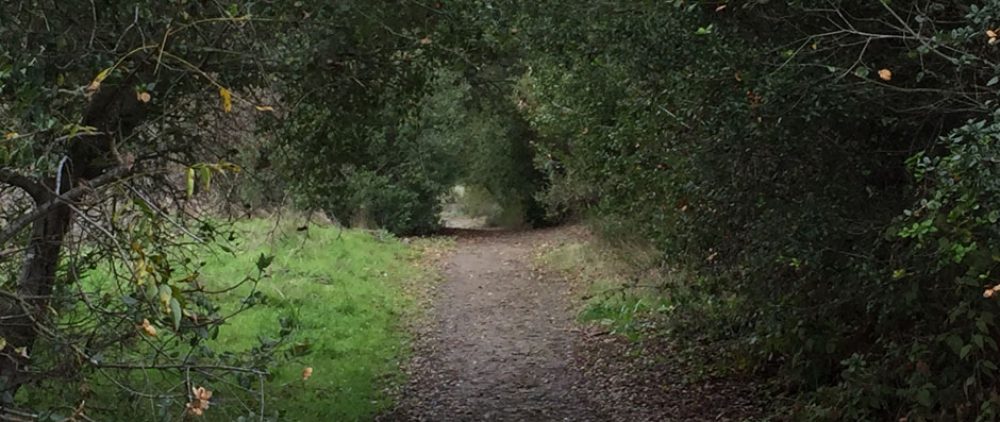
Photo by David Mark, public domain.

Talk of drought in California isn’t uncommon.  Normally it means lower levels in reservoirs and thinner snowpacks in the Sierras.  Bad news for skiers, and boaters, and farmers, perhaps, and an earlier start to the fire season, but’s it’s January, and for those who don’t ski, or boat, or farm, it’s easy to ignore until summer. But this time it’s different. This year it simply will not rain.

Even in “dry” winters, you see warnings that river currents are cold and swift.  This year the river’s so low there is no visible current.  Half of the local lawns are brown, and those that are green invite visits from the “water patrols” the districts threaten to form.  They say the reservoir from which we get our drinking water is at 17%; that image isn’t easy to forget.

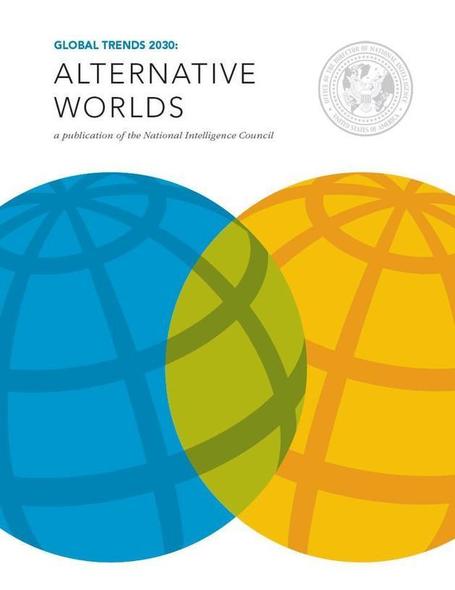
A year ago, I posted a report from the National Intelligence Council.  Every four years, the NIC, representing every US intelligence agency, collaborates on a summary of the world situation to give the incoming president.  They post the report online for anyone to read.  After the last presidential election, the NIC gave the administration a report called Global Trends 2030: Alternative Worlds:

Click for the text of the whole report

I discussed the report in detail in a post in December, 2012, but it’s worth reviewing one of the four “Megatrends” the report identified.  The CIA, the NSA, the FBI, and the 13 other agencies that compiled the report do not waste time debating climate change; they accept it as a given and factor it into predictions, saying that by 2030:

Demand for food, water, and energy will grow by approximately 35, 40, and 50 percent respectively owing to an increase in the global population and the consumption patterns of an expanding middle-class. Climate change will worsen the outlook for the availability of these critical resources. Climate change analysis suggests that the severity of existing weather patterns will intensify, with wet areas getting wetter and dry and arid areas becoming more so.

What gives you pause is their conclusion:

We are not necessarily headed into a world of scarcities, but policymakers and their private sector partners will need to be proactive to avoid such a future.

At this time, if we have to depend on our “policymakers and their private sector partners” to be proactive, we’re screwed, but there are different ways to look at our situation.  As usual, I try to relate literal “truth” to archetypal patterns, and in this case, the obvious mythic story is that of the Wasteland.

The story relates how Camelot fell apart.  How the rift between Arthur and his queen threw the land into ruin.  How the ailing king sent his knights in search of the Holy Grail, the one thing that could restore the barren world.  Those who reached the Grail Castle found another mysterious king inside, wounded through the testicles, in constant pain but unable to die.  His only relief by day was to float in a boat on a lake near the castle.  For this reason, he was known as “The Fisher King.”  He could only be healed by the right knight arriving at the castle to ask the right question.

Antecedents to the story are ancient and predate the Arthurian tales, perhaps by thousands of years.  In writing his poem, The Waste Land (1922), T.S. Eliot relied on an anthropological study, From Ritual to Romance by Jessie Weston, who in turn, drew on The Golden Bough, Sir James Frazier’s study of sacred kingship.

In the mythic cycle Frazier explored, the earthly king was “married” to the Goddess of the Land.  His potency and the earth’s fertility were one.  When he became old and infirm or impotent, the health of the land suffered.  He was ritually killed and a new king selected.  We find echoes of this in Arthur’s estrangement from Guinevere, though of course by then, the era when monarchs submitted to sacrifice was past.

We aren’t ruled by kings anymore, but if we consider “governments” alongside the word, “impotent,” and if we ignore what Viagra can fix, we find these meanings: “weak; ineffective, powerless or helpless; having no self-control.”

Yet the news isn’t all bad, and that is a theme I plan to explore in a series of posts exploring the Wasteland.  For one thing, the Grail hides there and nowhere else.  For another, the old stories never suggest that rulers can save us.  Renewal comes from the outsider, the dummling, the fool, Parsifal the rustic youth, or a carpenter from Nazareth.  

There are literally thousands of people today, already in or ready to enter the metaphorical forest on a quest for better ways to live.  I plan to discuss a few of their stories here.

“Arming the Grail Knights” by Edward Burne-Jones, tapestry, 1890’s, public domain

The Arcade Of Automatons

No one online presents the fascinating and sometimes disturbing art of fantasy quite like Lily Wight. Check out her Arcade of Automatons. The soul of objects and objects becoming ensouled have been part of the human dream in stories like Pygmalion, Pinocchio, and the recent movie, Hugo. Physical representations can be downright spooky. Ok, maybe not the lego automaton, but how about the skull and crossbones clock or the 16th century monk? Enjoy these great finds.

The day the music died

“We need magic and bliss, and power and myth, and celebration and religion in our lives, and music is a good way to encapsulate a lot of it.” – Jerry Garcia.

I was carried away in a rapture. And so i am a Deadhead now…” —Joseph Campbell

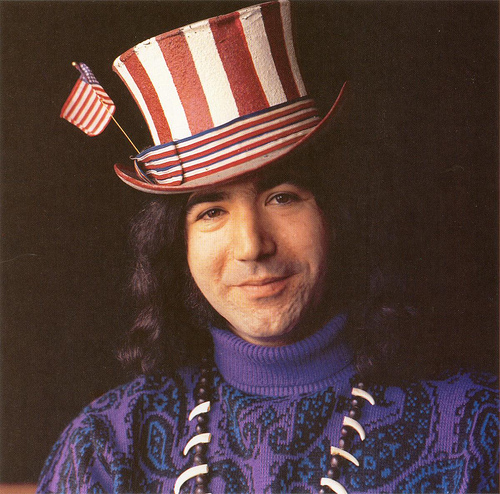
Jerry Garcia, 1966, by Zooomabooma, CC By-NC-SA 2.0

Jerry Garcia, 1966, by Zooomabooma, CC By-NC-SA 2.0

With all due respect to Don McLean, the music died on August 9, 1995, the day we lost Jerry Garcia, lead guitarist and most easily recognized member of the Grateful Dead.  Between 1965 and 1995, the Dead played an average of 77 shows a year.  Though volumes have been written about the experience, it is difficult to put into words.  Joseph Campbell was friends with several members of the band.  In a 1986 symposium with Garcia, drummer Micky Hart, and several Jungian analysts, Campbell said:

“The genius of these musicians- these three guitars and two wild drummers in the back… Listen, this is powerful stuff ! And what is it ? The first thing I thought of was the Dionysian festivals, of course…This is more than music. It turns something on in here (the heart?). And what it turns on is life energy. This is Dionysus talking through these kids. Now I’ ve seen similar manifestations, but nothing as innocent as what I saw with this bunch. This was sheer innocence…This is a wonderful fervent loss of self in the larger self of a homogeneous community. This is what it is all about!”

The Dead were always a touring band, and the shows were unique events that people loved or hated – I’ve never met anyone who was indifferent.  When they played Sacramento or Oakland on weekdays, half of the people in my department at work – and we’re talking electrical and software engineers – would arrive in the morning in tie-dye and take the afternoon off to attend.  The other half could not have cared less.

Campbell’s assessment reveals the “innocent joy” I felt after my first few shows, captured by the lyrics of “Scarlet Begonias:”

Strangers stopping strangers just to shake their hand,
Everybody’s playin in the Heart of Gold Band.

In reality, you don’t get that close to Dionysus without paying a price.  Thirty years on the road took its toll on Garcia.  In the summer of 1995, he checked himself into a rehab facility and died in his sleep of heart failure a week after his 53d birthday.

Jerry and the Dead left us a huge musical legacy, with at least one song, “Truckin,” designated as a National Treasure by the Library of Congress.  Surviving members of the band continue to release the best concert tapes, and everything has just been remastered for iTunes.  You can look at the collection here: Grateful Dead on iTunes.

In the end, maybe Joseph Campbell, with his eyes of innocence, saw it most clearly when he said, “It doesn’t matter what the name of the God is, or whether it’s a rock group or a clergy. It’s somehow hitting that chord of realization of the unity of God in you all, that’s a terrific thing and it just blows the rest away.”

Rest in peace, Jerry, and thanks for the ride!

The original Ghostbusters: The English Society for the Extermination of Ghosts (1908)

Let’s say you’ve got a haunted castle or cottage in Edwardian England – who ya gonna call? The “English Society for the Extermination of Ghosts,” of course, led by the owner of a small sports bar (in modern terms), who found a new way to harness the energy of his patrons. Armed with stout oaken cudgels, they set out to rid the country of haunts – read all about it in this post from “Freaky Folk Tales.”

Freaky Folk Tales's avatarfreaky folk tales

The original ghostbusters

In Edwardian London, if you had something strange in your neighbourhood then you would most likely call on the services of one Charles Dove. The establishment of the English Society for the Extermination of Ghosts, was borne out of several gentlemen having far too much time on their hands and a desire to find something more purposeful for their redundant athletic qualities.

Dove placed several advertisements in local papers at the time and was most surprised to be inundated with applications to join his team. However, despite the immediate allure, Dove promised each man signing up to the ‘Death on Ghosts’ brigade nothing more than an oak cudgel to lay the unsuspecting phantoms. And, although all the ghost warriors professed their disbelief in ghosts, I am reliably informed that Dove decided it wise always to send two hunters to lay away the reported miscreant spectre.

The Times, April 18…

View original post 828 more words

Finding Happiness

Here is a wonderful post from the Bhutan Chronicles, a blog by two European professionals who found work in Bhutan, the country that replaced GDP as a measure of its wellbeing with the Gross National Happiness index. Reflecting on life in Bhutan, Antonia says, “Coming from a competitive environment where superlatives are the norm, I find myself suddenly absorbed by this difference between driving myself to be happier and just accepting happiness.” Enjoy!

randallkrantz's avatarbhutan chronicles

“Stop running. Happiness has been chasing you all this time…”

Moving to Bhutan does funny things for one’s happiness. Increasingly famous for developing the concept of Gross National Happiness, Bhutan is the first country many people think of when asked to name the happiest place on earth. This has even led the Tourism Council of Bhutan to adopt the slogan, “Happiness is a Place”. Happiness is much more than a place, but indeed, Bhutan has been a great place for me to learn about my own happiness.

People often ask me if I am happier here, and whether those around me are truly the happiest people in the world. The answers to such questions are at first complicated, and eventually simple. People here are not in a race to be happier or happiest. I was amazed to learn recently that the happiness of an individual is 50% genetic, 40% attitude…

View original post 831 more words

We are barely a month shy of the 150th anniversary of the Battle of Chancellorsville, one of the key clashes of the Civil War. At the Chancellorsville Visitor Center, Mary Stong-Spaid discovered her home is actually on the battlefield. Earlier this month, she offered these moving reflections and photographs of Civil War graves and monuments.