Okay, time for a mea culpa on the recs contained in my last post on the National Geographic Channel’s Hunting UFOs series http://wp.me/pYql4-2b2. I grabbed the clicker after 20 minutes. The program was part Blair Witch and part reality TV, and I’m not fond of either.
And as for the tweets, I think we better hope the aliens don’t speak English. On the other hand, if they do, it probably means they’ve been tuning in to our TV signals for years. If they’ve been watching commercials and Fox news, this set of tweets won’t phase them.
For me, the most interesting item to emerge from all of this was a quote from Stephen Hawking that I pasted into a comment and will repeat here. He warned that if more advanced alien life forms landed on earth, we could see a replay of the fate of Native American populations at the hands of European colonizers.
“We only have to look at ourselves to see how intelligent life might develop into something we wouldn’t want to meet.” – Stephen Hawking
So life continues, as do our explorations, for as two researchers who are beyond reproach observed, “The truth is out there.”
Tonight at 9:00pm, the National Geographic Channel will present “Chasing UFO’s,” with a team of three investigators checking out reported sightings in Texas, Fresno, and other hotspots of alien activity.
The National Geographic Team – move over Men in Black!
In a recent survey, National Geographic discovered that 80 million Americans – a third of the population – believe in UFO’s. Seventy-nine percent of us think the government has kept UFO information hidden, and more than half believe there are real Men in Black who threaten people who report sightings.
Aliens grok Geena Davis in “Earth Girls are Easy,” 1988
But wait – there’s more going on tomorrow than just watching other people have all the fun. There’s something to take our minds off wondering how to land a job as a UFO Chaser. It’s the Wow Reply Project.
In August, 1977, Jerry Ehman, a researcher at the Ohio State Big Ear radio observatory, spotted a coherent alpha-numeric sequence on a computer printout of signals from deep space. He grabbed a red pen, circled it, and wrote “Wow!” in the margin.
And in case you’re a bit stuck in figuring what to say, the Geographic has solicited suggestions from several experts, including Stephen Colbert, to help us. Check out Colbert’s recorded message, which begins, “Greetings intelligent alien life forms. I am Stephen Colbert, and I come to you with an important message from all the peoples of the earth. We are not delicious.”
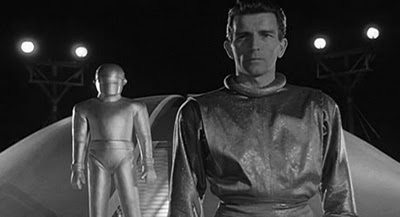
From “The Day the Earth Stood Still,” 1951
It isn’t easy to make up a tweet for space beings. What can you possibly say? “Greetings, aliens. I had cheerios for breakfast, how bout you?” See, this is going to take some work, and there isn’t much time, so we better get busy!
David Brooks, a writer for The New York Times, and several friends “threw financial sanity to the winds” to follow Bruce Springsteen on tour through France and Spain , because supposedly the crowds are even more intense than their American counterparts.
Young European fans know every word of songs The Boss recorded twenty years before they were born. Their enthusiasm “sometimes overshadows what’s happening onstage,” says Brooks. The moment that spawned his article was seeing “56,000 enraptured Spaniards, pumping their fists in the air…and bellowing at the top of their lungs, ‘I was born in the USA.‘”
How could this be, especially since in Springsteen’s music, USA often means New Jersey?
Brooks asked himself the same question and borrowed a term from child psychology to help understand it. The word is paracosm, meaning a world in imagination, “sometimes complete with with imaginary beasts, heroes and laws that help us orient ourselves in reality. They are structured mental communities that help us understand the wider world.”
Children do it, says Brooks, and as adults we continue the habit. Then he adds the observation that is the point of this post:
“It’s a paradox that the artists who have the widest global purchase are also the ones who have created the most local and distinctive story landscapes.”
Springsteen’s New Jersey. J.K. Rowling’s English boarding school. Tony Hillerman’s Navajo country. 221B Baker Street. Downton Abbey. Tolkein’s Edwardian rural England, aka, The Shire.
Hob Lane, near where Tolkien lived as a boy
I often think of the books I hate to see end, the kind that inspire fans to continue the story on their own, as I described in a recent post on fan fiction http://wp.me/pYql4-298. Character remains the essential ingredient – we want to follow Harry, Ron, and Hermione wherever they may lead us – but in his article David Brooks points out the critical nature of the world where they more and act and love and fight. We wouldn’t really want to see the Hogwarts gang on Sunset Boulevard anymore than we’d want Sam Spade in St. Mary Meade, working a case with Miss Marple.
“If you build a passionate and highly localized moral landscape, people will come,” says Brooks, echoing Field of Dreams, a movie that largely took place in a cornfield. “If your identity is formed by hard boundaries, if you come from a specific place…if your concerns are expressed through a specific paracosm, you are going to have more depth and definition than if you grew up in the far-flung networks of pluralism and eclecticism…sampling one style then the next, your identity formed by soft boundaries, or none at all.”
I think this is an important thing to consider – one you seldom read about in books on writing but which instantly resonates when called to mind in the context of our favorite fiction.
But let’s end with The Boss
One of Springsteen’s best known songs, “My Hometown,” moves me the way “Born in the USA” moved a stadium full of Spaniards. Hometown for me is part of a paracosm, a special kind of imaginary landscape. I’ve said elsewhere that when I was young, we moved around too often for me to have any sense of a hometown, yet the moment I say the word I can see it vividly, with eyes opened or closed.
We’ll let the master paint the picture, since someone (I forget who) once observed that only a troubadour of Springsteen’s calibre could make you nostalgic for New Jersey.
This Norman Rockwell magazine cover, showing Thanksgiving on Walton’s Mountain, is a perfect illustration of The American dream. The power of Rockwell’s vision of an American earthly paradise is so compelling that we long to believe it even though we know life was never like that and certainly isn’t now. I started thinking about the power of the dream after reading an excellent article in Time Magazine: “The American Dream: A Biography” by Jon Meacham, in the July 2, 2012 issue). Meacham’s conclusion supports what all of us know but wish we didn’t – the dream is in danger like never before.
The phrase, “American Dream,” first appeared in James Truslow Adams’s The Epic of America , an optimistic history published in 1931, as we neared the depths of the great depression. Adams wrote of: “that American Dream of a better, richer, and happier life of all our citizens of every rank which is the greatest contribution we have as yet made to the thought and welfare of the world.”
Even in 1931, there seemed to be cause for optimism: the day Adams finished his manuscript, President Herbert Hoover turned on the lights of the Empire State Building. Technical marvels coincided with the Time article as well, but they didn’t belong to us. On Sunday, three Chinese astronauts manually docked a spacecraft to their orbiting space station, a key milestone in their quest to reach the moon. On the same day, a Chinese deep sea craft set a national diving record, reaching a depth of 7000 meters in the Mariana Trench.
It took two centuries and a civil war before the right to “life, liberty, and the pursuit of happiness” was officially extended to everyone, and yet for a time, America offered a better chance to reinvent oneself, to start again, to rise above the limitations of birth than any other place in the world. Abraham Lincoln called himself “a living witness” that any child could grow up to be president. Somewhere along the line, things changed.
One interesting point that Meacham makes is that “there is a missing character in [the] popular version of the story of America’s rugged individualism: the government, which helped make the rise of the individual possible.” The Pacific Railroad and Homestead acts, signed by Lincoln, had much to do with knitting the country together and making allowing dreamers to “go west” or “light out for the Territory” like Huckleberry Finn as well as his creator. It was government, under a southern president, that enforced the Civil Rights Act, and during the 60’s, launched the drive that put men on the moon and started us on the road to a micro-electronics revolution.
In the end, dreams do not depend on facts and figures, but more on a sense of hope and possibilities. What was different in 1931 that allowed James Truslow Adams to write The Epic of America? In it, he said, “If the American dream is to come true and abide with us, it will, at bottom, depend on the people themselves.”
If it did then, it does now. What happened over the last eighty years? There aren’t any easy answers, but there are many things we can and should be thinking about.
A friend on a writer’s mailing list sent this notice of the ALMA short story contest. First prize is $1000 and inclusion in the ALMA Short Story Compilation for 2013. Word limit is 3000. Due date is Nov. 12, 2012. The entry fee is $15 before Aug. 12 and $20 after that. Here are the details:
Lewis Richmond, an ordained Zen priest and author of Aging as a Spiritual Practice, began his studies 40 years ago with the renowned teacher, Shunryu Suzuki Roshi. Richmond relates that one day, after a talk, a student said, “Suzuki Roshi – you’ve talked for an hour, and I haven’t understood a word you’ve said. Could you please tell me one thing about Buddhism I can understand?”
The master waited for the laughter to die down and said, “Everything changes.”
“Everything changes” is a truth we often would rather forget, but sometimes events make that impossible. Our oldest dog, Holly, has serious medical issues. She has come to the end of her life. This month has been a daily exercise in letting go, in watching her, in trying to gauge the quality of her life and which interventions make sense.
The vet confirms that she’s not in any pain. She is still feisty and cuddlesome in turn. She turns up her nose at dog food much of the time, but still likes buttered toast and hot dogs, so antibiotics make sense. So does medication to increase the blood flow to her kidneys, which are failing. We take turns administering “subcutaneous fluid replacement therapy” each morning, which was scary at first, but has become a very serene, if bitter-sweet, time to bond with her and reflect. With quiet music and morning sun slanting into the room, we calm ourselves so Holly calms down and stroke her head while 150 ml of solution flow through the drip.
We brought her home as a puppy when she was eight weeks old. She’ll be 16 at the end of the month if she lasts that long – we don’t know – it could be days or weeks or months. It’s hard to believe how quickly sixteen years goes by.
Is there anything that doesn’t change? All of the major religions say yes, there are the ways to unravel the knot. A reminder of why there is nothing more important may be Holly’s final gift.
A year ago, I wrote a post on Harry Potter fan fiction, http://wp.me/pYql4-14b. My information came from an article in Time on the occasion of the release of the final Potter movie. I had no idea how popular fan fiction had become, since my only prior experience was with its 20th century incarnation as cheaply printed fanzines on the magazine racks at Tower. I sometimes skimmed but never bought.
All of that has changed. The genre was featured last Friday in a Wall Street Journal article, “The Weird World of Fan Fiction.” No wonder the Journal took notice. E.L. james, author of the Fifty Shades of Gray erotic trilogy, which sold 15 million copies in three months, got her start writing fan fiction based on the Twilight Series (Edward as a powerful CEO and Bella as his sex slave).
The article mentions other well known writers whose first work was fan fiction. Meg Cabot, author of The Princess Diaries began writing Star Wars stories when she was 11. Naomi Novik, author of the Temeraire series, which has been optioned by Peter Jackson, continues to write fan fiction. For her it is play, and she has more than 400 stories online, set in the worlds of Star Trek, Sherlock Holmes, and The Avengers.
In addition to fan fiction writers who have broken into the mainstream, some have gathered huge numbers of online readers at sites like fanfiction.net or wattpad.net. One story based on The Hunger Games has been read two million times.
Fan fiction isn’t new. Conan Doyle fans in the late 19th century wrote their own Sherlock Holmes stores as authors continue to do. The theme for an upcoming TV series with a female Watson appeared first on fanfiction.net. One can argue that both Homer and Shakespeare in his histories, created stories akin to fan fiction; they used pre-existing worlds, situations, and characters.
The Journal gives a sense of the wild playfulness of fan fiction authors. There is Pride and Prejudice in Space. We have Alice and the Mad Hatter battling zombies, and The Lord of the Whiskers, which populates Middle Earth with cats. Male-male romance appears to be common, with Kirk and Spock, and Harry and Draco among readers’ favorite couples. There are character cross-over stories too, like characters from the TV series, Glee, winding up in Middle Earth.
Published authors are mixed in their response. Some, like J.K Rowling and Stephanie Meyer welcome the spinoff stories. Others like George R.R. Martin and Anne Rice are dead set against fan fiction, and threaten lawsuits, though suits are seldom launched except when fans try to move borrowed worlds into mainstream publication. Orson Scott Card was initially opposed to fan fiction but has come to embrace it. This fall he will host a contest for Ender’s Game fan fiction. Fans can submit works to his website, and the winning stories will be published in a anthology. “Every piece of fan fiction is an add for my book,” Card said. “What kind of idiot would I be to want that to disappear?”
I understand the draw of fan fiction. My first real literary effort was a sequel to The Wind in the Willows that I wrote in the fifth grade because I didn’t want the story to end. In college I was seized with great, “What am I going to do now?” angst when I finished Lord of the Rings. One of the things I did was work with a group of independent filmmakers on a 20 minute epic entitled, Billy the Kid Meets the Wizard of Oz
The word, “amateur” comes from the Latin, amare, to love. With that in mind, I look forward to checking out some of the web sites where these amateurs post their work.
Don’t worry, I’m not suggesting a space alien theory – quite the opposite. As reported on NPR, a new method of dating the paintings in Altamira and some of the other caves painted by prehistoric artists suggests that some of them may have been created before Homo Sapiens arrived in Europe. This would mean that Neanderthals, who roamed Europe for at least 200,000 years, were the original artists.
Pedro Saura AAAS/Science
Alistair Pike of the University of Bristol says that some Spanish cave paintings are at least 40,800 years old. Humans had just arrived from Africa. Archaeologist, Joao Zilhao of the University of Barcelona, is convinced that some of these works were done by Neanderthals. We know they engaged in symbolic behavior. They made ritual burials, they decorated beads and other implements, and left caches of ground up colored minerals that may have been used for pigments.
Though not everyone agrees, these findings and theories appear in the journal, Science. Pike says he and his Spanish colleagues just need to find paintings “a few thousand years older” to prove their point. They’re planning a return to the region to continue their search.
Take a look at this and several related articles on the NPR website. It helps put things in perspective for me to realize that we are not the only intelligent species that now walks, or has every walked the earth.





 The First Gates