Of Football and Family

I’m anything but a diehard sports fan, but I’ve noticed over the years that certain sporting events become unforgettable when they mark key moments in my life or our collective life.  Do you remember how moving the Super Bowl was in Feb., 2002?  Our nation was still hurting after the 9/11 attacks, but here was proof that we were not going to let anyone stop us from celebrating life.

I thought of my father yesterday.  Football was one of the ways he and I connected.  Thirty years ago, he and I talked on the phone with growing excitement as the season progressed, and this new quarterback, with the unusual name of Joe Montana, led the formerly hapless 49ers to their first ever Super Bowl victory.  The best game of the season, however, was the Division Championship game. Montana won it with an 89 yard drive after the two minute warning, and a justifiably famous touchdown pass to Dwight Clark with less than a minute to play.  This wasn’t just a persona moment; it set the entire region on fire after a difficult decade.

Montana to Clark, with 59 seconds in the game, Jan, 1982

My father moved up here to be with us in 1999, after he was diagnosed with a wasting illness. Mary and I spent most of our Sunday afternoons with him during football seasons. First lunch and then the afternoon game. My father died in 2007, and we haven’t watched much football since. Until this season. Until our “formerly hapless” 49ers took off so dramatically you couldn’t help but notice and want to follow along.

Yesterday it happened again, 30 years later, almost to the day. The niners won the Division Championship game with another spectacular drive and touchdown pass, this one with only seconds left. Another on-your-feet, unforgettable moment. Hopefully, something to rouse all of northern California after a difficult decade. My father would have loved this game.

Smith to Davis, with 9 seconds in the game, Jan, 2012

I don’t go in for sentiments like, “Maybe he was looking down from heaven.” Hopefully those in the afterlife have better things to do than peer over our poor shoulders. But I do believe – and I’ve heard various spiritual teachers hint at this – that the ancestors and those who are gone can pick up our prayers and love and kind thoughts. That’s a pretty good deal. And if football is the occasion, there is nothing wrong with that.

As the poet Lu Yu put it (quoted in The Tao of Pooh):

The clouds above us join and separate,
The breeze in the courtyard leaves and returns.
Life is like that, so why not relax?
Who can stop us from celebrating?

The News on Page 13

Just some quick notes on a story I have been following, in large part because it is so important and yet so downplayed in the US media. By coincidence (I assume), the latest saber-rattling news was back on page 13 of the Friday the 13th edition of the Sacramento Bee.  The front page headline story involved the closing of a local shopping center.

US carrier in the straits

Thanks to the internet, and especially British news sources, we learn that yesterday, Iranians accused the US of sending one of its ships into the 10 mile “maneuver zone” where the Iranian navy is conducting war games.  In response, Iran threatened to close the straits.  The Obama administration said this would be a “red line act,” that would provoke a military response.

On Wednesday, a top Iranian nuclear scientist died in a bomb blast after a passing motorcyclist attached a bomb to his vehicle.  He was the fourth top scientist to be targeted in the past two years according to a Jan. 12, editorial in the Los Angeles Times, which said, “That’s the kind of clean, covert assassination method favored by Western intelligence agencies.”  Although Secretary of State Clinton denied US involvement, the Iranians don’t believe her, and the Times was skeptical:

“[Clinton] went on to deliver a lecture about the need for Iran to shut down its nuclear program, which we agree with. But we also think the bombing merited something more – a strong statement that the United States decries political assassinations. The U.S. is already on shaky legal and ethical grounds with its own program of targeted drone assassinations of suspected terrorists. But at least we’re at war with al-Qaida. State-sponsored extrajudicial killing is a serious violation of international law, and car-bomb assassination is a tactic little different from the methods used by terrorists. It would be nice to hear Clinton, or President Obama, emphasize such principles.”

The Times editorial went on to say economic sanctions do not appear to be working, but that may depend on who you ask.    I caught an NPR interview with a correspondent in Iran who said, yes, they are working, just not perhaps as we want them to.  He said he went to the store to buy an Oral B toothbrush and there wasn’t even toothpaste available.  The citizenry doesn’t really understand the nuclear issue, but it does blame the US for mounting hardships.  Meanwhile, I’m guessing Iranian leaders are not suffering a lack of toothpaste.

Iranian warship test fires a missile in the Straits, Jan 1

The LA Times noted, you can’t assassinate collective knowledge.  Sooner or later, Iran will have nukes.  Another middle-east war will not close Pandora’s Box.  Yet I still find it hard to believe that this is all about nukes.  I’m thinking of Col. Andrew Bacevich’s 2008 predictions.  http://wp.me/pYql4-1AT.  Until we take the quest for energy independence seriously, armed conflict over oil will be our future.

In 2011, Wikipedia estimated that the price of Tomahawk cruise missile was $830,000.  How many scholarships would that buy for future energy scientists?  How many studies of alternative fuels would that fund?  How many lives and dollars are we prepared to spend trying to push back the river?

Are You Now, or Have You Ever Been Normal?

When I was a kid, I believed that my family was the standard by which all families should be judged.  In the ’80’s, however, when family psychology met popular culture and some of us went questing for our inner child, the news was not so good.  We learned that 96% of families were dysfunctional; that crazy had become the new normal; that 24 out of 25 of us had grown up with the Griswalds and not the Cleavers!

Who's your daddy?

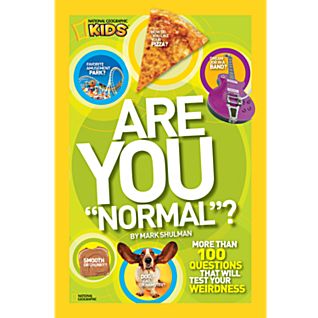
Just when we thought we had that settled, when I thought my cred as a free thinker and iconoclast was safe, a new book threatens all that: Are You Normal?, by Mark Shulman.  According to a Washington Post article, Shulman’s book has 176 pages of questions for kids, scored against other answers, which allows you rank yourself on a “weird-o-meter.”

With some trepidation, I answered the sample questions in the article, going for the perspective I would have had in grade school.  Feel free to ride along – if you dare:

1) Do you have a brother or sister:  

Yep – one sister, making me one of the 87.5% who have a sibling.  So right of the bat, it’s not looking good for the bohemian persona.

2) Have you ever faked being sick to get out of school?

Well duh, of course I did!  Can we say, “World Series?”  That boosted my weirdness quotient, since only 25% answer yes to this one.

3)  Where do you bite the chocolate bunny first?

The ears of course, along with “more than half”  of those polled.  Interestingly, 1 in 25 go for the bum…now that is strange!

4)  Smooth or Chunky peanut butter?

I started to say “chunky,” but that’s revisionist history.  As a kid, it had to be smooth, lest it tear my Wonder Bread.  “Slightly more than half,” share that predilection.

5) TV in your bedroom?

Not then, not now, though it wasn’t nearly as common when I was a kid as it is now (56% answer “yes”).  My parents had a portable with rabbit-ears, but those were the days when, if the TV “went on the fritz,” you pulled the tubes and carried them down to the tube tester at the local grocery store.

6)  Did you ever bite your fingernails?

Rarely but on certain stressful occasions, yes.  The answer to that was a 50/50 split.

7)  Did you ever bite your toenails?

Ewww!  And that reaction is not unique.  A full 90% say they “could not or would not” do such a thing, so most of us are plain vanilla on that score.

The Washington Post review concludes by saying “the real point of the book is to show that nobody is perfectly normal or perfectly weird.  We’re all unique, and that’s part of what makes us special.”  Not such a bad conclusion to reach.

However, if “special” is now normal,  but normal normal is weird…I guess I better not go down that road, just quit while I’m ahead.

Save the Cat by Blake Snyder: A Book Review

I love (good) books on screenwriting, because of all the available guides to writing fiction, these focus most squarely on the primacy of story; first the forest, then the trees.  Last week a fortunate weblink led me to Save the Cat, 2005, a brief but idea packed gem of a book by Blake Synder (1957 – 2009).

Snyder was a successful screenwriter and a respected teacher who began his career in movies doing voice-overs for his father at the age of eight.  By his own admission, when he started writing for movies, he had only a vague idea of structure.  Discovering Syd Field’s Screenplay was a revelation:  “truly career-saving,” Snyder says, but there were still gaps in his sense of movie architecture.  Snyder developed the methods he presents in this book in response.  Because he spun things in an unusual way, and uses his own terms for concepts that may have become overly familiar, his methods move the imagination in fresh ways.

Blake Snyder 1957-2009

The title of his book, for instance, is a code for his belief in the primacy of creating characters we want to follow.  In the opening scenes of older movies, the protagonist often did something nice – like saving a cat – to bond with the audience, a step contemporary movies often skip in favor of showing a lead who is hip, slick, and cool.  Snyder cites this as the cause of failures of several recent films.

His approach is top down.  He begins with the log line and the title, and demands that the writer polish them before moving on, because they are a touchstone for writing the script itself as well as a key selling point.  This single sentence and title, when well crafted, reveal what the movie’s about, its genre, the lead characters, and (ideally) pique curiosity.  Snyder gives examples like:  “A cop comes to L.A. to to visit his estranged wife and her office building is taken over by terrorists – Die Hard.”

Snyder then suggests we do something that few writers ever dream of – pitch the concept to strangers.  He would literally pick people out in a Starbucks line, and say, “Excuse me, I’m working on a movie concept, and I wonder if I could get your feedback.”  Since he lived in L.A., the answer was often yes, but he challenges us to do the same wherever we are.

He moves through ever increasing levels of detail as he takes the reader through the development of the script, and one thing I really appreciated was his in-depth knowledge of stories:

“Jaws is just a retelling of the ancient Greek myth of the Minatour or even the dragon-slayer tales of the Middle Ages.  Superman is just a modern Hercules.  Road Trip is just an update of Chaucer’s Canterbury Tales – isn’t it?  To not know the roots of the story you’re trying to create, either from the last 100 years of movie storytelling or the last thousand, is to not honor the traditions and fundamental goals of your job.”

Though Blake Snyder died suddenly in 2009, a website serves as a blog on his methods, and offers a bulletin board as well as classes geared to both screenplays and novels.  http://www.blakesnyder.com/

I’m sure this is old news to the screenwriters who read this blog.  If so, pass it along to your novelist friends; it seems we don’t get out often enough.

Sabre Rattling Over Oil: Better Get Used to It

The juxtaposition of headlines this morning was strange but telling.  On page one of the Sacramento Bee, under the heading of “Tourism,” was the story of Virgin Galactic, a travel company that expects to offer 2.5 hour rides into space, starting as soon as next Christmas, for a mere $200,000.

You might want try to lock in your price now, before it goes up.  Buried back on page seven was this headline:  “Risk of showdown with Iran escalates as oil prices climb.”  According to Andrew Bacevich, in a 2008 interview with Bill Moyers, we can expect a constant string of oil crises; the choices we make as a nation make them inevitable.  There’s a price to pay for cheap space travel, among other things.

Andrew Bacevich

Bill Moyers 2008 interview with Bacevich is published in, Bill Moyers Journal: The Conversation Continues, (2011).  In the preface, Moyers says, “Our finest warriors are often our most reluctant warmongers.”  Bacevich is a West Point graduate and Vietnam veteran who retired as a colonel after 23 years in the military, to teach history and international relations at Boston University.  Bacevich’s son, Andrew, died in Iraq in 2007.  Bacevich is the author of several books, including the best selling, The Limits of Power:  The End of American Exceptionalism (2008).

In his interview with Moyers, Andrew Bacevich doesn’t pull any punches.  He says our foreign policy, including our wars:

“reflect the perceptions of our political elite about what we the people want.  And what we want, by and large, is to sustain the flow of very cheap consumer goods.  We want to be able to pump gas into our cars regardless of how big they happen to be…and we want to be able to do these things without having to think about whether or not the books balance at the end of the month…”

To our list of wants we can now add, “affordable” space travel, with its guaranteed 5.5 minutes of weightlessness.   As an ex-miltary officer, Bacevich points to the dark side of this, something you never hear in presidential debates, and don’t often see anymore on the front page of the paper.

One of the ways we avoid confronting our refusal to balance the books is to rely increasingly on the projection of American military power around the world to maintain this dysfunctional system.”

The biggest elephant in the living room is our dependance on foreign oil.  Without oil, Bacevich notes, the middle east has “zero strategic significance.”  Every president since Richard Nixon has promised to address our dependance on foreign energy, and Jimmy Carter staked his political career on finding a solution.  Bacevich paraphrases Carter’s speech in 1979:

“If we don’t act now, we’re headed down a path along which not only will we become increasingly dependent upon foreign oil, but we will have opted for a false model of freedom.  A freedom of materialism, a freedom of self-indulgence, a freedom of collective recklessness.  The president was urging us to think about what we mean by freedom…Carter had a profound understanding of the dilemma facing the country in the post-Vietnam period.  And of course, he was completely derided and disregarded.” 

When Moyers asked him about the realities of al-Qaeda and radical Islam, Bacevich replied that yes, they are violent and dangerous, but are “akin to a criminal conspiracy…Rooting out and destroying the conspiracy is primarily the responsibility of organizations like the FBI, and of our intelligence community, backed up at times by Special Operations Forces.  That doesn’t require invading and occupying countries.”

At the end of the interview, Bacevich, who defines himself as a conservative, says he hopes we will come to understand the war in Iraq as a great mistake.  And rather repeat the mistake in Iran or anywhere else, hopes we will “look at ourselves in the mirror.  And…see what we have become.  And perhaps undertake an effort to make those changes that will enable us to preserve for future generations that which we value most about the American way of life.”

You can read the full text of the interview with Andrew Bacevich in Bill Moyers Journal, along with many other provocative talks with thinkers and artists across the spectrum of contemporary life.

Ebooks at the New Year

A funny thing happened to ebooks last year – they became legit.

Last January, right after I got my kindle, I started noticing stories about Amanda Hocking and a few other ebook superstars in places like the New York Times and the Wall Street Journal.   The articles had a semi-surprised, “look at this,” tone.  No longer.  Now an ebook author doing well raises no more eyebrows than John Grisham writing another best seller.

Even though I was paying attention, I don’t quite know when the shift in attitude happened.  It was a done-deal by October.  That’s when a local member of the California Writer’s Club asked advice from the group:  his manuscript was ready.  Should he submit it through traditional channels or go the ebook route?  Everyone in the room, with no exceptions, recommended the ebook option.

As recently as twelve months ago, people still talked of ebooks as “self-publishing,” a phrase that carries a touch of “vanity press” stigma.  That has changed.  Now we speak of “traditionally published” in contrast to “independently published” authors.  Listen to the words:  traditional vs. independent.   Which one has more panache?

Not long ago, approval by traditional agents and editors signified quality.  I think the rapid loss of brick and mortar stores was a factor in changing that.  When Borders folded, half the gates that gatekeepers kept disappeared.  As the industry scrambles to find new ways to stay afloat, literary quality may not be so big a factor in the mix.  Mark Coker, the founder of Smashwords put it like this:  “The cachet of traditional publishing is fading fast. Authors with finished manuscripts will grow impatient and resentful as they wait to be discovered by big publishers otherwise preoccupied with publishing celebrity drivel from Snooki, Justin Bieber and the Kardashians. 

When you consider more serious fiction, odds seem to favor established names more than ever these days, in stores both large and small.  I stopped at an independent bookstore last fall in a small town.  It has been around for a while and continues to thrive.  There were lots of attractive craft and gift items – pens, handmade notebooks, and things like that.  The books were shelved by genre, and carefully chosen to reflect popular titles and series.  It was easy to find something good to read, but almost all the choices were books by established authors.  I’d do the same if I was the owner and wanted to stay in business, but that’s bad news for authors just starting out.

This is where time enters the equation for everyone, especially for older writers.  The man who asked the ebook question at CWC was about my age and put it like this:  “I don’t have forever.”  Mid-list titles, which authors used to be able to sell while learning their craft are an endangered species.  “Their demise has been predicted for years,” said agent Donald Maass.  “This time it’s true.”  As all these trends converge, the attraction of the ebook publishing has exploded.

One thing I notice consistently in the ebooks I have enjoyed is a certain playfulness or quirkiness,  a willingness to step off the path of genre convention.  I’m reminded of fantasy fiction in the ’80’s, when getting published wasn’t such a nail biting affair.  The stories were full of surprises.  Writers took more chances than those I see today at Barnes&Noble.

Recently, a well-meaning writer friend warned me that, “Editors don’t like colons.”  That’s the second time someone has said that, and I’ve heard exclamation points are out of favor too!  The only kind of writer who’s going to remember tidbits like that is one who is contentious, dedicated to learning her craft, and interested in giving her peers a leg up.  And yet…isn’t that kind of “wisdom” going to backfire?  Where is my imagination when I’m trying to remember which punctuation marks are okay to use?  I’m not going to be fully engaged in telling the best story I can, especially if runs afoul of news of “what editors are looking for now.”

Everyone has to come to their own conclusions about what to read, what to write, and what to do with their writing.  I find myself ever more grateful for ebooks and independently published authors.  I plan to champion more of them this year.

“Be a Lamp Unto Yourself”

Happy New Year!!!!  

I thought I would begin the 2012 blogging year with words that have long been an inspiration to me.  They come from advice the Buddha gave his disciple, Ananda:

“Therefore, Ananda, be a lamp unto yourself, be a refuge to yourself. Take yourself to no external refuge. Hold fast to the Truth as a lamp; hold fast to the Truth as a refuge.”  – Mahaparinibbana Sutta

Part of the problem, then as now, was knowing the truth when you found it.  The Buddha’s India of 2600 years ago was similar to ours in this respect – it was awash in competing and often conflicting philosophies, teachers, and religions, each claiming special access to the truth.

Gandhara Buddha (4th-5th c.)

Once, as the Buddha passed through a village called Keshaputta, the inhabitants, members of a clan called the Kalamas, approached him for advice.  The Kalamas were seekers of truth.  They were happy to welcome traveling yogis, holy men, and teachers of all sorts, but by the time Buddha arrived, they were thoroughly confused by contradictory teachings from too many “experts.”

In response, the Buddha gave the teaching known as the Kalama Sutta, a fuller version of the advice he later gave Ananda.  In his discourse, the Buddha listed ten ways of knowing that are not sufficient to indicate the truth:  oral history, tradition, scripture, news, ordinary reasoning, dogmatism, common sense, one’s own opinions, expert opinions, opinions of authorities.  Instead, the Buddha asserts our need to test such sources experientially, and trust our own conclusions:

“O Kalamas, do not be satisfied with hearsay or tradition, or any teachings, however they may come to you.  Only when you know in yourself when things are wholesome, blameless, commended by the wise, and when adopted and practiced lead to welfare and happiness, should you practice them.  When they lead to virtue, honesty, loving-kindness, clarity, and freedom, then you must follow these.” (as quoted in A Path With Heart by Jack Kornfield)

A teaching like this can be difficult with its demand for our own freedom and responsibility.  The teaching seems to throw us back on our own moment by moment awareness.  If we lose our way in the maze of conceptual thought, our own direct experience is one of the few things left to trust.

Most traditions and most of the world’s folklore suggest that we each have a deep way of knowing within us.  It goes by many names:  Higher Power, Buddha Nature, Christ Consciousness, Holy Spirit, Inner Guru.  How and when do we contact this wisdom?

This seems like a very good question to ask at the start of a brand new year.