“On a day like today, my master William Faulkner said, ‘I decline to accept the end of man’. I would fall unworthy of standing in this place that was his, if I were not fully aware that the colossal tragedy he refused to recognize thirty-two years ago is now, for the first time since the beginning of humanity, nothing more than a simple scientific possibility. Faced with this awesome reality that must have seemed a mere utopia through all of human time, we, the inventors of tales, who will believe anything, feel entitled to believe that it is not yet too late to engage in the creation of the opposite utopia. A new and sweeping utopia of life, where no one will be able to decide for others how they die, where love will prove true and happiness be possible, and where the races condemned to one hundred years of solitude will have, at last and forever, a second opportunity on earth.”
medley (med-lē) n., 1a mixture of things not usually placed together; heterogeneous collection; hodgepodge.
A quiet week, with many ideas wandering through my mind without quite attaining blog post velocity. Sitting here, with a cup of coffee and the windows open to a fine spring morning, I decided to scoop up some of these notions, not necessarily in order of importance, and present them to you as a medley, or hodgepodge as the case may be.
On Mickey Rooney: I wish I had known that last Sunday, all day, Turner Classic Movies was hosting a day of Mickey Rooney movies. I tuned in late, but did get to see Boy’s Town (1938) and The Human Comedy (1943), both notable for their idealistic and almost too sentimental presentation of American life. Boys Town tells the story of Father Edward Flanagan (Spencer Tracy), who founded a home for abused and delinquent boys in Nebraska. Rooney plays Henry Hull, the tough kid who tests Flanagan’s belief that there is “no such thing as a bad boy.”
Tracy and Rooney in “Boys Town,” 1938
In addition to the real life humanity of Flanagan, whose Boys Town still exists in the Midwest, the film reflects 1930s progressive ideals, as well as an older, deeper, American romanticism, the belief that by nature, we are noble beings, corrupted only by cultural dysfunction. Watching Boys Town, I thought of the next great eruption of that ideal in the ’60s and remembered a line from Crosby, Stills & Nash that almost stands as an epitaph for that era: “It’s been a long time coming / it’s gonna be a long time gone.” The album came out in 1969, the year Charles Manson called optimism like Father Flanagan’s into serious question.
Mother Nature on the run: Now that I’m thinking of Crosby, Stills & Nash, that phrase popped to mind as title for this subsection, though it’s really about animals on the run. An editorial in yesterday morning’s paper, The case for banning wildlife-killing contests by Camillia H. Fox, outlines the common practice of for profit, recreational predator hunting contests.
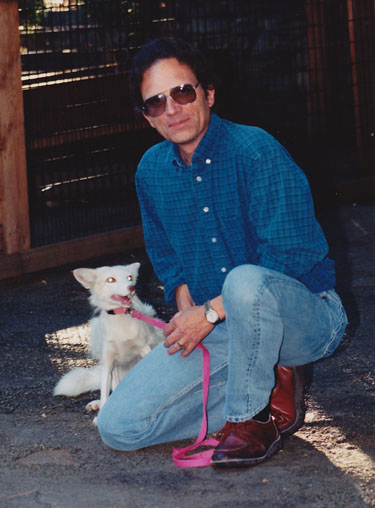
Exercising Vixen the fox while a volunteer at the Folsom City Zoo, ca. 1996. She was a sweetheart, though a bit of a drama queen. Is this the enemy?
“The greatness of a nation and its moral progress can be judged by the way its animals are treated,” said Mahatma Gandhi. It is heartening to learn that pushback is growing, both from citizens and state Fish and Game Commissions. In California, commission president, Michael Sutton said:
“I’ve been concerned about these killing contests for some time. They seem inconsistent both with ethical standards of hunting and our current understanding of the important role predators play in ecosystems.”
The way we treat the animals seems increasingly to be like the way we treat each other. Witness the case cited in the article, of the organizer of one of these killing contests, who (allegedly) pushed a 73 year old man to the ground for trying to photograph the event. We have to say, “allegedly” because, although the older man’s spine was fractured, the perpetrator has yet to be charged. This is not what our founding fathers meant when they spoke of a “well ordered militia.”
Of Jungians and Tibetans: I’ve recently started, with keen interest, The Psychology of Buddhist Tantra (2012) by Rob Preece, an in depth practitioner of both Jungian psychology and Tibetan Buddhism. Tibetan iconography is striking and vivid, almost begging for Jungian analysis, but most western commentators, including Jung himself, have written about it as outsiders looking in.
Not Preece, who studied with Lama Thubten Yeshe, one of the greatest 20th century Tibetan teachers to come to America. Lama Yeshe understood Jung and understood that Buddhist practice has always undergone change when crossing geographic and cultural boundaries.
Preece writes of Col. Francis Younghusband, who visited Tibet in 1904. Seeing pictures of wrathful deities, Younghusband concluded that this was a culture that worshiped demons. Jungians may pounce on the concept of shadow, but that too, will often be wide of the mark. Although Tibetans and Jungians both understand such imagery as depicting internal qualities, in this case, it is wrathful energy in the service of compassion. It’s the energy of, “This shit’s gotta stop!” The energy that led Camilla Fox to start a foundation to stop the slaughter of animals.
Two large gatherings: Over the last two weekends, I took part in two separate events which drew hundreds of people. Both were immensely satisfying days of harmonious groups, drawn together by shared interest, working cooperatively and having a lot of fun doing so. It’s almost enough to make you believe in no such thing as a bad boy or girl, in Mickey Rooney’s America.
That fundamental goodness is precisely what the Tibetans and Buddhists in general believe, even with their finely honed awareness of both relative truth, here in the trenches, and ultimate truth. Our ultimate nature, they say, the ground of our being is pure, unstained by any event, the way the sky is unstained by pollution. The bad news is, it can take eons for us to figure this out; a weekend at Woodstock is clearly not enough.
Still, I always feel energized after such gatherings, even as that wrathful energy rises at the thought of all the artificial barriers that divide us in our day to day lives. That’s something everyone has to work out for themselves. Meanwhile, I felt like listening again to Crosby, Stills & Nash. I hope they’re right in this song: that it’s always darkest before the dawn.
In an earlier post, Where seldom is heard a discouraging word, I announced an experiment. Following my wife’s efforts to suspend negative thinking and speech during Lent, I decided to refrain from critical posts through Easter. Here is the first of several observations I will share.
Avoiding negative and pessimistic topics leaves me a lot fewer subjects to blog about! Many of my posts begin with news stories, but often it seems, to paraphrase the old Hee-Haw song, “If it weren’t for bad news, I’d have no news at all.” More nights than not, when I’ve checked my usual source websites (CNN, NPR, USA Today, etc.), I haven’t found a single upbeat or funny or quirky post that I wanted to write about. Sure, there was the girl scout who sold 12,000 boxes of cookies, but even if it’s a good thing for a kid to become a marketing wizard, that isn’t my kind of story.
The real question for me, however, is not the content of this weeks’ or that weeks’ news, but the systemic nature of our news media, which makes trials and tribulations endemic. These are news stories, after all, and a good story demands tension, upping the stakes, and all that. The question is not whether these are gripping stories, but the degree to which they mirror “reality.”
I’m thinking of a book I have often cited here, Neal Gabler’s, Life the Movie: How Entertainment Conquered Reality (2000), in which the author says we are not just a post-modern culture but a “post reality culture.” Gabler locates the beginning of news-as-entertainment in America as “the penny press.” Prior to 1830, newspapers were single page “broadsheets” which appealed to the upper classes. Most of them cost six cents and the average daily circulation in New York City was 1200. Beginning with the Sun, which cost a penny, newspaper sales exploded. Gabler cites various reasons for the success of the penny press, but says that above all, it meshed with other sensational forms of entertainment:
“…for a constituency being conditioned by trashy crime pamphlets, gory novels and overwrought melodramas, news was simply the most exciting, most entertaining content a paper could offer, especially when it was skewed, as it invariably was in the penny press, to the most sensational stories. In fact, one might even say that the masters of the penny press invented the concept of news because it was the best way to sell their papers…”
In it’s first two weeks of publication, in 1835, the New York Herald ran stories that centered on “three suicides, three murders, the death of five persons in a fire, a man accidentally blowing off his head, an execution in France by guillotine and a riot in Philadelphia.” Needless to say, the Herald became wildly successful.
If it’s true that what we think of as “news” is an “invented concept,” we have to ask to what degree it mirrors reality and to what degree it creates it? Think about that the next time you open the paper or check your Tweets.
What I have discovered is how deep the contagion goes, even though I normally limit my sources, never watching the local news on TV, for instance. I confess that while I have cut negative posts from theFirstGates since March 7, I’ve probably doubled the number of depressing subjects I’ve posted on Twitter. In a way, I feel like I did a month after I quit smoking, and found that a nasty cough was still there. This is more serious than I thought at first. I’ll have more to say about it, but meanwhile, let’s change the tone as we end with a classic that came to mind at the start of this post.
Saturday was the fourth time in as many years that I’ve attended a daylong retreat with Edward Espe Brown, Zen abbot, author, cook, and altogether a charming and extremely funny man. In 1965, Edward became a student of Shunryu Suzuki Roshi, author of Zen Mind, Beginner’s Mind. When his teacher founded the Tassajara Zen Center near Big Sur, Ed became the head cook (as an author, he is best know for the Tassajara Cookbook and the Tassajara Bread Book).
Much of his learning took place in the kitchen, which gave him several unforgettable teaching stories. He relates his frustration in trying, without success, to produce a “perfect” muffin. He tried numerous recipes and variations. Everyone else thought they were great, but he was never satisfied.
One day he managed to taste a muffin without his usual preconceptions and found it delicious. In that moment, he realized the source of his earlier discomfort – he’d been comparing his muffins to the “perfectly” shaped Pillsbury muffins he’d eaten as a kid. This discovery led to one of the core ideas he tries to communicate as a teacher: we have the choice of living our lives according to someone else’s recipe or trying to discover our own. “There is no by-the-book way for you to be you,” he says.
Given this background, it’s no surprise that he started the day by saying, “I’m not going to give you any meditation instructions, because then you might try to follow them – and be looking over your shoulder to ask, ‘How am I doing?” The simplest instruction in Zen, “Just sit,” is the hardest to practice. Similar things can be said for writing or painting (“Just write/paint what’s in your heart”) – andmany other areas of life as well.
Such instructions (or lack thereof) assume the student knows the basics and some has experience. This was true for the group that gathered on saturday. It allows a generous teacher like Edward Brown to invite the student to seek what lies beyond a lifetime of learning how they are supposed to be.
Ed once said, “What is precious in us doesn’t come and it doesn’t go. It is not dependent on performance.” That’s a nice sounding aphorism, the kind of thing I jot down in notebooks. Saturday’s retreat was a chance to test the waters, and as I hope I’ve made clear, at its best, Zen is about everything in our lives. I’d heard that Ed had written a new book, and it proved to be a fine example of finding our own way.
He has several traditional books in print on Zen and cooking, and he also edited a collection of Suzuki Roshi’s teachings. When I’d read the title of his new book, By all Means A Zen Cautionary Tale, I assumed I’d be in for traditional reading. Instead, I was surprised and delighted to find he’d written a semi-fictional, semi-autobiographical story of his adventures a little pig hand puppet.
When I asked him to sign a copy, I said, “This is great. For my first 10 years, I had hand puppets. They were my closest friends and confidents.”
“Ah, then you know,” he said. “They’re powerful, aren’t they?”
In my next post, I’ll review By all Means, and after that, maybe the topic of conversing with inanimate things. Please stay tuned!
——————————————————————————————–
PS: When I posted this, I forgot to add a link to Edward’s home page, Peaceful Sea Sangha. In particular, I recommend the recordings of his talks, which give the flavor of his teaching style, his concerns, and his humor.
I find most alliterative titles, like “Media musings,” to be about 40% cute and 60% annoying, but in this case, it’s a good match for the headline that inspired this post: “Ellen’s Oscar ‘selfie’ a landmark media moment.”
“A what moment?” I mused. “A landmark media what?”
Because the media is falling over itself to celebrate Ellen’s tweet, and because nature abhors a vacuum, it has fallen to me to be the curmudgeonly voice of this “event.” One of the first things a curmudgeon does is reach for the dictionary. A “landmark event” is “an event, discovery, etc. considered as a high point or turning point in the history or development of something.”
At first I thought it must be the high point of product placement. The picture in question was taken with a Samsung phone, Samsung was a big Oscar sponsor, and the Academy Awards are the biggest post-Super Bowl marketing event. But that’s not really new news. Reading on, I realized the article referred to a landmark social media event. Since tweeting about TV isn’t new, an expert, in this case an Oscar co-producer, had to explain it to the likes of me:
“What it’s all about right now is creating a conversation, and social media allows for the conversation as it’s happening.”
Oh thanks, now I understand.
The dogs don’t like me being a curmudgeon, so while I was writing this post, Kit grabbed my (non-Samsung) phone and snapped a selfie, hoping to create a new conversation.
Kit snaps a selfie
“It’s all about what’s happening now,” she says, explaining why she wants to establish a social media presence.
So the price I pay for being a curmudgeon is having to ask all you loyal readers to give my dog a tweet (she accepts treats as well). After all, she is cuter than Ellen’s crew, and she hasn’t been real annoying since puppy days when she chewed up my wife’s phone. That really happened, but it’s a story for another day, and right now I need to let you log onto your twitter accounts. Don’t forget – it’s all about right now.
Be warned, this post has disturbing content. If it was a movie, I’d rate it “R,” not because of sex or violence, but because it concerns a penetrating essay on the current state of the US government. Change the channel now if you’re squeamish.
If you’re still here, good, because disturbing or not, I think everyone ought to read Anatomy of the Deep State, by Mike Lofgren, a former GOP Congressional aide who retired after 28 years as a staff member for Congress and the Senate. This article is a distillation of ideas he explored in his recent book, The Party is Over: How Republicans Went Crazy, Democrats Became Useless, and the Middle Class Got Shafted.
Lofgren says what many of us have long suspected, that our visible political landscape is merely the tip of a much bigger iceberg – that our various issues, debates, and elections often have little to do with the real trajectory of power in this country. Much of this “real” trajectory is hidden in plain sight. With almost three decades inside the belly of the beast, Lofgren can show us where to look.
He cites many examples. During the political circus surrounding the 2011 debt ceiling “crisis,” our leaders had no problem finding money to topple Gaddafi. A few months later, during the government “shutdown”, while debates raged over canceling meat inspections and air traffic control, we gave $112 million to Syrian rebels, to keep that conflict going. And since 2007, as our bridges collapse, schools fail, and cities go bankrupt, we’ve spent $1.7 billion on an NSA building in Utah the size of 17 football fields. Its purpose is to house a yottabyte of data. A yottabyte, the largest number computer scientists have so far coined, equals 500 quintillion pages of text. “They need that much storage to archive every single trace of your electronic life,” Lofgren says.
The best news, according to Lofgren, is that what he calls the Deep State is far from invincible. He notes how sufficient ineptitude draws pushback even from allies, citing our two failed wars and the Snowdon revelations among other things. Past elites have often reacted to challenges in one of two ways.
Some have tried to “stay the course,” and Lofgren observes that,“The dusty road of empire is strewn with the bones of former great powers that exhausted themselves in like manner.” Others have followed reformers, as diverse as Franklin D. Roosevelt, Charles de Gaulle, and Deng Xiaoping. What each of these men developed in common was a deep understanding that their cultural stories and myths were ossified and that survival depended upon renewing both vision and action.
Mike Lofgren, a self-described “former proud Republican” now says, “there is…a deep but as yet inchoate hunger for change. What America lacks is a figure with the serene self-confidence to tell us that the twin idols of national security and corporate power are outworn dogmas that have nothing more to offer us. Thus disenthralled, the people themselves will unravel the Deep State with surprising speed.”
The first step in dealing with any problem is understanding its nature. In this time of deliberate political and economic obfuscation, I highly recommend Anatomy of the Deep State as one of the best and most succinct diagnoses I’ve yet seen of what ails us.
We are a week into a major home reconstruction project that has about 2/3 of our living space sealed off against dust. Bedroom, study, kitchen, and bath are available. Internet too, since I carried the modem down to this end of the house. A little cramped at times, but overall, just fine for a short period of time.
What surprises me is how little I miss TV. More than that, it’s refreshing in many ways not to have it. The sound was on at one of the TV’s at the gym and I found it so irritating I moved away.
It hasn’t been a completely video-less week. One day we ventured out to the cineplex to watch Frozen. Another evening we viewed an Agatha Christie mystery on youTube (the 13″ screen of my mac was ample). On Friday, I watched a 20 minute Newshour segment on pbs.org. And last night, we clambered through the dust curtains, out to the living room where the furniture is clumped, to watch the finale of Downton Abbey.
I’m not going to waste any time with polemics against television. I enjoy several shows and of course, Turner Classic Movies. I expect to watch those when the house is back to normal. But a cautionary story came to mind as I looked for images for this post.
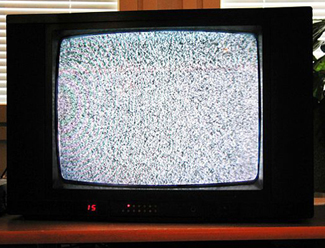
It’s possible some readers may not remember analog TV and the pre-404 no-signal pattern called “snow.”
Snow. CC BY-NC-ND 2.0
This always reminds me of Neal Stephenson’s visionary novel, Snow Crash. Published in 1992, Stephenson envisioned a post-nation state world in which people lived as citizens of corporate territories. The former United States still excelled at two things, computer micro-code and high speed pizza delivery, the latter because the mafia had taken over the business.
In 1992, the year I first got a windows computer, an 8K modem, and an AOL membership, Stephenson imagined virtual worlds where people created avatars to jack in and interact. Then someone launched a virus that messed with people’s brains. Anyone who opened this malware saw a pattern based on ancient glyphs that led to the Tower of Babel. Viewing these symbols scrambled their neurons, in essence, turning their minds to snow.
What struck me this past week were the parallels to our current media world. I can’t help thinking of all the ways that commercials, local news, political debates, and most of what passes for entertainment scramble our neurons, though much more slowly and in ways that leave us perfectly able to buy stuff.
I could say more, but this is enough – something to think about.
Between 1981 and 1984, I worked as a part time instructor at a community college in northern California. Like most part-timers, I dreamed of the tenure track. I was lucky. At one point during a faculty meeting, I looked at all the other hopefuls, did the math, and realized I was on, if not a sinking ship, one that was dead in the water. I started building a lifeboat and made my escape.
According to a recent NPR story, a million part-time, or adjunct professors, have not been so fortunate. That’s 75% percent of U.S. college teachers who are stuck in part time positions; like workers at McDonalds, many rely on food stamps to get by. Current pay for adjuncts is $2,000 – $3,000 a class with no benefits of any kind. “Freeway fliers” is what we called ourselves when I was in the ranks, zipping between nearby schools to pick up any available classes.
One adjunct interviewed in a parallel story on the PBS Newshour teaches six English classes at three Ohio universities. With a family to support, he couldn’t afford to stay home when he had pneumonia last fall.
At the time, I assumed the dismal prospects were my fault; I only had an M.A. and taught at a small town, two year school. The articles make clear that although the trend began at two year schools in the 1970’s, it soon spread to all types of colleges and universities.
Peter Brown, professor emeritus of the State University of New York at New Paltz says the average salary of adjuncts there is $12,000 a year – less than the custodial staff. “Between 1970 and 2008, the adjunct pay has gone down 49 percent,” says Brown. “The salary of college presidents has gone up 35 percent.”
In the 80’s we talked of organizing, and finally, three decades later, some colleges are granting part timers collective bargaining rights. Twenty-two percent of adjuncts now belong to a union. The death last fall of an 83 year old Duquesne University adjunct, who had taught for 20 years with good reviews, only to die impoverished, served as a wake-up call, as did a January congressional report that found adjuncts are treated like “cheap labor.”
In general, we get what we pay for, and as college students go ever deeper into debt, it’s worth asking what their education dollars are buying. Well-to-do college administrations. Top notch football teams. A lot of professors too sick or stressed or busy commuting to hold decent office hours. Ever fewer real-world prospects. And…?
If we don’t want to end up singing “Glory Days” when we think of the long-gone time when American education was the best in the world, something will have to change.







 The First Gates